South Africa Thermal Transfer Ribbon Market Size, Share & Industry Analysis, By Product Type (Wax Ribbon, Wax-Resin Ribbon, and Resin Ribbon), By End User (Entertainment and Hospitality, Healthcare, Manufacturing, Retail, Transportation and Logistics, and Others), and Country Forecast, 2025-2032
 Download Free Sample
KEY MARKET INSIGHTS
 Listen to Audio Version
The South Africa thermal transfer ribbon market size was valued at USD 6.48 million in 2024 and is projected to grow from USD 6.80 million in 2025 to USD 9.98 million by 2032 at a CAGR of 5.6% during the forecast period.
A thermal transfer ribbon is a heat-sensitive film coated with ink that is used in thermal transfer printers to produce clear, long-lasting prints on labels and flexible packaging materials. During printing, the printer’s heated printhead melts the ribbon’s ink and transfers it onto the surface of paper or synthetic labels with controlled heat and pressure. This process creates sharp, high-contrast images, barcodes, and text that stay readable over time. Thermal transfer ribbons are valued for their consistent print quality and their ability to resist fading, smudging, and environmental wear.
The major companies operating in the market include Zebra Technologies Corp, Ricoh Electronics, Inc., ARMOR-IIMAK, Label Ales, and Andtech Barcode Systems.
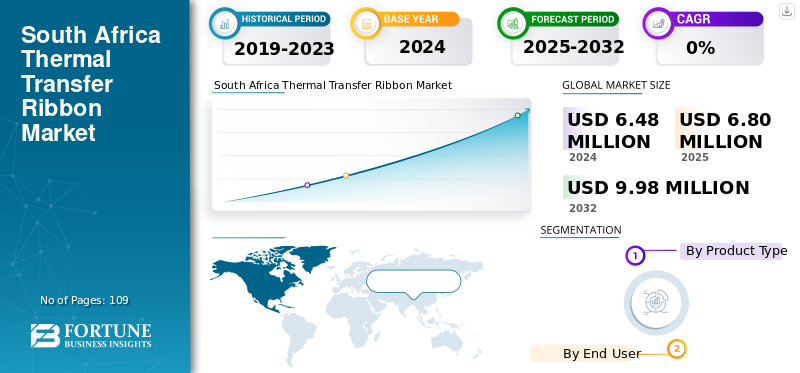
Download Free sample to learn more about this report.
South Africa Thermal Transfer Ribbon Market Trends
Demand for Eco-Friendlier Ribbon Formulations and Recyclable Packaging Driven by Sustainability Goals
A key trend in the South Africa thermal transfer ribbon market is the growing shift toward eco-friendly ribbon formulations and recyclable packaging. Companies are increasingly expected to show environmental responsibility, and this is influencing how they choose labeling supplies. Retailers, logistics operators, and manufacturers are looking for ribbon options that reduce plastic waste, use safer materials, and fit into recycling systems without harming print quality. This interest is also driven by corporate sustainability targets and pressure from customers and regulators to lower the environmental impact of packaging and labeling. As a result, suppliers are exploring cleaner ink coatings, reduced-waste ribbon designs, and packaging made from recyclable or lighter materials. With sustainability becoming a long-term priority across most industries, demand for environmentally responsible ribbon solutions is rising steadily and shaping the direction of new product development.
MARKET DYNAMICS
Market Drivers
Growing Retail and FMCG Activities are Fueling Higher Labeling and Thermal Transfer Ribbon Demand in South Africa
The steady growth of South Africa’s retail and FMCG sectors is a major reason why demand for thermal transfer ribbons is rising. Big retailers such as Shoprite, Pick'n Pay, and Massmart are opening more stores and upgrading their supply chain systems, which means they need clear and reliable labels for daily operations. Barcodes, shelf labels, and packaging tags have become essential as they help track stock, control prices, and identify products. These labels must stay clear even after handling and transport, which is why companies depend on good-quality ribbons. This demand is also increasing as retailers and FMCG producers are modernizing their warehouses and packaging areas. Many are adopting automated systems, updated labeling software, and new printing technologies. As a result, they are using more ribbons every day, simple wax thermal for shelf labels, and stronger resin ribbons for logistics and shipping labels. All of this supports steady market growth in ribbon use across the sector.
Market Restraints
Import Dependence and Currency Volatility Continue to Challenge Market Stability
The South Africa thermal transfer ribbon market remains largely dependent on imported raw materials, including PET base films and ink coatings sourced from suppliers in Asia and Europe. This reliance makes the industry vulnerable to fluctuations in exchange rates, freight costs, and shipping delays. Smaller converters and distributors often struggle to maintain steady inventories due to long import lead times, high minimum order quantities, and limited working capital to absorb sudden cost fluctuations. These factors undermine pricing stability, making it challenging for smaller players to respond promptly to shifts in customer demand.
Market Opportunities
Localization of Label and Ribbon Converting Operations Presents a Path to Greater Market Self-Reliance
South Africa’s renewed push to strengthen local manufacturing creates a clear opportunity for domestic value addition in the thermal transfer ribbon market. Although most coated films and master rolls are still imported, the growing needs of retail, logistics, and industrial users provide a strong foundation for local conversion and finishing activities. Companies such as Bidvest Labels, Label-Ales, and Spec Systems already run established label-printing and distribution operations, giving them a natural platform to expand into ribbon slitting and final processing. Building these capabilities locally could help shorten lead times, stabilize pricing, and reduce the risk of cost swings linked to imports. With increasing demand and supportive industrial policies, South Africa is well-placed to evolve into a regional center for ribbon conversion and distribution, serving both the domestic market and neighboring SADC (Southern African Development Community) countries.
Market Challenges
Supply-Chain Disruptions for Specialty Films and Pigment Materials Affecting Lead Times and Costs
A major challenge in the South Africa thermal transfer ribbon market growth is the ongoing supply-chain disruption affecting specialty films and pigment materials. Most of these inputs are imported, so any delays at ports, shortages at global suppliers, or increases in freight costs quickly affect local availability. This creates longer lead times and makes it harder for converters and distributors to keep steady stock levels. Price volatility has also become more common, as the cost of raw materials and international shipping fluctuates. As a result, many local users face unpredictable delivery schedules and higher operational expenses.
Segmentation Analysis
By Product Type
Wax Ribbon Segment Leads Due to Its Strong Adoption in Everyday Labeling Applications
Based on product type, the market is classified into wax ribbon, wax-resin ribbon, and resin ribbon.
The wax ribbon segment holds the largest South Africa thermal transfer ribbon market share. These ribbons are widely chosen for printing barcodes, price tags, and shelf labels in retail, warehousing, and light manufacturing. Their appeal comes from producing clear prints at a low cost while working well with common paper labels. As most daily operations do not require high quality, wax ribbons are suitable for quick scanning and short-term identification tasks.
The wax-resin ribbon segment held a notable share of the thermal transfer ribbon market as it offers a balance of print quality and durability that many industries need. These ribbons provide sharper images and better scratch resistance to smudging, moisture, and light handling compared to wax ribbons. They are commonly used for shipping labels, warehouse storage, and outdoor retail tags, where labels may face friction or mild exposure to the elements.
Resin Ribbons form the premium segment of thermal transfer printing, used when labels must withstand harsh or demanding environments. These ribbons create highly durable prints that resist chemicals, heat, abrasion, and long-term exposure to moisture. Due to superior performance, they are widely preferred in sectors such as pharmaceuticals, automotive, electronics, and industrial manufacturing.
By End User
Retail Sector Emerging as a Key User Segment for Advanced Labeling Solutions
In terms of end user, the market is segmented into entertainment and hospitality, healthcare, manufacturing, retail, transportation and logistics, and others.
The retail segment held the largest market share due to large usage across supermarkets, apparel stores, pharmacies, and specialty outlets for barcodes, price labels, shelf tags, and promotional stickers. Growth in this segment is driven by high product turnover, frequent price changes, and the need for accurate scanning at checkout counters. The expansion of modern retail formats, including convenience stores and e-commerce pick-up points, has further increased daily label usage.
The transportation and logistics segment holds a significant share in the market as these are essential for shipping labels, pallet tags, tracking codes, and warehouse identification, all of which must remain readable throughout long-distance movement. Rising e-commerce activity, faster delivery expectations, and the expansion of third-party logistics providers support the segment’s growth.
The manufacturing sector is a growing segment that supports a wide range of factory labeling needs, including product identification, compliance labels, asset tracking, and work-in-progress tags. Growth is driven by the need for accurate, durable labels that withstand heat, dust, friction, and industrial handling. As facilities expand automated systems and digital tracking tools, clear barcodes and long-lasting prints become even more important for operational efficiency.
To know how our report can help streamline your business, Speak to Analyst
COMPETITIVE LANDSCAPE
KEY INDUSTRY PLAYERS
Key Market Players to Strengthen Their Positions by Providing Solutions to Various Industries
In terms of the competitive landscape, the market depicts the presence of established and emerging companies. Zebra Technologies Corp, Ricoh Electronics, Inc., ARMOR-IIMAK, Label Ales, and Andtech Barcode Systems are some of the key players in the market.
List of Key South Africa Thermal Transfer Ribbon Companies Profiled:
- ARMOR-IIMAK (France)
- Ricoh Electronics, Inc. (U.S.)
- Zebra Technologies Corp (U.S.)
- Label Ales (South Africa)
- Andtech Barcode Systems (South Africa)
- Triocorp Pty Ltd (South Africa)
- Bidvest Labels (South Africa)
- Hempra Multi Prints Pvt. Ltd. (India)
- Kemtek (South Africa)
KEY INDUSTRY DEVELOPMENTS
- September 2025 – ARMOR-IIMAK launched AWR XL, a solvent-free wax ribbon designed with an ultra-thin PET base film that reduces plastic usage by more than 25%. The product reinforces the company’s focus on sustainability and positions it at the forefront of eco-designed thermal transfer materials.
- August 2024 – Ricoh introduced the B125CS general-purpose resin thermal transfer ribbon, marking its first product in this category. The launch broadens the company’s thermal ribbon portfolio and demonstrates a clear effort to balance its premium resin offerings with more versatile, cost-effective solutions for wider market adoption.
- April 2024 – ARMOR-IIMAK introduced MY ARMOR-IIMAK, a digital customer platform that streamlines order tracking, technical assistance, and access to product information. The platform supports greater transparency and efficiency for distributors and end users across the region.
- March 2024 – The Kemtek strengthened its consumables division with the formal positioning of the ThermoPro brand, offering wax, wax–resin, and resin ribbons converted locally for barcode and packaging applications. This development underscored Kemtek’s commitment to reducing import reliance and improving lead times for domestic clients.
- February 2024 – Kemtek entered into a partnership with Canon South Africa to distribute Canon’s range of digital printing systems, broadening its commercial print offering and enhancing its integrated hardware–consumable ecosystem.
REPORT COVERAGE
The report provides a detailed market analysis. It focuses on key aspects, such as leading companies, forging types, compositions used to produce these products, and end-use industries of the product. Besides this, it offers insights into the market and current industry trends and highlights key industry developments. In addition to the factors mentioned above, the report encompasses several factors contributing to the market's growth.
Request for Customization to gain extensive market insights.
Report Scope & Segmentation
|
ATTRIBUTE |
DETAILS |
|
Study Period |
2019-2032 |
|
Base Year |
2024 |
|
Forecast Period |
2025-2032 |
|
Historical Period |
2019-2023 |
|
Unit |
Value (USD Million) and Volume (Million Meter Square) |
|
Growth Rate |
CAGR of 5.6% from 2025 to 2032 |
|
Segmentation |
By Product Type and End User |
|
By Product Type |
· Wax Ribbon · Wax-Resin Ribbon · Resin Ribbon |
|
By End User |
· Entertainment and Hospitality · Healthcare · Manufacturing · Retail · Transportation and Logistics · Others |
Frequently Asked Questions
Fortune Business Insights says that the global market size was valued at USD 6.48 million in 2024 and is projected to reach USD 9.98 million by 2032.
Recording a CAGR of 5.6%, the market is slated to exhibit steady growth during the forecast period of 2025-2032.
By end user, the retail segment led in 2024.
Growing retail and FMCG activities in South Africa are boosting the need for reliable labeling, driving the market.
Rising investments in modern retail systems, automated warehouses, and improved product tracing are expected to drive stronger market growth.



- 2019-2032
- 2024
- 2019-2023
- 109
Get 30-60 hrs Free Customization
Expand Regional and Country Coverage, Segments Analysis, Company Profiles, Competitive Benchmarking, and End-user Insights.


















-
US +1 833 909 2966 ( Toll Free )
-
Get In Touch With Us