South Korea Push-To-Talk over Cellular (PoC) Market Size, Share & Industry Analysis, By End User (Public Safety and Security, Construction, Energy and Utility, Transportation and Logistics, Manufacturing, Travel and Hospitality, and Others), By Solution (Devices (Rugged, Standard, and Others), Software (Cloud and On-Premise), and Services (Network Services, Integration and Deployment Services, and Maintenance and Support Services)), By Enterprise Size (Small, Medium, and Large), and Country Forecast, 2025-2032
 Download Free Sample
KEY MARKET INSIGHTS
 Listen to Audio Version
The South Korea Push-To-Talk over Cellular (PoC) market size was valued at USD 445.8 million in 2024. It is projected to grow from USD 489.4 million in 2025 to USD 975.9 million by 2032, exhibiting a CAGR of 10.36% during the forecast period.
The South Korea Push-To-Talk over Cellular (PoC) market is expanding rapidly, driven by increasing demand in industries including public safety, logistics, and transportation for rapid communication. Better reliability and efficiency result from 4G and 5G networks' improved connection; PTToC’s cost-effectiveness attracts companies looking for simplified communication. Its use is further enhanced by integration with other technologies, including multimedia capabilities and GPS. Challenges, including network dependency and security issues, must be tackled, though. Cellular networks are becoming increasingly used by emergency services to meet important communication needs. As companies appreciate the benefits of cellular network solutions, the market is expected to grow significantly.
Major players in the market are Samsung, Motorola Solutions, SK Telecom, LG U+, and others. These companies are continuously focusing on improving push-to-talk over cellular technologies, including 4G and 5G, as well as the integration of AI and IoT. Key efforts include implementing data services that enable the sharing of multimedia and real-time information. The progress of 4G and 5G networks further drives the demand for Push-To-Talk over Cellular (PoC) services that provide better voice quality, wider service coverage, and improved call clarity.
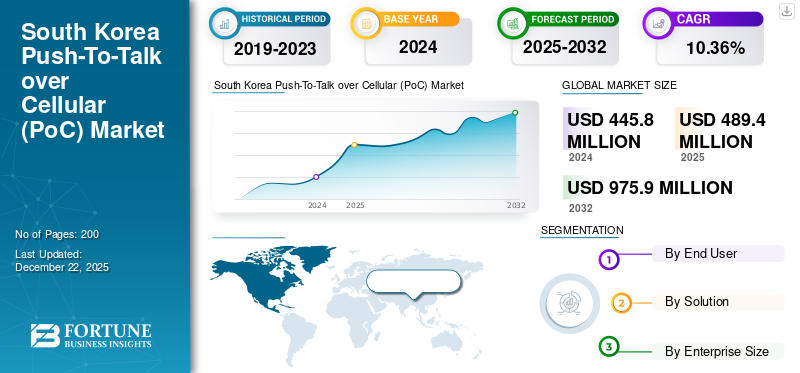
Download Free sample to learn more about this report.
Market Dynamics
Market Drivers
Instantaneous Communication Requirements to Drive Market Growth
With the rising need for instantaneous communication among companies and public safety organizations, the push-to-talk over cellular (PoC) industry in South Korea is seeing significant growth. Companies are realizing the need for real-time communication tools that enable quick and successful engagement in the fast-paced modern era of operating efficiency. By smoothly combining PTToC technology with sophisticated 4G and LTE networks, voice quality and reliability are improved, therefore making it a great option for a range of industries, including security services, logistics, and transportation.
For instance, in June 2020, Etherstack partnered with Samsung Electronics under a global teaming agreement to deliver mission-critical push-to-talk technology through long-term evolution (LTE) solutions to telecommunications carriers and governments globally.
Government Initiatives to Drive Market Growth
The South Korean government supports this expansion by prioritizing improving its communications infrastructure. Significant investments allocated for the implementation of 5G technology have led to a coordinated effort to integrate next-generation communication tools across various sectors. In addition to fostering innovative uses for PTToC, this project ensures that companies have the means to maintain seamless communication and facilitate rapid decision-making in dynamic environments. Rising focus on reliable communication networks by companies and public safety agencies is boosting the South Korea Push-To-Talk over Cellular (PoC) market growth.
Market Restraints
Competition from Traditional Communication Systems Hinders Market Growth
Although the market has significant development potential, some challenges could impede its progress. Strong competition from traditional walkie-talkie systems, which remain integral to several sectors including construction, hospitality, and emergency services, presents a major hurdle. Many businesses resist transitioning to push-to-talk over cellular (PoC) technology, primarily due to concerns about the necessary initial infrastructure investments and the extensive training their employees would require to navigate these new communication channels effectively.
Security Issues Restrain PTToC Adoption
Furthermore, significant security issues complicate the landscape of PTToC adoption. Especially in industries that handle sensitive data, including public safety and healthcare, the risks linked to data transmission, including those of cyber-attack vulnerabilities, present a significant hurdle. Companies are understandably wary about possible data breaches in these sensitive sectors that might expose confidential communications. Together, these elements produce a thoughtful and occasionally cautious attitude toward adopting PTT services, limiting the market potential for growth and innovation.
Market Opportunities
Integration of IoT with PoC is Transforming Communication Sector
For the South Korean market specializing in push-to-talk over cellular solutions, the development of the Internet of Things (IoT) presents a significant opportunity. The collaborative potential of PoC and IoT will transform remote communication and simplify data-sharing procedures as several sectors increasingly utilize IoT devices for enhanced monitoring, control, and operational tasks. Beyond improving operational efficiency across industries, this strategic integration paves the way for diverse revenue streams from innovative value-added services tailored to specific industry needs.
For Instance, in November 2024, LG U+ entered a strategic agreement with a leading global PoC solution provider. The collaboration focuses on integrating cloud-based, AI-powered push-to-talk software into LG U+’s expansive network infrastructure. By doing so, the company aims to enhance system interoperability, provide real-time data analytics, and further secure communications for enterprises and public safety applications.
Rising Trend of Remote Work Drives Demand for Efficient Communication Technologies
The urgent need for strong and effective teamwork across various industries and the rising trend of remote work highlight the critical demand for efficient communication technologies. South Korean companies actively seek solutions facilitating seamless support for distributed teams operating in diverse environments. In this context, PTToC presents an attractive option as it offers features for instant voice communication. This capability effectively bridges the gap between on-site personnel and remote employees, fostering a team atmosphere that boosts productivity. As a result, PTToC is well-positioned to attract a wider customer base, particularly appealing to companies that prioritize real-time interaction in the evolving landscape of the modern workplace.
For instance, in January 2020, No Jitter reported that Microsoft, Samsung, and Verizon jointly announced that they had developed a PTT capability for the Teams mobile app using the ruggedized Samsung Galaxy XCover Pro handsets that feature a PTT transmit button. As Microsoft is positioning this, the PTT services capability is an enhancement of its Teams vision for firstline workers.
South Korea Push-To-Talk over Cellular (PoC) Market Trends
Mobile Application is a Noticeable Trend that Market Follows
The trend toward mobile application integration is increasingly reflected in the South Korean PTT+ sector. Many companies are turning to PTT+ solutions that can be accessed via mobile devices as they look for both adaptability and simplicity of usage. This trend toward mobility lets field workers, such as construction crews and emergency responders, interact while in motion, enhancing efficiency and response throughout many sectors.
Growing Concentration on Improving Group Calling, Geo-Location Tracking, and Multimedia Messaging Inside PoC Solutions is a Major Trend
Vendors are actively innovating to meet particular industry demands, driven by developing more customized and robust applications. Along with enhancing user experiences, this development raises standards for features, therefore pushing providers to improve their products continuously to stay competitive.
Moreover, interoperability with existing technologies and communication systems is increasingly stressed. Organizations seek answers that easily fit their existing platforms to allow for a more unified communication environment. Vendors will thus have to give compatibility and adaptability top priority in their PoC products to satisfy these changing needs properly.
Download Free sample to learn more about this report.
SEGMENTATION ANALYSIS
By End User
Government-led Modernization Programs to Enhance Emergency Response Capabilities Resulted in Public Safety and Security Segment Development
By end user, the market is divided into public safety and security, construction, energy and utility, transportation and logistics, manufacturing, travel and hospitality, and others.
The public safety and security segment held the largest South Korea Push-To-Talk over Cellular (PoC) market share in 2024. Government-led modernization, enhanced emergency response capabilities, and integration of advanced technologies drive the segmental growth. For instance, in February 2025, KT Corporation finalized a contract with the Seoul Metropolitan Police Agency to deploy next-generation PoC devices across the city’s emergency services. This large-scale contract underscores the government’s commitment to modernizing public safety communication infrastructure.
Transportation and logistics emerged as the second-largest segment in 2024. E-commerce and supply chain evolution, operational efficiency and safety, and cost-effective communication solutions are the factors driving the segmental growth.
By Solution
Ruggedness, Advanced Connectivity, Government, and Enterprise Procurement Fueled Devices Segment Growth
By solution, the market is categorized into devices (rugged, standard, and others), software (cloud and on-premise), and services (network services, integration and deployment services, and maintenance and support services).
The devices segment dominated the market in 2024. Ruggedness, advanced connectivity, government and enterprise procurement, and technological innovation drive segmental growth. For instance, in March 2025, LG Uplus secured a contract with the Busan Metropolitan Administration to deploy rugged, 5 G-enabled PoC devices across critical municipal services. This deal underscores the government’s commitment to upgrading emergency and routine communications using state-of-the-art hardware.
Software was the second-largest segment in 2024 and is expected to grow at the highest rate during the forecast period. Factors propelling the segmental growth include cloud-based and AI-driven platforms, interoperability and scalability, enhanced cybersecurity, and real-time analytics.
To know how our report can help streamline your business, Speak to Analyst
By Enterprise Size
Medium Segment Growth is Driven by Agility, Investment Capacity, and Targeted Government and Industry Support
By enterprise size, the market is segregated into small, medium, and large.
The medium segment dominated South Korea's Push-To-Talk over Cellular (PoC) market in 2024. Factors driving the segment growth include agility, investment capacity, digital modernization, strategic upgrades, and targeted government and industry support. For instance, in March 2025, LG Uplus finalized a contract with a consortium of 120 medium-sized manufacturing firms in the Gwangju region to deploy rugged, 5 G-enabled PTT+ devices across their operations.
The small segment is anticipated to be the fastest-growing category with the highest CAGR during the forecast period. Factors such as cost-effective, scalable solutions, enhanced operational flexibility, and supportive government incentives are driving the growth of this segment.
South Korea Push-To-Talk Over Cellular (PoC) Market Country Outlook
South Korea Gains Traction in Market for Its Cellular Network as Businesses and Public Safety Sectors Seek Better Ways to Communicate
Major mobile carriers such as SK Telecom and KT Corp in South Korea Push-to-Talk over cellular (PoC) market, are enhancing their efforts to improve PTT+ services. Just recently, SK Telecom launched a new service loaded with advanced features such as location tracking and multimedia sharing, addressing the growing demand for flexible communication tools in areas such as construction and transportation. This represents a significant upgrade from traditional walkie-talkies, providing more reliable and broader coverage in urban and rural environments.
In addition to enhancing service quality, the South Korean government is supporting PTT+ initiatives as part of its broader digital transformation strategy. Recent reports have highlighted a partnership between the Ministry of Science and Technology and leading telecom companies aimed at strengthening network infrastructure and ensuring smooth connectivity even in the most remote areas. As businesses emphasize mobility and fast communication, the PTT+ market in South Korea is poised for continued growth, with forecasts indicating a substantial increase in user adoption over the coming years. This combination of regulatory and technological support is positioning South Korea as a leader in the PTT+ sector within the Asia Pacific region.
Competitive Landscape
Key Market Players
Presence of Major Players in Country Drives Market by Innovation and Investment in New Technology
The South Korea Push-To-Talk over Cellular (PoC) market is booming, driven by a growing need for quick communication solutions in various fields, including transportation, construction, and public safety. Major players in this space, such as Samsung Electronics, LG Uplus, SK Telecom, and KT Corporation, are tapping into the latest 5G technology to boost the reliability and features of their cellular network services. In addition, the integration of PoC with Internet of Things (IoT) technologies is making operations smoother and enhancing communication efficiency for mobile and remote teams.
While this market offers plenty of opportunities, it is not without its hurdles. Regulatory challenges and rising competition can squeeze profit margins. To stay ahead, companies are honing in on product differentiation, enhancing customer experiences, and forming strategic partnerships to solidify their positions. As the market landscape keeps changing, these players will need to tackle these challenges while meeting the increasing demand for innovative communication solutions.
List of Key South Korea Push-To-Talk over Cellular (PoC) Companies Profiled
- Samsung (South Korea)
- SK Telecom (South Korea)
- LG U+ (South Korea)
- KT Corporation (South Korea)
- Motorola Solutions (South Korea)
- Cybertel Bridge (South Korea)
- Hytera (South Korea)
- Kyocera (South Korea)
- Verizon (South Korea)
- AT&T (South Korea)
KEY INDUSTRY DEVELOPMENTS
- February 2024: Iridium Communications Inc. (NASDAQ: IRDM), a leading provider of global voice and data satellite communications, announced that the Republic of Korea (ROK) Ministry of Defense (MOD) has adopted Iridium® connectivity for strategic use within its military operations. Arion's SAT-PRE supports Iridium Push-to-Talk (PTT) and Short Burst Data® (SBD®) applications such as messaging and positioning.
- June 2022: Samsung Electronics introduced the Galaxy XCover6 Pro, a smartphone meticulously designed for enterprise applications, capable of meeting the rigorous demands of modern businesses. This device offers comprehensive security features, push-to-talk functionality, and robust durability, enabling employees to maximize its potential both in the office and in field settings.
- February 2021: Idis, one of South Korea’s largest video security technology manufacturers, acquired a controlling (44.84%) stake in KT Powertel, the radio communications subsidiary of telecoms giant KT Corp. The move aims to strengthen IDis’s offering in the security and safety sectors, with customers benefiting from powerful push-to-talk over cellular communications solutions.
- April 2020: Samsung Electronics announced a landmark achievement with the demonstration of the world's first video call utilizing the Amazon Web Services (AWS) cloud platform, leveraging the capabilities of Mission Critical Push-to-Talk, Data, and Video (MCPTX), also known as Mission Critical Communications. The successful onboarding, integration, and deployment on the AWS cloud facilitated this milestone, which is based on the Release 14 specifications.
- May 2019: Samsung Electronics Co., Ltd. announced the signing of an expansion contract with KT Corporation (KT) to provide public safety (PS-LTE) network solutions compliant with the 3GPP standard Release 13. This initiative will cover ten major metropolitan regions in South Korea, including Seoul, by the year 2020.
REPORT COVERAGE
The research report delivers a detailed market analysis and emphasizes key aspects such as key players, offerings, objects, and end-users of push-to-talk over cellular. Moreover, the report deals with insights into market trends, competitive landscape, market competition, product pricing, regional analysis, market players, competition landscape, and the market status, and highlights key industry growth. In addition to the factors stated above, the report encompasses several direct and indirect influences that have subsidized the sizing of the market in recent years.
Request for Customization to gain extensive market insights.
Report Scope & Segmentation
|
ATTRIBUTE |
DETAILS |
|
Study Period |
2019-2032 |
|
Base Year |
2024 |
|
Estimated Year |
2025 |
|
Forecast Period |
2025-2032 |
|
Historical Period |
2019-2023 |
|
Growth Rate |
CAGR of 10.36% from 2025 to 2032 |
|
Unit |
Value (USD Million) |
|
Segmentation |
By End User
|
|
By Solution
|
|
|
By Enterprise Size
|
|
|
By Country
|
Frequently Asked Questions
According to the Fortune Business Insights study, the global market was valued at USD 445.8 million in 2024 and is anticipated to be USD 975.9 million by 2032.
The market will likely grow at a CAGR of 10.36% over the forecast period (2025-2032).
The top players in the industry are Samsung (South Korea), SK Telecom (South Korea), LG U+ (South Korea), KT Corporation (South Korea), and Motorola Solutions (South Korea).
Instantaneous communication requirements and government initiatives drive market growth.
By end user, the public safety and security segment dominated the market in 2024.



- 2019-2032
- 2024
- 2019-2023
- 200
Get 30-60 hrs Free Customization
Expand Regional and Country Coverage, Segments Analysis, Company Profiles, Competitive Benchmarking, and End-user Insights.




















Related Reports
-
US +1 833 909 2966 ( Toll Free )
-
Get In Touch With Us