Sulfide-based Solid State Battery Market Size, Share & Industry Analysis, By Battery Chemistry (Lithium Metal Sulfide SSB, Lithium-Ion Sulfide SSB, Lithium-Sulfur Solid-State Battery, Silicon-Anode Sulfide Battery, Anode-Free Sulfide Battery), By Electrolyte Material (Argyrodite, LGPS-Type, LPS Glass & Glass-Ceramic, Thio-LISICON, and Others), By Capacity (Below 10 Ah, 10–50 Ah, 50–100 Ah, 100–200 Ah, and Above 200 Ah), By Application (Electric Vehicles (EVs), Consumer Electronics, Energy Storage Systems (ESS), Industrial Equipment, and Others), and Regional Forecast, 2026-2034
 Download Free Sample
Sulfide-Based Solid State Battery Market Size and Future Outlook
 Listen to Audio Version
The global sulfide-based solid state battery market size was valued at USD 422.87 million in 2025. The market is projected to grow from USD 598.51 million in 2026 to USD 6,735.45 million by 2034, exhibiting a CAGR of 35.34% during the forecast period. Asia Pacific dominated the sulfide based solid state battery market with a market share of 56.86% in 2025.
A sulfide-based solid-state battery (SSSB) is an advanced rechargeable battery that utilizes a sulfide solid electrolyte instead of the flammable liquid electrolyte used in conventional lithium-ion batteries. Sulfide based solid electrolytes, including argyrodite, lithium phosphorus sulfide (LPS), and lithium germanium phosphorus sulfide (LGPS), enable rapid lithium-ion transport while maintaining solid-state architecture. Their relatively soft mechanical properties allow intimate contact between electrodes and electrolytes, reducing interfacial resistance and supporting high-energy-density cell designs.
The market is being driven by its use in electric vehicles, energy storage systems, consumer electronics, aerospace, and industrial applications due to its potential to combine enhanced safety, fast-charging capability, and high energy density. The ongoing advancements in sulfide electrolyte synthesis, moisture stability, large-format cell manufacturing, and lithium metal anode integration are accelerating the transition of this technology from laboratory-scale development to pilot production and early-stage solid state battery commercialization.
- For instance, in April 2024, Toyota Motor Corporation and Idemitsu Kosan announced progress in their collaboration to commercialize all-solid-state batteries utilizing sulfide-based solid electrolytes. The partnership focuses on developing mass-production technologies for sulfide electrolyte materials and scaling manufacturing processes to support next-generation electric vehicles.
Leading companies operating in the global industry are Samsung SDI Co., Ltd., Toyota Motor Corporation, and LG Energy Solution Ltd. Samsung SDI Co., Ltd. is a South Korea-based advanced battery and electronic materials manufacturer and a key subsidiary of Samsung Group. The company develops and produces lithium-ion batteries for electric vehicles, energy storage systems (ESS), and consumer electronics, while actively investing in next-generation battery technologies, including sulfide-based batteries.
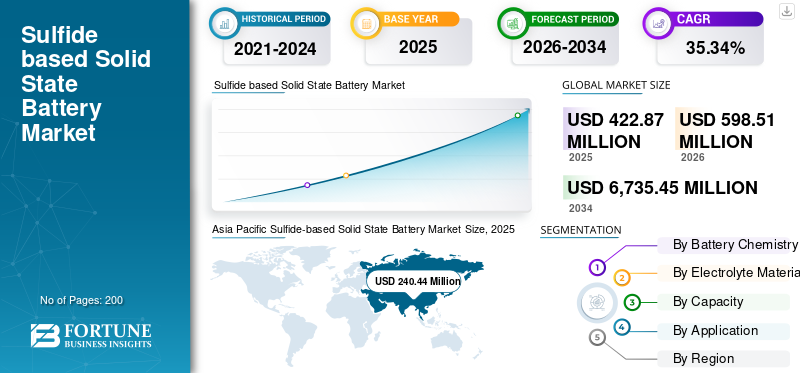
Download Free sample to learn more about this report.
Sulfide based Solid State Battery Market Key Takeaways
 Global Market Size & Forecast
- 2025 Market Size: USD 422.87 million
- 2026 Market Size: USD 598.51 million
- 2034 Forecast Market Size: USD 6,735.45 million
- CAGR: 35.34% (2026–2034)
 Market Share
- Asia Pacific dominated the market with a 56.86% share in 2025.
- The lithium metal sulfide SSB segment accounted for the largest market share of 43.53% in 2025.
- The anode-free sulfide battery segment is projected to register the fastest growth, expanding at a 41.21% CAGR during the forecast period.
 Key Regional Highlights
Asia Pacific
Asia Pacific generated USD 240.44 million in 2025, maintaining its leading market position.
North America
North America generated USD 61.96 million in 2025 and is projected to reach USD 88.31 million in 2026.
Europe
Europe accounted for USD 100.83 million in 2025 and is projected to grow at a 38.03% CAGR during the forecast period.
U.S.
U.S. market reached USD 52.07 million in 2025.
Japan
Japan market reached USD 51.73 million in 2025.
Read More

SULFIDE-BASED SOLID STATE BATTERY MARKET TRENDS
Rising Automotive Investment in Sulfide Electrolyte Commercialization is a Key Market Trend
The market is witnessing accelerated momentum due to growing investments from automotive OEMs and battery manufacturers focused on commercializing high-energy-density battery technologies. Sulfide electrolytes have emerged as a preferred pathway due to their ionic conductivity levels approaching those of liquid electrolytes while enabling the use of lithium-metal anodes. According to the International Energy Agency (IEA), the global electric car sales exceeded 17 million units in 2024, representing more than 20% of total car sales. Such a rise creates significant demand for next-generation battery solutions capable of extending vehicle range and improving safety.
In addition, companies such as Toyota, Samsung SDI, CATL, Nissan, and LG Energy Solution have expanded pilot-scale solid-state battery development programs. Government-backed initiatives, including Japan's NEDO battery programs, the European Battery Alliance, and the U.S. Department of Energy's advanced battery funding, are further supporting sulfide electrolyte research and manufacturing scale-up.
MARKET DYNAMICS
MARKET DRIVERS
Download Free sample to learn more about this report.
Expansion of Government-Funded Solid-State Battery Manufacturing Programs to Drive the Market Growth
A key driver for sulfide-based solid state battery market growth is the increasing deployment of government-backed programs aimed at strengthening domestic battery manufacturing and reducing reliance on imported battery technologies. Several countries have identified advanced batteries as strategic technologies for energy security and industrial competitiveness. For instance, the European Union has committed billions of euros through Important Projects of Common European Interest (IPCEI) and the European Battery Alliance to accelerate next-generation battery development.
In Japan, NEDO continues to support solid-state battery research involving automotive and materials companies, while the U.S. Department of Energy has allocated substantial funding for advanced battery manufacturing and battery materials innovation. According to the International Energy Agency (IEA), the global battery manufacturing capacity exceeded 9 TWh by 2030, with a growing share dedicated to next-generation battery technologies. These factors are anticipated to drive the market growth during the forecast period.
MARKET RESTRAINTS
Moisture Sensitivity and Manufacturing Complexity of Sulfide Electrolytes to Hamper Market Expansion
One of the major restraints affecting the market is the high moisture sensitivity of sulfide electrolyte materials and the resulting manufacturing challenges. Many sulfide electrolytes can react with atmospheric moisture during processing, generating hydrogen sulfide (H₂S) gas and requiring strictly controlled dry-room environments, specialized handling procedures, and additional safety systems.
These requirements increase production costs and complicate large-scale manufacturing compared to conventional lithium-ion battery production. Furthermore, maintaining stable interfaces between sulfide electrolytes and electrode materials remains a technical challenge, particularly in large-format cells intended for automotive and energy storage applications.
MARKET OPPORTUNITIES
Growing Adoption of Long-Duration Energy Storage Systems to Create New Revenue Opportunities
A significant opportunity for market players lies in the expanding deployment of long-duration energy storage systems (LDES) to support renewable energy integration and grid modernization. According to the International Renewable Energy Agency (IRENA), the global renewable power capacity additions reached a record 585 GW in 2024, increasing the need for advanced storage technologies capable of managing intermittency from solar and wind generation. Sulfide-based solid-state batteries offer advantages such as improved thermal stability, higher energy density, and the potential for longer operational life, making them attractive for future grid-scale applications. As utilities and energy developers seek safer alternatives to conventional lithium-ion batteries for large-scale installations, next-generation solid-state technologies are gaining attention.
MARKET CHALLENGES
Achieving Consistent Large-Scale Manufacturing and Yield Optimization to Create Challenges for Industry Growth
A major challenge in the market is achieving consistent large-scale manufacturing while maintaining high production yields and cell performance. Although sulfide electrolytes demonstrate excellent ionic conductivity in laboratory and pilot-scale environments, translating these results into mass production remains technically demanding. Manufacturers must ensure uniform electrolyte distribution, stable electrode-electrolyte interfaces, defect-free cell assembly, and reliable performance across thousands of large-format cells. Even minor variations in material purity, pressure conditions, or cell fabrication processes can affect battery durability and efficiency. Furthermore, scaling pilot production lines to gigawatt-hour manufacturing facilities requires significant capital investment, process standardization, and quality control systems.
Segmentation Analysis
By Battery Chemistry
Lithium Metal Sulfide SSB Led the Market Due to the Highest Energy Density Potential
Based on battery chemistry, the market is classified into lithium metal sulfide SSB, lithium-ion sulfide SSB, lithium-sulfur solid-state battery, silicon-anode sulfide battery, anode-free sulfide battery, and others.
In 2025, the lithium metal sulfide SSB segment dominated the global market with a share of 43.53%. This battery chemistry has the ability to achieve significantly higher energy density compared to conventional lithium-ion battery chemistries. The combination of lithium metal anodes and sulfide solid electrolytes enables greater energy storage capacity while reducing battery weight and volume. This technology is receiving substantial attention from automotive manufacturers and battery developers seeking longer driving ranges and improved performance for next-generation electric vehicles.
The anode-free sulfide battery segment is expected to grow at a CAGR of 41.21% during the analysis period.
To know how our report can help streamline your business, Speak to Analyst
By Electrolyte Material
Argyrodite Electrolytes Dominated the Market Owing to Superior Conductivity and Scalability
Based on electrolyte material, the market is classified into argyrodite electrolytes, LGPS-type electrolytes, LPS glass & glass-ceramic electrolytes, Thio-LISICON electrolytes, and others.
The argyrodite electrolytes segment dominated the global market, accounting for a share of 39.99% in 2025. Argyrodite electrolytes show an excellent balance of high ionic conductivity, material stability, and manufacturing scalability. These electrolytes offer conductivity levels comparable to liquid electrolytes while supporting efficient lithium-ion transport in solid-state battery systems. Compared to several other sulfide electrolyte families, argyrodite materials are more suitable for large-scale production and are being actively adopted in automotive solid-state battery development programs.
The LPS glass & glass-ceramic electrolytes segment is expected to grow at the highest CAGR of 36.85% over the analysis period.
By Capacity
50–100 Ah Segment Led the Market as they Offer Optimal Balance for Energy Storage Capability and Manufacturing Feasibility
On the basis of capacity, the market is classified into below 10 Ah, 10–50 Ah, 50–100 Ah, 100–200 Ah, and above 200 Ah.
In 2025, the 50–100 Ah segment held a dominant sulfide-based solid state battery market share of 29.98%. This segment offers an effective balance between energy storage capability, cell size, weight, and manufacturing feasibility. This capacity range aligns well with the requirements of passenger electric vehicles, which represent the primary commercialization target for solid-state batteries. Many pilot-scale and pre-commercial battery programs are focused on cells within this range as they provide sufficient energy density while maintaining manageable thermal and mechanical performance.
The above 200 Ah segment is expected to grow at a CAGR of 38.52% during the forecast period.
By Application
Electric Vehicles (EVs) Segment Dominated driven by Performance Benefits associated with Product Usage
On the basis of application, the market is classified into Electric Vehicles (EVs), consumer electronics, Energy Storage Systems (ESS), industrial equipment, and others.
In 2025, the electric vehicles (EVs) segment dominated the global market, accounting for a share of 54.07%. The use of sulfide-based solid-state batteries in EVs offers advantages such as higher energy density, enhanced safety, and potential fast-charging capability, which directly address key performance requirements of electric vehicles. Major automotive companies, including Toyota, Nissan, Hyundai, BMW, and Volkswagen, are investing in solid-state battery development to improve driving range and battery efficiency.
The Energy Storage Systems (ESS) segment is expected to grow at a CAGR of 37.63% over the forecast period.
Sulfide-Based Solid State Battery Market Regional Outlook
By geography, the market is categorized into North America, Europe, Asia Pacific, Latin America, and the Middle East & Africa.
Asia Pacific
Asia Pacific Sulfide-based Solid State Battery Market Size, 2025 (USD Million)
To get more information on the regional analysis of this market, Download Free sample
Asia Pacific accounted for the highest market share, reaching USD 240.44 million in 2025. In the region, India and China reached USD 15.37 million and USD 110.36 million, respectively, in 2025. Asia Pacific is the global center for battery innovation, led by China, Japan, and South Korea, which host a majority of battery manufacturing capacity and advanced battery R&D activities. Companies including Toyota, CATL, Samsung SDI, LG Energy Solution, SK On, Nissan, and Gotion High-Tech are actively developing sulfide electrolyte technologies and pilot-scale solid-state battery production lines.
India Sulfide-based Solid State Battery Market
The India market accounted for roughly 3.64% of global revenues in 2025. India is strengthening its position in product development through the PLI Scheme for Advanced Chemistry Cells (ACC) and growing investments in domestic battery manufacturing.
China Sulfide-based Solid State Battery Market
The China market represented roughly 26.10% of the global market in 2025.
Japan Sulfide-based Solid State Battery Market
In 2025, the Japan market reached around USD 51.73 million, accounting for roughly 12.23% of the global revenues.
North America
The North America market was valued at USD 61.96 million in 2025 and is estimated to hold a significant share in 2026 with a valuation of USD 88.31 million. The region is emerging as a key hub for sulfide-based solid-state battery development, supported by strong participation from companies such as Solid Power, Factorial Energy, and SES AI, alongside collaborations with Ford, BMW, Mercedes-Benz, and Stellantis. The U.S. Department of Energy continues to fund advanced battery manufacturing and solid-state battery research through national laboratories and industry partnerships.
U.S. Sulfide-based Solid State Battery Market
Based on North America’s strong contribution and the U.S. dominance within the region, the U.S. market reached around USD 52.07 million in 2025, accounting for roughly 12.31% of the global market size.
Europe
The Europe market accounted for the second-highest market share, reaching a valuation of USD 100.83 million in 2025. The market is projected to record a CAGR of 38.03% over the forecast period. Europe's ecosystem is being strengthened through initiatives under the European Battery Alliance (EBA) and Batteries European Partnership Association (BEPA), which support next-generation battery manufacturing and research.
Germany Sulfide-based Solid State Battery Market
The Germany market hit a value of around USD 35.02 million in 2025 and is estimated to touch around USD 50.74 million in 2026, representing roughly 8.28% of the global revenues. Germany serves as Europe's leading center for product development, driven by the involvement of Volkswagen, BMW, Mercedes-Benz, BASF, and Fraunhofer research institutes. The country is actively investing in solid electrolyte materials, lithium-metal battery technologies, and pilot-scale manufacturing facilities through national funding programs and European battery initiatives.
Latin America
The Latin America market is expected to witness moderate growth in the long term. The regional market hit a valuation of USD 8.41 million in 2025. Latin America is a gradually emerging region in the global market through investments in electric mobility and battery supply chains, particularly in Brazil, Mexico, Argentina, and Chile. The region benefits from substantial lithium resources, especially within the Lithium Triangle, which supports future battery material availability.
Brazil Sulfide-based Solid State Battery Market
The Brazil market reached a value of around USD 4.42 million in 2025, representing roughly 1.05% of the market.
Middle East & Africa
The Middle East & Africa market is expected to witness significant growth during the forecast period. The Middle East & Africa market reached a valuation of USD 11.23 million in 2025. The regional market is witnessing increasing interest in sulfide-based solid-state batteries through large-scale renewable energy and energy storage projects, particularly in Saudi Arabia, the UAE, and South Africa.
GCC Sulfide-based Solid State Battery Market
The GCC market touched a valuation of around USD 5.62 million in 2025, representing roughly 1.33% of the global market.
COMPETITIVE LANDSCAPE
Key Industry Players
Major Players to Expand their Market Share via Partnerships, Business Expansion, and Technological Advancements
The global sulfide-based solid state battery market holds a consolidated market structure, with prominent players such as Samsung SDI Co., Ltd., Toyota Motor Corporation, and LG Energy Solution Ltd. Companies operational in the market are adopting targeted growth strategies centered on the expansion of their manufacturing presence, strengthening of product portfolios, technical capability, and other areas.
- For instance, in February 2026, Toyota continued advancing its sulfide-based all-solid-state battery program through joint development activities with Idemitsu Kosan. The initiative focused on scaling sulfide electrolyte production processes and improving battery durability for automotive applications. The company also progressed vehicle integration and validation activities aimed at supporting future deployment of high-energy-density solid-state batteries in next-generation electric vehicles.
Other key players in the global market include Solid Power, Inc., Nissan Motor Co., Ltd., and Hyundai Motor Group. These companies are anticipated to prioritize partnerships and new product launches to increase their global market share during the analysis period.
LIST OF KEY SULFIDE-BASED SOLID STATE BATTERY COMPANIES PROFILED
- Samsung SDI Co., Ltd. (South Korea)
- Toyota Motor Corporation (Japan)
- LG Energy Solution Ltd. (South Korea)
- CATL (Contemporary Amperex Technology Co., Ltd.) (China)
- Solid Power, Inc. (U.S.)
- Nissan Motor Co., Ltd. (Japan)
- Hyundai Motor Group (South Korea)
- Factorial Energy (U.S.)
- SK On Co., Ltd. (South Korea)
- Gotion High-Tech Co., Ltd. (China)
KEY INDUSTRY DEVELOPMENTS
- June 2026: SK On advanced sulfide-based solid-state battery research through collaborations with universities and battery research institutes. The initiative focused on improving electrolyte conductivity, battery safety, and lithium-metal compatibility while supporting long-term commercialization objectives for automotive battery applications.
- May 2026: Nissan expanded testing and validation activities for all-solid-state batteries utilizing sulfide electrolyte technologies. The program focused on performance verification, fast-charging capability, and durability improvements. The company continued preparations for future commercialization by evaluating production processes and integration into upcoming electric vehicle platforms.
- March 2026: Samsung SDI expanded solid-state battery pilot manufacturing activities at its research facilities in South Korea. The initiative focused on sulfide electrolyte optimization, lithium-metal compatibility, and improving cycle life performance.
- October 2025: Toyota and Idemitsu Kosan accelerated the development of mass-production technologies for sulfide solid electrolytes. The initiative focused on improving material synthesis efficiency and reducing manufacturing bottlenecks associated with sulfide electrolyte production.
- September 2025: CATL increased investment in sulfide electrolyte material development aimed at enhancing ionic conductivity and moisture resistance. The initiative involved next-generation electrolyte compositions designed to improve manufacturability and operational stability. The company integrated these developments into broader solid-state battery programs intended for future high-performance EV battery systems.
REPORT COVERAGE
The global sulfide-based solid state battery market analysis provides an in-depth study of the market size and forecast by all the market segments included in the report. It includes details on the market dynamics and trends expected to drive the market over the forecast period. It offers information on technological advancements, new product launches, key industry developments, and details on partnerships, mergers, and acquisitions. The market research report also encompasses a detailed competitive landscape with information on the market share and profiles of key operating players.
Request for Customization to gain extensive market insights.
Report Scope & Segmentation
| ATTRIBUTE | DETAILS |
| Study Period | 2021-2034 |
| Base Year | 2025 |
| Estimated Year | 2026 |
| Forecast Period | 2026-2034 |
| Historical Period | 2021-2024 |
| Growth Rate | CAGR of 35.34% from 2026 to 2034 |
| Unit | Value (USD Million) |
| Segmentation | By Battery Chemistry, Electrolyte Material, Capacity, Application, and Region |
| By Battery Chemistry |
|
| By Electrolyte Material |
|
| By Capacity |
|
| By Application |
|
| By Region |
|
Frequently Asked Questions
Fortune Business Insights says that the global market value stood at USD 422.87 million in 2025 and is projected to reach USD 6,735.45 million by 2034.
In 2025, the Asia Pacific market value stood at USD 240.44 million.
The market is expected to exhibit a CAGR of 35.34% during the forecast period of 2026-2034.
By battery chemistry, the Lithium Metal Sulfide SSB segment led the market in 2025.
Rising investments in lithium-metal battery technologies and increasing commercialization of high energy-density solid-state batteries for electric vehicles are the key factors driving the market.
Samsung SDI Co., Ltd., Toyota Motor Corporation, and LG Energy Solution Ltd., are the prominent players in the market.
Asia Pacific dominated the market in 2025.
Higher energy density, improved battery safety, and lithium-metal anode compatibility are the major factors expected to favor product adoption.



- 2021-2034
- 2025
- 2021-2024
- 200
Get 30-60 hrs Free Customization
Expand Regional and Country Coverage, Segments Analysis, Company Profiles, Competitive Benchmarking, and End-user Insights.



















Related Reports
-
US +1 833 909 2966 ( Toll Free )
-
Get In Touch With Us