Sustainable Agriculture Market Size, Share & Industry Analysis, By Product Type (Enhanced-efficiency Synthetic Inputs, Biological Crop Protection Products, and Others), By Mode of Application (Soil-applied Field Application, Foliar Application, and Others), By Form (Liquid Formulations, Dry/Granular Formulations, and Others), By Farming System (Conventional Farms Adopting Sustainable Inputs, Regenerative/Conservation Agriculture Farms, and Others), By Crop Type (Cereals & Grains, Oilseeds & Pulses, Fruits & Vegetables, and Others), and Regional Forecast, 2026-2034
 Download Free Sample
(Offer valid till 31st Oct 2026)

Sustainable Agriculture Market Size and Future Outlook
 Listen to Audio Version
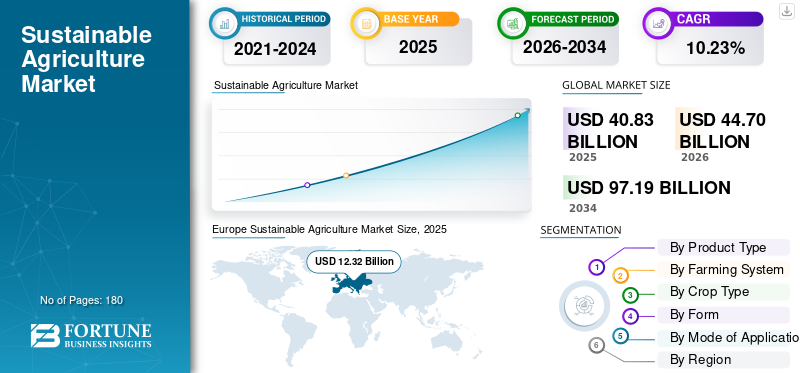
The global sustainable agriculture market size was valued at USD 40.83 billion in 2025 and is projected to grow from USD 44.70 billion in 2026 to USD 97.19 billion by 2034, exhibiting a CAGR of 10.19% during the forecast period. Europe dominated the sustainable agriculture market with a market share of 30.17% in 2025.
Sustainable agriculture refers to farming methods that produce crops while protecting the environment, conserving natural resources, and supporting healthy ecosystems. Sustainable agriculture farmers use methods such as regenerative farming, precision irrigation, conservation tillage, and integrated nutrient management, among others, to improve soil health. This helps make soil healthier, increase biodiversity, use water more efficiently, and help farmers transition to sustainable farms. The market is expanding rapidly as global agriculture faces challenges such as climate change, poor soil health, water shortages, and stricter rules on agrochemicals. This helps them reach sustainability goals and meet consumer demand for food.
Companies such as Bayer Crop Science, Gowan Company, Corteva Agriscience, UPL Ltd., and others are key players in this market. A new product launch is a key strategy that is boosting product sales and supporting market growth.
Download Free sample to learn more about this report.
Sustainable Agriculture Market Key Takeaways
 Global Market Size & Forecast
- 2025 Market Size: USD 40.83 billion
- 2026 Market Size: USD 44.70 billion
- 2034 Forecast Market Size: USD 97.19 billion
- CAGR: 10.19% from 2026-2034
 Market Share
- Europe dominated the sustainable agriculture market with a 30.17% share in 2025.
- The foliar application segment is projected to grow at a CAGR of 10.42% during the forecast period.
- The biological crop protection products segment is projected to grow at a CAGR of 10.42% during the forecast period.
 Key Regional Highlights
North America
North America was valued at USD 11.00 billion in 2025.
Asia Pacific
Asia Pacific was valued at USD 11.01 billion in 2025.
Europe
Europe led the global market with a value of USD 12.32 billion in 2025.
U.S.
The U.S. market was valued at USD 9.10 billion in 2025.
Japan
Japan reached a market value of USD 1.10 billion in 2025.
Read More

SUSTAINABLE AGRICULTURE MARKET TRENDS
Shift Toward Regenerative and Climate-Smart Farming is Reshaping Agricultural Systems
Farmers are shifting toward regenerative systems that help to restore soil, enhance biodiversity, and build long-term ecosystem resilience. More farmers are relying on cover crops, crop rotation, conservation tillage, and integrated livestock systems to boost soil carbon. Moreover, the use of digital agriculture tools has increased, including AI-powered farm management, drones for crop monitoring, automated irrigation, and satellite-guided nutrient application. Biological agriculture is becoming popular as demand grows for microbial fertilizers, biostimulants, biofungicides, and biopesticides to replace traditional agrochemicals.
MARKET DYNAMICS
MARKET DRIVERS
Download Free sample to learn more about this report.
Rising Resource Depletion and Climate Pressure Accelerate Adoption of Sustainable Agriculture Practices
The market is growing as global food systems face pressure to boost productivity while reducing environmental harm, greenhouse gas emissions, and resource use. Food manufacturers and retailers are responding to growing consumer demand for sustainability by building traceable, low-carbon supply chains. This helps them meet ESG goals and respond to consumers who responsibly source food. Climate change and extreme weather are prompting farmers to seek systems that can address these challenges. Increasing popularity of farming methods that improve soil health in an environmentally sustainable way is boosting the sustainable agriculture market growth.
MARKET RESTRAINTS
High Transition Costs and Yield Uncertainty Hinder Market Growth
Farmers often face unpredictable crop yields during the transition from conventional to sustainable farming. A lack of technical knowledge and inconsistent support services also make it difficult to use advanced sustainable practices in emerging economies. Inconsistent rules and certification standards for sustainable food across regions also create challenges for farmers and agribusinesses operating in global markets. These factors act as a major barrier to the acceptance and growth of these products among consumers.
MARKET OPPORTUNITIES
Carbon Farming and Digital Agriculture Create New Market Growth Potential
The market is growing, with new opportunities generated by carbon farming programs that incentivize regenerative agriculture and digital farming systems. Farmers who use no-till farming, cover crops, agroforestry, or soil carbon storage have the opportunity to earn extra income through carbon credit markets. Precision agriculture technologies such as AI crop analytics, satellite monitoring, self-driving farm equipment, and smart irrigation systems are helping farmers use resources more efficiently and work more effectively. Emerging countries in Asia Pacific, South America, and Africa have strong long-term growth potential as their governments focus more on saving water and on building food systems that can withstand climate change.
Segmentation Analysis
By Mode of Application
Growing Focus on Soil Health Restoration and Nutrient Efficiency Led to Soil-Applied Field Application Dominance
By mode of application, the market is segmented into soil-applied field application, foliar application, seed-applied/planting-stage application, and fertigation/irrigation-mediated application.
The soil-applied field application segment held the largest sustainable agriculture market share in 2025. Farmers are using biological fertilizers, organic soil amendments, microbial inoculants, and other bio-based inputs to improve moisture retention in their fields. These products increase nutrient availability, support soil microbes, store more carbon, and help the soil hold water. In addition, soil application provides longer residual effectiveness and improves root-zone nutrient uptake, making it critical for large-scale crop productivity and climate resilience.
The foliar application segment is expected to grow at a 10.42% CAGR during the forecast period. More farmers are turning to foliar sprays with biological crop protection, micronutrients, seaweed extracts, amino acids, and biostimulants. Foliar treatments are especially useful for high-value crops such as fruits, vegetables, and greenhouse plants.
By Product Type
Need for Immediate Productivity Gains and Reduced Input Losses Fueled Enhanced-Efficiency Synthetic Inputs Segment Growth
Based on the product type, the market is segmented into enhanced-efficiency synthetic inputs, biological crop protection products, non-microbial biostimulants & plant health products, biological crop nutrition products, and circular soil and crop input products.
Enhanced-efficiency synthetic inputs held the largest market share in 2025. They allow farmers to improve productivity while reducing excessive fertilizer and agrochemical losses. Products such as controlled-release fertilizers, stabilized nitrogen fertilizers, precision nutrient formulations, and advanced water-soluble inputs are widely adopted as they improve nutrient-use efficiency, reduce leaching and volatilization losses, and support compliance with tightening environmental regulations.
The biological crop protection products segment is expected to grow at a 10.42% CAGR during the forecast period. More farmers are now using microbial pesticides, biofungicides, bioinsecticides, and plant-based protection agents to lower chemical residues and support environmental sustainability. Such products are increasingly being used in fruits, vegetables, specialty crops, and export-focused farming.
By Crop Type
Cereals & Grains Led Due to Large Cultivation Area and High Resource Optimization Needs
By crop type, the market is segmented into cereals & grains, oilseeds & pulses, fruits & vegetables, industrial & cash crops, turf, ornamentals & nursery crops, and others.
The cereals & grains segment led the global market in 2025. They are the most widely grown crops globally and use significant amounts of fertilizers, irrigation, crop protection products, and soil management resources. As governments and food companies focus on sustainable cereal production, farmers are widely adopting precision nutrient management, regenerative farming, and biological inputs to boost productivity and meet environmental standards.
The oilseeds & pulses segment is expected to grow at a CAGR of 10.12% during the forecast period. Oilseeds and pulses have the second-largest market share. These crops are increasingly valued for their benefits in crop rotation, including nitrogen fixation, improved soil fertility, and support for plant-based protein supply chains. As global demand for plant-based proteins, edible oils, and sustainable livestock feed grows, more farmers are using biological fertilizers and regenerative farming methods when growing oilseeds and pulses.
By Form
Liquid Formulations Dominated Due to Rising Adoption of Precision Irrigation and High-Efficiency Nutrient Delivery
By form, the market is segmented into liquid formulations, dry/granular formulations, powder/wettable powder formulations, and other formulations.
Liquid formulations led the global market in 2025, as they deliver nutrients quickly, allow for precise application, and work well with modern precision farming and irrigation systems. Liquid products also work well for high-value crops, greenhouse growing, horticulture, and climate-smart farming, where careful management of nutrients and water is important.
The dry/granular formulations segment accounted for the second-largest market share in 2025 and is expected to register a 10.37% CAGR during the forecast period. Dry, granular formulations offer longer shelf life, easier bulk transportation, and suitability for broad-acre farming applications. Granular organic fertilizers, soil conditioners, microbial carriers, and slow-release nutrient products are widely used in cereals, grains, and large-scale field crop production, where long-duration nutrient release and soil conditioning are essential.
By Farming System
To know how our report can help streamline your business, Speak to Analyst
Large Existing Agricultural Base and Gradual Sustainability Transition Fueled Dominance of Conventional Farms Adopting Sustainable Inputs
By farming system, the market is segmented into conventional farms adopting sustainable inputs, regenerative/conservation agriculture farms, organic agriculture, integrated pest management-focused farms, and protected/high-value controlled production.
The conventional farms adopting sustainable inputs segment commanded the global market in 2025. Large commercial farms are increasingly adopting more efficient fertilizers, biological crop protection, precision irrigation, and soil health solutions. Food companies, governments, and agribusinesses are encouraging conventional farmers to adopt more sustainable practices and support future generations.
The regenerative/conservation agriculture farms segment accounted for the second-largest market share in 2025 and is expected to register a 10.61% CAGR during the forecast period. Segment growth is driven by the rapid adoption of practices such as no-till farming, cover cropping, crop rotation, agroforestry, and soil carbon management, which are increasing rapidly in response to climate resilience and carbon sequestration goals. These farming systems rely on biological inputs, soil restoration products, and low-disturbance cultivation methods to support long-term ecosystem health.
Sustainable Agriculture Market Regional Outlook
By geography, the market is categorized into Europe, North America, Asia Pacific, South America, and the Middle East & Africa.
Europe
Europe Sustainable Agriculture Market Size, 2025 (USD Billion)
To get more information on the regional analysis of this market, Download Free sample
The European market was valued at USD 12.32 billion in 2025 and is the leading region globally. Europe is one of the world’s most policy-driven markets for sustainable agriculture, shaped by the EU Green Deal, the Farm to Fork Strategy, and carbon reduction goals. Germany, France, the Netherlands, and Denmark are quickly adopting biological fertilizers, integrated pest management, precision spraying, and regenerative farming methods. Precision agriculture tools such as satellite-guided nutrient management, AI crop monitoring, and automated irrigation are also becoming increasingly popular. Government subsidies for organic farming and carbon sequestration are also speeding up investment in sustainable agriculture and climate-smart solutions.
Germany Sustainable Agriculture Market
The German market in 2025 reached around USD 2.18 billion, accounting for roughly 5.34% of global revenues. Germany represents one of Europe’s leading markets due to strong environmental regulations and extensive adoption of regenerative farming practices. Farmers are increasingly integrating biological crop protection products, precision nutrient application systems, conservation tillage, and carbon-smart cultivation techniques to comply with EU sustainability targets and support long-term growth.
U.K. Sustainable Agriculture Market
The U.K. market reached USD 1.10 billion in 2025, equivalent to around 2.69% of global sales.
Asia Pacific
The Asia Pacific market was valued at USD 11.01 billion in 2025. Concerns about food security, water shortages, and the environmental impact of intensive farming drive this growth. China, India, Japan, and Australia are making significant investments in precision irrigation, biological crop protection, improved nutrient management, and farming systems that can adapt to changing climates. Government programs in China are encouraging farmers to use less fertilizer, restore soil health, and adopt modern digital agriculture methods. Similarly, in India, farmers are using biofertilizers, drip irrigation, and integrated farming systems to boost productivity and rely less on traditional inputs. There is also growing interest in the region for controlled-environment agriculture, vertical farming, and AI-powered farm analytics to use resources more efficiently as climate change and land degradation become bigger challenges.
India Sustainable Agriculture Market
The India market in 2025 was valued at USD 2.22 billion, accounting for roughly 5.43% of global market revenues.
China Sustainable Agriculture Market
China’s market in 2025 was valued at USD 3.04 billion, representing roughly 7.45% of global revenues. China’s market is growing quickly as the government promotes reducing fertilizer use, soil restoration, modernizing agriculture through precision irrigation, drone monitoring of crops, and biological crop protection. These tools help boost productivity and limit environmental harm from intensive farming.
Japan Sustainable Agriculture Market
The Japan market in 2025 reached around USD 1.10 billion, accounting for roughly 2.70% of global revenues.
North America
The market in North America was valued at USD 11 billion in 2025. Sustainable agriculture is expanding in North America as more farmers adopt regenerative practices, precision technologies, and carbon-smart crop systems. Large agribusinesses and food retailers are investing in low-carbon farming to meet their sustainable sourcing goals and cut Scope 3 emissions. An increasing number of farmers are using cover crops, no-till methods, and nutrient-efficient solutions to boost soil health and join carbon credit programs. Additionally, new regulations about fertilizer runoff, pesticide use, and groundwater safety are pushing more farms to use biological inputs, precise nutrient systems, and sustainable crop management tools.
U.S. Sustainable Agriculture Market
In 2025, the U.S. market was valued at USD 9.10 billion. The U.S. market is growing as larger commercial farms use regenerative farming, precision agriculture, and carbon-smart crop management. Farmers are using more biological crop protection, better fertilizers, no-till methods, and AI-powered analytics to boost productivity and lower their environmental impact. Carbon credit programs and ESG commitments from major food companies are accelerating the adoption of soil carbon sequestration and water-efficient irrigation systems. Demand is particularly strong for corn, soybeans, wheat, and specialty crops.
South America and Middle East & Africa
Over the forecast period, South America is expected to experience significant growth in this market. The South American market in 2025 was valued at USD 4.66 billion. Brazil leads the region due to its major soybean, sugarcane, coffee, and livestock sectors. These farmers are switching from traditional inputs toward biological crop inputs, regenerative farming, and precision agriculture. Global concerns about deforestation and carbon emissions are pushing agribusinesses to improve how they manage land and track their products. However, uneven access to agricultural technology continues to limit broader adoption among small-scale farmers.
The Middle East & Africa region was valued at USD 1.83 billion in 2025. Water scarcity, food security concerns, and increased investment in climate-resilient farming systems are impacting the Middle East & Africa market. Gulf countries, particularly the UAE and Saudi Arabia, are investing heavily in hydroponics, vertical farming, controlled-environment agriculture, and precision irrigation technologies to reduce dependence on imported food and improve the efficiency of domestic crop production. South Africa is emerging as a key regional market for precision farming and water-efficient irrigation systems.
UAE Sustainable Agriculture Market
The UAE market is set to grow at a CAGR of 6.79% during the forecast period. The UAE market is expanding rapidly due to food security concerns, limited freshwater resources, and rising investment in controlled-environment agriculture. Hydroponics, vertical farming, precision irrigation, and climate-controlled greenhouse systems are widely adopted to reduce water consumption and improve domestic food production capacity.
COMPETITIVE LANDSCAPE
Key Industry Players
New Product Launches by Top Players Reshape Market Landscape
The sustainable agriculture market is semi-consolidated, with leading agrochemical and seed companies such as Bayer, Gowan, and Syngenta investing in and expanding sustainable agriculture products, including biological fertilizers, biostimulants, efficient nutrients, and regenerative agriculture programs. Such advanced product lines help them meet stricter environmental rules and support ESG-focused food supply chains. Manufacturers are also focusing on integrated farming systems that use biological inputs, digital technologies, precision irrigation, and carbon-smart crop management. Agritech companies are collaborating on AI-powered farm analytics, drone crop monitoring, automated irrigation, and satellite-guided precision tools to help farmers use resources more efficiently and reduce emissions.
LIST OF KEY SUSTAINABLE AGRICULTURE COMPANIES PROFILED
- Bayer Crop Science (U.S.)
- Gowan Company (U.S.)
- Rallis India (India)
- Syngenta Group (Switzerland)
- Corteva Agriscience (U.S.)
- UPL Ltd. (India)
- FMC Corporation (U.S.)
- Sumitomo Chemical (Japan)
- ADAMA (Israel)
- Nufarm (U.S.)
KEY INDUSTRY DEVELOPMENTS
- March 2026: Regrow Ag and PUMA (Plataforma Única de Monitoreo Ambiental) merged to form a unified, enterprise-grade system to manage global agricultural sourcing, sustainability performance, and regulatory compliance.
- July 2025: Corteva and Hexagon Bio entered into a joint venture to develop next-generation crop protection products derived from nature for the market.
- September 2023: Corteva launched Reklemel active, a new nematicide that protects a wide variety of food and row crops from plant-parasitic nematodes.
- August 2023: FMC Corporation launched ENTAZIATM biofungicide, formulated with Bacillus subtilis, to protect crops from pest attacks. It is suitable to control bacterial leaf blight in rice.
- February 2022: BioWorks introduced two new products: BioNex, an insecticide and miticide, and Hoplite, a moss and algae control product. It supports greenhouse and nursery growers and helps to manage pests and unwanted plant growth.
REPORT COVERAGE
The global sustainable agriculture market research provides an in-depth study of market sizes & forecast by all the market segments included in the report. Market analysis includes details on market dynamics and trends expected to drive the forecast. It offers information on the technological advancements, new product launches, key industry developments, and details on partnerships, mergers & acquisitions. The industry also encompasses a detailed competitive landscape with information on market segmentation, market share, and profiles of key operating players.
Request for Customization to gain extensive market insights.
Report Scope & Segmentation
| ATTRIBUTE | DETAILS |
| Study Period | 2021-2034 |
| Base Year | 2025 |
| Estimated Year | 2026 |
| Forecast Period | 2026-2034 |
| Historical Period | 2021-2024 |
| Growth Rate | CAGR of 10.19% from 2026 to 2034 |
| Unit | Value (USD Billion) |
| Segmentation | By Product Type, By Farming System, By Crop Type, By Form, By Mode of Application, and Region |
| By Product Type |
|
| By Farming System |
|
| By Crop Type |
|
| By Form |
|
| By Mode of Application |
|
| By Region |
|
Frequently Asked Questions
Fortune Business Insights says that the global market value stood at USD 40.83 billion in 2025 and is projected to reach USD 97.19 billion by 2034.
In 2025, the market value in Europe stood at USD 12.32 billion.
The market is expected to exhibit a CAGR of 10.19% during the forecast period.
By crop type, the cereals & grains segment led the global market in 2025.
Rising resource depletion and climate pressure are driving market growth.
Bayer Crop Science, Gowan Company, Corteva Agriscience, and UPL Ltd. are among the players in the market.
Europe held the largest market share in 2025.
A shift toward regenerative and climate-smart farming is reshaping agricultural production systems.


- 2021-2034
- 2025
- 2021-2024
- 180
-
(Offer valid till 31st Oct 2026)
Get 30-60 hrs Free Customization
Expand Regional and Country Coverage, Segments Analysis, Company Profiles, Competitive Benchmarking, and End-user Insights.














Related Reports
-
US +1 833 909 2966 ( Toll Free )
-
Get In Touch With Us