Sustainable Personal Care Products Market Size, Share Market & Industry Analysis, By Product (Skincare, Haircare, Bath & Shower Products, Oral Care, and Others), By Distribution Channel (Hypermarkets/Supermarkets, Specialty Stores, Online Retail, and Others), and Regional Forecast, 2026-2034
 Download Free Sample
(Offer valid till 15th Oct 2026)

Sustainable Personal Care Products Market Size and Industry Overview
 Listen to Audio Version
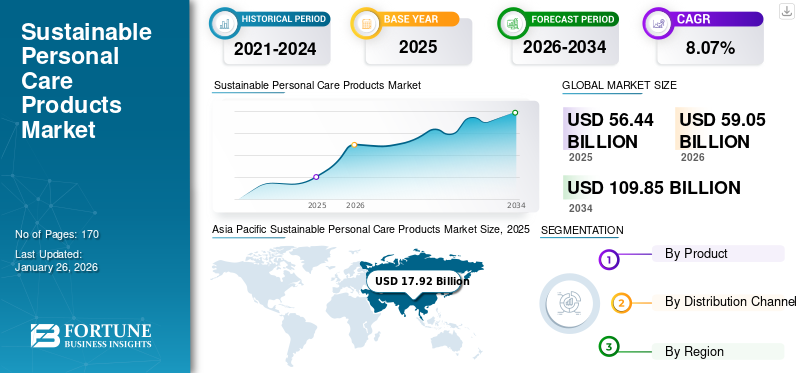
The global sustainable personal care products market size was valued at USD 56.44 billion in 2025 and is projected to grow from USD 59.05 billion in 2026 to USD 109.85 billion by 2034, exhibiting a CAGR of 8.07% over the forecast period. Asia Pacific dominated the sustainable personal care products market with a market share of 31.76% in 2025.
Various manufacturers across the globe are looking to collaborate with other international giants to offer sustainable and eco-friendly products to consumers. For instance, in September 2024, L’Oréal is trying to make a maximum percentage (95%) of ingredients bio-based by expanding their partnership with Abolis, a French biotechnology company.
Sustainable personal care products are made from eco-friendly materials and are designed with ethical manufacturing and sustainable practices. These products help minimize skin issues associated with exposure to potentially harmful chemicals found in synthetically made products. Businesses are responding to the consumers' sustainable living and shopping needs by producing a diverse range of eco-friendly personal care products, establishing supply chains from ethical and sustainable sources, and promoting their products through sustainability campaigns. Increasing eco-consciousness of consumers worldwide drives the demand for such products.
- According to the survey conducted by the National Centre for Biotechnology Information (NCBI), in 2021, 73% of consumers across 60 countries are determined to pay more for sustainable products.
Download Free sample to learn more about this report.
SUSTAINABLE PERSONAL CARE PRODUCTS MARKET KEY TAKEAWAYS
 Global Market Size & Forecast
- 2025 Market Size: USD 56.44 billion
- 2026 Market Size: USD 59.05 billion
- 2034 Forecast Market Size: USD 109.85 billion
- CAGR: 8.07% from 2026–2034
 Market Share
- Asia Pacific held a 31.76% market share in 2025.
- Skincare is expected to account for 40.78% of the market in 2026.
- Hypermarkets/Supermarkets are projected to hold a 28.75% market share in 2026.
 Key Regional Highlights
South America
Represented 11.98% of the global market in 2025.
Asia Pacific
Held a 31.76% market share in 2025.
Europe
Accounted for 22.26% of the global market in 2025.
U.S.
Expected to reach USD 12.60 billion by 2026.
Japan
Expected to reach USD 2.58 billion by 2026.
Read More

SUSTAINABLE PERSONAL CARE PRODUCT MARKET Trends
Increasing Production of Custom Formulation-based Products to Favor Market Growth
Manufacturers are increasingly utilizing digital platforms and their internal formulation databases to produce customer-specific personal care products, including skincare, haircare, suncare, and oral care products. For instance, in January 2022, BASF SE developed D’lite, an online platform that enables manufacturers to produce custom formulation-based products. Increasing demand for custom formulation-based products favors market growth worldwide.
- Asia Pacific witnessed sustainable personal care products market growth from USD 17.92 billion in 2025 to reached USD 18.94 billion in 2026.
Download Free sample to learn more about this report.
MARKET DYNAMICS
Market Drivers
Advancements in Bio-ingredients to Drive Market Growth
Advancements in the development of bio-degradable ingredients for skincare, Hair care, oral care, and personal hygiene products, and continual manufacturing companies’ focus on producing eco-friendly personal care goods, are positively contributing to the global sustainable personal care products market growth. In May 2024, Cellugy, a Danish biotechnology firm, invested USD 5.32 million (EUR 4.9 million) to develop EcoFLEXY, a dry cellulose ingredient for personal care applications. This sustainably produced ingredient can replace polluting petrochemical ingredients required in producing personal care products.
In addition, the increasing adoption of eco-friendly personal hygiene and care products, providing a value-for-money benefit to users, is driving product revenues globally. Furthermore, increasing preference for clean, safer, and chemical-free hygiene products to avoid the side-effects of synthetically produced ones favor the product demand during the forecast period from 2024-2032.
Growing Demand for Sustainable Packaging to Propel Market Expansion
Manufacturing businesses are launching greener personal care products made from naturally sourced materials and energy-efficient sources to encourage eco-conscious consumers to buy such products. Sustainable personal care products appeal to environmentally conscious eco-friendliness consumers but also enable companies to differentiate themselves from competitors. Increasing launches of products made of sustainable materials and eco-friendly packaging options drive product consumption across many countries worldwide.
Market Restraint
Higher Product Prices to Limit Market Growth
Higher prices of premium eco-friendly personal care products, coupled with increasing inflationary pressure, and growing consumer price index are expected to limit product consumption among middle-income and upper-middle-income consumers worldwide. In addition, consumer skepticism about the ethical claims made in green product promotions poses challenges for companies targeting green personal care products, thereby impacting market growth.
Market Opportunity
Adoption of Ethical Supply-chain Practices to Fuel Market Growth
Personal care industry stakeholders, including manufacturers, retailers, wholesalers, raw material vendors, and agents, are increasingly adopting ethical supply chain practices to achieve their business sustainability goals and positively contribute to the environment. For instance, BASF SE is producing sustainable, coconut oil-based certified bio-active ingredients for personal care applications. Additionally, there is an increasing necessity for industry stakeholders to adhere to Environmental, social, and governance (ESG) regulations to fulfill compliance requirements, further supporting market growth worldwide.
In 2021, Procter & Gamble Company set an ambitious goal to achieve zero greenhouse gas emissions (GHG) emissions across its supply chain and operations, from raw materials to retailers. In addition, the company also initiated an action plan, 'Climate Transition Action Plan,' covering the company's entire lifecycle emissions from products, packaging, supply chain, operations, consumers' product usage, and product end-of-life phases. This plan aims to achieve a zero-emission target by 2040.
SEGMENTATION ANALYSIS
By Product
Higher Necessities of Maintaining Daily Skincare Routines Dominated Skincare Segment
By product, the sustainable personal care products market is divided into skincare, haircare, bath & shower products, oral care, and others.
The skincare segment is anticipated to exhibited a leading global market share with a 40.78% in 2026, attributed to higher consumer spending on natural skincare products, including creams, lotions, gels, face care oils, mousse, and others for their daily skincare routines. In addition, advancements in the development of skincare creams utilizing innovative bio-active ingredients and recycled materials have positively contributed to the segment’s growth.
- The skincare segment is expected to hold a 40.78% share in 2026.
The haircare segment ranked second in global market share. Manufacturers focus on developing hair care oils, shampoos, soaps, and other hair care products made of natural, clean, and sustainable ingredients. In addition, they are also focusing on replacing the usage of sulfates, silicones, parabens, and artificial fragrances with plant-based derivatives in hair care products. Continual development in sustainable hair care products is expected to support growth in the hair care segment.
The others segment includes sun care and feminine care products. The increasing prevalence of sunburn and shifting consumer preference toward organic and natural sun tanning products are favoring revenue growth in this segment. In addition, manufacturers' initiatives to use compostable or recycled materials in the manufacturing of feminine care products, such as tampons, pads, and menstrual cups, are accelerating the consumption of such products worldwide.
The bath & shower products segment is mainly driven by manufacturers' increasing efforts to produce sustainable bath and shower products that utilize advanced micro-biome technology and by growing consumer demand for organic ingredient-based soaps & shampoos worldwide.
The expanding consumer preferences for herbal toothpaste that addresses specific oral care needs such as gum caries, tooth decays, and teeth whitening, further drive oral care segment growth.
To know how our report can help streamline your business, Speak to Analyst
By Distribution Channel
Hypermarkets/Supermarkets Segment Led due to Available of Diverse Natural Products Ranges
Based on distribution channel, the market is segmented into hypermarkets/supermarkets, specialty stores, online retail, and others.
The hypermarkets/supermarkets segment accounted for a majority global sustainable personal care products market with a share of 28.75% in 2026. Its significant share is attributed to the higher consumer preferences for purchasing a diverse range of sustainable products under one roof. In addition, increasing stores’ provision of discounted products and the growing trend of bulk product purchasing at these stores are expected to drive revenue growth in this segment.
Shifting consumer preferences toward buying premium products from specialty beauty shops, pharmacy stores, and personal care brand stores to address specific skincare concerns is favoring the specialty stores’ segment growth. In addition, increasing the provision of over-the-counter skincare products featuring sustainability certification labels in drugstores and beauty shops supports product consumption in these settings.
Rising adoption of online shopping for personal care goods, coupled with continual green marketing promotions by e-commerce retailers, is expected to accelerate the online retail CAGR of 8.33% during the forecast period.
The other segment includes various distribution channels such as convenience stores and discount stores. The need for manufacturers to broaden their sales channels and the increasing consumer demand for mass-produced products mainly drives the growth in this segment.
Regional Outlook
Geographically, the global market is studied across North America, Europe, Asia Pacific, South America, and the Middle East & Africa.
Asia Pacific
Asia Pacific Sustainable Personal Care Products Market Size, 2025 (USD Billion)
To get more information on the regional analysis of this market, Download Free sample
Asia Pacific region dominated the market in 2025 with a value of USD 17.92 billion, and is projected to reached USD 18.94 billion in 2026, owing to significant consumer spending on personal hygiene-related products. Additionally, a higher number of commercial settings such as hospitality, offices, and hospitals, utilizing personal care products for their regular hygiene needs, is also driving market growth. Growing awareness of buying green-labeled personal care products among consumers in India, Southeast Asia, and China accelerates the Asia Pacific region’s market growth. The Japan sustainable personal care products market is projected to reach USD 2.58 billion by 2026, the China sustainable personal care products market is projected to reach USD 5.9 billion by 2026, and the India sustainable personal care products market is projected to reach USD 3.26 billion by 2026.
Increasing population aging and increasing consumer preference for natural formulation-based personal hygiene products drive product revenues across China. According to the Ministry of Civil Affairs, by the end of 2022, around 280 million Chinese citizens (19.8% of the total population) were aged 60 years and above.
North America
North America is anticipated to be the second-largest market, with a value of USD 14.58 billion in 2025, registering the second-fastest growing CAGR of 6.37% during the forecast period. Growing prevalence of skin problems, including skin cancers, skin rashes, and wrinkles, and higher preference for safer, organic skincare products in the U.S. and Mexico, has resulted in significant sales revenues in the North American region.
- According to the data published by the American Academy of Dermatology Association, in January 2024, nearly 50 million Americans are suffering from acne skin conditions.
Government regulations regarding consultative labeling on cosmetic products enable consumers to select personal care products made from natural and organic ingredients. Continual implementation of regulations requiring consultative labeling has significantly boosted product consumption in Mexico and Canada. For instance, the government of Canada has implemented a consultative framework regarding the targeted amendments for natural health products to improve labeling activities of the natural products intended to better support consumer shopping. The U.S. sustainable personal care products market is projected to reach USD 12.60 billion by 2026.
Europe
Europe contributed 22.26% to the global market in 2025, with a valuation of USD 12.56 billion, and is projected to reach USD 13.13 billion in 2026. Natural fibers, including cotton, cellulose, and seaweed materials, are increasingly used in the composition of absorbent hygiene products. The necessity for manufacturers to produce hygiene care products made from plant-based materials and bioactive sources is favoring growth in the European market. In addition, growing awareness of ethical shopping among the population in the Eastern European region accelerates the market growth. The UK sustainable personal care products market is projected to reach USD 2.16 billion by 2026, while the Germany sustainable personal care products market is projected to reach USD 2.6 billion by 2026.
Middle East & Africa
In 2025, Middle East & Africa held 8.16% of the global market, reaching a valuation of USD 4.61 billion, and is projected to grow to USD 4.84 billion in 2026.
Rest of the World
Rising adoption of online shopping for consumer goods and growing awareness of buying eco-friendly products among consumers in the countries such as UAE, South Africa, and Saudi Arabia drive the Middle East & African market growth. The UAE market is expected to hit USD 0.72 billion in 2025.
South America
South America maintained a strong presence in the global market, reaching USD 6.76 billion in 2025, accounting for 11.98% share, and is expected to reach USD 6.96 billion in 2026. An increasing number of beauty shops offering premium-based skincare products and emerging domestic modern trade networks in Chile and Brazil support the product consumption in the South American region.
COMPETITIVE LANDSCAPE
Key Industry Players
Prominent Players Focus on R&D Investment to Diversify Their Portfolio and Build Their Market Position
Key players in the market, including L’Oréal S.A., Unilever Plc, The Procter & Gamble Company, and The Colgate Palmolive Company, are focusing on investing in R&D activities for eco-friendly products to enhance their environmental sustainability and support the consumer for ethical shopping. For instance, in November 2022, L’Oreal S.A. invested USD 55.16 million (EUR 50 million) as a part of its Future sustainability program fund of USD 165.49 million (EUR 150 million). This investment aimed to diversify various operations, including packaging, R&D, recycling & waste, logistics, and the implementation of eco-efficient processes, all contributing to the transition toward circular and sustainable business operations.
List of Key Sustainable Personal Care Products Companies:
- Unilever Plc. (U.K.)
- L’Oréal S.A. (France)
- The Procter & Gamble Company (U.S.)
- The Colgate-Palmolive Company (U.S.)
- Coty, Inc. (U.S.)
- Kao Corporation (Japan)
- Estee Lauder Companies Inc. (U.S.)
- Natura & Co. (Brazil)
- Henkel AG & Co. KGaA (Germany)
- 3M (U.S.)
KEY INDUSTRY DEVELOPMENTS:
- July 2024: Syensqo partnered with Allozymes, a Singaporean enzyme engineering start-up, to develop advanced bio-sciences solutions for home and personal care applications.
- July 2023: Evonik Industries acquired Nova Chem Industries, an Argentinian sustainable cosmetic actives innovator, to build its capabilities in sourcing biotechnological, natural, and sustainable cosmetic active ingredients for its products.
- February 2023: Symrise AG, a German specialty chemical company, partnered with Synergio, a biotechnology company, to offer plant-based sustainable beauty solutions to consumers worldwide.
- June 2022: DoW, a global chemical company, partnered with EcoSynthetix to expand its portfolio of bio-based, biodegradable, and low-carbon solutions for the personal care industry.
- March 2022: Unilever Plc. launched Positive Beauty Growth Platform, a network aimed at inviting innovative industry start-ups to collaborate. This platform focuses on producing next-generation biodegradable and sustainable ingredients and packaging for personal care & beauty applications.
REPORT COVERAGE
The sustainable personal care products market report analysis includes in-depth market-related information, and it highlights crucial aspects such as prominent companies, type analysis, application, and distribution channels. The report on the sustainable personal care products market outlooks insights into the market trends and highlights significant industry developments.
Request for Customization to gain extensive market insights.
Report Scope & Segmentation
|
ATTRIBUTE |
DETAILS |
|
Study Period |
2021-2034 |
|
Base Year |
2025 |
|
Estimated Year |
2026 |
|
Forecast Period |
2026-2034 |
|
Historical Period |
2021-2024 |
|
Growth Rate |
CAGR of 8.07% from 2026 to 2034 |
|
Unit |
Value (USD billion) |
|
Segmentation |
By Product
|
|
By Distribution Channel
|
|
|
By Region
|
Frequently Asked Questions
Fortune Business Insights says that the worldwide market was USD 59.05 billion in 2025 and is anticipated to reach USD 109.85 billion by 2034.
Ascending at a CAGR of 8.07%, the global market forecasted to grow during 2026-2034.
By product, the skin care segment dominated the market.
Continual advancements in the development of bio-ingredients is a key factor driving market growth.
LOreal S.A., Unilever Plc., The Procter & Gamble Company, and The Colgate Palmolive Company are the leading companies operating in the worldwide market.



- 2021-2034
- 2025
- 2021-2024
- 170
-
(Offer valid till 15th Oct 2026)
Get 30-60 hrs Free Customization
Expand Regional and Country Coverage, Segments Analysis, Company Profiles, Competitive Benchmarking, and End-user Insights.


















Related Reports
-
US +1 833 909 2966 ( Toll Free )
-
Get In Touch With Us