Switch Mode Power Supply Transformer Market Size, Share & Industry Analysis, By Transformer Type (Flyback Transformers, Forward Transformers, Push-Pull Transformers, Half-Bridge Transformers, Full-Bridge Transformers, and Resonant/LLC Transformers), By Power Rating (Up to 50 W, 50 W to 250 W, 250 W to 1 kW, and Above 1 kW), By End-User (Consumer Electronics, IT & Data Centers, Telecommunications, Industrial Electronics, Automotive, Healthcare, Energy & Power, Aerospace & Defense, and Others) and Regional Forecast, 2026-2034
 Download Free Sample
Switch Mode Power Supply Transformer Market Size and Future Outlook
 Listen to Audio Version
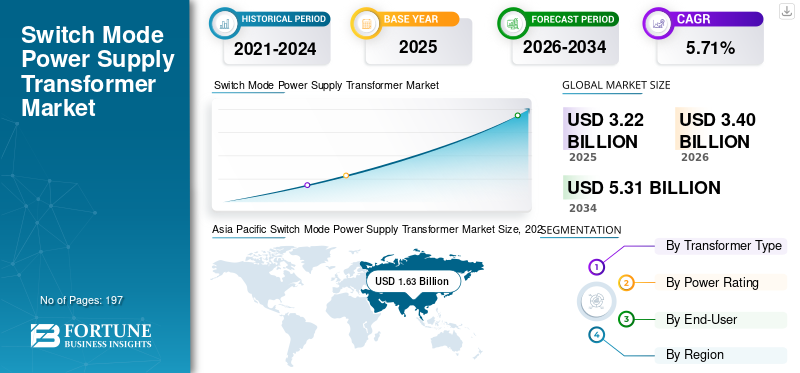
The global switch mode power supply transformer market size was valued at USD 3.22 billion in 2025. The market is projected to grow from USD 3.40 billion in 2026 to USD 5.31 billion by 2034, exhibiting a CAGR of 5.71% during the forecast period. Asia Pacific dominated the switch mode power supply transformer market with a market share of 50.62% in 2025.
A Switch Mode Power Supply (SMPS) transformer is a critical component used in high-frequency power conversion systems to efficiently transfer electrical energy while providing voltage transformation and isolation. Unlike conventional transformers, SMPS transformers operate at significantly higher switching frequencies, enabling compact designs, reduced material usage, and improved overall efficiency. These transformers are widely deployed across a broad range of electronic and electrical applications, including consumer electronics, industrial automation, telecommunications equipment, automotive systems, and renewable energy solutions. Their ability to support stable power delivery, minimize energy losses, and meet stringent size and performance requirements makes them essential in modern power electronics architectures.
The demand for SMPS transformers is witnessing steady growth, supported by the increasing proliferation of electronic devices and the ongoing shift toward energy-efficient power systems. Rapid advancements in consumer electronics, such as smartphones, laptops, and smart home devices, are driving the need for compact and high-performance power supplies. Additionally, the expansion of data centers and telecom infrastructure, particularly with the rollout of advanced communication networks, is contributing to higher adoption of reliable SMPS-based power solutions. Industrial automation and electric mobility trends are further accelerating the use of these transformers, as industries seek improved efficiency, reduced heat generation, and enhanced system reliability. Moreover, regulatory emphasis on energy conservation and reduced carbon emissions is encouraging the adoption of advanced power conversion technologies, thereby supporting market expansion.
The global market is moderately fragmented, characterized by the presence of both well-established component manufacturers and a wide base of regional and niche power electronics suppliers operating across domestic and international markets. Key participants such as TDK Corporation, Murata Manufacturing Co., Ltd., Delta Electronics, Inc., Würth Elektronik Group, Pulse Electronics, and Tamura Corporation maintain a strong presence through diversified product portfolios and technological expertise. At the same time, numerous small and mid-sized players cater to application-specific and cost-sensitive segments, intensifying competition.
Market participants are increasingly focusing on innovations in high-frequency materials, miniaturization, thermal management, and custom-designed transformer solutions to meet evolving application requirements. Strategic initiatives, including partnerships with OEMs, expansion of production capabilities, and penetration into high-growth end-use sectors, are shaping the competitive landscape and supporting long-term market development.
Download Free sample to learn more about this report.
Switch Mode Power Supply Transformer Market Key Takeaways
 Global Market Size & Forecast
- 2025 Market Size: USD 3.22 billion
- 2026 Market Size: USD 3.40 billion
- 2034 Forecast Market Size: USD 5.31 billion
- CAGR: 5.71% from 2026–2034
 Market Share
- Asia Pacific dominated the switch mode power supply transformer market with a 50.62% share in 2025.
- The flyback transformer segment accounted for 36.82% of the market share in 2025.
- The resonant/LLC transformers segment is projected to grow at a CAGR of 9.13% during the forecast period.
 Key Regional Highlights
Asia Pacific
Asia Pacific led the global market with a valuation of approximately USD 1.63 billion in 2025.
North America
North America reached approximately USD 0.63 billion in 2025, supported by demand from data centers and EVs.
Europe
Europe generated USD 0.57 billion in 2025, driven by energy efficiency and renewable energy investments.
U.S.
The switch mode power supply transformer market was valued at approximately USD 0.55 billion in 2025.
Japan
Growing adoption of advanced electronics and energy-efficient power systems is expected to support market growth.
Read More

Switch Mode Power Supply Transformer Market Trends
Rising Demand for Compact and Energy-Efficient Electronic Devices is Accelerating Market Growth
The increasing demand for compact, lightweight, and energy-efficient electronic devices is significantly driving switch mode power supply transformer market growth. As industries and consumers continue to prioritize smaller form factors without compromising performance, there has been a strong shift toward high-frequency power conversion technologies. SMPS transformers, which operate at elevated switching frequencies, enable substantial reductions in size and weight while improving overall power efficiency compared to traditional transformers. This makes them highly suitable for applications such as consumer electronics, medical devices, industrial equipment, and portable systems, where space constraints and energy efficiency are critical. These transformers play a vital role in ensuring stable power delivery, minimizing losses, and supporting high-power-density designs, thereby enhancing overall system performance.
Furthermore, increasing regulatory emphasis on energy efficiency and reduced power consumption across regions is reinforcing the adoption of advanced SMPS-based power solutions. Governments and regulatory bodies are implementing stringent efficiency standards for electronic devices and power supplies, compelling manufacturers to integrate high-performance transformer technologies. In addition, the rapid growth in applications such as laptops, smartphones, gaming devices, and IoT-enabled products is further amplifying the need for efficient and compact power conversion components. SMPS transformers contribute to improved thermal management and reduced energy wastage, making them essential in next-generation electronic designs.
For instance, in 2025, Samsung Electronics Co., Ltd. introduced ultra-compact fast-charging adapters and power modules incorporating high-frequency SMPS transformers to achieve higher efficiency and reduced size. This development highlights the growing importance of compact and energy-efficient transformer solutions in meeting evolving design requirements and supporting advancements in modern electronics.
MARKET DYNAMICS
MARKET DRIVERS
Download Free sample to learn more about this report.
Growing Demand for Energy-Efficient Power Electronics is Driving Market Growth
The increasing demand for energy-efficient power electronics across various end-use industries is a major driver of the market. As industries and consumers focus on reducing energy consumption and improving system efficiency, there is a strong shift toward switch mode power supply transformer technologies, which offer significantly higher efficiency compared to traditional linear power supplies. SMPS transformers play a critical role in enabling efficient power conversion, reducing energy losses, and supporting compact system designs.
In addition, the rapid proliferation of consumer electronics, data centers, industrial automation systems, and electric vehicles is driving the need for reliable and high-performance power supply components. These applications require stable voltage regulation, thermal efficiency, and compact form factors, all of which are supported by SMPS transformer technologies. The growing emphasis on sustainability, coupled with regulatory standards for energy efficiency, is further encouraging the adoption of advanced SMPS-based systems across global markets.
For instance, in 2025, Delta Electronics, Inc. introduced high-efficiency power supply solutions incorporating advanced SMPS transformers to enhance energy performance in data center applications, highlighting the increasing importance of energy-efficient power solutions.
MARKET RESTRAINTS
Design Complexity Associated with SMPS Transformers are Restraining Market Growth
The design complexity associated with SMPS transformers and the challenges related to thermal management are key restraints for market growth. Unlike conventional transformers, SMPS transformers operate at high switching frequencies, which require precise design considerations such as core material selection, winding techniques, insulation, and electromagnetic interference (EMI) control. These complexities increase design time and development costs for manufacturers.
Moreover, managing heat dissipation in compact, high-power-density applications remains a significant challenge. Inefficient thermal management can impact transformer performance, reduce lifespan, and lead to system failures. This is particularly critical in applications such as electric vehicles, telecom equipment, and industrial systems, where reliability is essential.
For instance, in 2024, TDK Corporation emphasized advancements in thermal management materials and high-frequency transformer designs to address overheating challenges in compact SMPS applications, underscoring the technical complexities in this market.
MARKET OPPORTUNITIES
Rising Adoption of Electric Vehicles and Renewable Energy Systems is Creating Market Opportunities
The increasing adoption of electric vehicles (EVs) and renewable energy systems is creating significant growth opportunities for the SMPS transformer market. In EVs, SMPS transformers are widely used in onboard chargers, battery management systems, and auxiliary power units, where efficiency, compactness, and reliability are critical. The global transition toward electric mobility is therefore driving demand for advanced transformer solutions.
In addition, the expansion of renewable energy sources such as solar and wind power is increasing the need for efficient power conversion systems. Switch mode power supply transformers are essential components in inverters, energy storage systems, and grid interface technologies, supporting efficient energy transfer and system stability. The growing focus on decentralized energy generation and smart grid infrastructure is further accelerating the adoption of SMPS-based power solutions.
For instance, in 2026, Murata Manufacturing Co., Ltd. expanded its portfolio of compact power modules incorporating SMPS transformer technologies for EV and renewable energy applications, reflecting the growing demand across these sectors.
MARKET CHALLENGES
Supply Chain Constraints and Component Standardization Issues are Challenging Market Expansion
Supply chain disruptions and the lack of standardization in transformer design across applications present significant challenges for the switch mode power supply transformer market. The production of SMPS transformers depends on critical raw materials such as ferrite cores, copper windings, and specialized insulation materials, which are subject to price volatility and supply fluctuations. Any disruption in the supply chain can impact manufacturing timelines and increase production costs.
Additionally, the high level of customization required for SMPS transformers across different applications limits standardization. Variations in voltage, frequency, power ratings, and design requirements make it difficult to achieve economies of scale, leading to higher production complexity and longer development cycles. This is particularly challenging for manufacturers serving diverse end-use industries with specific performance requirements.
For instance, in 2025, Würth Elektronik Group highlighted challenges related to raw material sourcing and customization requirements in high-frequency transformer production, emphasizing ongoing supply chain and standardization constraints in the market.
Segmentation Analysis
By Transformer Type
Flyback Transformers Segment Led the Market due to its Wide Application in Low-to-Medium Power Applications
Based on transformer type, the global market is segmented into flyback transformers, forward transformers, push-pull transformers, half-bridge transformers, full-bridge transformers, and Resonant/LLC Transformers.
The flyback transformer segment dominated the market, accounting for 36.82% share in 2025, driven by its simple design, cost-effectiveness, and widespread use in low-to-medium power applications. Flyback transformers are extensively used in consumer electronics such as mobile chargers, adapters, televisions, and small power supplies due to their ability to provide isolation and multiple output voltages with minimal components. Their compact size and ease of integration make them highly preferred across mass-market electronic devices.
The resonant/LLC transformers are emerging as the fastest-growing segment, accounting 9.13% of CAGR during the forecast period. The growth is driven by its superior efficiency, reduced switching losses, and ability to support high-frequency operations. These transformers are widely used in applications requiring high power density and minimal energy loss, such as data centers, electric vehicle charging systems, renewable energy inverters, and high-end consumer electronics. LLC resonant topologies enable soft switching, which significantly reduces heat generation and improves overall system reliability, making them highly suitable for next-generation power supply designs.
By Power Rating
50 W to 250 W Segment Led the Market, Driven by Strong Demand for Energy-Efficient Electronic Devices
Based on power rating, the global market is segmented into up to 50 W, 50 W to 250 W, 250 W to 1 kW, and above 1 kW.
The 50 W to 250 W segment captured the dominant switch mode power supply transformer market share, accounting for 31.77% in 2025, driven by its widespread application across consumer electronics, telecom equipment, and computing devices. This power range is extensively used in applications such as laptops, gaming consoles, networking equipment, and industrial control systems, where a balance between efficiency, size, and power output is essential. The increasing demand for compact and energy-efficient electronic devices is further supporting the growth of this segment.
The above 1 kW segment is expected to grow at a CAGR of 8.96% during the forecast period, supported by rising adoption in high-power applications such as data centers, electric vehicle charging infrastructure, and renewable energy systems. These applications require high-efficiency power conversion and robust thermal performance, driving the demand for advanced SMPS transformers.
By End-User
To know how our report can help streamline your business, Speak to Analyst
Consumer Electronics Segment Led the Market, Supported by High Device Penetration and Rapid Innovation
Based on end-user, the global market is segmented into consumer electronics, IT & data centers, industrial electronics, automotive, healthcare, telecommunications, Energy & Power, Aerospace & Defense, and others.
The consumer electronics segment dominated the market, accounting for 27.47% share in 2025, driven by the widespread adoption of electronic devices such as smartphones, laptops, televisions, and wearable devices. The increasing demand for compact, energy-efficient, and high-performance power supply solutions is significantly boosting the adoption of SMPS transformers in this segment. Continuous product innovation and shorter device replacement cycles are further contributing to sustained demand.
The automotive segment is expected to grow at a CAGR of 7.26% during the forecast period, supported by the rising adoption of electric vehicles and advanced electronic systems in automobiles. SMPS transformers are increasingly used in onboard chargers, infotainment systems, and battery management systems, driving growth in this segment.
The telecommunications and industrial electronics segment holds notable shares, driven by expanding network infrastructure and increasing automation across industries.
Switch Mode Power Supply Transformer Market Regional Outlook
By geography, the market is categorized into Europe, North America, Asia Pacific, Latin America, and the Middle East & Africa.
Asia Pacific
Asia Pacific Switch Mode Power Supply Transformer Market Size, 2025 (USD Billion)
To get more information on the regional analysis of this market, Download Free sample
The Asia Pacific region dominated the global market, accounting for approximately USD 1.63 billion in 2025. The market is growing due to strong electronics manufacturing presence, rapid industrialization, increasing adoption of consumer electronics, and expansion of telecommunications and data center infrastructure across countries such as China, India, Japan, and Southeast Asia. The region benefits from large-scale production capabilities and growing demand for energy-efficient power solutions. Government initiatives supporting digitalization, electrification, and renewable energy integration are further driving market growth.
China Switch Mode Power Supply Transformer Market
In 2025, the Chinese market reached approximately USD 0.65 billion. China’s market is growing due to its dominance in electronics manufacturing, strong presence of component suppliers, and increasing demand from consumer electronics, electric vehicles, and industrial automation sectors. Ongoing investments in 5G infrastructure and data centers are further supporting market expansion.
India Switch Mode Power Supply Transformer Market
The Indian market in 2025 stood at around USD 0.23 billion, accounting for a significant share of the Asia Pacific market. The market is growing due to rising consumer electronics demand, expansion of telecom infrastructure, increasing adoption of electric mobility, and government initiatives such as “Make in India” promoting domestic manufacturing and electrification.
North America
North America was valued at approximately USD 0.63 billion in 2025. The market in North America is growing due to the strong presence of data centers, increasing adoption of electric vehicles, and high demand for advanced power electronics across industrial and commercial sectors. The region is witnessing rising investments in energy-efficient infrastructure and digital technologies, driving the adoption of high-performance SMPS transformers.
U.S. Switch Mode Power Supply Transformer Market
The U.S. market can be analytically approximated at USD 0.55 billion in 2025. The U.S. market is growing due to the rapid expansion of hyperscale data centers, increasing adoption of EV charging infrastructure, and strong demand for advanced power supply solutions in industrial automation and telecommunications.
Europe
In Europe, the market was valued at USD 0.57 billion in 2025 and is growing due to strong regulatory focus on energy efficiency, increasing investments in renewable energy systems, and rising adoption of electric vehicles. The region’s emphasis on reducing carbon emissions and improving energy efficiency is encouraging the use of advanced SMPS-based power solutions across industries.
U.K. Switch Mode Power Supply Transformer Market
The U.K. market in 2025 stood at around USD 0.11 billion, driven by increasing investments in EV infrastructure, expansion of data centers, and strong demand for energy-efficient electronic systems.
Germany Switch Mode Power Supply Transformer Market
The German market in 2025 stood at around USD 0.15 billion, driven by a strong industrial base, growing adoption of automation technologies, and increasing deployment of renewable energy and electric mobility solutions.
Latin America & Middle East Africa
Latin America and the Middle East & Africa accounted for approximately USD 0.19 billion and USD 0.20 billion, respectively, in 2025. The Latin American market is growing due to increasing adoption of consumer electronics, expansion of telecom infrastructure, and rising investments in industrial and energy sectors. Countries such as Brazil and Mexico are witnessing growing demand for efficient power supply components driven by urbanization and digital transformation.
The Middle East & Africa market is growing due to expanding infrastructure development, rising investments in renewable energy and smart city projects, and increasing adoption of advanced power electronics across commercial and industrial sectors.
GCC Switch Mode Power Supply Transformer Market
The GCC market in 2025 stood at around USD 0.08 billion. The market is growing due to increasing investments in smart cities, expansion of data centers, and rising focus on energy-efficient infrastructure across countries such as the UAE, Saudi Arabia, and Qatar.
COMPETITIVE LANDSCAPE
KEY INDUSTRY PLAYERS
Key Players are Focusing on Improving Efficiency to Support Applications Across Consumer Electronics
The switch mode power supply transformer market vendors are undertaking various developments to support market growth by focusing on product innovation, miniaturization, and the integration of advanced materials and high-frequency technologies. Major players such as TDK Corporation, Murata Manufacturing Co., Ltd., Delta Electronics, Inc., Würth Elektronik Group, Pulse Electronics, Tamura Corporation, Vishay Intertechnology, Inc., and Coilcraft, Inc. are investing in high-performance transformer solutions designed for improved efficiency, reduced size, and enhanced thermal management. These companies are continuously enhancing product capabilities by incorporating features such as high-frequency operation, low core losses, compact form factors, and improved power density to support applications across consumer electronics, data centers, automotive, and industrial sectors.
In February 2026, TDK Corporation introduced advanced high-frequency transformer solutions optimized for next-generation power supplies, focusing on improved efficiency and compact design for industrial and automotive applications. This development highlights the growing focus on high-performance and energy-efficient transformer technologies in the SMPS market.
LIST OF KEY SWITCH MODE POWER SUPPLY TRANSFORMER COMPANIES PROFILED
- TDK Corporation (Japan)
- Murata Manufacturing Company Ltd. (Japan)
- Delta Electronics, Inc (Taiwan)
- Wurth Elektronik Group (Germany)
- Pulse Electronics (U.S.)
- Tamura Corporation (Japan)
- Vishay Intertechnology, Inc. (U.S.)
- Coilcraft, Inc. (U.S.)
- Sumida Corporation (Japan)
- Eaton Corporation plc (Ireland)
KEY INDUSTRY DEVELOPMENTS
- March 2026: Murata Manufacturing Co., Ltd. expanded its portfolio of compact SMPS transformers designed for high-efficiency power modules used in consumer electronics and automotive applications. The development also focuses on improving miniaturization and supporting higher power density designs in next-generation devices. Additionally, the company aims to address increasing demand for compact and thermally efficient components across portable and automotive electronics.
- February 2026: TDK Corporation launched next-generation high-frequency transformers aimed at improving power density and reducing energy losses in industrial and EV applications. These transformers are designed to support advanced semiconductor technologies such as GaN and SiC, enabling improved switching performance. The initiative reflects TDK’s focus on enhancing efficiency and reliability in high-power applications.
- January 2026: Delta Electronics, Inc. introduced advanced power supply solutions incorporating optimized SMPS transformer designs to enhance efficiency in data center and telecom infrastructure. The solutions are tailored to meet the growing energy needs of hyperscale data centers and high-speed communication networks. This development also supports improved thermal management and reduced operational costs.
- November 2025: Wurth Elektronik Group enhanced its range of planar transformers for high-power applications, focusing on improved thermal performance and compact design. The upgraded designs enable better heat dissipation and higher efficiency in space-constrained environments. These transformers are particularly suited for industrial automation and renewable energy systems.
- September 2025: Pulse Electronics expanded its high-frequency transformer offerings, targeting telecom and networking equipment, supporting higher efficiency and reduced electromagnetic interference. The new designs aim to improve signal integrity and system stability in high-speed communication applications. This expansion aligns with the increasing deployment of 5G infrastructure and data networking systems.
REPORT COVERAGE
The global switch mode power supply transformer market analysis provides an in-depth study of the market size & forecast by all the market segments included in the report. It contains details on the market dynamics and market trends expected to drive the market during the forecast period. It offers information on technological advancements, new product launches, key industry developments, and partnerships, mergers & acquisitions. The market research report also includes a detailed competitive landscape, providing market share and profiles of key players.
Request for Customization to gain extensive market insights.
Report Scope & Segmentation
| ATTRIBUTE | DETAILS |
| Study Period | 2021-2034 |
| Base Year | 2025 |
| Estimated Year | 2026 |
| Forecast Period | 2026-2034 |
| Historical Period | 2021-2024 |
| Growth Rate | CAGR of 5.71% from 2026-2034 |
| Unit | Value (USD Billion) |
| Segmentation | By Transformer Type, By Power Rating, By End-User, and Region |
| By Transformer Type |
|
| By Power Rating |
|
| By End-User |
|
| By Geography |
|
Frequently Asked Questions
Fortune Business Insights says that the global market value stood at USD 3.22 billion in 2025 and is projected to reach USD 5.31 billion by 2034.
The market is expected to exhibit a CAGR of 5.71% during the forecast period (2026-2034).
The consumer electronics segment led the market in terms of end-user.
Growing demand for energy-efficient power electronics is the key factor driving the market.
TDK Corporation, Murata Manufacturing, Delta Electronics, and Pulse Electronics are among the top players in the market.
Asia Pacific dominated the market.



- 2021-2034
- 2025
- 2021-2024
- 197
Get 30-60 hrs Free Customization
Expand Regional and Country Coverage, Segments Analysis, Company Profiles, Competitive Benchmarking, and End-user Insights.



















Related Reports
-
US +1 833 909 2966 ( Toll Free )
-
Get In Touch With Us