Tactical Mesh Networking Market Size, Share & Industry Analysis, By Offering (Hardware, Software, Services), By System (Handheld Mesh, Manpack Mesh, Vehicular Mesh, Airborne), By Platform (Dismounted Soldier, Ground Vehicles, UAV), By Network Type (Soldier-Level Mesh Network, Vehicle-Level Mesh Network), By Frequency Band (VHF / UHF Band, L-Band, S-Band, C-Band), By Data Type (Voice Communication, Position Location Information), By Application (Command & Control, Situational Awareness, Data Sharing), By End User (Air Force, Navy, Defense, Marine) & Regional Forecast, 2026-2034
 Download Free Sample
Tactical Mesh Networking Market Size and Future Outlook
 Listen to Audio Version
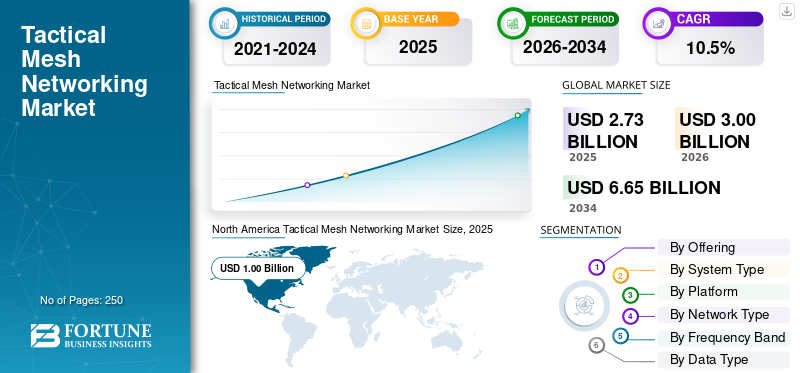
The global tactical mesh networking market size was valued at USD 2.73 billion in 2025. The market is projected to grow from USD 3.00 billion in 2026 to USD 6.65 billion by 2034, exhibiting a CAGR of 10.5% during the forecast period. North America dominated the tactical mesh networking market with a market share of 36.63% in 2025.
Tactical mesh networking represents a critical layer in modern military communications, enabling decentralized, self-forming, and self-healing connectivity among soldiers, vehicles, UAVs, sensors, command posts, and mission systems. The market is accelerating, driven by the need for resilient battlefield satellite communications, real-time situational awareness, distributed command-and-control, and reliable data exchange in contested, infrastructure-limited, and electronically disrupted environments.
The market is further driven by the growing integration of edge computing, which enables real‑time data processing directly at the network edge in mission‑critical operations. There is rising demand for resilient low latency connectivity in applications such as public safety and disaster management, where reliable communications must be maintained even under degraded or contested conditions.
Aerospace and defense firms such as L3Harris Technologies, Thales, Silvus Technologies, TrellisWare Technologies, and Rafael Advanced Defense Systems are advancing systems that support secure, mobile, and interoperable connectivity at the tactical edge. Key technical advances include software defined MANET waveforms for adaptive routing, multi-band radios for spectrum flexibility, and low-latency datalinks that support voice, video, telemetry, and position-location information.
Download Free sample to learn more about this report.
Tactical Mesh Networking Market Key Takeaways
 Global Market Size & Forecast
- 2025 Market Size: USD 2.73 billion
- 2026 Market Size: USD 3.00 billion
- 2034 Forecast Market Size: USD 6.65 billion
- CAGR: 10.5% from 2026–2034
 Market Share
- North America dominated the market with a 36.63% share, valued at USD 1.00 billion in 2025.
- Hardware segment held the largest market share in 2025.
- Joint commands/special mission users segment held the largest market share in 2025.
 Key Regional Highlights
North America
The market reached USD 1.00 billion in 2025, driven by tactical communications modernization and defense R&D.
Asia Pacific
The market is projected to witness the fastest growth, driven by military modernization and battlefield digitization.
Europe
The market is projected to grow at a 12.2% CAGR during 2026–2034, supported by NATO digitization and vehicle radio modernization.
U.S.
The market reached USD 0.93 billion in 2025, driven by tactical radio programs and command-and-control modernization.
Japan
The market reached USD 0.06 billion in 2025, supported by tactical radio upgrades and secure military communications.
Read More

TACTICAL MESH NETWORKING MARKET TRENDS
Shift Toward Standalone Tactical Radios to Software-Defined is Emerging as a Key Market Trend
The tactical mesh networking market is increasingly being shaped by the transition from standalone tactical radios to software-defined, multi-domain MANET architectures. Modern mesh networks are evolving into resilient battlefield data fabrics that connect soldiers, vehicles, UAVs, sensors, command posts, and joint mission systems in real time. This trend is pushing defense agencies and system providers to prioritize adaptive routing, open network architectures, software-upgradable waveforms, low-latency IP transport, embedded mesh modules, and gateway-based interoperability across legacy and next-generation networks communication systems.
- For instance, in April 2025, the U.S. Army established the Next Generation Command and Control program office under PEO C3N to accelerate the development of a more agile, mobile, and integrated command-and-control network architecture for tactical units.
This trend is expected to drive increased procurement of software-defined radios, MANET waveforms, tactical gateways, edge networking equipment, and network-management software. As militaries move toward joint all-domain operations, demand is shifting beyond hardware-only radio replacement toward integrated systems that can support high-bandwidth ISR video, blue-force tracking, autonomous platforms, rapid software updates, coalition interoperability, and secure battlefield data exchange.
MARKET DYNAMICS
MARKET DRIVERS
Download Free sample to learn more about this report.
Growing Need for Communications Solutions in Contested and Infrastructure-Denied Environments is Propelling Market Growth
The market is being driven by the increasing need for communication solutions that can operate in contested, mobile, and infrastructure-denied environments. Modern land and joint forces face increasing challenges from electronic warfare, spectrum congestion, GPS disruption, and cyber threats, and the operational need to exchange data rapidly across dispersed units. In this environments, tactical mesh networks offer a practical way to maintain connectivity when fixed infrastructure, satellite links, or centralized communication nodes are degraded or unavailable.
- For instance, in January 2025, the U.S. Army awarded L3Harris nearly USD 300 million in full-rate production orders for Manpack and Leader radios under the HMS program. The systems are intended to support resilient, mission critical communications from the tactical edge to the aerial tier in electronic-warfare environments.
The market is expected to gain momentum as defense forces modernize tactical radios, vehicle communication systems, UAV relay nodes, and soldier network equipment. Demand is particularly strong for systems that support voice, data, video, position-location information, sensor feeds, and command traffic over self-forming and self-healing networks.
MARKET RESTRAINTS
Connectivity Challenges in Contested Environments to Limit Market Expansion
A key restraint for the market is the difficulty of maintaining secure, high-throughput, and reliable connectivity in heavily contested operational environments. Tactical mesh networks depend on radio-frequency availability, routing stability, encryption performance, power management, and node density to sustain network performance. In modern military operations, these systems can be affected by jamming, spoofing, interception, spectrum crowding, terrain masking, urban obstruction, and adversary cyber activity. This increases the validation burden for radios, waveforms, antennas, encryption modules, gateways, and network-management tools.
The U.S. Department of Defense has identified rising strain on available spectrum for command, control, and communications as a major operational issue, which reinforces the challenges faced by military wireless networks in contested environments. As a result, procurement may be slowed by spectrum-clearance requirements, COMSEC certification, interoperability testing, cyber-hardening, anti-jam validation, export-control restrictions, and the need to prove performance under realistic electronic attack conditions. These factors are expected to limit rapid adoption in cost-sensitive markets and hamper tactical mesh networking market growth.
MARKET OPPORTUNITIES
Expansion of UAV, Robotic, and Sensor-to-Shooter Networks Presents Growth Opportunities for the Market
The tactical mesh networking market is expected to gain strong opportunities from the rapid expansion of UAV-enabled communications, robotic platforms, unattended sensors, mobile ISR systems, and sensor-to-shooter architectures. As military forces deploy increasing number of drones, loitering systems, ground robots, mobile sensors, and distributed command nodes, the requirement for compact, embedded, high-bandwidth mesh connectivity is increasing. This creates opportunities for MANET radio suppliers, waveform developers, embedded module providers, gateway manufacturers, UAV payload integrators, and tactical edge-networking companies.
- For instance, in May 2025, Motorola Solutions announced a USD 4.4 billion agreement to acquire Silvus Technologies, a provider of mission-critical mobile ad hoc network technology, to address growing defense, autonomous-system, drone, and secure high-bandwidth communication use cases.
The opportunity is especially strong for networking solutions systems that can be embedded directly into UAVs, UGVs, sensors, vehicle platforms, and portable mission kits. Defense organizations are increasingly looking for networks that can carry ISR video, telemetry, command data, target information, and blue-force tracking data without depending on fixed communication infrastructure.
MARKET CHALLENGES
Interoperability and Integration Complexity Hinders Market Development
A major challenge for the market is that mesh networks must operate within a broader, heterogeneous tactical communications environment rather than as standalone radio systems. Military users often field different generations of radios, waveforms, encryption standards, command systems, satellite links, LTE/5G bubbles, vehicle networks, coalition interfaces, and battlefield management systems. Connecting these systems into a seamless tactical network is difficult as vendor-specific interfaces, national security restrictions, spectrum policies, and legacy architectures can slow integration.
- For instance, in December 2024, Rheinmetall and KNDS received a USD 2.30 billion (EUR 1.98 billion) contract to digitize around 10,000 Bundeswehr vehicles with digital radio and command-and-control equipment under Germany’s D-LBO program. The initiative highlights the scale and complexity involved in integrating tactical communications across large legacy vehicle fleets.
NATO’s Federated Mission Networking framework shows why interoperability remains a persistent challenge for coalition operations. Future mission networks require agreed standards, governance, reusable capabilities, and trusted information-sharing mechanism across allied and partner forces. While these operational requirements create strong long-term demand for tactical networking solutions, they also increase deployment complexity.
Segmentation Analysis
By Offering
High Dependence on Radio, Gateways, and Rugged Routers Equipment to Support Hardware Segment Growth
Based on offering, the market is divided into hardware, software, and services.
The hardware segment is expected to hold a leading share in the market, as defense procurement programs remains heavily centered on radios, gateways, antennas, rugged routers, relay nodes, vehicle kits, and airborne communication equipment. Tactical mesh networks require a sizeable physical equipment layer before software-defined waveforms, routing tools, and mission applications can be deployed effectively at scale. As a result, demand for the product is supported by procurement of tactical mesh capability through physical radio and network equipment programs.
- For instance, in January 2025, the U.S. Army awarded L3Harris nearly USD 300 million in full-rate production orders for Manpack and Leader radios under the HMS program, supporting resilient communications from the tactical edge to the aerial tier.
The software segment is anticipated to rise with a fastest CAGR of 15.9% over the forecast period.
To know how our report can help streamline your business, Speak to Analyst
By System Type
Increasing Need for Battlefield Connectivity to Drive Vehicular Mesh Radios Segment Growth
By system type, the market is segmented into handheld mesh radios, manpack mesh radios, vehicular mesh radios, airborne/UAV mesh nodes, deployable relay nodes, tactical gateways, and embedded/OEM mesh modules.
The vehicular mesh radios segment is expected to dominate the market, as military ground vehicles increasingly function as mobile communication nodes for maneuver forces, artillery units, air defense formations, logistics convoys, and tactical command posts. Armored vehicles and tactical trucks provide the power, mounting space, antennas, and network capacity needed to support higher-performance mesh radios compared with dismounted systems. Demand for this segment is further supported by the need to connect soldiers, sensors, UAVs, headquarters, and weapon systems through vehicle-mounted network backbones.
- For instance, in December 2024, Rheinmetall and KNDS received a D-LBO contract to integrate digital radio and command-and-control equipment across around 10,000 Bundeswehr vehicles.
The airborne/UAV mesh nodes segment is poised to register the fastest CAGR of 13.7% over the forecast period.
By Platform
Armored Formation Connectivity and Mobile Battlefield Networking to Support Ground Vehicles Segment Growth
On basis of platform, the market is segmented into dismounted soldier, ground vehicles, UAVs/ airborne platforms, UGVs/robotic platforms, fixed/deployable command posts, and maritime/ littoral platforms.
The ground vehicles segment is expected to hold a leading share of the tactical mesh networking market, as military organizations increasingly prioritize mobile connectivity across armored formations, tactical trucks, reconnaissance vehicles, artillery platforms, and command vehicles. Ground platforms are central to battlefield networking as they connect dismounted teams, mobile headquarters, sensors, and airborne assets while operating across dispersed terrain. The segment is further supported by the modernization of vehicle fleets to enable real-time situational awareness, convoy coordination, and sensor-to-shooter connectivity.
- For instance, in October 2025, the U.S. Army selected Persistent Systems’ Wave Relay MANET as the network foundation for its Next Generation Command and Control prototype. The initiate included an initial order valued at USD 34 million order to outfit tactical units with mobile networking devices.
The UAVs/airborne platforms segment is projected to grow at a CAGR of 13.2% over the forecast period.
By Network Type
Enhanced Battlefield Connectivity for Mechanized Forces to Support Vehicle-Level Mesh Network Segment Growth
By network type, the market is segmented into soldier-level mesh network, vehicle-level mesh network, air-ground mesh network, sensor-to-shooter mesh network, command-post mesh network, and multi-domain tactical mesh network.
The vehicle-level mesh network segment is expected to dominate the market, as military vehicles serve as a high-capacity relay and routing nodes within tactical formations. These networks allow moving units to exchange voice, data, video, blue-force tracking, and command information without depending entirely on fixed infrastructure or centralized communication hubs. Vehicle-level mesh is especially important for mechanized and armored forces, as it provides mobile network continuity between headquarters, combat platforms, sensors, and dismounted users.
- For instance, in February 2025, Rheinmetall received a TaWAN LBO contract to build an integrated tactical wide-area communication network for the Bundeswehr. The program is intended to support end-to-end land-force command capabilities and high-data-rate connectivity.
The multi-domain tactical mesh network segment is projected to grow at a CAGR of 14.3% over the forecast period.
By Frequency Band
Legacy Interoperability and Line-of-Sight Battlefield Networking Needs to Support VHF/UHF Band Segment Growth
By frequency band, the market is segmented into VHF/UHF band, L-Band, S-band, C-band, and multi-band mesh systems.
The VHF/UHF band segment is expected to hold a leading share of the market, as these bands remain essential for tactical voice, legacy interoperability, dismounted communication, vehicle radios, and line-of-sight battlefield networking. Many armed forces continue to depend on VHF/UHF-capable radios as they support established waveforms, wide range, and compatibility with existing tactical radio fleets. The segment is supported by the procurement of multiband tactical radios that retain VHF/UHF functionality while adding MANET and advanced waveform capabilities.
- For instance, in 2025, the Philippine Army approved a procurement contract for VHF/UHF MANET handheld radios and VHF/UHF MANET base radios, supporting tactical voice and data communications across legacy-compatible frequency bands.
The multi-band mesh systems segment is poised to register the fastest CAGR of 12.5% over the forecast period.
By Data Type
Rising Requirement for Mission-Critical Battlefield Communications to Sustain Voice Communication Segment Growth
On the basis of data type, the market is divided into voice communication, position location information/blue-force tracking, data & messaging, video & ISR data, and telemetry & control data.
The voice communication segment is expected to hold a leading share, as voice remains the most immediate and mission-critical form of battlefield communication for commanders, soldiers, vehicle crews, and special mission teams. Demand is supported by modern MANET waveforms that allow voice to operate alongside data, video, and position-location information within the same tactical network.
- For instance, in October 2025, Silvus Technologies, a Motorola Solutions company, launched StreamCaster NEXUS, a chest-mounted tactical networking system designed for dismounted military operators. The platforms support mission-critical voice, high-fidelity video, and IP data at the tactical edge.
The video & ISR data segment is poised to register the fastest CAGR of 12.6% over the forecast period.
By Application
Rising Military Modernization Programs to Support Command & Control Segment Growth
By application, the market is divided into command & control, situational awareness, ISR video & data sharing, UAV/robotics connectivity, sensor-to-shooter connectivity, convoy & mobile force communications, disaster response/public safety tactical networking, and electronic warfare-resilient communications.
The command & control segment is expected to dominate the market, as tactical mesh networks are increasingly used to support faster decision-making, mobile command posts, distributed maneuver, and resilient information exchange across battlefield units. The segment is further supported by modernization programs focused on agile, integrated, and data-centric battlefield command architectures.
- For instance, in April 2025, the U.S. Army established the Next Generation Command and Control program office under PEO C3N to accelerate a mobile, integrated command-and-control network architecture for tactical formations.
The UAV/robotics connectivity segment is designed to register the fastest CAGR of 14.1% over the forecast period.
By End User
Increasing Use of UAVs for Special Mission Operations to Drive Joint Commands/Special Mission Users Segment Growth
Basis of end user, the market is divided into air force, navy/naval aviation, defense R&D/test agencies, marine/expeditionary forces, and joint commands/special mission users.
The joint commands/special mission users segment is expected to hold a leading tactical mesh networking market share, as these organizations require compact, rapidly deployable, secure, and infrastructure-light communication networks for high-risk and fast-moving operations. Demand is also supported by the increasing use of UAVs, robotic systems, ISR feeds, and multi-domain mission coordination in special operations and joint task-force environments.
- For instance, in April 2025, Persistent Systems was selected by the Joint Program Executive Office for Chemical, Biological, Radiological and Nuclear Defense to use Wave Relay MANET as the data link connecting dismounted reconnaissance sensors and operators for real-time threat detection.
The air force segment is expected to register the fastest CAGR of 11.1% over the forecast period.
Tactical Mesh Networking Market Regional Outlook
By geography, the market is segmented into North America, Europe, Asia Pacific, Latin America, and the Middle East & Africa.
North America
North America Tactical Mesh Networking Market Size, 2025 (USD Billion)
To get more information on the regional analysis of this market, Download Free sample
North America dominated the market in 2025 with a valuation of USD 1.00 billion. The market is expected to reach USD 1.08 billion in 2026. North America is expected to remain the largest regional market, primarily driven by the U.S. military’s mature tactical communications base, active MANET radio procurement, strong defense R&D funding, and the shift toward mobile, resilient, software-defined command networks. Market growth is supported by the need to maintain secure connectivity across soldiers, vehicles, UAVs, sensors, command posts, and joint mission systems in contested electromagnetic environments. The region is also benefiting from the U.S. focus on Next Generation Command and Control, tactical edge networking, air-ground communications, and resilient datalinks for combined joint all-domain operations.
- For instance, in January 2025, the U.S. Army awarded L3Harris nearly USD 300 million in full-rate production orders for Manpack and Leader radios under the HMS program, supporting resilient communications from the tactical edge to the aerial tier in electronic-warfare environments.
U.S. Tactical Mesh Networking Market
Based on North America’s strong contribution and the U.S. dominance within the region, the U.S. market can be approximated at around USD 0.93 billion in 2025. The U.S. is expected to remain the largest country-level market due to its dedicated tactical radio programs, advanced MANET supplier ecosystem, large land-force modernization requirement, and increasing focus on agile command-and-control architectures. Growth is supported by the need to connect maneuver units, air-ground platforms, tactical sensors, autonomous systems, and dispersed command nodes through secure, self-forming networks.
- For instance, in April 2025, the U.S. Army established the Next Generation Command and Control program office under PEO C3N to accelerate a more agile, mobile, and integrated command-and-control network architecture for tactical units.
Europe
Europe is projected to record a fastest growth rate of 12.2% from 2026 to 2034. Market growth is supported by NATO land-force digitization, post-2022 battlefield lessons, electronic-warfare resilience requirements, vehicle radio modernization, and the need for interoperable coalition communication networks. The region is moving from fragmented legacy radio fleets toward increasing investments in secure, IP-based tactical networks that can connect platforms, soldiers, sensors, and command systems in real time. Growth is especially visible in Germany, the U.K., France, Poland, the Nordics, and other NATO-aligned markets where tactical mesh networking is becoming a core part of land-force modernization and high-readiness force development.
- For instance, in December 2024, Rheinmetall and KNDS received a USD 2.30 billion gross D-LBO contract to equip around 10,000 Bundeswehr vehicles with digital radio and command-and-control systems, enabling real-time interconnection of platforms, soldiers, and sensors.
U.K. Tactical Mesh Networking Market
The U.K.’s market in 2025 reached around USD 0.17 billion, representing roughly 6.3% of global revenues.
Germany Tactical Mesh Networking Market
Germany’s market reached approximately USD 0.15 billion in 2025, equivalent to around 5.3% of global sales.
Asia Pacific
Asia Pacific is projected to witness the fastest growth during the forecast period, owing to rising border-security requirements, Indo-Pacific military modernization, UAV and ISR network demand, island-defense requirements, and increasing adoption of indigenous SDR/MANET technologies. China, India, Japan, South Korea, Australia, Singapore, and Taiwan are expected to support long-term demand through tactical radio upgrades, battlefield digitization, mobile C2 modernization, and secure voice/data/video connectivity.
- For instance, in October 2025, DRDO released Indian Radio Software Architecture standard 1.0 to enable interoperability in military communications, providing a software specification for SDRs covering standardized interfaces, APIs, waveform portability, certification, and conformance.
Japan Tactical Mesh Networking Market
The Japanese market in 2025 stood at around USD 0.06 billion, accounting for roughly 2.3% of global revenues.
China Tactical Mesh Networking Market
China’s market is projected to be one of the largest worldwide, with 2025 revenues standing at around USD 0.24 billion representing roughly 8.8% of global sales.
India Tactical Mesh Networking Market
The Indian market in 2025 stood at around USD 0.12 billion, accounting for roughly 4.4% of global revenues.
Latin America and Middle East & Africa
Latin America represents a smaller but gradually developing market. Regional demand remains concentrated around border security, internal security, mobile command posts, tactical communications modernization, and selective military digitization rather than large-scale MANET deployment. Brazil is expected to remain the largest Latin American opportunity due to its stronger defense-industrial base and SISFRON border-monitoring program, while Mexico and the rest of Latin America are expected to grow steadily.
Brazil Tactical Mesh Networking Market
Brazil market in 2025 stood at around USD 0.04 billion, accounting for roughly 1.5% of global revenues.
The Middle East & Africa region is expected to show stronger long-term potential than Latin America, primarily due to high defense spending in Gulf markets, Israeli battlefield communications expertise, border-security requirements, and growing demand for UAV, mobile C2, and special mission networking. Saudi Arabia, the UAE, and Israel are expected to remain the key regional markets, supported by software-defined radio localization, advanced tactical communications, and resilient battlefield network requirements.
Saudi Arabia Tactical Mesh Networking Market
Saudi Arabia market in 2025 stood at around USD 0.07 billion, accounting for roughly 2.6% of global revenues.
COMPETITIVE LANDSCAPE
Major Players Focus on Building Battlefield Communication Ecosystems to Gain Competitive Edge
The global tactical mesh networking market is characterized by competition among tactical radio manufacturers, MANET waveform developers, rugged networking providers, defense electronics companies, tactical gateway suppliers, and mission-system integrators that are building resilient battlefield communication ecosystems. Competitive leadership is increasingly shaped by companies that can combine secure software-defined radios, scalable MANET waveforms, low-latency voice/data/video transport, multi-band operation, embedded mesh modules, tactical gateways, encryption, and network-management tools into a single deployable offering. The market is moving beyond conventional combat-net radio replacement toward software-defined, self-forming, and self-healing tactical networks that connect soldiers, vehicles, UAVs, sensors, command posts, and joint mission systems.
LIST OF KEY TACTICAL MESH NETWORKING COMPANIES PROFILED
- L3Harris Technologies, Inc. (U.S.)
- Motorola Solutions, Inc. / Silvus Technologies (U.S.)
- Persistent Systems, LLC (U.S.)
- TrellisWare Technologies, Inc. (U.S.)
- Thales Group (France)
- Rafael Advanced Defense Systems Ltd. (Israel)
- Elbit Systems Ltd. (Israel)
- Bittium Corporation (Finland)
- Rohde & Schwarz GmbH & Co. KG (Germany)
- ASELSAN A.Ş. (Türkiye)
KEY INDUSTRY DEVELOPMENTS
- March 2026: The U.K. Ministry of Defence selected Persistent Systems’ Wave Relay MANET, including the MPU5 tactical communication system, for Project CAIN modernization, supporting the British Army’s 16 Air Assault Brigade Combat Team with resilient edge-to-cloud tactical connectivity.
- February 2026: The U.S. Army awarded Persistent Systems a follow-on USD 87.5 million order for MANET devices to support the transport layer of the Next Generation Command and Control prototype, bringing total NGC2 prototype awards to Persistent to USD 121.5 million.
- January 2026: Silvus Technologies, a Motorola Solutions company, launched the StreamCaster MINI 5200, an ultra-compact tactical MANET radio designed to provide secure voice, video, and data connectivity for ground forces without dedicated infrastructure.
- October 2025: The Indian Army signed a contract to procure its first indigenously designed and manufactured Software Defined Radios, developed by DRDO and produced by Bharat Electronics Limited, with high-data-rate and MANET capabilities for secure real-time battlefield communication.
- February 2025: Rheinmetall received the TaWAN LBO contract to establish the Bundeswehr’s future tactical wide-area network for land-based operations, with an initial USD 1.28 billion order to support deployable, interference-resistant tactical communications.
- January 2025: The U.S. Army awarded L3Harris nearly USD 300 million in full-rate Manpack and Leader radio production orders under the HMS program, supporting resilient tactical communications from the edge to the aerial tier.
Request for Customization to gain extensive market insights.
Report Scope & Segmentation
| ATTRIBUTE | DETAILS |
| Study Period | 2021-2034 |
| Base Year | 2025 |
| Estimated Year | 2026 |
| Forecast Period | 2026-2034 |
| Historical Period | 2021-2024 |
| Growth Rate | CAGR of 10.5% from 2026-2034 |
| Unit | Value (USD Billion) |
| Segmentation | By Platform, System type, Offering, Network Type, Frequency Band, Data type, Application, By End User , and Region |
| By Offering |
|
| By System Type |
|
| By Platform |
|
| By Network Type |
|
| By Frequency Band |
|
| By Data Type |
|
| By Application |
|
| By End User |
|
| By Geography |
|
Frequently Asked Questions
According to Fortune Business Insights, the global market value stood at USD 2.73 billion in 2025 and is projected to reach USD 6.65 billion by 2034.
In 2025, the market value stood at USD 1.00 billion.
The market is expected to exhibit a CAGR of 10.5% during the forecast period.
By system type, the vehicular mesh radios segment is expected to lead the market.
Rising demand for communications solutions in contested and infrastructure-denied environments is a key factor driving the market.
L3Harris Technologies, Inc. Motorola Solutions, Inc./Silvus Technologies, and Persistent Systems, LLC are some of the major players in the global market.
North America dominated the market in 2025.



- 2021-2034
- 2025
- 2021-2024
- 250
Get 30-60 hrs Free Customization
Expand Regional and Country Coverage, Segments Analysis, Company Profiles, Competitive Benchmarking, and End-user Insights.




















Related Reports
-
US +1 833 909 2966 ( Toll Free )
-
Get In Touch With Us