Thermodilution Catheter Market Size, Share & Industry Analysis, By Material (Polyurethane, PVC, Silicone, and Others), By Application (Hemodynamic Monitoring, Cardiac Output Measurement, Critical Care & Shock Management, and Others), By End-user (Hospitals & ASCs, Specialty Clinics, and Others), and Regional Forecast, 2026-2034
 Download Free Sample
Thermodilution Catheter Market Size and Future Outlook
 Listen to Audio Version
The global thermodilution catheter market size was valued at USD 629.1 million in 2025. The market is projected to grow from USD 659.9 million in 2026 to USD 1,019.4 million by 2034, exhibiting a CAGR of 5.6% during the forecast period. North America dominated the thermodilution catheter market with a market share of 36.85% in 2025.
Thermodilution catheters are specialized medical tubes inserted into patients' blood vessels to measure heart function and blood flow during critical care and surgical procedures. These devices help doctors monitor how well a patient's heart is pumping blood, which is crucial for managing seriously ill patients in intensive care units and operating rooms. The growth of the global market is driven by the rising number of heart-related surgeries and the increasing preference for minimally invasive medical procedures that require precise monitoring. In addition, market players are continuously improving these catheters with advanced materials and technologies, making them safer and more effective, which encourages more healthcare facilities to adopt them for patient care.
- For instance, in March 2022, Cathi Distribution GmbH announced the launch of its new catheter which enables thermodilution capabilities.
Furthermore, many key industry players, such as BD, Teleflex Incorporated, ICU Medical, Inc., Edwards Lifesciences Corporation, and Getinge AB operating in the market, are focusing on developing various innovative technologies to offer better products with improved accuracy and efficiency.
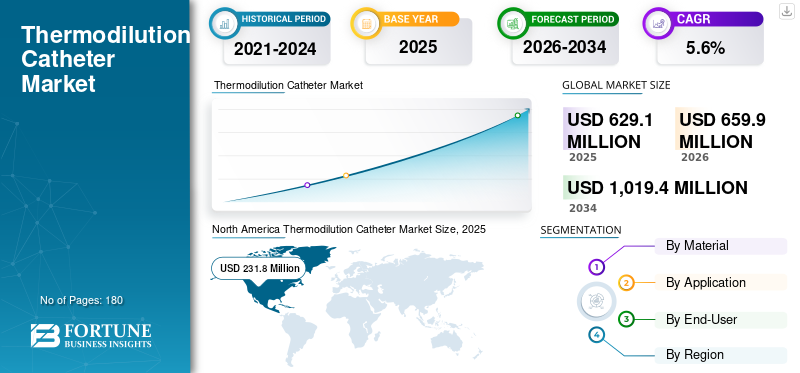
Download Free sample to learn more about this report.
Thermodilution Catheter Market Key Takeaways
 Global Market Size & Forecast
- 2025 Market Size: USD 629.1 million
- 2026 Market Size: USD 659.9 million
- 2034 Forecast Market Size: USD 1,019.4 million
- CAGR: 5.6% from 2026–2034
 Market Share
- North America dominated the thermodilution catheter market with a 36.85% share in 2025.
- Polyurethane material segment held the leading market position due to superior safety and durability.
- Hemodynamic monitoring segment dominated the market in 2025, driven by critical heart monitoring demand.
 Key Regional Highlights
North America
North America dominated with USD 231.8 million market size in 2025.
Europe
Europe is expected to reach USD 179.5 million by 2026.
Asia Pacific
Asia Pacific is projected to reach USD 178.3 million by 2026.
U.S.
Market estimated at USD 206.9 million in 2026 with 31.3% global share.
Japan
Market projected at USD 30.9 million in 2026 with 4.7% global share.
Read More

THERMODILUTION CATHETER MARKET TRENDS
Rapid Shift from Traditional to Advanced Digital Monitoring Systems is a Key Trend
A notable trend reshaping the market is the transition from conventional monitoring approaches to sophisticated digital platforms with enhanced capabilities. Healthcare providers are moving away from basic measurement devices toward integrated systems that offer continuous monitoring, automated data analysis, and wireless connectivity. Moreover, hospitals are also heavily investing in compact, user-friendly systems that provide more accurate readings, reduce the risk of complications, and integrate with existing hospital information systems.
MARKET DYNAMICS
MARKET DRIVERS
Download Free sample to learn more about this report.
Growing Number of Heart Surgeries and Critical Care Patients Fuels Market Demand
Substantial rise in the number of cardiovascular surgeries and the growing number of patients requiring intensive monitoring in hospitals is prominently driving the global thermodilution catheter market growth. As heart disease remains one of the leading causes of death globally, more people are undergoing complex heart procedures that require continuous monitoring of cardiac function.
- For instance, in June 2021, an estimated 236 million adults worldwide were suffering from peripheral artery disease.
MARKET RESTRAINTS
High Costs and Budget Constraints Limit Market Growth
A significant challenge facing the market is the substantial upfront cost of advanced catheter systems and the supporting infrastructure required to use them effectively. Many mid-sized hospitals and outpatient surgery centers struggle to justify the investment in premium monitoring systems when they can extend the life of their existing equipment or purchase refurbished devices at lower prices. Additionally, in cost-conscious healthcare markets, especially in developing regions, hospitals often prioritize basic equipment over advanced monitoring systems, which delays the replacement of older technology and limits market expansion despite the clear clinical benefits of newer systems.
MARKET OPPORTUNITIES
Rising Demand for AI-Powered Smart Monitoring Systems Create Market Opportunities
The growing interest in intelligent, AI-enabled monitoring systems presents a significant opportunity for the market. Healthcare facilities are increasingly witnessing beyond basic measurement tools to comprehensive systems that can analyze data, predict complications, and guide treatment decisions automatically. In addition, modern healthcare providers want systems that integrate seamlessly with electronic medical records, provide real-time alerts about patient conditions, and help standardize treatment protocols across different departments. This creates opportunities for manufacturers who can combine thermodilution technology with artificial intelligence, machine learning algorithms, and cloud-based analytics to deliver next-generation monitoring solutions that improve both patient outcomes and hospital efficiency.
MARKET CHALLENGES
Staffing Shortages and Training Requirements Pose Implementation Barriers
Despite strong technological innovation, healthcare providers face significant challenges around staffing, training, and effectively using advanced thermodilution catheter systems. These sophisticated devices require skilled nurses, technicians, and doctors who can properly insert the catheters, interpret the monitoring data, and make appropriate clinical decisions based on the readings. In environments already affected by widespread healthcare workforce shortages, finding and retaining qualified staff becomes difficult. Training programs are time-consuming and expensive, requiring hospitals to invest in continuous education to keep pace with evolving technology. Additionally, the learning curve for new systems can temporarily disrupt workflows and potentially compromise patient care if staff members are not adequately prepared. These implementation barriers often slow adoption rates and limit the full utilization of advanced monitoring capabilities, particularly in smaller facilities with limited resources for ongoing staff development and technical support.
Segmentation Analysis
By Material
Superior Safety and Durability of Polyurethane to Drive Segment Growth
Based on the material, the market is divided into polyurethane, PVC, silicone, and others.
Polyurethane thermodilution catheters command the largest market share due to their exceptional combination of safety, durability, and clinical performance that makes them the preferred choice for healthcare providers. Moreover, unlike older materials, polyurethane offers excellent mechanical strength and flexibility, allowing catheters to navigate through blood vessels more easily while resisting kinking or breaking during insertion and use. In addition, polyurethane catheters maintain their structural integrity over longer periods, which is essential for patients requiring continuous monitoring for days or weeks.
The silicone segment is anticipated to rise with a CAGR of 5.8% over the forecast period.
To know how our report can help streamline your business, Speak to Analyst
By Application
Increasing Demand for Critical Heart Monitoring to Boost Hemodynamic Monitoring Segment Growth
Based on application, the market is segmented into hemodynamic monitoring, cardiac output measurement, critical care & shock management, and others.
In 2025, hemodynamic monitoring dominated the global market. Certain factors such as the need for critical heart care medicine, comprehensive analysis of a patient's cardiovascular system, and technological developments are responsible for segment growth. Thermodilution catheters provide this essential data that cannot be obtained through non-invasive methods. This application is particularly vital in intensive care units where critically ill patients require constant monitoring to guide fluid administration, medication adjustments, and other life-saving interventions.
The critical care & shock management segment is anticipated to rise with a CAGR of 6.4% over the forecast period.
By End-User
Higher Volume of Cardiac Surgeries in Hospitals & ASCs to Boost Segment Growth
Based on end-user, the market is segmented into hospitals & ASCs, specialty clinics, and others.
In 2025, hospitals and Ambulatory Surgical Centers (ASCs) account for the largest thermodilution catheter market share as these facilities perform the vast majority of surgical procedures and manage the most critically ill patients who require intensive monitoring. Hospitals, particularly large medical centers and specialized cardiac facilities, have the necessary infrastructure, trained staff, and patient volume to justify investment in advanced monitoring equipment. Also, ambulatory surgical centers, which have grown significantly in recent years, perform an increasing number of cardiac and vascular procedures that benefit from precise hemodynamic monitoring. Furthermore, the segment is set to hold 61.8% share in 2026.
In addition, the specialty clinics segment is projected to grow at a CAGR of 6.2% during the study period.
Thermodilution Catheter Market Regional Outlook
By region, the market is categorized into Europe, North America, Asia Pacific, Latin America, and the Middle East & Africa.
North America
North America Thermodilution Catheter Market Size, 2025 (USD Million)
To get more information on the regional analysis of this market, Download Free sample
North America held the dominant share in 2024, valuing at USD 221.8 million, and also maintained the leading share in 2025, with USD 231.8 million. The market in North America is expected to increase due to higher emphasis on minimally invasive surgeries, rising incidence of cardiac conditions, and development in thermodilution-based catheters.
U.S. Thermodilution Catheter Market
Based on North America’s strong contribution, the U.S. market can be analytically approximated at around USD 206.9 million in 2026, accounting for roughly 31.3% of global sales.
Europe
Europe is projected to record a growth rate of 5.0% in the coming years, and reach a valuation of USD 179.5 million by 2026. The region's expansion is attributed to the presence of major medical device manufacturers in countries such as Germany, the U.K., and France, along with well-developed healthcare systems that prioritize patient safety and quality care.
U.K. Thermodilution Catheter Market
The U.K. market in 2026 is estimated at around USD 29.1 million, representing roughly 4.4% of global revenues.
Germany Thermodilution Catheter Market
Germany’s market is projected to reach approximately USD 40.4 million in 2026, equivalent to around 6.1% of global sales.
Asia Pacific
Asia Pacific is estimated to reach USD 178.3 million in 2026 and secure the position of the third-largest region in the market. Improving healthcare infrastructure coupled with favorable reimbursement policies, and rising prevalence of chronic cardiac conditions are estimated to accelerate regional growth.
Japan Thermodilution Catheter Market
Japan’s market in 2026 is estimated at around USD 30.9 million, accounting for roughly 4.7% of global revenues.
China Thermodilution Catheter Market
China’s market is projected to be one of the largest worldwide, with 2026 revenues estimated at around USD 59.2 million, representing roughly 9.0% of global sales.
India Thermodilution Catheter Market
India’s market in 2026 is estimated at around USD 39.6 million, accounting for roughly 6.0% of global revenues.
Latin America and Middle East & Africa
Latin America and the Middle East & Africa regions are expected to witness moderate growth during the forecast period. The Latin America market is set to reach a valuation of USD 34.9 million in 2026. The rising risk of cardiovascular conditions coupled with expansion of healthcare infrastructure in Latin America is expected to accelerate market growth. Also, strategic partnerships in the Middle East and emphasis on minimally invasive procedures is estimated to have positive impact on the market growth. Further, in the Middle East & Africa, the GCC is set to reach a value of USD 9.2 million in 2026.
South Africa Thermodilution Catheter Market
The South Africa market is projected to reach around USD 3.8 million in 2026, representing roughly 0.57% of global revenues.
COMPETITIVE LANDSCAPE
Key Industry Players
Rising Collaborations and Increasing Investments by Major Players Drive Technological Upgradation to Boost Market Growth
The global thermodilution catheter market exhibits a semi-consolidated structure, with major companies such as BD, Teleflex Incorporated, ICU Medical, Inc., Edwards Lifesciences Corporation, and Getinge AB holding strong positions. Their substantial market presence is driven by various strategic initiatives, including massive investments and product approvals.
- In July 2025, Teleflex Incorporated completed the acquisition of Biotronik’s vascular intervention business.
Other key participants in the market are Cook, Argon Medical Devices, Inc., Lepu Medical Technology (Beijing) Co., Ltd., SCW Medicath Ltd., and B. Braun Melsungen AG. These companies are likely to focus on partnerships and collaborations in order to strengthen their market position over the forecast period.
LIST OF KEY THERMODILUTION CATHETER COMPANIES PROFILED
- BD (U.S.)
- Teleflex Incorporated (U.S.)
- ICU Medical, Inc. (U.S.)
- Edwards Lifesciences Corporation (U.S.)
- Getinge AB (Sweden)
- Cook Medical (U.S.)
- Argon Medical Devices, Inc. (U.S.)
- Lepu Medical Technology (Beijing) Co., Ltd. (China)
- SCW Medicath Ltd. (China)
- Braun Melsungen AG (Germany)
KEY INDUSTRY DEVELOPMENTS
- April 2025: BD announced the launch of its new system called HemoSphere Alta. It is an advanced hemodynamic monitoring platform which incorporates predictive artificial intelligence.
- December 2024: Liquet Medical received FDA clearance for its Versus catheter, designed to treat pulmonary artery blood clots using real-time pulmonary artery pressure monitoring.
- September 2024: BD announced acquisition of critical care business from Edward Lifesciences Inc.
- May 2022: Endotronix announced positive results from the SIRONA 2 clinical trial, where its Cordella pulmonary artery pressure sensor system met all primary safety and efficacy endpoints in NYHA class III heart failure patients.
- September 2021: Caretaker Medical received FDA approval for its new wireless hemodynamics monitoring and blood pressure platform.
REPORT COVERAGE
The global thermodilution catheter market analysis includes a comprehensive study of the market size & forecast by all the market segments included in the report. It includes details on the market dynamics and market trends expected to drive the market over the forecast period. It provides information on key aspects, including an overview of technological advancements, the regulatory environment, and product launches. Additionally, it details partnerships, mergers & acquisitions, as well as key industry developments and investments by key regions. The global market research report also provides a depth competitive landscape with information on the market share and profiles of key operating players.
Request for Customization to gain extensive market insights.
Report Scope & Segmentation
| ATTRIBUTE | DETAILS |
| Study Period | 2021-2034 |
| Base Year | 2025 |
| Estimated Year | 2026 |
| Forecast Period | 2026-2034 |
| Historical Period | 2021-2024 |
| Growth Rate | CAGR of 5.6% from 2026-2034 |
| Unit | Value (USD Million) |
| Segmentation | By Material, Application, End-User, and Region |
| By Material |
|
| By Application |
|
| By End-User |
|
| By Region |
|
Frequently Asked Questions
According to Fortune Business Insights, the global market value stood at USD 629.1 million in 2025 and is projected to reach USD 1,019.4 million by 2034.
In 2025, the market value stood at USD 231.8 million.
The market is expected to exhibit a CAGR of 5.6% during the forecast period.
By material, the polyurethane segment is expected to lead the market.
The growing number of heart surgeries and critical care patients coupled with rising prevalence of heart conditions are driving market expansion.
BD, Teleflex Incorporated, ICU Medical, Inc., Edwards Lifesciences Corporation, and Getinge AB are the major players in the global market.
North America dominated the market in 2025.



- 2021-2034
- 2025
- 2021-2024
- 180
Get 30-60 hrs Free Customization
Expand Regional and Country Coverage, Segments Analysis, Company Profiles, Competitive Benchmarking, and End-user Insights.













.webp)






Related Reports
-
US +1 833 909 2966 ( Toll Free )
-
Get In Touch With Us