Tunnel Automation Market Size, Share & Industry Analysis, By Component (Lighting & Power Supply Systems, HVAC, Signalization & Control Systems, Monitoring & Surveillance Systems, Communication Systems, Fire Detection & Safety Systems, and SCADA & Integrated Control Systems), By Offering (Hardware, Software, and Services), By Tunnel Type (Roadways and Highways, Railways and Metros, and more), and Regional Forecast, 2026 – 2034
 Download Free Sample
Tunnel Automation Market Size and Future Outlook
 Listen to Audio Version
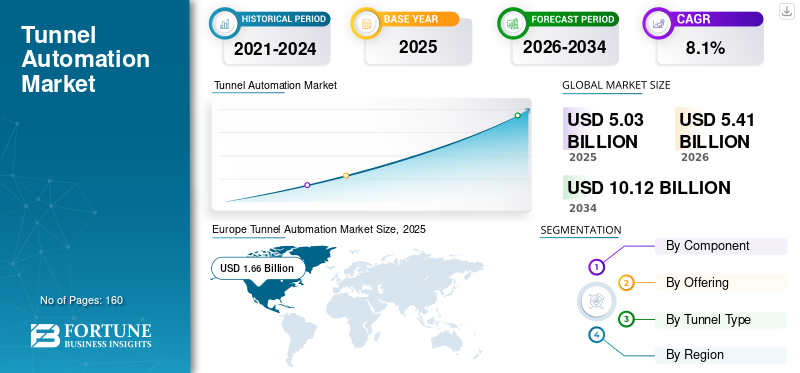
The global tunnel automation market size was valued at USD 5.03 billion in 2025 and demand is projected to grow from USD 5.41 billion in 2026 to USD 10.12 billion by 2034, exhibiting a CAGR of 8.1% during the forecast period. Asia pacific dominated the equipment monitoring market with a market share of 32.52% in 2025.
Increasing investment in transportation infrastructure projects, stricter tunnel safety requirements, and the growing use of intelligent transportation technologies are supporting the market’s growth. As governments expand metro rail networks and upgrade aging tunnel assets, demand for advanced real time monitoring, control, and safety solutions continues to rise. Transportation authorities are increasingly adopting centralized tunnel management systems to improve traffic flow, strengthen operational reliability, and enhance emergency preparedness. The deployment of integrated technologies such as SCADA for tunnel automation platforms, intelligent incident detection, intelligent video surveillance, automated ventilation management, and predictive maintenance tools is further accelerating adoption across both new and existing tunnel projects.
- For instance, in December 2025, the ongoing Colombia’s Toyo Tunnel development received an investment exceeding USD 710 million from national, regional, and municipal authorities. It is 9.7 kilometers long and is one of the many tunnels in the transportation network, which comprises 39 tunnels and 43 bridges. Technologies related to monitoring and automation of traffic management were utilized for the construction of this tunnel, as well as other advanced tunnel safety devices.
Leading companies including Siemens AG, ABB Ltd., Honeywell International Inc., Johnson Controls International plc, and Kapsch TrafficCom AG continue to strengthen their presence through investments in end-to-end tunnel management solutions. Industry participants are expanding capabilities across traffic monitoring, ventilation control, lighting automation, communication networks, and emergency response systems to address the growing need for safer and more connected tunnel infrastructure. At the same time, increasing adoption of data analytics, digital twins, remote monitoring platforms, and cybersecurity-focused solutions is helping operators improve system reliability and asset performance. Collaborations with transportation agencies, infrastructure developers, and technology partners remain central to securing large-scale tunnel modernization and new construction projects.
Download Free sample to learn more about this report.
Tunnel Automation Market Key Takeaways
 Global Market Size & Forecast
- 2025 Market Size: USD 5.03 billion
- 2026 Market Size: USD 5.41 billion
- 2034 Forecast Market Size: USD 10.12 billion
- CAGR: 8.1% (2026–2034)
 Market Share
- Asia Pacific dominated the market with a 32.52% share in 2025.
- The SCADA & integrated control systems segment is projected to register the fastest growth during the forecast period.
- The roadways & highways segment held the largest market share.
 Key Regional Highlights
Asia Pacific
Asia Pacific is projected to register the fastest growth at a 9.8% CAGR during the forecast period.
North America
North America is projected to experience steady growth, supported by rising investments in tunnel renovation projects, intelligent transportation systems.
Europe
Europe is expected to witness steady growth, driven by stringent tunnel safety regulations, extensive tunnel infrastructure.
U.S.
U.S. market is expected to witness steady growth, driven by highway and transit tunnel modernization, intelligent traffic management systems.
Japan
Japan market is projected to witness steady growth during the forecast period.
Read More

TUNNEL AUTOMATION MARKET TRENDS
Smart Tunnel Infrastructure Investments to Drive Market Growth across Emerging Economies
There have been increased efforts by governments and transport authorities to ensure that they increase mobility, set higher standards on safety, and improve the effectiveness of transport corridors. Today, tunnels have been provided with smart traffic controlling, heating ventilation and air conditioning, ventilation control software, automation devices, surveillance systems, and control centers that allow them to make decisions in real time.
On the other hand, roadways, highways, metros, and railways are receiving increased investments, resulting in a rising demand for automation equipment that can provide higher efficiencies and reduce the risk of accidents and malfunctions. Connected infrastructure, efficient routes, and reliable asset management have been key factors in the application of tunnel automation, creating a wealth of opportunities in industry.
- In February 2026, The Indian government approved the country's first underwater road-rail tunnel project, taking a significant step in urban and coastal infrastructure development. The decision shows a shift toward integrated transport corridors that combine road and rail modes to enhance connectivity and resilience.
MARKET DYNAMICS
MARKET DRIVERS
Download Free sample to learn more about this report.
Increasing Deployment of AI-Enabled Tunnel Management Systems to Accelerate Market Growth
Intelligent management of tunnels is essential considering the rising trend of increased requirements for improved visibility, faster response times, and better management inside the tunnels. Managers use intelligent management solutions which help them in automatically detecting occurrences, intelligent monitoring, centralizing SCADA systems and ventilation which helps in improving safety without relying on manual processes. Information can be provided continuously about traffic flow, environment and any other event. This has been caused due to the increased focus of the government authorities toward developing the transportation system.
- In January 2026, NTT and Nishimatsu Construction successfully achieved an ultra-remote operation of tunnel construction equipment over 200 kilometers away through the utilization of APN and 5G technology. Communication lag was minimized to under 100 milliseconds which helped in improving safety and visibility of tunnel construction work.
MARKET RESTRAINTS
High Modernization Costs and Legacy Infrastructure Constraints to Limit Market Expansion
Most tunnel construction that exists today was done prior to the widespread use of automation and digital systems. Modernization of these tunnels is likely to entail many changes within the existing electric and communication network and therefore would be expensive and complicated. There is also the potential problem of integrating the new automation system into an existing infrastructure that could lead to increased complication in these endeavors.
MARKET OPPORTUNITIES
AI, Robotics, and Autonomous Inspection Technologies to Create Growth Opportunities
Advancements in AI, robotics, and automated inspection systems are providing tunnel operators with opportunities to explore different ways of enhancing asset management and improving tunnel operations. Monitoring devices can continually evaluate the conditions within the tunnels, detect any structural irregularities, and enable effective maintenance plans. Moreover, robots are able to conduct inspections without human intervention and increase the efficiency and safety of the process. Overall, digital twins, prediction models, and autonomous robots will presumably revolutionize the industry in terms of tunnel operation and management.
- For instance, in June 2025, Costain introduced ATRIS, an integrated robotic and AI-based solution capable of autonomously identifying installation locations and performing tunnel infrastructure installation tasks, demonstrating the growing adoption of automation and robotics in tunnel operations and maintenance.
MARKET CHALLENGES
Cybersecurity and Interoperability Risks across Connected Tunnel Networks
Digitalization in tunnels has presented new problems concerning cybersecurity, integrity of data, and compatibility. Today, tunnel automation technologies incorporate various sensors, control platforms, security cameras, and cloud technology that can be hacked and accessed by cybercriminals. Besides, transport organizations have different types of systems that include both old legacy technologies and new digitalized technologies provided by various firms, which complicates integration. Therefore, it is necessary to focus on such aspects as secure communication channels, interoperability, and constant availability of the tunneling system.
Segmentation Analysis
By Component
Lighting & Power Supply Systems Dominate as they Ensure Continuous Tunnel Operations and Safety
Based on component, the market is sub-divided into lighting & power supply systems, HVAC, signalization & control systems, monitoring & surveillance systems, communication systems, fire detection & safety systems, and SCADA & integrated control systems.
Lighting & power supply systems dominate owing to their critical role as the backbone of tunnel operations, supporting essential functions such as ventilation, surveillance, communication, and emergency systems. Increasing investments in energy-efficient lighting upgrades and reliable power infrastructure to meet stringent safety and operational requirements continue to drive their leading market share.
SCADA & integrated control systems is estimated to be the fastest growing segment fueled by the rising need for central management and real-time monitoring in tunnels. The rising implementation of smart tunnels, artificial intelligence, and integration technologies is boosting investments in SCADA solutions, thereby helping operators boost efficiency, enhance their response to emergencies, and maximize tunnel productivity.
To know how our report can help streamline your business, Speak to Analyst
By Offering
Critical Role in Tunnel Infrastructure Deployment Places Hardware in the Leading Position
Based on offering, the market is segmented into hardware, software, and services.
Hardware accounts for the major market share as it plays an important role in the implementation of automation solutions in tunnels. Lighting systems, power supply units, sensors, CCTV cameras, ventilation systems, communications systems, fire safety measures, and controls form the basic building blocks of an automated tunnel. Owing to the increase in the construction of road, railway, and metro tunnels, as well as the modernization of currently available tunnels, there will be an increase in investments in automation technology that rely heavily on hardware.
Software will experience the highest CAGR driven by the adoption of smart tunnel management software, AI-based analytics, digital twin technologies, and control systems in tunnel management operations.
By Tunnel Type
Roadways & Highways to Lead the Market Owing to Large Installed Tunnel Base and Continuous Modernization Investments
Based on tunnel type, the market is segmented into roadways & highways and railways, metros & other transit tunnels.
Roadways & highways hold the largest market share due to the presence of large-scale tunnel infrastructure globally, as well as investments being made in tunnel safety, traffic management, and automation. The increased construction and modernization of highways tunneling is anticipated to continue to contribute to the growth of the market.
Railways, metros & others are projected to grow at the highest CAGR due to the rapid development of metros as well as high-speed rails around the world, which have attracted massive investments in smart transit infrastructure.
Tunnel Automation Market Regional Outlook
By geography, the market is categorized into North America, Europe, Asia Pacific, the Middle East & Africa, and South America.
North America
Europe Tunnel Automation Market Size, 2025 (USD Billion)
To get more information on the regional analysis of this market, Download Free sample
Key factors boosting the North American tunnel automation market include rising investments made in tunnel renovation projects, ITS implementation, and smart infrastructure construction. In addition, transportation agencies in the region are paying heed toward making enhancements in their aged tunnel systems with the help of sophisticated surveillance, ventilation, lighting, communication, and management systems. Another major reason behind the increasing use of automation technology in tunnels is the increased adoption of AI-based monitoring and predictive maintenance technologies.
U.S. Tunnel Automation Market
The U.S. market is driven by ongoing modernization of highway and transit tunnels, increasing deployment of intelligent traffic management systems, and rising investments in digital infrastructure. Federal infrastructure funding programs and growing emphasis on tunnel safety compliance are further supporting the adoption of advanced tunnel automation solutions.
Europe
Europe's growth is driven by stringent tunnel safety regulations, extensive tunnel infrastructure, and increasing investments in transportation modernization projects. The region is witnessing growing adoption of integrated tunnel management platforms, advanced ventilation systems, and AI-based incident detection technologies. Furthermore, ongoing expansion of rail and metro networks, coupled with modernization of existing road and rail tunnels, continues to create demand for tunnel automation solutions.
U.K. Tunnel Automation Market
In 2026, the U.K. market will reach USD 0.21 billion, representing roughly 3.9% of the global revenues.
Germany Tunnel Automation Market
Germany’s market is estimated at USD 0.35 billion for 2026, equivalent to around 6.5% of the global sales.
Asia Pacific
Asia Pacific is expected to register the fastest growth of 9.8% during the forecast period, driven by large-scale tunnel construction projects, metro expansion programs, and increasing investments in smart transportation infrastructure. China, India, Japan, and South Korea are investing heavily in highway, metro, and high-speed rail tunnels, creating substantial opportunities for tunnel automation providers. Additionally, rapid urbanization and government-backed infrastructure development initiatives are accelerating automation adoption across the region.
China Tunnel Automation Market
China’s market is projected to remain dominant in Asia Pacific, with revenues projected to reach USD 0.13 billion in 2026, representing roughly 8.5% of global sales.
India Tunnel Automation Market
In 2026, India is estimated at USD 0.34 billion, accounting for roughly 6.3% of the global market.
South America
The South American market is driven by transportation infrastructure modernization, urban transit development, and growing investments in road connectivity projects. Governments are increasingly focusing on improving tunnel safety, operational efficiency, and traffic management through deployment of intelligent monitoring and automation systems. Rising infrastructure spending and tunnel rehabilitation projects are expected to support long-term market growth.
Brazil Tunnel Automation Market
In 2026, Brazil is projected to achieve USD 0.15 billion in 2026, representing roughly 2.7 % of the global market
Middle East & Africa
The Middle East & Africa’s growth is attributed to mega infrastructure projects, smart city developments, and expanding transportation networks. Governments across the GCC are investing heavily in advanced transportation infrastructure, creating demand for integrated tunnel management systems, intelligent surveillance platforms, and automated traffic control solutions. Additionally, increasing focus on infrastructure resilience and operational efficiency is supporting market adoption.
GCC Tunnel Automation Market
The GCC market will reach USD 0.30 billion in 2026, representing roughly 5.6% of the global market.
COMPETITIVE LANDSCAPE
Key Industry Players
Strategic Partnerships and Smart Infrastructure Investments to Propel Market Penetration
The market is moderately concentrated, with major participants including Siemens AG, ABB Ltd., Honeywell International Inc., Johnson Controls International plc, Kapsch TrafficCom AG, and SICK AG among others. Key players are focusing on integrated tunnel management solutions that combine surveillance, ventilation, lighting, communication, traffic control, and safety systems into centralized platforms. Companies are increasingly investing in AI-enabled incident detection, predictive maintenance, digital twins, and cloud-based tunnel management technologies to enhance operational efficiency and improve tunnel safety. Strategic collaborations with transportation authorities, infrastructure developers, and system integrators are further supporting market expansion and technology deployment across roadway and transit tunnel projects.
- In January 2025, Witt India and ABB India expanded their partnership to deploy advanced tunnel ventilation and smoke extraction technologies across key road tunnel projects in India. The collaboration focuses on enhancing tunnel safety, emergency response capabilities, and operational efficiency through high-performance ventilation systems.
LIST OF KEY TUNNEL AUTOMATION COMPANIES
- Siemens AG (Germany)
- ABB Ltd. (Switzerland)
- Honeywell International Inc. (U.S.)
- Johnson Controls International plc (Ireland)
- Kapsch TrafficCom AG (Austria)
- SWARCO AG (Austria)
- SICK AG (Germany)
- Eaton Corporation plc (Ireland)
- Rockwell Automation, Inc. (U.S.)
- Schneider Electric SE (France)
KEY INDUSTRY DEVELOPMENTS
- October 2025: Topcon Positioning Systems and Amberg Technologies entered into a strategic collaboration to launch fully integrated solutions for rail and tunnel applications. The partnership enables seamless interoperability between both companies' hardware and software platforms, improving surveying accuracy, project efficiency, and digital workflow integration for tunnel infrastructure projects.
- February 2025: Siemens Mobility, in partnership with Leonhard Weiss, secured a share of Deutsche Bahn’s USD 6.5 billion digital rail modernization framework agreement to deploy ETCS and Digital Interlocking technologies across Germany. The company also won four contracts worth approximately USD 700 million for the UK's HS2 high-speed rail project, covering signaling, power supply, telecommunications, and engineering management systems.
- October 2025: SICK AG highlighted the deployment of its 3D LiDAR-based object detection technology for tunnel applications, enabling real-time monitoring of vehicles, obstacles, and operational hazards in low-visibility environments. The solution enhances tunnel safety and traffic management through precise detection, classification, and automated incident response capabilities.
- July 2024: STRABAG won a USD 9 million contract to equip the Karawanken Tunnel connecting Austria and Slovenia with tunnel automation technologies, including lighting, ventilation, fire detection, CCTV surveillance, traffic control, sensors, and power supply systems.
- June 2024: NYX Hemera Technologies enhanced its tunnel management platform by integrating multiple tunnel subsystems including ventilation, air quality monitoring, traffic monitoring, fire detection, communications, CCTV, and power distribution into a centralized SCADA environment.
REPORT COVERAGE
The global tunnel automation market analysis includes a comprehensive study of the market size & forecast by all segments in the report. It includes details on the market dynamics and market trends expected to drive the market over the forecast period. It provides information on key aspects, including an overview of technological advancements, regulatory environment, and product launches. Additionally, it details partnerships, mergers & acquisitions, as well as key industry developments. The research report also provides a detailed competitive landscape with information on the market share and profiles of key players.
Request for Customization to gain extensive market insights.
Report Scope & Segmentation
| ATTRIBUTE | DETAILS |
| Study Period | 2021-2034 |
| Base Year | 2025 |
| Estimated Year | 2026 |
| Forecast Period | 2026-2034 |
| Historical Period | 2021-2024 |
| Growth Rate | CAGR of 8.1% from 2026-2034 |
| Unit | Value (USD Billion) |
| Segmentation | By Component, Offering, Tunnel Type, and Region |
| By Component |
|
| By Offering |
|
| By Tunnel Type |
|
| By Region |
|
Frequently Asked Questions
According to Fortune Business Insights, the global market value stood at USD 5.03 billion in 2025 and is projected to reach USD 10.12 billion by 2034.
In 2025, Europe’s market value stood at USD 1.66 billion.
The market is expected to exhibit a CAGR of 8.1% during the forecast period.
The lighting & power supply systems is the leading component in the market.
Increasing deployment of AI-enabled tunnel management systems is a key factor driving market growth.
Siemens AG, ABB Ltd., Honeywell International Inc., Johnson Controls International plc, and Kapsch TrafficCom AG, are the major players in the global market.
Europe dominated with the largest market share in 2025.



- 2021-2034
- 2025
- 2021-2024
- 160
Get 30-60 hrs Free Customization
Expand Regional and Country Coverage, Segments Analysis, Company Profiles, Competitive Benchmarking, and End-user Insights.















-
US +1 833 909 2966 ( Toll Free )
-
Get In Touch With Us