Two-Wheeler Connectivity System Market Size, Share & Industry Analysis, By Connectivity Type (Embedded, Tethered, and Integrated / Hybrid Connectivity), By Vehicle Type (Scooters, Motorcycles, Mopeds, and Electric Two-Wheelers), By Sales Channel (OEM and Aftermarket), By Component (Telematics Control Unit (TCU), Connectivity Module / SIM / eSIM, Smart Instrument Cluster, Sensors & GPS Module, and Software, Cloud & App Platform), By Application (Navigation & Infotainment, Safety & Emergency Assistance, Vehicle Tracking & Anti-Theft, and Remote Diagnostics), and Regional Forecast, 2026-2034
 Download Free Sample
(Offer valid till 15th Oct 2026)

Two-Wheeler Connectivity System Market Size and Future Outlook
 Listen to Audio Version
The global two-wheeler connectivity system market size was valued at USD 519.4 million in 2025 and is projected to grow from USD 620.4 million in 2026 to USD 1965.5 million by 2034, with a CAGR of 15.5% over the forecast period. Asia Pacific dominated the global market with a market share of 58.38% in 2025.
A two-wheeler connectivity system is a digital platform that links motorcycles, scooters, and electric two-wheelers with smartphones, cloud platforms, GPS tracking systems, sensors, and apps to enable navigation, diagnostics, safety alerts, infotainment, tracking, and connected mobility services.
The global market growth is driven by rising demand for connected motorcycles, smart scooter technology, electric two-wheelers, vehicle-to-smartphone connectivity, real-time vehicle diagnostics, and rider assistance technologies. Growing use of telematics solutions, anti-theft systems, motorcycle navigation systems, and cloud-based vehicle management further supports market demand.
Major players in the global market include Robert Bosch GmbH, Continental AG, Harman International, Qualcomm Technologies, TVS Motor Company, and Yamaha Motor. These companies are expanding connected vehicle platforms, IoT-enabled two-wheelers, two-wheeler infotainment systems, and smart mobility solutions across premium, electric, and urban mobility segments.
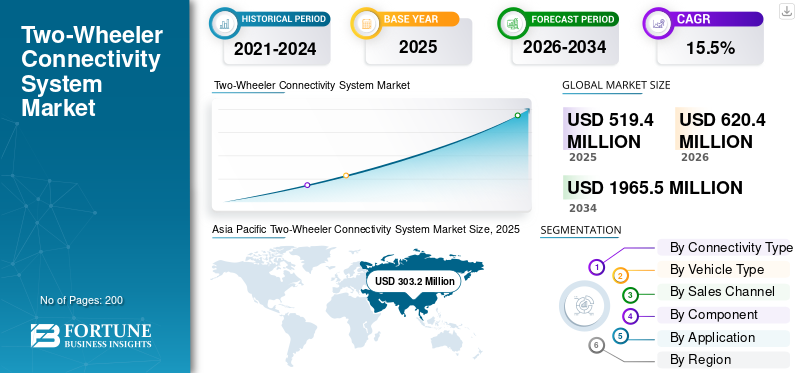
Download Free sample to learn more about this report.
Two-Wheeler Connectivity System Market Key Takeaways
 Global Market Size & Forecast
- 2025 Market Size: USD 519.4 million
- 2026 Market Size: USD 620.4 million
- 2034 Forecast Market Size: USD 1,965.5 million
- CAGR: 15.5% from 2026-2034
 Market Share
- Asia Pacific dominated the two-wheeler connectivity system market with a 58.38% share in 2025.
- The embedded connectivity segment is projected to grow at an 18.8% CAGR.
- The aftermarket segment is projected to grow at a 17.3% CAGR.
 Key Regional Highlights
North America
North America is projected to maintain a steady position in the global market, supported by increasing adoption of connected two-wheelers.
Asia Pacific
Asia Pacific is projected to hold a dominant position, driven by rising demand for advanced connectivity solutions.
Europe
Europe is projected to remain a high-value regional market, supported by growing adoption of connected mobility technologies.
U.S.
The market is estimated to reach USD 33.02 million in 2026, supported by increasing integration of connectivity features in two-wheelers.
Japan
The market is estimated to reach USD 32.41 million in 2026, driven by growing adoption of embedded connectivity technologies.
Read More

TWO-WHEELER CONNECTIVITY SYSTEM MARKET TRENDS
Smartphone-Led Two-Wheeler Connectivity Shapes Market Trends
Vehicle-to-smartphone connectivity is becoming a visible market trend as OEMs add app-linked dashboards, navigation, call alerts, music control, and two-wheeler infotainment systems without making every vehicle fully embedded or cellular-enabled. This trend supports connected motorcycles and smart scooter technology as riders can access digital functions through familiar mobile interfaces while OEMs keep system cost manageable. In October 2023, TVS Motor Company launched the Jupiter 125 SmartXonnect variant with a Bluetooth-connected TFT cluster, SmartXtalk, and SmartXtrack features.
MARKET DYNAMICS
MARKET DRIVERS
Download Free sample to learn more about this report.
Rising Electric Two-Wheeler Adoption Accelerates Market Growth
Electric scooters and motorcycles are pushing market growth as they need connected vehicle platforms for battery status, range estimation, charging alerts, ride data, theft protection, and real-time vehicle diagnostics. Unlike basic ICE commuter models, electric two-wheelers depend more heavily on software and cloud-based vehicle management, making connectivity a functional requirement rather than only a comfort feature. In 2025, the IEA reported that electric two- and three-wheelers remained the most electrified road transport segment in 2024, with over 9% of the global fleet electric.
MARKET RESTRAINTS
Cybersecurity and Data Privacy Risks Restrain Wider Adoption
Connectivity adds more data points, remote access routes, app permissions, and cloud links, which create restraints for OEMs and suppliers developing telematics solutions and IoT-enabled two-wheelers. Riders share location, usage, diagnostics, and personal data through GPS tracking systems and mobile apps, so any weak protection can reduce customer trust and increase compliance costs. In September 2022, NHTSA updated its Cybersecurity Best Practices for the Safety of Modern Vehicles, stating that cybersecurity should be a priority as vehicle technology and connectivity develop.
MARKET OPPORTUNITIES
Scalable OEM Platforms Open New Growth Opportunities
Connected platform standardization creates an opportunity for OEMs to launch motorcycle navigation systems, rider assistance technologies, OTA updates, safety alerts, and subscription services across multiple models and regions. Instead of building separate systems for every scooter or motorcycle, manufacturers can use scalable hardware, cloud services, and pre-integrated software stacks to reduce launch time and support smart mobility solutions. In March 2026, HARMAN announced Ready Ride, a rugged two-wheeler connectivity platform using Snapdragon Digital Chassis technology for connected, safer, and more convenient rider experiences.
MARKET CHALLENGES
Network Coverage and Legacy Technology Transitions Challenge Deployment
Reliable connected transportation ecosystem development depends on consistent mobile coverage, long device life, and smooth migration from older connectivity networks to 4G, 5G, and future standards. This remains challenging for two-wheelers as many vehicles operate in rural areas, emerging markets, and delivery routes where coverage quality varies. Older GPS trackers and low-cost telematics units may also depend on legacy networks. In 2025, GSMA reported that 131 mobile networks were planned to shut down by 2030, including 61 within 2025.
Segmentation Analysis
By Connectivity Type
Smartphone-Based Affordability Sustained Tethered Connectivity Segment Demand
Based on connectivity type, the market is segmented into embedded connectivity, tethered connectivity, and integrated / hybrid connectivity.
The tethered connectivity segment dominated the market in 2025. The growth of the segment is due to its lower system cost, easier smartphone pairing, and suitability for mass-market scooters and motorcycles. Riders can access navigation, call alerts, messages, trip data, and service reminders without expensive embedded SIM/eSIM hardware, making it attractive across price-sensitive two-wheeler markets. In 2025, Suzuki’s Ride Connect app continued to support Bluetooth-based smartphone integration with connected digital consoles, including navigation, call alerts, message notifications, trip data, weather alerts, and service alerts.
The embedded connectivity segment is projected to grow at a CAGR of 18.8% over the forecast period and is the fastest-growing segment. Growth is supported by electric two-wheelers, fleet monitoring, anti-theft services, OTA updates, real-time diagnostics, and direct vehicle-to-cloud communication, where independent connectivity is more valuable than smartphone-dependent systems.
By Sales Channel
Factory Integration and Brand-Controlled Data Platforms Advanced OEM Segment Growth
Based on sales channel, the market is segmented into OEM and aftermarket.
The OEM segment dominated the market in 2025. The growth is driven by rising factory integration of connected clusters, Bluetooth systems, embedded telematics, navigation, diagnostics, OTA support, and app-based ownership features. OEM-fitted systems offer stronger warranty control, better vehicle-data access, safer hardware integration, and long-term customer engagement compared with retrofit devices. In October 2023, TVS Motor Company launched the Jupiter 125 SmartXonnect variant with connected features for customers.
The aftermarket segment is projected to grow at a CAGR of 17.3% over the forecast period and is also the fastest-growing segment. Electric two-wheelers, premium motorcycles, connected scooters, cloud platforms, and factory-fitted telematics support growth. At the same time, aftermarket demand remains relevant for GPS tracking, anti-theft, and fleet retrofit use cases.
By Vehicle Type
Large Commuter and Premium Motorcycle Base Supported Motorcycles Segment Demand
By vehicle type, the market is segmented into scooters, motorcycles, mopeds, and electric two-wheelers.
The motorcycle segment dominated the market in 2025. The growth of the segment is due to the large global motorcycle parc, strong commuter motorcycle usage in Asia, Latin America, and Africa, and higher connected-feature adoption in premium and touring motorcycles. Motorcycle connectivity supports navigation, call alerts, ride data, safety alerts, and smartphone pairing, making it valuable across both mass and premium models. In August 2025, Honda Canada announced nationwide availability of the Honda RoadSync app for select motorcycle models, enabling Android and iOS smartphone connectivity.
The electric two-wheelers segment is projected to grow at a CAGR of 19.0% over the forecast period and is the fastest-growing segment. Growth is supported by battery monitoring, OTA updates, range tracking, charging alerts, infotainment, diagnostics, and app-based vehicle control across connected electric scooters and motorcycles.
To know how our report can help streamline your business, Speak to Analyst
By Component
Software, Cloud & App Platform Segment Dominated Owing to Increasing Connected Vehicle Platforms
By component, the market is segmented into telematics control unit, connectivity module / SIM / eSIM, smart instrument cluster/display, sensors & GPS module, and software, cloud & app platform.
The software, cloud & app platform segment dominates the market in 2025. The growth of the segment is due to rising use of mobile apps, connected vehicle platforms, cloud dashboards, OTA updates, navigation, subscription services, ride history, remote locking, and real-time vehicle diagnostics. These platforms help OEMs manage connected transportation ecosystems beyond one-time hardware sales. In April 2025, Ather Energy introduced AtherStack 6 with Google Maps integration, Alexa voice commands, live location sharing, theft alerts, and safety features.
The Telematics Control Unit (TCU) segment is projected to grow at a CAGR of 16.5% over the forecast period and is the fastest-growing segment. Embedded connectivity, GPS tracking systems, emergency alerts, fleet telematics, OTA readiness, and direct vehicle-to-cloud communication in electric scooters and premium motorcycles support growth.
By Application
Connected Riding Convenience Boosted Navigation & Infotainment Segment Demand
Based on application, the market is segmented into navigation & infotainment, safety & emergency assistance, vehicle tracking & anti-theft, remote diagnostics & vehicle health monitoring, and ride analytics & fleet management.
The navigation & infotainment segment dominated the market in 2025. The growth is bolstered by rising rider preference for turn-by-turn navigation, Bluetooth pairing, media control, call alerts, and app-linked two-wheeler infotainment systems. These features are widely adopted as they improve daily commuting, touring, and smart scooter usability without requiring complex embedded telematics. In January 2024, Garmin announced that it would provide infotainment systems with Bluetooth connectivity, media integration, and enhanced navigation functionality for select Yamaha motorcycles and smart scooters.
The remote diagnostics & vehicle health monitoring segment is projected to grow at a CAGR of 17.6% over the forecast period and is the fastest-growing segment. Electric two-wheelers, OTA updates, battery monitoring, fault alerts, predictive maintenance, and cloud-based service support across connected motorcycles and scooters support growth.
TWO-WHEELER CONNECTIVITY SYSTEM MARKET REGIONAL OUTLOOK
By geography, the market is categorized into Europe, North America, Asia Pacific, South America, and the Middle East & Africa.
ASIA PACIFIC
Asia Pacific Two-Wheeler Connectivity System Market Size, 2025 (USD Million)
To get more information on the regional analysis of this market, Download Free sample
Asia Pacific is projected to hold a dominant position in the global market, supported by the world’s largest two-wheeler population, rapid electric scooter adoption, strong smartphone penetration, and growing OEM integration of connected vehicle platforms. China, India, Japan, South Korea, and Southeast Asia support regional demand through connected motorcycles, smart scooter technology, GPS tracking systems, and IoT-enabled two-wheelers. Rising use of battery monitoring, remote diagnostics, app-based vehicle control, fleet telematics, and two-wheeler infotainment systems continues to strengthen the region’s market outlook.
CHINA TWO-WHEELER CONNECTIVITY SYSTEM MARKET
China accounts for approximately 40.9% of the Asia Pacific market in 2026, supported by its large electric two-wheeler base, urban mobility demand, app-enabled scooters, and strong domestic connected transportation ecosystem. Battery monitoring, anti-theft functions, real-time vehicle diagnostics, GPS tracking systems, connected vehicle platforms, and cloud-based vehicle management support demand.
INDIA TWO-WHEELER CONNECTIVITY SYSTEM MARKET
India is projected to register a CAGR of 16.7% during 2026–2034, supported by large two-wheeler sales, expanding electric scooter adoption, OEM mobile apps, Bluetooth-enabled clusters, and anti-theft features. Growing demand for smart scooter technology, vehicle-to-smartphone connectivity, navigation, real-time vehicle diagnostics, and telematics solutions continues to improve the country’s market growth prospects.
JAPAN TWO-WHEELER CONNECTIVITY SYSTEM MARKET
Japan is estimated to reach USD 32.41 million in 2026, supported by premium motorcycles, connected scooters, strong OEM technology capability, and advanced rider assistance technologies. Growing adoption of smart instrument clusters, motorcycle navigation systems, app-linked ownership features, real-time vehicle diagnostics, and embedded connectivity continues to support the country’s contribution to the Asia Pacific two-wheeler connectivity system market growth.
NORTH AMERICA
North America is projected to maintain a steady position in the global market, supported by premium motorcycle ownership, connected instrument clusters, GPS tracking systems, infotainment features, and vehicle-to-smartphone connectivity. The region benefits from higher adoption of connected motorcycles, touring bikes, and rider assistance technologies, particularly in the U.S. and Canada. Mexico adds volume-led demand through commuter motorcycles and connected mobility applications. Growing use of telematics solutions, anti-theft monitoring, embedded connectivity, and cloud-based vehicle management continues to support regional market expansion through the forecast period.
U.S. TWO-WHEELER CONNECTIVITY SYSTEM MARKET
The U.S. market is estimated to reach USD 33.02 million in 2026, supported by premium motorcycles, touring bikes, connected dashboards, motorcycle navigation systems, and rider assistance technologies. Increasing adoption of OEM-fitted connectivity, vehicle-to-smartphone connectivity, two-wheeler infotainment systems, real-time vehicle diagnostics, and GPS tracking systems continues to strengthen the country’s role within the market.
EUROPE
Europe is projected to remain a high-value regional market, supported by premium motorcycles, urban scooters, connected dashboards, safety technologies, and electric two-wheeler adoption. The region benefits from strong use of embedded connectivity, smart scooter technology, motorcycle navigation systems, emergency assistance, and real-time vehicle diagnostics. Germany, France, Italy, and the U.K. contribute significantly through premium vehicle demand and urban mobility applications. Rising adoption of connected vehicle platforms, rider assistance technologies, and cloud-based vehicle management supports long-term regional market development.
U.K. TWO-WHEELER CONNECTIVITY SYSTEM MARKET
The U.K. market is estimated to reach USD 13.9 million in 2026, supported by premium motorcycle usage, urban scooter demand, app-linked infotainment, and navigation-focused connectivity. Growing adoption of connected motorcycles, GPS tracking systems, safety alerts, smart mobility solutions, and real-time vehicle diagnostics continues to support demand across personal mobility, touring, and urban commuting applications.
GERMANY TWO-WHEELER CONNECTIVITY SYSTEM MARKET
Germany accounts for approximately 18.4% of the European market in 2026, supported by premium motorcycle adoption, advanced automotive electronics capability, and strong demand for connected instrument clusters. Growing use of embedded connectivity, telematics solutions, motorcycle navigation systems, safety features, and cloud-based vehicle management continues to reinforce Germany’s role in Europe’s connected two-wheeler ecosystem.
SOUTH AMERICA
South America is projected to witness moderate growth in the market, supported by motorcycle-based commuting, delivery fleet expansion, theft-prevention needs, and increasing adoption of aftermarket GPS tracking systems. Brazil remains the key revenue contributor, while Argentina and other regional markets support demand through urban mobility and commercial two-wheeler use. Retrofit telematics solutions, anti-theft monitoring, fleet tracking, and cloud-based vehicle management continue to shape regional adoption. OEM-fitted connected platforms are also gaining traction as newer models integrate app-based and diagnostic features.
BRAZIL TWO-WHEELER CONNECTIVITY SYSTEM MARKET ANALYSIS
Brazil accounts for approximately 65.3% of the South American market in 2026, supported by the region’s largest motorcycle base, high commuter usage, delivery fleet activity, and demand for anti-theft monitoring. GPS tracking systems, aftermarket telematics solutions, fleet management, vehicle-to-smartphone connectivity, and connected vehicle platforms continue to support market development across the country.
MIDDLE EAST & AFRICA
Middle East & Africa is projected to expand gradually in the market, supported by delivery fleets, urban mobility demand, theft protection, asset tracking, and early electric two-wheeler adoption. Aftermarket GPS tracking systems, fleet telematics, mobile-based monitoring, and cloud-based vehicle management mainly support the region’s connectivity demand. Gulf markets support premium and smart mobility applications, while African markets contribute through commercial motorcycles and delivery use cases. Increasing use of IoT-enabled two-wheelers and connected transportation ecosystem solutions supports future market growth.
SOUTH AFRICA TWO-WHEELER CONNECTIVITY SYSTEM MARKET ANALYSIS
The market is projected to register a CAGR of 20.3% during 2026–2034, supported by smart mobility initiatives, delivery fleet digitization, premium motorcycle demand, and electric two-wheeler adoption. Growing use of GPS tracking systems, fleet dashboards, real-time vehicle diagnostics, anti-theft solutions, connected vehicle platforms, and cloud-based vehicle management continues to strengthen market expansion.
COMPETITIVE LANDSCAPE
Key Industry Players
Platform Scalability, OEM Integration, and Connected Riding Services Define Competitive Landscape
The global two-wheeler connectivity system market is moderately fragmented, with competition spread across automotive technology suppliers, telematics providers, mapping companies, and two-wheeler OEMs. Key players compete through connected vehicle platforms, smart clusters, telematics solutions, GPS tracking systems, cloud-based vehicle management, and vehicle-to-smartphone connectivity. To gain an edge, companies are integrating real-time vehicle diagnostics, OTA updates, rider assistance technologies, navigation, app ecosystems, and two-wheeler infotainment systems into motorcycles, scooters, and electric two-wheelers. Strategic partnerships between semiconductor suppliers, platform developers, and OEMs are becoming important as the market shifts toward scalable IoT-enabled two-wheelers. In March 2026, HARMAN announced Ready Ride, a rugged two-wheeler connectivity platform powered by Snapdragon Digital Chassis technology to reduce OEM time-to-market and ownership cost.
LIST OF KEY TWO-WHEELER CONNECTIVITY SYSTEM COMPANIES PROFILED IN REPORT
- Robert Bosch GmbH (Germany)
- Continental AG (Germany)
- HARMAN International (U.S.)
- Qualcomm Technologies, Inc. (U.S.)
- Valeo SE (France)
- Ather Energy Ltd. (India)
- Geotab Inc. (Canada)
- Octo Telematics S.p.A. (Italy)
- MapmyIndia / C.E. Info Systems Ltd. (India)
- Zeliot Connected Services Pvt. Ltd. (India)
- Yamaha Motor Co., Ltd. (Japan)
- Honda Motor Co., Ltd. (Japan)
- BMW Motorrad / BMW AG (Germany)
- Hero MotoCorp Ltd. (India)
- TVS Motor Company Ltd. (India)
KEY INDUSTRY DEVELOPMENTS
- March 2026: Honda explained the role of Honda RoadSync and Honda RoadSync Duo in connecting motorcycles with smartphones through Bluetooth. RoadSync supports navigation, phone calls, music, and smartphone access, while RoadSync Duo is positioned for electric motorcycles with suggested navigation and software-enabled connected riding functions.
- November 2025: Hero MotoCorp implemented Excelfore’s eSync platform to enable secure over-the-air updates and remote data gathering for next-generation motorcycles and scooters. The system was integrated with AWS IoT cloud infrastructure and went live across more than ten Indian cities, supporting connected vehicle lifecycle management.
- November 2025: Yamaha Motor India launched the all-new XSR155 and unveiled its first EVs, AEROX-E and EC-06, strengthening its premium and electric two-wheeler portfolio. The launch aligns with Yamaha’s connected mobility direction, supported by its Y-Connect ecosystem for smartphone-linked rider information and vehicle interaction.
- July 2025: Roadzen partnered with a top global two-wheeler OEM to launch connected roadside assistance for electric and connected vehicles in India. The platform enables riders to request assistance through the vehicle dashboard or mobile app, with AI agents managing dispatch, tracking, and real-time customer updates.
- January 2025: HERE Technologies and Pioneer announced the Asia Pacific debut of connected two-wheeler devices at Bharat Mobility Global Expo 2025. The showcase included Pioneer Smart Display and Ride Recorder devices, designed to improve two-wheeler safety, navigation, dynamic routing, real-time traffic awareness, and connected rider information.
REPORT COVERAGE
The global two-wheeler connectivity system market report provides an in-depth study of the market size & forecast across all market segments included in the report. It includes details on market research dynamics and trends expected to drive the market during the forecast period. It offers information on rapid technological advancements, new product launches, key industry developments, strategic partnerships, and mergers & acquisitions. The market forecast provides a comprehensive competitive landscape, including the most significant global market shares, emerging opportunities, and profiles of key players.
Request for Customization to gain extensive market insights.
Report Scope & Segmentation
| ATTRIBUTE | DETAILS |
| Study Period | 2021-2034 |
| Base Year | 2025 |
| Estimated Year | 2026 |
| Forecast Period | 2026-2034 |
| Historical Period | 2021-2024 |
| Growth Rate | CAGR of 15.5% from 2026 to 2034 |
| Unit | Value (USD Million) |
| Segmentation | By Connectivity Type, By Vehicle Type, By Sales Channel, By Component, By Application, and By Region |
| By Connectivity Type |
|
| By Sales Channel |
|
| By Vehicle Type |
|
| By Component |
|
| By Application |
|
| By Region |
|
Frequently Asked Questions
Fortune Business Insights says that the global market value stood at USD 519.4 million in 2025 and is projected to reach USD 1965.5 million by 2034.
In 2025, the Asia Pacific’s market value stood at USD 303.2 million.
The market is expected to grow at a CAGR of 15.5% from 2026 to 2034.
The OEM segment led the market by sales channel.
Rising demand for connected motorcycles, smart scooter technology, electric two-wheelers, vehicle-to-smartphone connectivity, and real-time vehicle diagnostics is driving market momentum.
Key market players include Robert Bosch GmbH, Continental AG, Harman International, Qualcomm, TVS Motor Company, and Yamaha Motor.
The Asia Pacific region held the largest share of the market.



- 2021-2034
- 2025
- 2021-2024
- 200
-
(Offer valid till 15th Oct 2026)
Get 30-60 hrs Free Customization
Expand Regional and Country Coverage, Segments Analysis, Company Profiles, Competitive Benchmarking, and End-user Insights.




















-
US +1 833 909 2966 ( Toll Free )
-
Get In Touch With Us