Two-Wheeler Electronic Control Unit Market Size, Share & Industry Analysis, By ECU/Product Type (Engine Control Units, Body Control & Safety ECUs, Connected & Smart ECUs, and Electric Powertrain/BMS ECUs), By Two-Wheeler Type (Motorcycles, Scooters, and Mopeds), By Propulsion Type (ICE and Electric), By Sales Channel (OEM and Aftermarket), and Regional Forecast, 2026-2034
 Download Free Sample
(Offer valid till 30th Sep 2026)

Two-Wheeler Electronic Control Unit Market Size and Future Outlook
 Listen to Audio Version
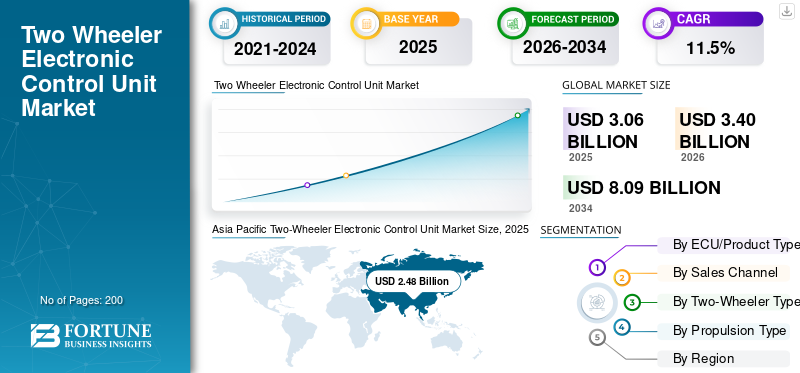
The global two-wheeler electronic control unit market size was valued at USD 3.06 billion in 2025 and is projected to grow from USD 3.40 billion in 2026 to USD 8.09 billion by 2034, exhibiting a CAGR of 11.5% during the forecast period. Asia Pacific dominated the two wheeler electronic control unit market with a market share of 81.04% in 2025.
A two-wheeler electronic control unit is an embedded controller that manages engine, braking, safety, battery, connectivity, and diagnostic functions in motorcycles, scooters, and electric two-wheelers for efficient performance. Market growth is driven by rising electric two-wheeler adoption, stricter emission norms, increasing demand for safety systems, connected mobility, advanced ECUs, fuel efficiency, and smarter electronic control systems.
Major players in the market include Robert Bosch GmbH, Continental AG, Denso Corporation, Hitachi Astemo, Ltd., Marelli Holdings Co., Ltd., and Mitsubishi Electric Corporation. They compete through advanced ECUs, electronic systems, connected diagnostics, safety systems, electrification support, and high-performance control solutions.
Download Free sample to learn more about this report.
TWO-WHEELER ELECTRONIC CONTROL UNIT MARKET KEY TAKEAWAYS
 Global Market Size & Forecast
- 2025 Market Size: USD 3.06 billion
- 2026 Market Size: USD 3.40 billion
- 2034 Forecast Market Size: USD 8.09 billion
- CAGR: 11.5% from 2026–2034
 Market Share
- Asia Pacific dominated the market with an 81.04% share in 2025.
- The Engine Control Units segment held the largest market share in 2025.
- The OEM segment held the largest market share in 2025.
 Key Regional Highlights
Asia Pacific
Asia Pacific the dominant and fastest-growing region, driven by large-scale motorcycle and scooter production, rising electric two-wheeler adoption, stricter emission regulations, and increasing ECU integration.
Europe
Europe held the second-largest market share and is projected to grow at a 7.8% CAGR, supported by stringent emission standards, premium motorcycle demand, electric scooter adoption, and advanced ECU integration.
North America
North America held the third-largest market share, supported by premium and recreational motorcycles, electric two-wheelers, connected diagnostics, and aftermarket ECU upgrades.
U.S.
The market is projected to reach USD 0.07 billion by 2026, accounting for roughly 2.1% of global revenues.
Japan
Japan growth is supported by increasing adoption of advanced electronic control systems, electric and connected two-wheelers, stricter emissions requirements, and demand for enhanced vehicle safety and diagnostics.
Read More

TWO-WHEELER ELECTRONIC CONTROL UNIT MARKET TRENDS
Connected ECUs Enable Smarter Two-Wheeler Performance
Connected and smart electronic control units are becoming a major market trend as OEMs integrate telematics, remote diagnostics, ride analytics, theft tracking, and over-the-air update capabilities. These ECUs help manufacturers improve vehicle performance, reduce service downtime, and support digital ownership experiences. As scooters, motorcycles, and electric two-wheelers become more software-driven, connected ECUs are increasingly integrated into vehicle platforms to support safety, convenience, predictive maintenance, and long-term customer engagement.
- In March 2026, Harman unveiled Ready Ride, a two-wheeler connectivity platform combining a scalable telematics control unit, cellular connectivity, intelligent software stack, and OEM backend to support OTA updates, navigation, media access, vehicle monitoring, diagnostics, theft alerts, and tracking.
Electrification Accelerates ECU Architecture Transformation
The shift toward electric vehicles is reshaping ECU design in two-wheelers, especially for battery management, motor control, thermal monitoring, regenerative braking, and charging communication. Electric and hybrid two-wheelers require advanced ECUs that can coordinate multiple electronic systems while improving range, safety, and efficiency. This trend is pushing suppliers to develop compact, high-performance, energy-efficient controllers that support different voltage platforms and smart mobility features, creating strong technology differentiation across urban commuter and premium electric two-wheeler segments.
- In June 2026, Honda and Nissan were reported to be nearing a partnership to co-develop ECUs for electric vehicles, aiming to localize components, reduce production costs, support software-defined vehicles, and improve competitiveness in India’s expanding EV market.
MARKET DYNAMICS
MARKET DRIVERS
Download Free sample to learn more about this report.
Rapid Adoption of Advanced Engine Control Units Due to Stricter Emission Norms Fuels Market Growth
Stricter emission regulations are a key driver for advanced ECUs in internal combustion engine two-wheelers. Engine control units help optimize fuel injection, ignition timing, air-fuel ratio, and exhaust performance, enabling manufacturers to meet emission standards without compromising ride quality. As governments continue tightening pollution control rules, OEMs are increasing the use of precise electronic control systems in motorcycles and scooters. This supports two-wheeler electronic control unit market growth by making ECUs essential for compliance, fuel efficiency, and improved engine performance.
- In July 2025, India’s Ministry of Road Transport and Highways proposed mandatory ABS for all two-wheelers manufactured from January 2026, impacting entry-level models, raising prices by 3-5%, and increasing demand for ECU-enabled braking safety systems.
Increased ECU Integration Due to Rising Demand for Safety Systems Propels Market Expansion
Rising demand for safety systems is driving ECU adoption across two-wheelers, particularly in braking, traction control, stability control, lighting, and rider assistance functions. Advanced driver assistance systems (ADAS) are gradually entering premium motorcycles and urban mobility platforms, increasing the role of electronic control units. Consumers are becoming more aware of safety, while regulators and OEMs are promoting safer mobility. This creates steady demand for body control, safety ECUs, and advanced control systems.
- In June 2026, the government of India is considering a three-layer safety system for two-wheelers using grip sensors, warnings, and automatic slowdown features, potentially increasing ECU, sensor, electronic control module, and speed management software integration in motorcycles and scooters.
MARKET RESTRAINTS
High Electronic Component Costs Limit Mass-Market Adoption
High electronic component costs remain a restraint for the market, especially in price-sensitive commuter motorcycle and scooter categories. Advanced ECUs require semiconductors, sensors, software, connectors, and validation systems, which increase vehicle production costs. In emerging markets, buyers are highly cost-conscious, making it difficult for OEMs to add multiple electronic systems without affecting affordability. This can slow adoption in entry-level models, even though demand for safety, connectivity, and efficiency continues to rise.
MARKET OPPORTUNITIES
Smart Diagnostics Open New Aftermarket Revenue Models
Smart diagnostics create a strong opportunity for ECU suppliers, two-wheeler OEMs, workshops, and fleet operators. As ECUs collect data on engine health, battery status, riding patterns, fault codes, and component wear, service providers can offer predictive maintenance and faster repair solutions. This improves customer experience and reduces downtime for delivery fleets and shared mobility operators. The opportunity is especially strong in connected scooters, electric two-wheelers, and premium motorcycles where digital service platforms are becoming more valuable.
- In January 2023, Honda Motorcycle & Scooter India launched the Activa 2023 in three variants, making it the company’s first OBD2-compliant two-wheeler.
Emerging Markets Create Scope for ECU Localization
Emerging markets in Asia Pacific, Latin America, and parts of Africa offer strong opportunities for localized ECU development and production. These regions have large two-wheeler populations, increasing demand for fuel-efficient motorcycles, and growing adoption of electric scooters. Local manufacturing of advanced ECUs can reduce costs, improve supply chain stability, and support regional emission and safety requirements. Suppliers that offer affordable, rugged, and scalable electronic control systems can gain market share among mass-market OEMs and mobility service providers.
MARKET CHALLENGES
Cybersecurity Risks Increase with Connected ECU Adoption
Cybersecurity is a major challenge as two-wheeler ECUs become connected to mobile apps, cloud platforms, diagnostics tools, and over-the-air update systems. Connected ECUs can improve convenience and serviceability, but they also create risks related to unauthorized access, data privacy, software manipulation, and vehicle control vulnerabilities. Manufacturers must invest in secure software architecture, encryption, authentication, and continuous monitoring. This increases development complexity and cost, especially for companies launching connected and smart electronic control units at scale.
Segmentation Analysis
By Propulsion Type
Large Installed ICE Two-Wheeler Base Boosted Segment Growth
Based on propulsion type, the market is segmented into ICE and electric.
The ICE segment dominated the two-wheeler electronic control unit market share in 2025 due to the large global base of internal combustion engine motorcycles and scooters, especially across Asia Pacific and other price-sensitive regions. These vehicles require advanced ECUs for fuel injection, ignition control, emission compliance, diagnostics, and engine performance optimization. Continuous upgrades in electronic systems and stricter emission norms sustain ECU demand across commuter, mid-range, and premium two-wheelers.
The electric segment is projected to grow at a CAGR of 16.1% during 2026–2034, driven by rapid electric two-wheeler adoption, battery management needs, motor control systems, connected diagnostics, charging communication, and increasing demand for efficient electronic control solutions.
- In June 2026, Samarth E-Mobility launched Avore Electric, a new Indian electric two-wheeler brand with an in-house technology stack, proprietary AVR platform, patented BMS, motor controller, power module, vehicle operating system, and over 110 IP filings.
By ECU/Product Type
Emission Compliance and Engine Optimization Propelled Engine Control Units Segment Growth
Based on ECU/product type, the market is segmented into engine control units, body control & safety ECUs, connected & smart ECUs, and electric powertrain/BMS ECUs.
The engine control units segment dominated the market in 2025 due to its essential role in fuel injection, ignition timing, emission control, engine diagnostics, and performance management across ICE motorcycles and scooters. Large production volumes of commuter two-wheelers, stricter emission standards, and the need for efficient internal combustion engine operation continue to support adoption. OEMs increasingly use advanced ECUs to improve fuel economy, reliability, and regulatory compliance.
The electric powertrain/BMS ECUs segment is projected to grow at a CAGR of 14.0% over the forecast period. The growth is driven by rising electric two-wheeler adoption, battery safety needs, motor control, thermal management, charging communication, and connected diagnostics.
- In October 2024, Bosch showcased a new 2kW drive control unit for smaller electric two-wheelers, combining powertrain control functions and supporting electrification across compact motorcycles, scooters, and urban mobility platforms.
To know how our report can help streamline your business, Speak to Analyst
By Sales Channel
Rising Integration of ECUs During Vehicle Production for Engine Control Augmented OEM Segment Growth
Based on the sales channel, the market is segmented into OEM and aftermarket.
The OEM segment dominated the market in 2025, owing to the rising integration of ECUs during vehicle production for engine control, safety systems, electric powertrain management, diagnostics, and connected functions. Two-wheeler manufacturers prefer factory-installed electronic control units to ensure system reliability, regulatory compliance, warranty protection, and seamless compatibility. Increasing use of advanced ECUs in ICE, electric, and hybrid two-wheelers continues to support OEM-led demand.
The aftermarket segment is projected to grow at a CAGR of 10.3% during 2026–2034, supported by ECU replacement, diagnostics, repair demand, performance tuning, connected retrofit solutions, and servicing needs across aging motorcycles, scooters, and electric two-wheelers.
- In June 2026, Barni Spark Racing Team and Mectronik launched an electronic race kit for Ducati Panigale V4, S, and R models, offering customizable control of traction control, anti-wheelie, engine braking, throttle response, and torque curve.
By Two-Wheeler Type
Large Commuter Base and ECU Integration Boosted Motorcycles Segment Growth
Based on two-wheeler type, the market is segmented into motorcycles, scooters, and mopeds.
The motorcycle segment dominated the market in 2025 due to high motorcycle production and ownership across Asia Pacific, Latin America, and other commuter-heavy regions. Motorcycles increasingly use ECUs for fuel injection, ignition control, emission compliance, diagnostics, safety systems, and performance optimization. Growing demand for premium bikes, stricter emission norms, and wider adoption of advanced electronic systems continue to support ECU integration across commuter and performance motorcycle categories.
Scooters is the fastest-growing segment and is projected to develop at a CAGR of 12.3% during 2026–2034, driven by urban mobility demand, electric scooter adoption, connected features, battery management systems, compact control systems, and increasing use of smart electronic systems.
- In September 2025, SRIVARU Motors launched its Alive electric scooter series and PRANA Class electric motorcycle in India, featuring LiFePO4 batteries, regenerative braking, smart digital displays, CBS disc brakes, IP67-rated battery and motor systems, and multiple ride modes.
Two-Wheeler Electronic Control Unit Market Regional Outlook
By geography, the market is categorized into Asia Pacific, North America, Europe, South America, and the Middle East & Africa.
Asia Pacific
Asia Pacific Two-Wheeler Electronic Control Unit Market Size, 2025 (USD Billion)
To get more information on the regional analysis of this market, Download Free sample
Asia Pacific is the dominating region and is also the fastest-growing region in the market. Growth is supported by large motorcycle and scooter production in China, India, Indonesia, Vietnam, and Thailand. Rising electric two-wheeler adoption, emission regulations, affordable commuter mobility, and increasing use of electronic systems in ICE and electric models strengthen market demand. Local ECU manufacturing, battery management systems, connected scooters, and advanced safety integration further support regional growth during the forecast period.
- In November 2024, Nidec Mobility developed the world’s first electric clutch ECU for two-wheelers, enabling riders to shift gears without using the clutch lever and switch optionally between manual and automatic clutch control modes.
China Two-Wheeler Electronic Control Unit Market
The China market in 2026 is estimated at around USD 1.02 billion, accounting for roughly 30.0% of global revenues. Large-scale scooter manufacturing, strong electrification policies, connected mobility platforms, and growing ECU integration across commuter and smart electric two-wheelers reinforce expansion.
Indonesia Two-Wheeler Electronic Control Unit Market
The Indonesian market in 2026 is estimated at around USD 0.24 billion, accounting for roughly 7.1% of global revenues. Market development is supported by dense urban scooter usage, affordability-led mobility demand, fuel efficiency requirements, and gradual adoption of electronically controlled engines and safety functions.
India Two-Wheeler Electronic Control Unit Market
The India market in 2026 is estimated at around USD 0.86 billion, accounting for roughly 25.2% of global revenues. Demand is advancing through high commuter motorcycle volumes, stricter emission compliance, electric scooter penetration, and wider use of fuel injection, diagnostics, and safety-focused electronic control systems.
North America
North America holds the third-largest market share. Premium motorcycles, recreational bikes, electric two-wheelers, and increasing demand for connected diagnostics and safety systems support regional growth. The U.S. leads adoption due to strong demand for performance motorcycles, advanced rider assistance features, and aftermarket ECU upgrades. Electrification initiatives, smart mobility platforms, and gradual adoption of advanced electronic control systems in urban commuting and leisure riding segments also support growth.
- In September 2024, Krämer Motorcycles announced the 2025 APX-350 MA prototype for MotoAmerica Talent Cup racing, featuring a 350cc single-cylinder motor, Mectronik MKE7 racing ECU, adjustable engine-braking control, tailorable throttle maps, and ECUMASTER dash.
U.S. Two-Wheeler Electronic Control Unit Market
The U.S. market in 2026 is estimated at around USD 0.07 billion, accounting for roughly 2.1% of global revenues. Momentum is driven by premium motorcycles, recreational riding, electric motorcycle launches, performance tuning demand, and aftermarket ECU upgrades for diagnostics, engine mapping, and safety enhancement.
Europe
Europe holds the second-largest market share and is projected to grow at a CAGR of 7.8% during 2026–2034. Growth is driven by strict emission standards, premium motorcycle demand, electric scooter adoption, and rising integration of advanced ECUs for safety, diagnostics, and powertrain control. Countries such as Germany, Italy, France, Spain, and the U.K. support demand through urban mobility policies, electric and hybrid two-wheeler adoption, and consumer preference for connected and high-performance riding technologies.
- In May 2024, Bosch aimed to release a motorcycle ECU with smartphone connectivity, enabling service alerts, fuel consumption tracking, lean angle, speed and distance data, remote immobilization, riding modes, cruise control, and motorcycle stability control integration.
Italy Two-Wheeler Electronic Control Unit Market
The Italian market in 2026 is estimated at around USD 0.05 billion, accounting for roughly 1.6% of global revenues. Premium motorcycle culture, strong scooter ownership, Euro emission standards, and rising integration of advanced ECUs for performance, safety, and vehicle diagnostics shape growth.
U.K. Two-Wheeler Electronic Control Unit Market
The U.K. market in 2026 is estimated at around USD 0.02 billion, accounting for roughly 0.5% of global revenues. Adoption is improving as urban riders shift toward electric scooters, connected services, low-emission mobility, and compact ECU solutions supporting diagnostics, battery control, and rider safety.
South America
South America holds the smallest market share. Growth is supported by commuter motorcycle demand in Brazil, Argentina, Colombia, and Chile, where two-wheelers remain important for daily mobility and delivery services. ECU demand is increasing with fuel injection systems, emission compliance, diagnostics, and gradual electric scooter adoption. However, inflation pressure, import dependency, currency volatility, and affordability concerns limit faster adoption of advanced ECUs across mass-market motorcycles and scooters.
Colombia Two-Wheeler Electronic Control Unit Market
The Colombia market in 2026 is estimated at around USD 0.04 billion, accounting for roughly 1.1% of global revenues. Growth is encouraged by widespread motorcycle commuting, last-mile delivery fleets, fuel-efficient mobility needs, and increasing adoption of ECU-enabled fuel injection and maintenance diagnostics.
Middle East & Africa
The Middle East & Africa region holds the fourth-largest market share, supported by increasing two-wheeler use for personal mobility, delivery services, and cost-efficient transportation. Growth is gradually improving as urbanization, e-commerce logistics, and fuel-efficient mobility demand rise across selected Gulf and African markets. Engine efficiency needs, basic safety systems, and growing electric scooter pilots support ECU adoption. However, lower vehicle electrification penetration and price sensitivity keep adoption slower than in developed markets.
Turkey Two-Wheeler Electronic Control Unit Market
The Turkey market in 2026 is estimated at around USD 0.03 billion, accounting for roughly 1.2% of global revenues. Progress is supported by expanding urban scooter demand, cost-efficient commuting, regional vehicle assembly, emission compliance needs, and rising interest in electric and connected two-wheeler platforms.
COMPETITIVE LANDSCAPE
Key Industry Players
Electrification, Connected Diagnostics, and Advanced ECU Integration Define Competitive Landscape
The market is moderately consolidated, with leading suppliers competing through advanced ECU platforms, embedded software, safety integration, and electrification-ready control systems. Key players such as Robert Bosch GmbH, Continental AG, Denso Corporation, Hitachi Astemo, Ltd., Marelli Holdings Co., Ltd., and Mitsubishi Electric Corporation focus on compact, high-performance ECUs for ICE, electric, and hybrid two-wheelers. To strengthen competitiveness, companies are investing in battery management, connected diagnostics, cybersecurity, over-the-air updates, and localized manufacturing. Partnerships with motorcycle OEMs and semiconductor providers help improve supply resilience, cost efficiency, and regional penetration.
LIST OF KEY TWO-WHEELER ELECTRONIC CONTROL UNIT COMPANIES PROFILED
- Robert Bosch GmbH (Germany)
- Denso Corporation (Japan)
- Hitachi Astemo, Ltd. (Japan)
- Mitsubishi Electric Corporation (Japan)
- Marelli Holdings Co., Ltd. (Japan)
- Continental AG (Germany)
- Vitesco Technologies Group AG (Germany)
- Mikuni Corporation (Japan)
- SEDEMAC Mechatronics Pvt. Ltd. (India)
- Uno Minda Ltd. (India)
- SEG Automotive (Germany)
- Autoliv Inc. (Sweden)
- Ecotrons LLC (U.S.)
- Athena S.p.A. (Italy)
- Dimsport S.r.l. (Italy)
KEY INDUSTRY DEVELOPMENTS
- July 2026: Hero launched the HF Deluxe flex-fuel bike with E85 capability, featuring a 97.2cc engine with upgraded components and ECU calibration to support ethanol blends.
- April 2026: Renesas highlighted hands-off handlebar detection for India’s two-wheelers, using impedance sensing to detect rider grip, reduce false alerts, support warnings, and encourage safer rider behavior in real-world conditions.
- December 2025: Bosch stated cloud-based motorcycle communication could help reduce accidents by sharing road hazard, weather, and surface-condition data, while existing ARAS technology communicates with ECU, IMU, and stability control systems.
- June 2025: Damon announced Damon I/O as a comprehensive rider intelligence and connected services platform, designed to transform electric motorcycle use into safer, smarter, and more connected personal mobility experiences.
- April 2024: MV Agusta debuted the Enduro Veloce adventure bike with an ECU that adapts electronic response based on tire selection, supporting 8 traction control levels for Bridgestone Battlax A41 and 8 levels for AX41 tires.
- June 2023: Autoliv announced plans to launch a motorcycle airbag system by the first quarter of 2025, featuring crash sensors, an ECU with a deployment algorithm, airbag module, and gas generator to reduce collision-related rider injuries.
- April 2022: Continental showcased its two-wheeler Advanced Rider Assistance Systems near Bengaluru, including blind spot detection, lane change assist, optimized curve braking, deflation detection, telematics control unit, battery management system, sensors, diagnostic solutions, and connected display technologies.
REPORT COVERAGE
The global two-wheeler electronic control unit market analysis provides an in-depth study of the market size & forecast by all the market segments included in the market report. It includes details on the market dynamics and trends expected to drive the market over the forecast period. It offers information on technological advancements, new product launches, key automotive industry developments, and details on partnerships, mergers, and acquisitions. The market report scope also encompasses a detailed competitive landscape with information on the market share and profiles of key operating players.
Request for Customization to gain extensive market insights.
Report Scope & Segmentation
| ATTRIBUTE | DETAILS |
| Study Period | 2021-2034 |
| Base Year | 2025 |
| Estimated Year | 2026 |
| Forecast Period | 2026-2034 |
| Historical Period | 2021-2024 |
| Growth Rate | CAGR of 11.5% from 2026 to 2034 |
| Unit | Value (USD Billion) and Volume (Thousand Units) |
| Segmentation | By Propulsion Type, By ECU/Product Type, By Sales Channel, By Two-Wheeler Type, and By Region |
| By Propulsion Type |
|
| By ECU/Product Type |
|
| By Sales Channel |
|
| By Two-Wheeler Type |
|
| By Region |
|
Frequently Asked Questions
Fortune Business Insights says that the global market value stood at USD 3.06 billion in 2025 and is projected to reach USD 8.09 billion by 2034.
In 2025, the Asia Pacific market value stood at USD 2.48 billion.
The market is expected to exhibit a CAGR of 11.5% during the forecast period of 2026-2034.
The engine control units segment led the market by ECU/product type.
Rapid adoption of advanced engine control units due to stricter emission norms is driving the market.
Major players in the market include Robert Bosch GmbH, Continental AG, Denso Corporation, Hitachi Astemo, Ltd., Marelli Holdings Co., Ltd., and Mitsubishi Electric Corporation.
Asia Pacific holds the largest share of the market.



- 2021-2034
- 2025
- 2021-2024
- 200
-
(Offer valid till 30th Sep 2026)
Get 30-60 hrs Free Customization
Expand Regional and Country Coverage, Segments Analysis, Company Profiles, Competitive Benchmarking, and End-user Insights.




















Related Reports
-
US +1 833 909 2966 ( Toll Free )
-
Get In Touch With Us