Two-Wheeler Leasing Market Size, Share & Industry Analysis, By Two-Wheeler Type (Scooters, Motorcycles and Mopeds), By Propulsion Type (Internal Combustion Engine (ICE) and Electric), By Leasing Type (Operating Lease and Financial Lease), By Lease Duration (Short-term and Long-term), By End User (Individual and Commercial), and Regional Forecast, 2026-2034
 Download Free Sample
(Offer valid till 30th Sep 2026)

Two-Wheeler Leasing Market Size and Future Outlook
 Listen to Audio Version
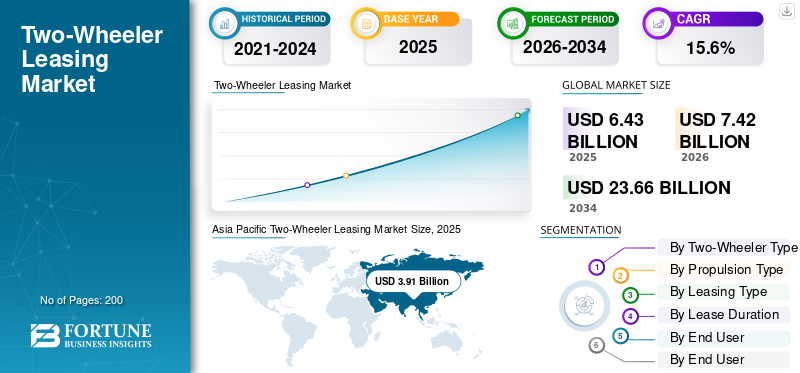
The two-wheeler leasing market size was valued at USD 6.43 billion in 2025 and is projected to grow from USD 7.42 billion in 2026 to USD 23.66 billion by 2034, exhibiting a CAGR of 15.6% during the forecast period. Asia Pacific dominated the two-wheeler leasing market with a market share of 60.81% in 2025.
The market represents business of offering scooters, motorcycles, and mopeds to individuals and businesses through lease, rent-to-use, subscription based, or fleet-access models instead of direct ownership. The market includes short-term wheeler rental, scooter rental, long-term leasing, operating lease, financial lease, and commercial fleet leasing models. It serves daily commuters, students, tourists, delivery riders, courier companies, food delivery platforms, e-commerce operators, and shared mobility companies.
The overall market is growing as users increasingly prefer flexible vehicle access without paying the full purchase price. For many riders, leasing reduces the burden of ownership, insurance, servicing, battery replacement, resale risk, and maintenance. For businesses, leasing helps increase fleet size quickly while keeping cash flow under control. This is especially useful in last-mile delivery, where vehicle uptime and fleet utilization directly affect operating margins.
During the forecast period, the market is expected to evolve from basic rental models toward managed mobility platforms. Leasing companies are likely to bundle vehicles with insurance, servicing, roadside assistance, telematics, charging access, and battery support. The electric vehicle transition will also reshape the rental industry, as leasing makes electric bike and electric scooter adoption easier for riders who want lower running costs but cannot afford high upfront prices.
The market growth will depend on leasing penetration, vehicle financing, EV infrastructure, and commercial delivery activity. Major key players such as Zypp Electric, Neuron Mobility and Cooltra are expanding partnerships, improving vehicle uptime, adding electric fleets, and using digital platforms to protect market share and accelerate market growth.
Download Free sample to learn more about this report.
TWO-WHEELER LEASING MARKET TRENDS
App-Based Subscription Models Improve Rental Industry Access and is a Prominent Market Trend
A key market trend is the move from traditional rental shops to app-based leasing and subscription based platforms. Customers can now book, unlock, renew, return, or upgrade vehicles digitally. This improves convenience, pricing transparency, and fleet utilization. For operators, digital platforms help track usage, maintenance, payments, and vehicle location, improving profitability in the rental industry.
- For instance, in March 2026, Suzuki Motorcycle India partnered with Royal Brothers to offer the e-ACCESS scooter through flexible rental and subscription plans from 24 hours to one year.
MARKET DYNAMICS
MARKET DRIVERS
Download Free sample to learn more about this report.
Delivery Fleet Expansion Accelerates Market Growth
Rising food delivery, grocery delivery, courier, and e-commerce activity is increasing demand for leased two-wheelers. Commercial users prefer leasing as it reduces upfront vehicle investment and allows quick fleet size expansion. Leasing also supports better fleet utilization, maintenance planning, and rider replacement. This driver is especially strong in Asia Pacific and Latin America, where two-wheelers are widely used for last-mile transport.
- In December 2024, Zypp Electric completed over 20.5 million zero-emission deliveries in one year, supporting EV leasing demand in India’s delivery ecosystem.
MARKET RESTRAINTS
Battery Cost and Residual Value Risk Limit Leasing Profitability
The shift toward electric two-wheelers create uncertainty around battery life, resale value, repair cost, and replacement cycles. Leasing providers must price these risks into monthly plans, which can make electric vehicle leasing expensive for some riders. If residual values fall or batteries degrade faster than expected, operators may face weaker margins, reducing investment slowing two-wheeler leasing market growth.
MARKET OPPORTUNITIES
Electric Fleet Leasing Opens New Revenue Opportunities for Market
Electric two-wheeler leasing offers strong opportunity as businesses want cleaner, lower-cost vehicles without owning battery-related risks. Leasing can make electric bike and electric scooter adoption easier by bundling maintenance, battery support, and charging access. This creates a scalable opportunity for commercial delivery fleets, subscription based services, and urban mobility operators during the forecast period.
- For instance, in May 2024, Zypp Electric raised USD 15 million to expand its EV fleet from 21,000 to 200,000 vehicles across 15 Indian cities.
MARKET CHALLENGES
High Fleet Maintenance and Utilization Pressure Challenge Market Development
Two-wheeler leasing companies must keep vehicles roadworthy, insured, charged, repaired, and available. Poor fleet utilization, theft, accident damage, seasonal demand, and high servicing cost can reduce margins. This challenge is higher in short-term wheeler rental and shared mobility models, where vehicles face heavy use and frequent relocation across cities.
Segmentation Analysis
By Two-Wheeler Type
Scooters Segment Dominate Due to Urban Mobility and Delivery Suitability
On the basis of two-wheeler type, the market is segmented into scooters, motorcycles and mopeds.
Scooters segment dominate the market as they are easy to ride, affordable, fuel-efficient, and highly suitable for city commuting, delivery work, tourism, and scooter rental platforms. Their automatic operation and compact design make them attractive for both individual and commercial users. Electric scooters also strengthen this segment by supporting low-cost, short-distance mobility and higher fleet utilization.
- For instance, in April 2025, Bounce Daily restarted scooter rentals in Bengaluru, targeting delivery partners, gig workers, and commuters with 100% electric scooters and app booking.
To know how our report can help streamline your business, Speak to Analyst
The motorcycles segment is expected to grow at a CAGR of 13.9% over the forecast period.
By Propulsion Type
ICE segment Dominates Due to Large Existing Vehicle Base
On the basis of propulsion type, the market is segmented into ICE and electric.
Internal combustion engine two-wheelers dominate the market as global two-wheeler parc is still mainly petrol-based. ICE scooters and motorcycles are widely available, easier to refuel, and cheaper to operate in regions with limited charging infrastructure. Leasing companies also prefer ICE in many emerging markets as servicing networks, resale channels, and rider familiarity are already well established.
- For instance, in May 2025, IEA stated electric two- and three-wheelers represented around 15% of 2024 sales, leaving conventional powertrains dominant globally.
The electric segment is expected to grow at a CAGR of 25.8% over the forecast period.
By Leasing Type
Operating Lease Dominates the Market Due to Flexible Access-Based Models
On the basis of leasing type, the market is segmented into operating lease and financial lease.
Operating lease held the largest two-wheeler leasing market share as it covers subscription based leasing, fleet-as-a-service, short-term rental, and full-service leasing models. Customers use the vehicle without taking ownership, while the provider manages maintenance, insurance, replacement, and sometimes battery support. This model is popular among delivery fleets, shared mobility operators, and individuals seeking flexible access instead of ownership.
- For instance, in November 2024, Odysse Electric secured an order to supply 40,000 EVs to Zypp Electric under an EV-as-a-service expansion deal.
Financial lease segment is expected to grow at a CAGR of 8.6% over the forecast period.
By Lease Duration
Long-Term Leasing Segment Dominates Due to Commercial Fleet Stability
On the basis of lease duration, the market is segmented into short-term and long-term.
Long term leasing dominates as delivery riders, logistics companies, and corporate users need continuous vehicle access rather than occasional rentals. Longer contracts help users manage monthly costs while helping providers improve asset planning, servicing schedules, and revenue visibility. This format is also better suited for bundled insurance, maintenance, battery support, and replacement services.
- In 2025, Cooltra promoted long-term motorcycle rental for companies, including insurance, servicing, roadside assistance, helmets, and fleet support.
The short-term segment is expected to grow at a CAGR of 13.9% over the forecast period.
By End User
Commercial Users Dominate Due to Delivery and Fleet Demand
On the basis of end user, the market is segmented into individual and commercial.
Commercial users dominate the market as leasing is highly useful for food delivery, grocery delivery, courier services, e-commerce logistics, field sales, and shared mobility. Businesses prefer leasing to scale fleet size quickly, reduce capital expenditure, and maintain vehicle uptime. Commercial leasing also supports EV adoption as operators can reduce running costs without directly owning batteries.
- For instance, in December 2024, Zypp Electric reported strong quick-commerce use, with 15-20% of Delhi-NCR quick-commerce orders handled through its EV platform.
The individual segment is expected to grow at a CAGR of 11.6% over the forecast period.
Two-Wheeler Leasing Market Regional Outlook
By geography, the market is categorized into North America, Europe, Asia Pacific, Latin America and Middle East & Africa.
Asia Pacific
Asia Pacific Two-Wheeler Leasing Market Size, 2025 (USD Billion)
To get more information on the regional analysis of this market, Download Free sample
Asia Pacific held the dominant share in 2025, valuing at USD 3.91 billion, and also maintained the leading share in 2024, with USD 3.61 billion. Asia Pacific dominates the market as China, India, Indonesia, Vietnam, and Thailand have very large two-wheeler populations and strong delivery-based mobility demand. Leasing grows as riders and businesses seek lower upfront costs, flexible contracts, and electric scooter access. The region also benefits from dense urban areas, gig platforms, battery-swapping pilots, and expanding last-mile logistics. During the forecast period, the region will retain the highest market share due to commercial fleet leasing and fast EV adoption.
China Two-Wheeler Leasing Market
China’s market is projected to be one of the largest worldwide and 2025 revenues reached at USD 0.97 billion, representing roughly 15.0% of market sales.
India Two-Wheeler Leasing Market
India market in 2025 was at USD 1.22 billion, accounting for roughly 19.0% of global revenues.
Europe
Europe is estimated to reach USD 1.07 billion in 2026 and secure the position of the second-largest region in the market. Europe will grow through mature leasing systems, urban scooter use, tourism rentals, and electric micro-mobility. Germany, France, Italy, Spain, and the U.K. are important due to strong motorcycle and moped registrations. Operators are expanding digital booking, short-term rentals, and company fleet solutions to improve market growth.
Germany Two-Wheeler Leasing Market
Germany market in 2025 reached USD 0.19 billion, accounting for roughly 3.0% of global revenues.
Italy Two-Wheeler Leasing Market
Italy market in 2025 was at around USD 0.21 billion, accounting for roughly 3.3% of global sales.
Latin America
Latin America is projected to record a growth rate of 14.1% in the coming years, and reach a valuation of USD 0.69 billion by 2026. Latin America will grow through Brazil and Colombia, where motorcycles are widely used for commuting, delivery, and income generation. Leasing and rent-to-own models help riders avoid high upfront costs. Brazil’s rental ecosystem and Colombia’s growing motorcycle registrations support market growth in commercial and individual mobility.
Brazil Two-Wheeler Leasing Market
Brazil market in 2025 was at USD 0.38 billion, accounting for roughly 6.0% of global market revenues.
North America
North America will grow through urban micromobility, motorcycle rentals, delivery-focused electric bike leasing, and app-based rental services. The U.S. market is more developed in shared e-bike and scooter platforms than traditional commuter two-wheeler leasing. Growth will come from delivery riders, city mobility programs, and subscription based offerings that reduce ownership costs.
U.S. Two-Wheeler Leasing Market
U.S. market in 2025 was valued at USD 0.23 billion, representing roughly 3.6% of global market.
Middle East & Africa
The Middle East & Africa market will grow gradually through delivery fleets, tourism rentals, and commercial two-wheeler use. UAE supports organized rental and delivery mobility, while South Africa adds structured vehicle finance and urban delivery demand. Rest of Middle East & Africa region remains price-sensitive, but leasing can improve access where ownership affordability is limited.
UAE Two-Wheeler Leasing Market
UAE market in 2025 was at USD 0.14 billion, representing roughly 2.1% of global market.
COMPETITIVE LANDSCAPE
Key Industry Players
Increasing Adoption of Digital Fleet Models Reshapes Market Competition
The competitive landscape of the two-wheeler leasing market is fragmented but becoming more organized as digital mobility companies, EV-as-a-service providers, rental platforms, OEM-backed finance arms, and micromobility operators expand across regions. Competition is no longer based only on vehicle availability. Companies now compete on vehicle quality, pricing flexibility, maintenance coverage, battery support, service network, app experience, insurance inclusion, and contract flexibility.
In mature urban markets, key players are using digital booking platforms and mobile apps to improve customer access and increase fleet utilization. In delivery-heavy markets, operators are focusing on commercial fleet contracts, rider onboarding, and maintenance support. In tourist destinations, players are building short-term scooter rental models with daily and weekly pricing. In emerging economies, lease-to-own and rent-to-own models are gaining traction as they help riders access vehicles without high upfront capital.
The main competitive strategies include expanding electric fleets, forming partnerships with delivery platforms, offering subscription based pricing, building repair and battery support networks, and improving financing options. Several major players are also moving toward full-service leasing, where the customer receives the vehicle, insurance, maintenance, roadside assistance, and sometimes charging or battery-swapping support in one package. This improves customer retention and raises switching costs.
The market is also seeing consolidation in shared mobility. Larger operators are acquiring or merging with competitors to improve scale, reduce city-level operating costs, and protect market share. During the forecast period, competition will likely shift toward fleet efficiency, cost per kilometer, battery health management, and data-driven asset utilization. Companies that can manage large fleets profitably, maintain vehicles quickly, and serve both individual and commercial users will be better positioned for market growth.
LIST OF KEY TWO-WHEELER LEASING COMPANIES PROFILED
- Yulu Bikes Pvt. Ltd. (India)
- Zypp Electric (India)
- Cityscoot (France)
- Gogoro Inc. (Taiwan)
- Neuron Mobility (Singapore)
- Moby Bikes (Ireland)
- Mottu (Brazil)
- Lime Micromobility (U.S.)
- Bird Global, Inc. (U.S.)
- Whizz (U.S.)
- Felyx (Netherlands)
- JOCO (U.S.)
- Cooltra (Spain)
- ONN Bikes (India)
- Bolt Mobility Services (Estonia)
KEY INDUSTRY DEVELOPMENTS
- February 2026: Bolt launched shared scooters and e-bikes in Liverpool with 2,000 electric scooters and 150 e-bikes. The service marked Bolt’s first U.K. scooter city and expanded its micromobility footprint.
- October 2025: Voi issued USD 46.94 million and in senior secured bonds under its USD 146.70 million bond framework. The funding strengthened the company’s balance sheet and supported its ability to scale shared e-scooter and e-bike operations across European cities, where fleet density, vehicle uptime, and operating efficiency remain important competitive factors.
- October 2025: Shell Foundation partnered with Zypp Electric to expand EV rental solutions in India. The partnership focuses on Tier-2 cities, women riders, EV training, and sustainable last-mile delivery.
- September 2025: Neuron Mobility and Beam Mobility completed their merger, forming Neuron Mobility Holdings. The combined company planned to operate around 100,000 e-scooters across 100 cities worldwide.
- May 2025: Zoomo supported Uber Eats France’s USD 2.27 million courier initiative by offering eligible riders high-performance e-bike rentals at 50% discount, starting from USD 79.57 per month. The initiative lowered monthly access costs for couriers and strengthened Zoomo’s role in the delivery-focused leasing ecosystem, where flexible rental plans help riders avoid vehicle ownership and maintenance burden.
- February 2025: Cooltra reported USD 64.9 million revenue in 2024, up 32%, and expanded digital Click&Ride access for short- and mid-term rentals.
- February 2025: Zypp Electric partnered with Indofast Energy to deploy 100,000 electric two-wheelers over 12-18 months. The plan built on 10,000+ EVs already using Indofast’s battery-swapping infrastructure.
REPORT COVERAGE
The two-wheeler leasing market analysis provides an in-depth study of market size & forecast by all the market segments included in the report. It includes details on the market dynamics and market trends expected to drive the market in the forecast period. It offers information on the technological advancements, new product launches, key industry developments, and details on partnerships, mergers & acquisitions. The research report also encompasses detailed competitive landscape with information on the market share and profiles of key operating players.
Request for Customization to gain extensive market insights.
Report Scope & Segmentation
| ATTRIBUTE | DETAILS |
| Study Period | 2021-2034 |
| Base Year | 2025 |
| Estimated Year | 2026 |
| Forecast Period | 2026-2034 |
| Historical Period | 2021-2024 |
| Growth Rate | CAGR of 15.6% from 2026-2034 |
| Unit | Value (USD Billion) |
| Segmentation | By Two-Wheeler Type, Propulsion Type, Leasing Type, Lease Duration, End User and Region |
| By Two-Wheeler Type |
|
| By Propulsion Type |
|
| By Leasing Type |
|
| By Lease Duration |
|
| By End User |
|
| By Geography |
|
Frequently Asked Questions
Fortune Business Insights says that the global market value stood at USD 6.43 billion in 2025 and is projected to reach USD 7.42 billion by 2034.
In 2025, the Asia Pacific market value stood at USD 3.91 billion.
The market is expected to exhibit a CAGR of 15.6% during the forecast period of 2026-2034.
Scooters segment led the market by two-wheeler type.
Delivery fleet expansion is driving the market.
Zypp Electric, Neuron Mobility, Cooltra and Bolt Mobility Services are some of the top players in the market.
Asia Pacific dominated the market in 2025.



- 2021-2034
- 2025
- 2021-2024
- 200
-
(Offer valid till 30th Sep 2026)
Get 30-60 hrs Free Customization
Expand Regional and Country Coverage, Segments Analysis, Company Profiles, Competitive Benchmarking, and End-user Insights.




















Related Reports
-
US +1 833 909 2966 ( Toll Free )
-
Get In Touch With Us