Unmanned Sea Systems Market Size, Share & Industry Analysis, By End User (Naval, Coast Guards & Maritime, & Offshore Critical Infrastructure & Commercial Maritime), By Platform Type (Unmanned Surface, Unmanned Underwater, Autonomous Underwater, Remotely Operated, and Hybrid Surface-Underwater), By Application (Intelligence, Surveillance & Reconnaissance, Mine Countermeasures, Anti-Submarine Warfare, Maritime Security), By Payload (Sonar & Acoustic Sensors, Electro-Optical/Infrared Sensors, Radar & Surface Surveillance, Mine Detection & Neutralization), and Regional Forecast, 2026-2034
 Download Free Sample
Unmanned Sea Systems Market Size and Future Outlook
 Listen to Audio Version
The global unmanned sea systems market size was valued at USD 4.78 billion in 2025. The market is projected to grow from USD 5.41 billion in 2026 to USD 13.25 billion by 2034, exhibiting a CAGR of 11.8% during the forecast period. North America dominated the unmanned sea systems market with a market share of 37.78% in 2025.
The market encompasses a wide range of autonomous and remotely operated vehicles (ROVs) designed for surface and underwater naval operations. These systems are increasingly integrated into military, commercial, and scientific applications, supporting missions such as surveillance, mine countermeasures, hydrographic surveys, and anti-submarine warfare. Advances in artificial intelligence, sensor fusion, and autonomous navigation are reshaping maritime defense strategies. Growing geopolitical tensions and the need for persistent maritime domain awareness are prompting governments and defense agencies worldwide to accelerate the procurement and development of unmanned sea systems across both surface and subsurface platforms.
Key players in the market include BAE Systems, Boeing, L3Harris Technologies, Huntington Ingalls Industries, Leidos, Textron Systems, Kongsberg Discovery, Saab AB, General Dynamics Mission Systems, and Anduril Industries. These companies compete through advanced autonomy algorithms, multi-domain interoperability, extended endurance platforms, sophisticated sensor payloads, and modular mission architectures tailored for naval defense, mine countermeasures, anti-submarine warfare, intelligence gathering, hydrographic surveying, and maritime security applications across surface and subsurface operational environments.
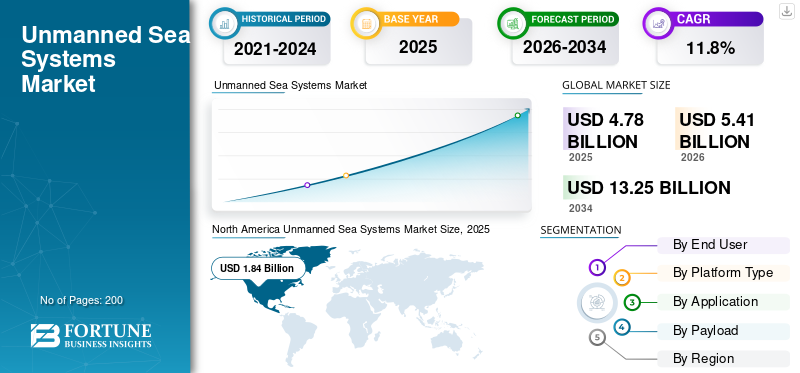
Download Free sample to learn more about this report.
Unmanned Sea Systems Market KEY TAKEAWAYS
 Global Market Size & Forecast
- 2025 Market Size: USD 4.78 billion
- 2026 Market Size: USD 5.41 billion
- 2034 Forecast Market Size: USD 13.25 billion
- CAGR: 11.8% during 2026–2034
 Market Share
- North America dominated the global market with a 37.78% share in 2025.
- Naval Forces accounted for the largest market share in 2025.
- Unmanned Surface Vehicles dominated the platform segment in 2025.
 Key Regional Highlights
North America
Dominated the market in 2025 with a valuation of USD 1.84 billion, supported by U.S. Navy procurement programs.
Europe
The market is estimated to reach USD 1.38 billion in 2026, supported by naval modernization initiatives.
Asia Pacific
The market is projected to reach USD 1.55 billion in 2026 and register the highest CAGR of 12.4%.
U.S.
The market is estimated at approximately USD 1.81 billion in 2026.
Japan
The market is estimated at approximately USD 0.31 billion in 2026, with a CAGR of around 11.6%.
Read More

UNMANNED SEA SYSTEMS MARKET TRENDS
AI-Driven Autonomy and Multi-Domain Integration to Transform Unmanned Maritime Systems’ Capabilities
A prominent trend reshaping the market is the rapid integration of artificial intelligence, machine learning, and autonomous decision-making into both surface and underwater platforms. Naval forces are moving beyond remotely operated systems toward truly autonomous vessels capable of conducting persistent surveillance, coordinated swarm operations, and real-time threat assessment with minimal human intervention. Simultaneously, cross-domain interoperability enabling seamless data exchange between unmanned surface vehicles, underwater drones, aerial assets, and command networks is becoming a defining competitive differentiator, pushing manufacturers to develop open-architecture platforms compatible with evolving naval communication and battle management ecosystems.
MARKET DYNAMICS
MARKET DRIVERS
Download Free sample to learn more about this report.
Escalating Maritime Security Threats and Naval Modernization Imperatives to Accelerate Product Adoption
The rising geopolitical rivalries, territorial disputes in contested maritime zones, and increasing incidents of piracy and smuggling are compelling governments to modernize their naval fleets with unmanned systems. These platforms enable persistent maritime domain awareness without risking human lives in high-threat environments. Naval forces are prioritizing autonomous surface and undersea vehicles to supplement manned fleets, reduce operational costs, and extend surveillance reach across vast ocean territories propelling unmanned sea systems market growth. Defense budget expansions across NATO member states, Indo-Pacific nations, and Gulf countries are directly translating into increased procurement programs for unmanned surface vehicles, autonomous underwater vehicles, and associated sensor and communication payloads.
MARKET RESTRAINTS
High Development Costs and Regulatory Complexity May Limit Broader Market Penetration
The market faces considerable restraint from the high capital investment required for research, development, and qualification of advanced autonomous maritime platforms. Complex waterproofing, pressure tolerance, and corrosion-resistant engineering requirements significantly elevate production costs compared to land or air unmanned systems. Furthermore, the absence of harmonized international maritime regulations governing autonomous vessel operations creates deployment uncertainty for both military and commercial operators. Export control frameworks such as ITAR and EAR impose restrictions on technology transfer, constraining market expansion in allied and partner nations. These aspects may slow the pace at which manufacturers can scale production and recoup development expenditures.
MARKET OPPORTUNITIES
Expanding Mine Countermeasures and Anti-Submarine Warfare Programs to Create Significant Growth Avenues
A significant market opportunity lies in the globally growing demand for unmanned systems dedicated to mine countermeasures and anti-submarine warfare as navies seek to replace legacy manned platforms with safer, more cost-effective autonomous alternatives. Emerging economies are investing in indigenous naval unmanned programs, opening new procurement pipelines. Additionally, dual-use commercial applications including offshore energy infrastructure inspection, deep-sea scientific research, and port security are creating new avenues for business growth. The convergence of affordable sensor miniaturization and improved battery and fuel-cell propulsion technologies further accelerates the feasibility for next-generation unmanned maritime missions across both defense and commercial segments.
MARKET CHALLENGES
Communication Reliability and Cybersecurity Vulnerabilities to Create Critical Operational Obstacles
One of the most persistent challenges in the market is ensuring reliable, low-latency communication between autonomous platforms and command infrastructure, particularly in GPS-denied, deep-water, or electromagnetically contested environments. Underwater acoustic communication bandwidth limitations constrain real-time data transmission for subsurface vehicles. Simultaneously, increasing system connectivity exposes unmanned sea platforms to sophisticated cyber threats, including signal spoofing, jamming, and unauthorized control. Developing resilient, encrypted communication architectures that can operate autonomously under degraded conditions while maintaining mission integrity remains a formidable technical challenge requiring sustained investment from both defense agencies and industry participants.
Segmentation Analysis
By End User
Escalating Naval Threats and Fleet Modernization to Drive Naval Forces Segment Growth
Based on end user, the market is segmented into naval forces, coast guards & maritime border security agencies, and offshore critical infrastructure & commercial maritime operators.
The naval forces segment accounted for the largest unmanned sea systems market share in 2025. The product demand for the segment is rising as maritime threat environments grow increasingly complex. Navies worldwide are deploying unmanned systems to supplement manned fleets, conduct persistent surveillance, execute mine countermeasures, and support anti-submarine operations, while reducing crew risk and extending operational reach across contested and deep-ocean environments.
The offshore critical infrastructure & commercial maritime operators segment is anticipated to rise at a CAGR of 13.0% over the forecast period.
By Platform Type
Rising Need for Cost-effective Maritime Surveillance Systems to Fuel Unmanned Surface Vehicles Segment Growth
Based on platform type, the market is segmented into unmanned surface vehicles, unmanned underwater vehicles, autonomous underwater vehicles, remotely operated vehicles, and hybrid surface-underwater systems.
In 2025, the unmanned surface vehicles segment dominated the global market. The demand for these vehicles is accelerating as defense agencies require cost-effective, enduring surface platforms for patrol, escort, and threat detection missions. USVs offer scalable deployment in contested littoral zones and open-ocean environments, enabling continuous monitoring and rapid response capabilities without committing crewed vessels to high-risk operational scenarios.
The hybrid surface-underwater systems segment is projected to expand at a CAGR of 13.4% over the forecast period.
To know how our report can help streamline your business, Speak to Analyst
By Application
Rising Demand for Consistent Maritime Monitoring to Propel the Intelligence, Surveillance & Reconnaissance Segment Growth
Based on application, the market is segmented into intelligence, surveillance & reconnaissance, mine countermeasures, anti-submarine warfare, maritime security & force protection, and electronic warfare & signals intelligence.
The intelligence, surveillance & reconnaissance segment is anticipated to witness a dominating market share over the forecast period. The product demand across the ISR segment is expanding as naval and coast guard forces prioritize persistent, wide-area ocean monitoring. Unmanned sea systems equipped with advanced sensor suites deliver continuous, covert intelligence collection across expansive maritime domains, enabling faster threat identification, improved situational awareness, and more informed command decisions in both peacetime and conflict scenarios.
The electronic warfare & signals intelligence segment is projected to grow at a high CAGR of 12.9% over the forecast period.
By Payload
Increasing Undersea Threat Detection Requirements to Drive Sonar & Acoustic Sensors Segment Growth
Based on payload, the market is segmented into sonar & acoustic sensors, electro-optical/infrared sensors, radar & surface surveillance payloads, mine detection & neutralization payloads, electronic warfare/SIGINT payloads, and weaponized/combat payloads.
The sonar & acoustic sensors segment dominated the global market share in 2025. The product demand is surging as navies intensify focus on anti-submarine warfare and underwater domain awareness. Advanced sonar payloads integrated into autonomous underwater vehicles enable the detection and classification of hostile submarines, underwater drones, and unexploded ordnance, making high-performance acoustic sensing systems indispensable for modern maritime defense operations.
In addition, the electronic warfare/SIGINT payloads segment is projected to grow at a CAGR of 13.6% during the analysis period.
Unmanned Sea Systems Market Regional Outlook
By geography, the market is categorized into North America, Europe, Asia Pacific, and the rest of the world.
North America
North America Unmanned Sea Systems Market Size, 2025 (USD Billion)
To get more information on the regional analysis of this market, Download Free sample
North America held the dominant share in 2024, with a valuation of USD 1.62 billion, and also maintained the leading share in 2025, accounting for a value of USD 1.84 billion. North America leads the global market, driven by substantial procurement programs by the U.S. Navy, presence of advanced domestic manufacturing capabilities, and significant defense R&D investments targeting autonomous underwater and surface vehicle development for naval superiority.
U.S. Unmanned Sea Systems Market
Based on North America’s strong contribution and the dominance of the U.S. within the region, the U.S. market can be analytically approximated at around USD 1.81 billion in 2026, representing a CAGR of roughly 11.2% over the forecast period. The U.S. dominates the global market, with the Navy actively deploying unmanned surface and underwater vehicles through programs such as XLUUV and Ghost Fleet, backed by robust Pentagon budgets prioritizing autonomous maritime warfare capabilities.
Europe
The Europe market is estimated to reach a value of USD 1.38 billion in 2026 and secure the position of third largest region in the market. Europe represents a significant market supported by NATO-aligned naval modernization initiatives, growing investment in mine countermeasures, and rising defense budgets among member states responding to evolving maritime security threats in the Baltic, North Sea, and Mediterranean regions.
U.K. Unmanned Sea Systems Market
The U.K. market is estimated to hit a valuation of around USD 0.34 billion in 2026, representing a CAGR of roughly 11.9% during the forecast period. The U.K. market is advancing unmanned sea capabilities through modernization programs of the Royal Navy. These initiatives are aimed at investing in autonomous mine countermeasure vessels and surveillance USVs as part of the nation’s broader maritime defense transformation strategy.
Germany Unmanned Sea Systems Market
The Germany market is projected to reach approximately USD 0.28 billion in 2026. Germany is expanding its naval unmanned systems focus within NATO obligations, investing in autonomous underwater surveillance and mine detection platforms to strengthen Baltic Sea security and fulfill alliance maritime defense commitments.
Asia Pacific
The Asia Pacific market is projected to record a CAGR of 12.4% during the forecast period, which is the highest among all regions, and reach a valuation of USD 1.55 billion by 2026. Asia Pacific is the fastest-growing regional market, propelled by escalating maritime territorial disputes, rapid naval fleet expansion in China, India, Japan, and South Korea, and increased government funding for indigenous unmanned sea system development and deployment.
China Unmanned Sea Systems Market
The China market is projected to be one of the largest markets in Asia Pacific, with 2026 revenues estimated to hit around USD 0.61 billion. China is aggressively developing unmanned systems as part of its broader naval expansion strategy, deploying autonomous surface and underwater vehicles for surveillance, anti-submarine warfare, and asserting influence across disputed South China Sea territories.
Japan Unmanned Sea Systems Market
The Japan market is estimated to capture a valuation of around USD 0.31 billion in 2026 and depict a CAGR of roughly 11.6% during the forecast period. Japan is rapidly integrating uncrewed systems into its Maritime Self-Defense Force modernization plan, prioritizing underwater surveillance drones and autonomous patrol vessels to counter submarine threats and monitor vast Pacific Ocean maritime territories.
India Unmanned Sea Systems Market
The India market is estimated to reach around USD 0.27 billion in 2026. India is investing in indigenous unmanned sea system development under its defense self-reliance initiatives, procuring autonomous surface and underwater vehicles to strengthen maritime domain awareness across the Indian Ocean Region's expansive and strategically critical waters.
Rest of the World
The rest of the world includes the Middle East and Africa and Latin America. These regions are expected to witness moderate growth during the forecast period. The Middle East & Africa and Latin America markets are set to reach USD 0.28 billion and USD 0.13 billion, respectively, in 2026. The rest of the world market is gradually expanding as the Middle Eastern, Latin American, and African naval forces begin incorporating unscrewed systems for coastal patrol, port security, and maritime surveillance. Technology transfer agreements and growing defense collaboration programs support these initiatives.
COMPETITIVE LANDSCAPE
Key Industry Players
Pivotal Players Focus on Autonomous Maritime Platforms and Mine Countermeasures Systems to Bolster their Market Presence
In the unmanned sea systems market, key players are depicting a shift in solutions for naval and maritime operations from crewed, platform-heavy missions toward autonomous, distributed, and lower-risk sea-based systems. Companies such as BAE Systems, Boeing, L3Harris Technologies, Huntington Ingalls Industries, Leidos, Textron Systems, Kongsberg Discovery, and so on are focusing on unmanned surface vessels, autonomous underwater vehicles, extra-large UUVs, mine-countermeasure systems, ISR payloads, acoustic sensors, secure command-and-control software, and AI-enabled mission autonomy.
Boeing records a significant position in the market given its large-displacement undersea systems such as the Orca XLUUV, while HII is strengthening its standing through REMUS and advanced UUV capabilities for underwater intelligence, surveillance, and reconnaissance. Kongsberg and Saab are contributing through mature AUV, sonar, and mine-warfare solutions, whereas Textron Systems and Leidos are advancing unmanned surface platforms for mine countermeasures, force protection, and maritime surveillance.
LIST OF KEY UNMANNED SEA SYSTEMS COMPANIES PROFILED
- BAE Systems (U.K.)
- Boeing (U.S.)
- L3Harris Technologies (U.S.)
- Huntington Ingalls Industries (U.S.)
- Leidos (U.S.)
- Textron Systems (U.S.)
- Kongsberg Discovery (Norway)
- Saab AB (Sweden)
- General Dynamics Mission Systems (U.S.)
- Anduril Industries (U.S.)
KEY INDUSTRY DEVELOPMENTS
- May 2026: The U.S. Navy's Naval Information Warfare Center (NIWC) Pacific awarded a USD 349.4 million multiple-award IDIQ contract to nine defense vendors (including HII and Science Applications International Corp.) for uncrewed maritime systems support through 2034.
- April 2026: The U.K. Ministry of Defence awarded HII Unmanned Systems Inc. a USD 3.3 million contract for in-service support of the Royal Navy's REMUS 100 and REMUS 300 UUV fleets.
- February 2026: The U.S. Air Force awarded a USD 25 million Foreign Military Sales (FMS) contract to Liquid Robotics Inc. to procure 20 uncrewed surface vehicles (USVs) for Japan. The deal is aimed at enhancing Japan's maritime security capabilities by bolstering surveillance and ocean data collection.
- February 2026: Teledyne Marine and U.K.-based M Subs signed an MoU for a strategic collaboration targeting naval opportunities, including the joint deployment of autonomous gliders and AUVs.
- March 2025: Liquid Robotics (a Boeing company) and India's Sagar Defence Engineering signed an MoU to co-develop and produce Autonomous Surface Vehicles (ASVs) for enhanced maritime domain awareness.
REPORT COVERAGE
The unmanned sea systems market research report offers a detailed analysis of emerging trends and rapidly adopted technologies in the industry across key regions. The report outlines key factors driving market growth and challenges to expansion, delivering a detailed overview of the maritime industry landscape. The study also highlights recent advancements to support stakeholders in making well-informed decisions.
Request for Customization to gain extensive market insights.
Report Scope & Segmentation
| ATTRIBUTE | DETAILS |
| Study Period | 2021-2034 |
| Base Year | 2025 |
| Estimated Year | 2026 |
| Forecast Period | 2026-2034 |
| Historical Period | 2021-2024 |
| Growth Rate | CAGR of 11.8% from 2026-2034 |
| Unit | Value (USD Billion) |
| Segmentation | By End User, By Platform Type, By Application, By Payload, and Region |
| By End User |
|
| By Platform Type |
|
| By Application |
|
| By Payload |
|
| By Region |
|
Frequently Asked Questions
According to Fortune Business Insights, the global market value stood at USD 4.78 billion in 2025 and is projected to reach USD 13.25 billion by 2034.
In 2025, the North America market value stood at USD 1.84 billion.
The market is expected to exhibit a CAGR of 11.8% during the forecast period of 2026-2034.
By end user, the naval forces segment led the market in 2025.
Escalating maritime security threats and naval modernization imperatives are key factors propelling the expansion of the market.
BAE Systems (U.K.), Boeing (U.S.), L3Harris Technologies (U.S.), Huntington Ingalls Industries (U.S.), Leidos (U.S.), Textron Systems (U.S.) are major players in the global market.
North America dominated the market in 2025.



- 2021-2034
- 2025
- 2021-2024
- 200
Get 30-60 hrs Free Customization
Expand Regional and Country Coverage, Segments Analysis, Company Profiles, Competitive Benchmarking, and End-user Insights.




















-
US +1 833 909 2966 ( Toll Free )
-
Get In Touch With Us