UPS Battery Market Size, Share & Industry Analysis, By Battery Type (Lead Acid, Lithium-ion, Nickel Cadmium, and Others), By Application (Residential, Commercial, and Industrial), By End-use (Data Centers, Telecommunication, Industrial, Healthcare, Consumer Electronics, and Others), and Regional Forecast, 2026-2034
 Download Free Sample
UPS Battery Market Size and Future Outlook
 Listen to Audio Version
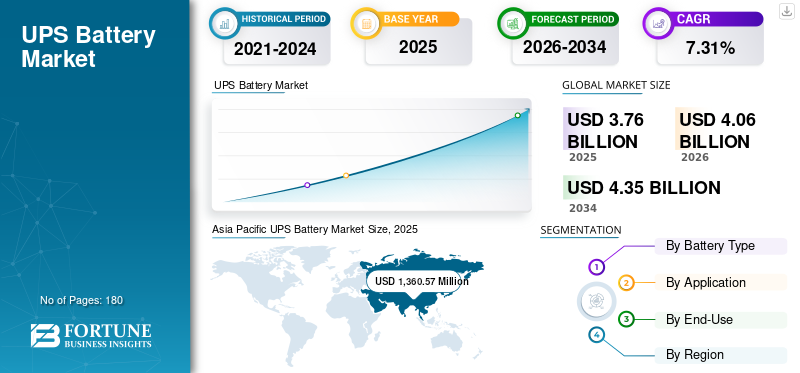
The global UPS battery market size was valued at USD 3,766.3 million in 2025 and is projected to grow from USD 4,060.67 million in 2026 to USD 4,352.60 million by 2034 at a CAGR of 7.31% during the forecast period. Asia Pacific dominated the ups battery market with a market share of 36.12% in 2025.
The Asia Pacific region dominated the global UPS battery market, driven by rapid industrialization, extensive data center expansion, and the rising adoption of lithium-ion technology in countries such as China, India, and Japan.
UPS Battery (PTF) is a chemical recycling process that converts non-recyclable or difficult-to-recycle materials into usable products. A Uninterruptible Power Supply (UPS) battery is a rechargeable energy storage device that serves as the core component of a UPS system, providing immediate, short-term power to electronic equipment when the primary utility power fails or drops to an unacceptable voltage level. It bridges the gap between power loss and the activation of backup generators, or enables a controlled shutdown of critical systems to prevent data loss and hardware damage. The rapid expansion of hyper-scale data centers, colocation facilities, and cloud computing requires constant, uninterruptible power (99.999% uptime), making them the primary market driver.
EnerSys is a dominant global leader in stored energy solutions for industrial applications, including the UPS market, with a strong presence in North America and Europe. Supported by brands such as DataSafe and PowerSafe, they compete alongside major industry players such as GS Yuasa Corporation, Exide Technologies, and East Penn Manufacturing to meet rising data center and industrial power demands.
Download Free sample to learn more about this report.
UPS Battery Market Key Takeaways
 Market Size & Forecast
- 2025 Market Size: USD 3,766.3 Million
- 2026 Market Size: USD 4,060.67 Million
- 2034 Forecast Market Size: USD 4,352.60 Million
- CAGR: 7.31% from 2026–2034
 Market Share
- Asia Pacific dominated the UPS battery market with a 36.12% share in 2025.
- Lead-acid batteries accounted for 50.00% of the market share in 2025.
- The industrial segment held 60.40% of the market share in 2025.
 Key Regional Highlights
Asia Pacific
Asia Pacific led the market with a value of USD 1,360.57 million and a 36.12% share in 2025.
North America
North America reached USD 1,136.76 million in 2025, supported by data center expansion and AI workloads.
Europe
Europe accounted for USD 927.80 million in market value in 2025, driven by industrial automation and renewable energy adoption.
U.S.
The UPS battery market reached USD 1,013.23 million in 2025, representing approximately 26.90% of global revenue.
Japan
The UPS battery market was valued at USD 180.74 million in 2025, accounting for approximately 4.80% of global revenue.
Read More

UPS BATTERY MARKET TRENDS
Shift from Lead-Acid to Lithium-ion Batteries Boosts New Market Trends
The UPS battery market is witnessing a structural transition from traditional lead-acid batteries to lithium-ion technologies, driven by higher energy density, longer lifecycle, and reduced maintenance requirements. Data centers and large enterprises are increasingly adopting lithium-ion UPS systems to reduce total cost of ownership (TCO) over time, despite higher upfront costs.
- In June 2024, Delta launched the revolutionary UZR Gen3 Series UPS Li-ion battery system for data centers, offering unmatched safety, reliability, and TCO reduction. It features a compact design, high power density, UL9540A certification, and a lifespan of up to 10 years.
Additionally, lithium-ion batteries offer faster charging rates and better performance at high temperatures, making them suitable for modern digital infrastructure. However, lead-acid batteries continue to dominate due to their cost-effectiveness, especially in price-sensitive markets such as the Asia Pacific, Latin America, and Africa. This dual-technology landscape is expected to persist through the forecast period.
MARKET DYNAMICS
MARKET DRIVERS
Download Free sample to learn more about this report.
Rapid Expansion of Data Centers and Digital Infrastructure is Driving the Market
The market is witnessing a structural transition from traditional lead-acid batteries to lithium-ion technologies, driven by higher energy density, longer lifecycle, and reduced maintenance requirements. Including data centers and large enterprises are increasingly adopting lithium-ion UPS systems to reduce total cost of ownership (TCO) over time, despite higher upfront costs.
- In March 2026, NTT DATA opened the Keihanna Data Center in Japan's Kansai Region on April 9th, 2026, expanding digital infrastructure to support AI, cloud computing, and high-performance workloads amid growing regional demand.
Additionally, lithium-ion batteries offer faster charging rates and better performance at high temperatures, making them suitable for modern digital infrastructure. However, lead-acid batteries continue to dominate due to their cost-effectiveness, especially in price-sensitive markets such as the Asia Pacific, Latin America, and Africa. This dual-technology landscape is expected to persist through the forecast period.
MARKET RESTRAINTS
High Initial Cost of Lithium-ion Battery Systems Restraints the Market Growth
Despite their long-term benefits, lithium-ion UPS batteries face adoption barriers due to their significantly higher upfront costs compared to lead-acid alternatives. This cost differential is particularly impactful in developing regions and small-scale applications, where capital expenditure constraints influence purchasing decisions. Many end users prioritize lower initial investment over lifecycle savings, slowing the transition to advanced battery technologies. Furthermore, the need for specialized battery management systems (BMS) and safety mechanisms adds to the overall system cost. As a result, lead-acid batteries continue to dominate a large portion of the market, limiting the pace of technological transition and restraining rapid revenue growth in the premium segment.
MARKET OPPORTUNITIES
Growth in Emerging Markets with Unreliable Power Infrastructure Offers Lucrative Opportunities
Emerging economies in Asia Pacific, Latin America, and Africa offer significant growth opportunities for the market due to frequent power outages and grid instability. Industries, telecom towers, healthcare facilities, and small businesses in these regions increasingly rely on UPS systems for operational continuity. As electrification and digitalization expand, the demand for reliable power solutions is expected to grow substantially. Additionally, government initiatives to improve digital connectivity and industrial development are further boosting UPS adoption. The increasing penetration of small and medium enterprises (SMEs) and rising awareness of power reliability solutions are driving strong demand for UPS batteries, particularly cost-effective lead-acid systems.
MARKET CHALLENGES
Environmental Concerns and Battery Disposal Issues Create Challenges for Market Development
Environmental regulations and concerns related to battery disposal and recycling pose significant challenges for the market, particularly for lead-acid batteries. Improper disposal can lead to hazardous lead contamination and environmental damage, prompting stricter regulatory frameworks across regions such as Europe and North America. Compliance with these regulations increases operational costs for manufacturers and recyclers. Additionally, the recycling infrastructure in developing regions remains underdeveloped, exacerbating environmental risks. While lithium-ion batteries offer environmental advantages in operation, their recycling ecosystem is still evolving and remains complex. Managing end-of-life battery disposal sustainably while maintaining cost efficiency is a critical challenge for industry participants moving forward.
Segmentation Analysis
By Battery Type
Lead-acid Batteries Lead the Segmental Growth Due to Widespread Availability and Effectiveness
Based on battery type, the market is classified into lead-acid, lithium-ion, nickel-cadmium, and others.
In 2025, Lead-acid batteries dominated the UPS battery market share of 50.00%, due to their cost-effectiveness, reliability, and widespread availability.
Meanwhile, lithium-ion is the fastest-growing segment, with a CAGR of 9.51% during the forecast period. This is driven by superior energy density, longer lifespan, faster charging, and compact design, fueling demand in data centers, telecom, and renewable energy applications.
By Application
Industrial Segment Leads the Market Due to High Uptime Requirements and Critical Infrastructure
Based on application, the market is classified into residential, commercial, and industrial.
In 2025, the industrial segment accounted for 60.40% of market share, driven by its massive power demands, high uptime requirements, and critical infrastructure needs worldwide.
Meanwhile, the residential segment is expected to witness significant growth with CAGR of 7.14%. The demand for UPS batteries in residential applications is experiencing strong growth, driven by increasing reliance on digital home infrastructure, remote work setups, smart home automation, and the need to protect sensitive electronics from frequent power outages and grid instability.
To know how our report can help streamline your business, Speak to Analyst
By End-Use
Data Center Emerged as the Leading Segment Owing to the Surging Cloud Computing and AI Workloads
Based on end-use, the market is classified into data centers, telecommunication, industrial, healthcare, consumer electronics, and others.
In 2025, the data center segment accounted for 41.52% of market share, driven by its critical need for uninterrupted power amid surging cloud computing and AI workloads.
Meanwhile, telecommunications is one of the fastest-growing segments, with a CAGR of 6.99% over the forecast period. Rising home automation, smart appliances, frequent outages, and affordable backup solutions for off-grid living propel the segment.
UPS Battery Market Regional Outlook
By region, the market is categorized into North America, Europe, Asia Pacific, Latin America, and the Middle East & Africa.
Asia Pacific
Asia Pacific UPS Battery Market Size, 2025 (USD Million)
To get more information on the regional analysis of this market, Download Free sample
Asia Pacific held the largest share in 2025, valued at USD 1,360.57 million. In 2026, the region is expected to hold USD 1,480.41 million. Asia Pacific dominates the market, driven by rapid urbanization, booming data center growth, telecom expansion, and renewable energy integration across China, India, and Japan. Rising industrial and residential demand, coupled with the adoption of lithium-ion technology, drive robust growth amid improving grid reliability.
China UPS Battery Market
The Chinese market in 2025 reached USD 533.28 million, accounting for roughly 14.16% of the global revenues. The region thrives on surging data center growth, driven by increasing telecom expansion and industrial power needs. Lithium-ion batteries lead adoption for their efficiency, supporting digitalization and renewable integration across urban and manufacturing hubs.
India UPS Battery Market
India's market is projected to be among the largest worldwide, with 2025 revenues of USD 252.88 million, representing approximately 6.71% of the global market. The regional market is growing rapidly amid power outages, data center expansion, a surge in telecom, and industrialization. Lead-acid batteries dominate for affordability, while lithium-ion batteries gain traction for efficiency in the IT and residential sectors.
Japan UPS Battery Market
The Japan market in 2025 valued at USD 180.74 million, accounting for approximately 4.80% of global revenues.
North America
The North American market reached USD 1,136.76 million in 2025, driven by massive data center expansion, increasing AI workloads, and critical infrastructure resilience needs. The U.S dominates the region, with high demand for lithium-ion technology over traditional lead-acid due to superior performance in mission-critical applications.
U.S. UPS Battery Market
With North America's strong contribution and the U.S. dominance in the region, the U.S. market reached USD 1,013.23 million in 2025, accounting for roughly 26.90% of the global market. The U.S. market thrives on data center expansion, cloud computing demands, and critical infrastructure needs in healthcare and telecom. Lithium-ion batteries gain traction for efficiency amid focus on renewable integration and power reliability.
Europe
Europe regional market accounted for a value of USD 927.80 million in 2025. Europe's market grows steadily, driven by data center expansion, industrial automation, and renewable energy needs. Lithium-ion batteries lead in efficiency, with Germany dominating amid a sustainability focus.
Germany UPS Battery Market
The German market in 2025 reached USD 188.74 million. It is projected to reach USD 203.46 million by 2026, representing approximately 5.01% of the global industry revenues.
Latin America
Latin America is expected to witness moderate growth in this market space during the forecast period. The Latin America market is set to reach a valuation of USD 224.37 million in 2026. The regional market is expanding amid unstable grids, data center growth, and industrial demand. Brazil leads, with lithium-ion batteries gaining favor for efficiency in telecom and renewables.
Brazil UPS Battery Market
The Brazilian market reached approximately USD 102.15 million in 2025, accounting for a very minor share of the global market.
Middle East & Africa
The Middle East & Africa accounted for 3.42% market share in 2025 and are expected to witness significant growth in this market during the forecast period. The Middle East and Africa market reached a valuation of USD 128.95 million in 2025.
GCC UPS Battery Market
The GCC market reached approximately USD 67.79 million in 2025, accounting for around 1.80% of the global revenue. The Middle East & Africa market is growing amid frequent outages, a telecom surge, and data center expansion. Saudi Arabia leads, with lithium-ion batteries boosting renewables and industrial reliability.
COMPETITIVE LANDSCAPE
Key Industry Players
Strategic Partnership with Safeware Among Major Key Industry Players Leads to Market Strengthening
The global industry is considered fragmented, featuring a mix of major global players and numerous regional market players. EnerSys, GS Yuasa Corporation, Exide Technologies, and East Penn Manufacturing are some of the prominent players in the market.
For instance, in May 2024, KULR Technology added United Parcel Service to its battery safety shipping platform and formed a strategic partnership with Safeware for an online marketplace. It offers SafeCASE and SafeSLEEVE for secure transport of lithium-ion batteries up to 2.5kWh. Such developments are expected to fuel market growth during the forecast period.
LIST OF KEY UPS BATTERY COMPANIES PROFILED
- EnerSys (U.S.)
- GS Yuasa Corporation (Japan)
- Exide Technologies (U.S.)
- East Penn Manufacturing (U.S.)
- Leoch International Technology Limited (Singapore)
- Narada Power Source Co., Ltd. (China)
- C&D Technologies, Inc. (U.S.)
- Saft Groupe S.A. (France)
- Amara Raja Energy & Mobility Limited (India)
- HBL Power Systems Ltd. (India)
- Samsung SDI Co., Ltd. (South Korea)
- LG Energy Solution Ltd. (South Korea)
- BYD Company Limited (China)
- Toshiba Corporation (Japan)
- Hitachi Energy Ltd. (Switzerland)
KEY INDUSTRY DEVELOPMENTS
- February 2026: Honda-backed OMC Power launched India's first UPS leasing service using Mobile Power Pack e: stationary storage in Uttar Pradesh. It stabilizes power, cuts emissions by repurposing EV batteries, and has already gained 56 users.
- October 2025: Solidion Technology launched the PEAK Series UPS battery system for AI data centers, featuring its 5500-cell with silicon-carbon anode tech. It offers 30% space savings, three times longer life, and lower costs versus conventional backups.
- October 2025: Altech Batteries, partnering with AMPower, launched a 15kWh sodium-nickel-chloride UPS battery for European gas pipelines. It's explosion-proof, maintenance-free, drop-in replacement for lead-acid, ideal for ATEX zones.
- July 2024: ABB introduced nickel-zinc (NiZn) batteries from ZincFive for its MegaFlex UPS solutions targeting data centers. They provide safer, compact, sustainable power with a lower carbon footprint, less maintenance, and high energy efficiency for mission-critical applications.
- February 2024: Consistent Infosystems launched its advanced UPS Battery in India, featuring an eco-friendly design, fast charging, and long-life performance for reliable power during outages in IT, telecom, and data centers.
REPORT COVERAGE
The global UPS battery market analysis provides an in-depth study of the market size & forecast by all the segments included in the report. It contains details on the market dynamics and industry trends expected to drive the growth in the forecast period. It offers information on technological advancements, new product launches, key industry developments, and partnerships, mergers & acquisitions. The market report also encompasses a detailed competitive landscape, including market share and profiles of key players.
Request for Customization to gain extensive market insights.
Report Scope & Market Segmentation
| ATTRIBUTE | DETAILS |
| Study Period | 2021-2034 |
| Base Year | 2025 |
| Estimated Year | 2026 |
| Forecast Period | 2026-2034 |
| Historical Period | 2021-2024 |
| Growth Rate | CAGR of 7.31% from 2026-2034 |
| Unit | Value (USD Million) |
| Segmentation | By Battery Type, Application, End-Use, and Region |
| By Battery Type |
|
| By Application |
|
| By End-Use |
|
| By Region |
|
Frequently Asked Questions
Fortune Business Insights says that the global Market value stood at USD 3,766.3 million in 2025 and is projected to reach USD 4,352.60 million by 2034.
In 2025, the market value stood at USD 1.36 million.
The market is expected to exhibit a CAGR of 7.31% during the forecast period of 2026-2034.
The industrial led the application segment.
Rapid expansion of data centers and digital infrastructure is driving the market.
EnerSys, GS Yuasa Corporation, Exide Technologies, and East Penn Manufacturing are some of the prominent players in the market.
Asia Pacific dominated the market in 2025.



- 2021-2034
- 2025
- 2021-2024
- 180
Get 30-60 hrs Free Customization
Expand Regional and Country Coverage, Segments Analysis, Company Profiles, Competitive Benchmarking, and End-user Insights.



















Related Reports
-
US +1 833 909 2966 ( Toll Free )
-
Get In Touch With Us