 Download Free Sample



Get a Quote
Receive a tailored pricing based on your needs.
- Choose license type
- Multiple user options
- Custom scope & coverage
- Fast turnaround
"Designing Growth Strategies is in our DNA"
 Listen to Audio Version
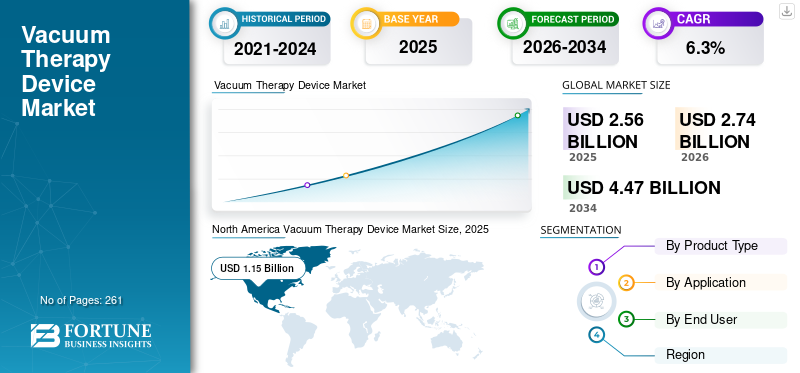
The global vacuum therapy device market size was valued at USD 2.56 billion in 2025 and is projected to grow from USD 2.74 billion in 2026 to USD 4.47 billion by 2034, exhibiting a CAGR of 6.3% during the forecast period. North America dominated the vacuum therapy device market with a market share of 44.92% in 2025.
A vacuum therapy device is a non-invasive mechanical pump used for the treatment of erectile dysfunction (ED) and acute and chronic wounds among the patient population. The rising prevalence of acute and chronic wounds, increasing incidence of erectile dysfunction, and growing healthcare expenditure are driving the adoption of these devices in the market. The increasing aging population is further contributing to the demand for the product in the market.
Furthermore, the increasing incorporation of technological innovations in this equipment among the major companies, such as Mölnlycke AB and Solventum, among others, is further driving their adoption in the market.
Download Free sample to learn more about this report.
 Global Market Size & Forecast
 Market Share
 Key Regional Highlights
North America
Valued at USD 1.15 billion in 2025 and projected to reach USD 1.23 billion in 2026.
Asia Pacific
Projected to reach USD 0.61 billion in 2026, driven by increasing surgical procedures and demand for chronic wound therapy.
Europe
Expected to reach USD 0.67 billion in 2026, growing at a 5.7% CAGR during the forecast period.
U.S.
The U.S. market is projected to reach USD 1.10 billion in 2026.
Japan
The Japan market is projected to reach USD 0.10 billion in 2026.
Read More

Technological Advancements to Boost Product Demand
There are increasing technological advancements in vacuum therapy devices in the global market. The market is shifting toward single-use, easier-to-manage devices and portable vacuum therapy devices that contribute to treatment across hospitals, ambulatory surgical centers, and homecare settings. The companies are also focusing on technologically advanced devices, including home-based wound care, closed surgical incisions, and NPWT devices with instillation, which combines negative pressure with automated wound cleansing.
These innovations are enhancing patient mobility and improving clinician workflow, resulting in rising adoption of the product. Along with this, technological advancements are improving treatment convenience and compliance, further strengthening the adoption across healthcare facilities.
Download Free sample to learn more about this report.
Increasing Prevalence of Chronic Wounds to Fuel Market Growth
The increasing prevalence of chronic conditions such as diabetic foot ulcers, venous leg ulcers, and others is driving demand for negative pressure wound therapy among patients, consequently boosting the demand for the product.
In addition, improving healthcare access, a growing geriatric population, expansion of home healthcare services, and the rising availability of portable medical devices are further fueling the adoption of these devices. Moreover, the growing focus of key companies on R&D to introduce innovative devices is expected to augment adoption, thereby contributing to the global vacuum therapy device market growth.
High Cost Associated with the Product to Hamper Market Growth
The high cost associated with vacuum therapy devices remains a major restraint in the global market, especially for negative pressure wound therapy devices used in chronic and complex wound management.
These devices involve higher upfront spending for pumps, dressings, canisters, accessories, infection control requirements, and follow-up care, which makes the adoption challenging for cost-sensitive hospitals, outpatient centers, and emerging markets. The preference for standard dressings or simpler wound-care alternatives over premium NPWT systems adds to cost pressure. Additionally, an inadequate reimbursement framework and complex documentation requirements delay approvals and reduce the penetration of these devices globally.
Growth of Ambulatory Surgical Centers (ASCs)
The expansion of healthcare facilities in emerging markets, including India, China, and Mexico, is supporting market growth. The increasing number of surgical procedures, expansion of healthcare expenditure, and growing number of ambulatory surgical centers (ASCs) are driving the adoption of vacuum therapy devices in healthcare facilities. ASCs emphasize faster patient turnover, efficiency, and complication prevention, which makes advanced incision and wound management technologies increasingly relevant in these facilities.
Limited Number of Surgical Procedures in Developing Nations to Hinder Market Growth
There is an increasing demand for novel vacuum therapy devices among the patient population. However, limited healthcare spending, limited availability of technologically advanced devices, a lower number of surgical procedures, stringent regulatory approvals, and limited compliance with medical device safety standards, especially in emerging countries, are resulting in reduced access to healthcare services for patients.
Furthermore, a shortage of skilled professionals and limited funding initiatives are some of the crucial factors contributing to the low adoption of these devices, especially in emerging countries, such as China and India.
Increasing Prevalence of Acute And Chronic Wounds Boosted Negative Pressure Wound Therapy (NPWT) Segment Growth
Based on product type, the market is classified into Negative Pressure Wound Therapy (NPWT) devices and Vacuum Erection Devices (VEDs).
Negative pressure wound therapy is further subdivided into conventional NPWT and single-use NPWT. Vacuum erection devices (VEDs) are further fragmented into manual devices and battery-powered devices.
To know how our report can help streamline your business, Speak to Analyst
The negative pressure wound therapy (NPWT) devices segment held the largest market share in 2025 due to the increasing prevalence of acute and chronic wounds among the patient population, resulting in a rising demand for NPWT devices globally. This, along with the growing focus of major companies on launching innovative devices, is further boosting the segment’s growth.
The vacuum erection devices (VEDs) segment is expected to grow at a CAGR of 4.5% over the forecast period.
Increasing Prevalence of Chronic Wounds Led to the Dominance of the Segment
Based on application, the market is segmented into chronic wounds, acute wounds, and erectile dysfunction.
The chronic wounds segment dominated the global market in 2025, holding a share of 58.8% in 2025. The growth is due to the increasing prevalence of chronic wounds, which is driving demand for vacuum therapy devices and contributing to overall market expansion.
The acute wounds segment is set to flourish with a growth rate of 6.3% during the forecast period.
Increasing Number of Surgical Procedures Boosted Hospitals & ASCs Segment Growth
Based on end user, the market is divided into hospitals & ASCs, specialty clinics, homecare settings, and others.
The hospitals & ASCs segment dominated the market in 2025. The increasing prevalence of chronic conditions, rising number of surgical procedures, growth in the number of hospitals are among the major factors contributing to the segment’s growth. Furthermore, the segment is set to hold a 50.7% share by 2026.
The specialty clinics segment is projected to grow at a 5.8% CAGR during the forecast period.
Based on region, the market is studied across North America, Europe, Asia Pacific, Latin America, and the Middle East & Africa.
North America Vacuum Therapy Device Market Size, 2025 (USD Billion)
To get more information on the regional analysis of this market, Download Free sample
The North American market held the dominant share in 2024, valued at USD 1.07 billion, and also maintained its leading share in 2025 with USD 1.15 billion. The growing prevalence of diabetic foot ulcers and pressure ulcers, increasing adoption of NPWT and VED devices, developed healthcare infrastructure, and technological advancement in this equipment are some of the key factors contributing to the growth of the region.
Based on North America’s strong contribution and the U.S. dominance within the region, the U.S. market is likely to reach around USD 1.10 billion by 2026, accounting for roughly 40.1% of global sales.
Europe is projected to record a growth rate of 5.7% in the coming years, which is the second-highest among all regions. The region is slated to reach a valuation of USD 0.67 billion by 2026. The growing technological advancements in these devices are likely to contribute to market growth.
The U.K. market is estimated to reach around USD 0.10 billion by 2026, representing roughly 3.6% of global revenues.
Germany’s market is projected to reach approximately USD 0.12 billion by 2026, equivalent to around 4.6% of global sales.
The Asia Pacific market size is estimated to reach USD 0.61 billion by 2026, securing its position as the third-largest region in the market. The rapid growth in surgical procedures, along with the growing demand for chronic wound therapy and vacuum constriction devices, is likely to drive market growth. In the region, India and China are both estimated to reach USD 0.04 billion and USD 0.19 billion, respectively, by 2026.
The Japanese market is estimated to reach around USD 0.10 billion by 2026, accounting for roughly 3.7% of global revenues. Japan has historically reported a relatively high prevalence of acute and chronic wounds, along with a large number of surgical procedures.
China’s market is estimated to reach around USD 0.19 billion by 2026, representing roughly 7.1% of global sales. The growth is due to the rising number of key companies focusing on introducing novel devices in the market.
The Indian market size is estimated to reach around USD 0.04 billion by 2026, accounting for roughly 1.6% of global revenues.
The Latin America and Middle East & Africa regions are expected to witness moderate growth in this market during the forecast period. The Latin American market is set to reach a valuation of USD 0.13 billion by 2026. The growth is due to the increasing medical tourism hubs and equipment launches in the region. The Middle East & Africa region is anticipated to witness steady growth during the study period due to improving healthcare access and research and development facility expansion to strengthen its presence in the market. In the Middle East & Africa, the GCC is set to reach USD 0.04 billion by 2026.
The South African market is projected to reach around USD 0.02 billion by 2026, representing roughly 0.8% of global revenues.
Major Players Focus on Product Launches to Boost Their Product Portfolios
Mölnlycke AB and Solventum are major companies in the market in 2025. A diversified product portfolio, along with a strong emphasis on inorganic growth strategies globally, is one of the key factors contributing to the dominance of these companies in the market. Moreover, the growing focus of key companies on acquisitions and mergers is likely to strengthen their market presence, boosting the global vacuum therapy device market share.
key players, including Smith+Nephew, are also expanding their presence, primarily due to their increasing focus on product introductions to strengthen their product portfolios.
The report provides a detailed global vacuum therapy device market analysis and focuses on key aspects such as leading companies and market segmentation, including product type, application, and end user. Besides this, the global report offers insights into the market growth trends and highlights key industry developments. In addition to the aforementioned factors, the report encompasses several factors that have contributed to the growth and advancement of the market over recent years.
Request for Customization to gain extensive market insights.
| ATTRIBUTE | DETAILS |
| Study Period | 2021-2034 |
| Base Year | 2025 |
| Estimated Year | 2026 |
| Forecast Period | 2026-2034 |
| Historical Period | 2021-2024 |
| Growth Rate | CAGR of 6.3% from 2026-2034 |
| Unit | Value (USD Billion) |
| Segmentation | By Product Type, Application, End User, and Region |
| By Product Type |
|
| By Application |
|
| By End User |
|
| By Region |
|
Fortune Business Insights says that the global market size was valued at USD 2.56 billion in 2025 and is projected to reach USD 4.47 billion by 2034.
In 2025, North America’s market value stood at USD 1.15 billion.
Growing at a CAGR of 6.3%, the market will exhibit steady growth over the forecast period (2026-2034).
By product type, the negative pressure wound therapy (NPWT) devices segment dominated the market.
Increasing prevalence of chronic wounds is a key factor driving the market's growth.
Solventum and Mölnlycke AB are the major players in the global market.
North America dominated the market share.
The rising number of surgical procedures is anticipated to drive the adoption of the product globally.

Get 30-60 hrs Free Customization
Expand Regional and Country Coverage, Segments Analysis, Company Profiles, Competitive Benchmarking, and End-user Insights.













.webp)






Related Reports
Get In Touch With Us
US +1 833 909 2966 ( Toll Free )
Receive a tailored pricing based on your needs.
Discuss your questions with our industry experts.
Have questions? Get quick answers before you purchase.

