Variant Interpretation Software Market Size, Share & Industry Analysis, By Component (Software and Services), By Deployment Model (On-premise, Cloud-based, and Hybrid), By Testing (Germline Testing, Somatic Oncology Testing, Population Genomics, and Others), By Application (Disease Diagnosis, Pharmacogenomics, Drug Discovery and Development, Precision Oncology, and Others), By End User (Clinical Genetic Testing Laboratories, Academic & Research Institutes, Pharmaceutical & Biotechnology Companies, and Others), and Regional Forecast, 2026-2034
 Download Free Sample
Variant Interpretation Software Market Size and Future Outlook
 Listen to Audio Version
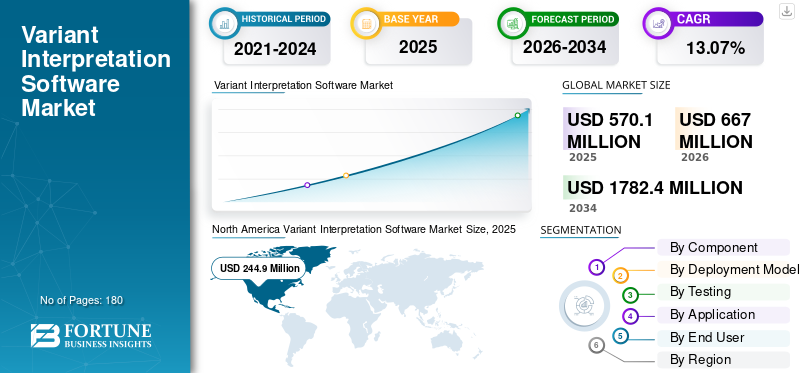
The global variant interpretation software market size was valued at USD 570.1 million in 2025. The market is projected to grow from USD 667.0 million in 2026 to USD 1,782.4 million by 2034, exhibiting a CAGR of 13.07% during the forecast period. North America dominated the variant interpretation software market with a market share of 42.95% in 2025.
The global market is experiencing steady and substantial growth. The broader genomics and personalized medicine industries use this software as it focuses on tools for analyzing, interpreting, and classifying genetic variants identified by Next-Generation Sequencing (NGS) technologies. It also assists clinicians and researchers in determining the clinical significance of genetic mutations, thereby enabling accurate diagnoses and tailored treatment plans. Furthermore, increasing genomic testing in clinical settings and the launch of advanced software for functional annotation, pathogenicity prediction, and integration with large genetic databases is driving market growth.
For instance, in January 2026, Metropolis Healthcare announced the launch of the Centre of Genomics to scale its capabilities in genomics, molecular diagnostics, precision medicine, and genomic research.
Additionally, many key industry players, such as Illumina Inc. and Qiagen are continuously enhancing their platforms with machine learning algorithms and updated databases to improve accuracy.
Download Free sample to learn more about this report.
Variant Interpretation Software Market Key Takeaways
 Global Market Size & Forecast
- 2025 Market Size: USD 570.1 million
- 2026 Market Size: USD 667.0 million
- 2034 Forecast Market Size: USD 1,782.4 million
- CAGR: 13.07% from 2026–2034
 Market Share
- North America dominated the market with a 42.95% share in 2025.
- Clinical genetic testing laboratories held the largest end-user share of 49.8% in 2025.
- Somatic oncology testing accounted for 45.0% of the market in 2025.
 Key Regional Highlights
North America
The market reached USD 244.9 million in 2025 and is driven by advanced genomic research and personalized medicine initiatives.
Asia Pacific
The market reached USD 121.6 million in 2025, driven by increasing genomic testing and rising genetic disorder prevalence.
Europe
The market is projected to reach USD 145.7 million in 2025, supported by oncology research and population genomics programs.
U.S.
The market was valued at approximately USD 226.5 million in 2025.
Japan
The market reached USD 19.9 million in 2025.
Read More

VARIANT INTERPRETATION SOFTWARE MARKET TRENDS
Increased Demand for Cloud-Based Tertiary Analysis Suites to Emerge as a Prominent Trend
The demand for cloud-based tertiary analysis suites is a significant global trend in the variant interpretation software market. This is due to the scalability, accessibility, and cost-effectiveness. Also, it will be efficient for researchers and clinicians to analyze large genomic datasets efficiently without the need for extensive local infrastructure. As the volume of genomic data continues to grow, the shift toward cloud-based suites supports faster, more flexible, and more comprehensive analysis workflows.
For instance, in January 2024, DNAnexus, Inc., a provider of the Precision Health Data Cloud, announced a collaboration with Intelliseq, a genome informatics company specializing in NGS analysis solutions. The collaboration aims to integrate Intelliseq’s automated genome interpretation and reporting tools into DNAnexus’s platform, creating a streamlined NGS data analysis pipeline and efficiently generating insights into conditions.
MARKET DYNAMICS
MARKET DRIVERS
Download Free sample to learn more about this report.
Rising Demand for Next-Generation Sequencing for Clinical Diagnosis to Drive Market Growth
The increasing adoption of Next-Generation Sequencing (NGS) in clinical diagnostics is significantly driving market growth. As NGS provides comprehensive genetic insights, there is a growing demand for advanced software solutions to analyze and interpret complex genetic data accurately. This is due to rising demand for precise diagnosis, personalized treatment plans, and early detection of genetic disorders. Also, increasing the focus of key players on launching advanced software for clinical diagnosis boost market growth.
For instance, in July 2024, Saphetor SA announced that the VarSome Clinical platform has received European CE mark approval, enabling automated variant discovery, annotation, and interpretation of Next Generation Sequencing (NGS) data in accordance with the European Union’s In-Vitro Diagnostic Medical Devices Regulation (IVDR).
MARKET RESTRAINTS
High Integration Burden to Restrict Market Growth
The high integration burden associated with variant interpretation software is a significant restraint on the variant interpretation software market growth. The need to seamlessly connect with bioinformatics pipelines, LIMS, and hospital IT and reporting systems to eliminate manual handoffs presents considerable challenges. This complexity heightens the risks of vendor switching and prolongs deployment cycles.
Moreover, many hospital organizations are hiring contract health service providers, thus highlighting that workflow integration and standardization are major practical hurdles that labs are actively funding projects to solve.
For instance, in December 2022, Congenica, an U.K. based digital health company, was awarded the second stage of a contract to develop standardized Next-Generation Sequencing (NGS) workflows in oncology for a group of seven Central European hospitals.
MARKET OPPORTUNITIES
Government Focus on Population Genomics Studies to Boost Market Growth
The increasing focus of government bodies on population genomics studies presents a significant growth opportunity for the variant interpretation software market. The growing focus on understanding genetic diversity and disease associations is driving demand for advanced software tools to efficiently analyze and interpret vast variant data. This focus fosters collaborations with biotech and healthcare sectors, driving innovation and adoption of sophisticated interpretation solutions.
For instance, in July 2025, Union Minister of State for Science & Technology, India, inaugurated the state-of-the-art Phenome India "National Biobank" at the CSIR-Institute of Genomics and Integrative Biology (IGIB), to build India’s own longitudinal health database and enable personalized treatment regimens in the future.
MARKET CHALLENGES
Data Governance and Privacy Constraints to Challenge Market Growth
Data governance and privacy constraints pose significant challenges to the market growth. Strict regulations, such as GDPR and HIPAA, limit data sharing and access, thereby hindering the ability to aggregate large datasets, which are essential for accurate variant analysis. Also, privacy concerns restrict the use of sensitive genetic information which slows down collaboration and data exchange among institutions.
Segmentation Analysis
By Component
User-Friendly Interface and Automation Launch Propel Software Segment’s Growth
Based on component, the market is categorized into software and services.
The software segment accounted for the largest variant interpretation software market share in 2025 driven by user-friendly interfaces and automation capabilities that reduce analysis time. It offers advanced algorithms for accurate pathogenicity prediction and seamless integration with large genomic databases, which enhance diagnostic precision.
For instance, in June 2024, QIAGEN launched a new version of its clinical decision support software, QIAGEN Clinical Insight Interpret (QCI Interpret), featuring substantial performance and scalability improvements designed for high-throughput next-generation sequencing (NGS) laboratories transitioning to larger test panels and increased testing volumes.
The services segment is expected to grow at a CAGR of 10.23% over the forecast period.
To know how our report can help streamline your business, Speak to Analyst
By Deployment Model
Security and Control Over Sensitive Information to Boost On-Premise Segment’s Growth
Based on deployment model, the market is segmented into on-premise, cloud-based, and hybrid. In 2025, the on-premise segment dominated, accounting for 43.2% of the market share. The segment's dominant share is driven by rising demand from organizations for on-premises software due to enhanced data security and control over sensitive genetic information.
The cloud-based segment is projected to grow at a CAGR of 18.61% over the forecast period fueled by rising demand for cloud-based software and product launches.
For instance, in March 2023, Illumina Inc. announced the release of Connected Insights, a new cloud-based software that enables tertiary analysis of clinical Next-Generation Sequencing (NGS) data.
By Testing
Somatic Oncology Testing Leads Due to Demand for Personalized Cancer Care
Based on testing, the market is segmented into germline testing, somatic oncology testing, population genomics, and others.
The somatic oncology testing segment held a 45.0% market share in 2025 owing to the increasing adoption of personalized cancer therapies, and the growing volume of tumor genomic data is driving the demand for specialized somatic variant analysis tools.
- For example, in July 2025, Dana-Farber Cancer Institute, Inc. researchers developed an innovative formulation and delivery method for the NeoVax personalized cancer vaccine. They observed robust vaccine-specific immune responses in melanoma patients.
The germline testing segment is projected to grow at a CAGR of 11.29% over the forecast period.
By Application
Genomic Research for Precision Oncology to Boost Segment’s Growth
Based on application, the market is segmented into disease diagnosis, pharmacogenomics, drug discovery and development, precision oncology, and others.
In 2025, the precision oncology segment held a dominant market share of 43.8% owing to the rising prevalence of cancer and the increasing demand for genomic data for the prevention and treatment of diseases. Also, rising genomic research in oncology is expected to boost segment growth.
- For instance, in January 2026, SOPHiA GENETICS partnered with the University of Texas MD Anderson Cancer Center to combine SOPHiA GENETICS' advanced AI analytics with MD Anderson's clinical and scientific expertise to advance data-driven cancer treatment.
The disease diagnosis segment is projected to grow at a CAGR of 11.46% over the forecast period.
By End User
Increased Demand or Clinical Genetic Testing To Boost The Segment’s Growth
Based on end user, the market is segmented into clinical genetic testing laboratories, academic & research institutes, pharmaceutical & biotechnology companies, and others.
The clinical genetic testing laboratories sector accounted for a 49.8% share in 2025, which is attributed to rising demand for these software solutions for accurate research and development and rising launches of new software for laboratories.
- For instance, in November 2024, Genomic Testing Cooperative launched GTC Interpret, a new web-based platform designed for laboratories and partner labs to provide seamless online access for fully analyzing genomic data with sophisticated reporting tools.
The academic & research institutes segment is projected to grow at a CAGR of 11.19% over the forecast period.
Variant Interpretation Software Market Regional Outlook
By geography, the market is categorized into Europe, North America, Asia Pacific, Latin America, and the Middle East & Africa.
North America
North America Variant Interpretation Software Market Size, 2025 (USD Million)
To get more information on the regional analysis of this market, Download Free sample
North America held the dominant share in 2024, valued at USD 207.4 million, and maintained its leading position in 2025 with USD 244.9 million. The market in North America is expected to grow due to the presence of advanced research and development facilities and the region's focus on genomic research for personalized medicine.
U.S. Variant Interpretation Software Market
Given North America’s substantial contribution and the U.S. dominance in the region, the U.S. market can be estimated at around USD 226.5 billion in 2025, accounting for roughly 39.7% of global sales.
Europe
Europe is projected to grow at 12.75% over the coming years, and reach USD 145.7 million by 2025 driven by the rising prevalence of cancer, oncology research for personalized treatment, and government efforts to support population genomic studies which are expected to boost growth.
U.K. Variant Interpretation Software Market
The U.K. market in 2025 is estimated to be around USD 28.0 million, representing approximately 4.9% of global revenues.
Germany Variant Interpretation Software Market
In Germany, the market is projected to reach approximately USD 33.4 million in 2025, equivalent to around 5.9% of the global sales.
Asia Pacific
Asia Pacific reached USD 121.6 million in 2025 and secured the third position. In the region, India and China are both estimated to reach USD 15.6 million and USD 43.0 million, respectively, in 2025. The increasing adoption of genomic testing in clinical settings and the growing prevalence of genetic disorders are expected to boost market growth.
Japan Variant Interpretation Software Market
The market share of Japan in 2025 was valued at USD 19.9 million, accounting for roughly 3.5% of global revenues.
China Variant Interpretation Software Market
China’s market share is projected to be one of the largest worldwide, with 2025 revenues estimated at around USD 43.0 million, representing roughly 7.5% of global sales.
India Variant Interpretation Software Market
The market share of India in 2025 is estimated at around USD 15.6 million, accounting for roughly 3.5% of global revenues.
Latin America and the Middle East & Africa
The Latin America and the Middle East & Africa regions are expected to witness moderate growth during the forecast period. Latin America achieved USD 28.5 million in 2025 due to lower exposure to genetic testing in clinical settings and a rising focus by government bodies on adequate disease diagnosis. In the Middle East & Africa, the GCC hit USD 12.9 million in 2025.
COMPETITIVE LANDSCAPE
Key Industry Players
Companies Focus on Increasing their Portfolio to Cement Position
The global variant interpretation software market is highly consolidated, led by a small set of platform vendors with deep clinical-grade knowledge bases and regulatory-ready workflows. QIAGEN and Illumina Inc. hold prominent positions in their high-throughput clinical interpretation portfolios.
Other notable players, such as Velsera Inc., Saphetor SA, and Thermo Fisher Scientific Inc. have strengthened leadership with expanded portfolios and global footprints.
- For instance, in June 2024, Velsera launched CGW Plus, a Clinical Genomics Workspace (CGW) platform for advanced workflows for variant quality and clinical evidence review.
LIST OF KEY VARIANT INTERPRETATION SOFTWARE COMPANIES PROFILED
- QIAGEN (Netherlands)
- Illumina Inc. (U.S.)
- Congenica Ltd. (U.K.)
- Thermo Fisher Scientific Inc. (U.S.)
- Genomics, Inc. (U.S.)
- Genomenon, Inc. (U.S.)
- Helix, Inc. (U.S.)
- Saphetor SA (Switzerland)
- Velsera Inc. (U.S.)
KEY INDUSTRY DEVELOPMENTS
- September 2025: Genomenon partnered with Golden Helix to combine both companies’ platforms to enhance genomic interpretation, in order to deliver high-confidence, evidence based insights to clinical laboratories worldwide.
- July 2025: Saphetor SA collaborated with LongSeq, a biotech company specializing in advanced long-read DNA sequencing, intending to advance Long-Read Sequencing Diagnostics in Spain.
- June 2025: Galatea Bio collaborated with Fabric Genomics to enhance genetic testing by incorporating both rare pathogenic variant analysis and Polygenic Risk Scoring (PRS) to assess genetic susceptibility to common diseases.
- May 2025: GenDX acquired Fabric Genomics, a pioneer in AI-powered genomic interpretation, to unlock the next phase of genomic medicine.
- October 2023: Oxford Nanopore Technologies plc partnered with Saphetor, the next-generation sequencing data analysis company, to support the comprehensive analysis of nanopore sequencing data and to enable end-to-end workflows.
REPORT COVERAGE
The global variant interpretation software market analysis includes a comprehensive study of the market size & forecast across all market segments covered in the report. It includes details on the market dynamics and market trends expected to drive the market over the forecast period. It provides information on key aspects, including the prevalence of key diseases, technological advancements, market compliance standards, and product launches. Additionally, it details partnerships, mergers & acquisitions, key industry developments by major players, pipeline analysis, and reimbursement and regulatory guidelines across the globe. The global market research report also provides a detailed competitive landscape, including market share and profiles of key players.
Request for Customization to gain extensive market insights.
Report Scope & Segmentation
| ATTRIBUTE | DETAILS |
| Study Period | 2021-2034 |
| Base Year | 2025 |
| Estimated Year | 2026 |
| Forecast Period | 2026-2034 |
| Historical Period | 2021-2024 |
| Growth Rate | CAGR of 13.07% from 2026-2034 |
| Unit | Value (USD Million) |
| Segmentation | By Component, Deployment Model, Testing, Application, End User, and Region |
| By Component |
|
| By Deployment Model |
|
| By Testing |
|
| By Application |
|
| By End User |
|
| By Region |
|
Frequently Asked Questions
According to Fortune Business Insights, the global market value stood at USD 570.1 million in 2025 and is projected to reach USD 1,782.4 million by 2034.
In 2024, the market value of North America stood at USD 244.9 million.
The market is expected to grow at a CAGR of 13.07% over the forecast period of 2026-2034.
By component the software segment is expected to lead the market.
Rising demand for next-generation sequencing for clinical diagnosis are the key factors that drive the market growth.
QIAGEN and Illumina Inc. are the major players in the global market.
North America dominated the market in 2025 by holding the largest share.



- 2021-2034
- 2025
- 2021-2024
- 180
Get 30-60 hrs Free Customization
Expand Regional and Country Coverage, Segments Analysis, Company Profiles, Competitive Benchmarking, and End-user Insights.













.webp)






Related Reports
-
US +1 833 909 2966 ( Toll Free )
-
Get In Touch With Us