Vehicle Software Lifecycle Management Market Size, Share & Industry Analysis, By Deployment Mode (On-Premises and Cloud-Based), By Vehicle Type (Hatchback & Sedan, SUV, LCV, and HCV), By Propulsion Type (ICE, BEV, and HV), By Application (Over-the-Air (OTA) Software Updates, Autonomous Driving Software Management, Infotainment & Telematics Management, and Others), and Regional Forecast, 2026-2034
 Download Free Sample
(Offer valid till 30th Sep 2026)

Vehicle Software Lifecycle Management Market Size and Future Outlook
 Listen to Audio Version
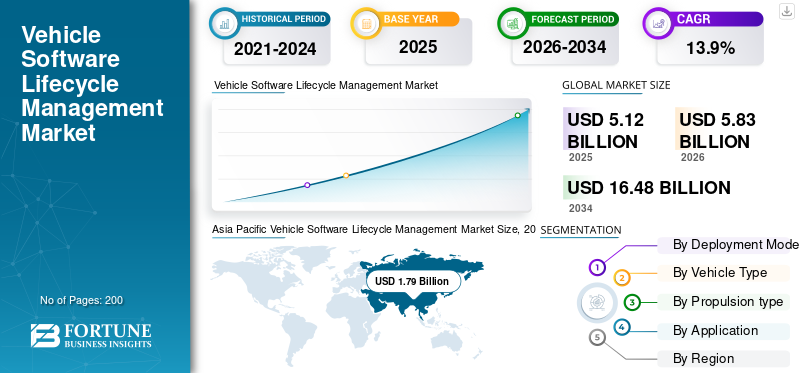
The global vehicle software lifecycle management market size was valued at USD 5.12 billion in 2025. The market is projected to grow from USD 5.83 billion in 2026 to USD 16.48 billion by 2034, exhibiting a CAGR of 13.9% during the forecast period. Asia Pacific dominated the vehicle software lifecycle management market with a market share of 34.96% in 2025.
The market represents solutions and services that manage software, from development and testing to deployment, updates, maintenance, and retirement. These platforms help automakers and suppliers streamline software integration, ensure cybersecurity, support Over-the-Air (OTA) updates, and maintain regulatory compliance.
Growing adoption of connected, electric, and autonomous vehicles is a major driver of the market. Increasing demand for over-the-air (OTA) updates, cybersecurity compliance, and technologically advanced driver assistance systems (ADAS) is accelerating software complexity. Automakers are investing in lifecycle management platforms to improve software quality, reduce development time, and ensure continuous vehicle performance and regulatory compliance.
Major market players in the market include Bosch, Siemens, Vector Informatik, Elektrobit, Wind River, IBM, Microsoft, and KPIT Technologies, competing through advanced software development platforms, over-the-air (OTA) update capabilities, cloud integration, cybersecurity solutions, AI-driven analytics, and compliance-focused lifecycle management systems. Companies are focusing on automation, continuous software deployment, and connected vehicle technologies to strengthen their market position and support next-generation automotive software architectures.
Download Free sample to learn more about this report.
Vehicle Software Lifecycle Management Market Key Takeaways
 Global Market Size & Forecast
- 2025 Market Size: USD 5.12 billion
- 2026 Market Size: USD 5.83 billion
- 2034 Forecast Market Size: USD 16.48 billion
- CAGR: 13.9% from 2026–2034
 Market Share
- Asia Pacific dominated the market with a 34.96% share, valued at USD 1.79 billion in 2025.
- On-premises segment held the largest market share in 2025.
- Over-the-Air (OTA) software updates segment held the largest market share in 2025.
 Key Regional Highlights
North America
The market is driven by connected vehicles, AI-driven mobility, and cloud-based software platforms.
Asia Pacific
The market reached USD 1.79 billion in 2025, driven by EV adoption and connected vehicle technologies.
Europe
The market is projected to grow at a 14.2% CAGR during 2026–2034, supported by software-defined vehicles and cybersecurity investments.
U.S.
The market is projected to reach USD 1.46 billion by 2026, driven by connected vehicles and autonomous mobility.
Japan
The market is projected to reach USD 0.26 billion by 2026, supported by connected vehicles and OTA software management.
Read More

VEHICLE SOFTWARE LIFECYCLE MANAGEMENT MARKET TRENDS
Growing Integration of Artificial Intelligence and DevOps Practices Emerging as a Key Trend
A major trend shaping the market is the growing integration of artificial intelligence (AI), machine learning, and DevOps methodologies into automotive software development processes. Automotive companies are increasingly adopting AI-driven analytics for predictive maintenance, automated testing, defect detection, and software optimization. Simultaneously, DevOps practices are enabling continuous integration and continuous deployment (CI/CD), helping automakers accelerate software release cycles while improving system reliability. Cloud-native development platforms and digital twin technologies are also gaining popularity for real time simulation and validation of vehicle software systems. These innovations support faster product updates, enhanced cybersecurity monitoring, and improved software quality management. As software-defined vehicles become mainstream, manufacturers are prioritizing intelligent and automated lifecycle management frameworks to remain competitive in the evolving automotive ecosystem.
MARKET DYNAMICS
MARKET DRIVERS
Download Free sample to learn more about this report.
Rising Adoption of Connected and Software-Defined Vehicles to Drive Market Growth
The growing deployment of connected, electric, and software-defined vehicles is significantly driving the vehicle software lifecycle management market growth. Automakers are increasingly integrating advanced software platforms to support infotainment, autonomous driving, battery management, and vehicle connectivity features. This rising software complexity has increased the need for efficient lifecycle management solutions that streamline development, testing, deployment, and maintenance processes. Additionally, over-the-air (OTA) software updates are becoming essential for delivering real-time enhancements, security patches, and feature upgrades without physical servicing. Automotive manufacturers are also focusing on reducing development cycles and ensuring regulatory requirement, further accelerating increased adoption of lifecycle management systems. The increasing collaboration between OEMs and software providers is expected to strengthen market demand globally over the forecast period.
MARKET RESTRAINTS
High Integration Complexity and Development Costs to Restrain Adoption
The market faces restraints due to the high complexity associated with integrating software management platforms into existing automotive architectures. Modern vehicles contain multiple Electronic Control Units (ECUs), sensors, and connected systems that require seamless interoperability, making integration highly challenging. Small and mid-sized automotive manufacturers often struggle with the substantial costs related to software development infrastructure, cybersecurity frameworks, cloud deployment, and continuous testing environments. Furthermore, maintaining compatibility across different vehicle models and operating systems increases operational expenses and development timelines. The shortage of skilled software engineers and cybersecurity experts further limits efficient implementation. These factors collectively create barriers for companies with limited technological capabilities, potentially slowing the widespread adoption of advanced software lifecycle management solutions.
MARKET OPPORTUNITIES
Expansion of Over-the-Air Update Ecosystems to Create New Opportunities
The increasing adoption of over-the-air (OTA) update technologies is creating substantial growth opportunities in the market. Automakers are rapidly transitioning toward cloud-connected vehicle ecosystems that enable remote software upgrades, performance optimization, and feature activation without dealership visits. This allows manufacturers to reduce costs, improve customer experience, and extend vehicle functionality throughout the ownership lifecycle. The rising penetration of electric and autonomous vehicles further expands demand for continuous software monitoring and update capabilities. In addition, regulatory emphasis on vehicle cybersecurity and safety compliance is encouraging OEMs to invest in advanced lifecycle management platforms with integrated OTA support. Emerging markets are also witnessing growing digital vehicle adoption, opening new revenue opportunities for software platform providers and cloud service vendors.
MARKET CHALLENGES
Rising Cybersecurity Risks and Data Privacy Concerns to Challenge Market Expansion
Increasing cybersecurity threats and data privacy concerns present a significant challenge for the market. Connected vehicles continuously exchange large volumes of sensitive data through cloud platforms, wireless networks, and OTA update systems, making them vulnerable to hacking, malware, and unauthorized access. As vehicles become more software-centric, cyberattacks targeting infotainment systems, autonomous driving functions, and vehicle control systems are becoming more sophisticated. Automotive manufacturers must continuously invest in secure coding practices, encryption technologies, and real-time threat monitoring systems to protect vehicle software environments. Additionally, varying cybersecurity regulations across regions create compliance complexities for global market automakers and software providers. Failure to ensure robust cybersecurity can lead to financial losses, operational disruptions, reputational damage, and reduced consumer trust in connected vehicle technologies.
Segmentation Analysis
By Deployment Mode
Established Enterprise Infrastructure and Data Control Requirements to Propel On-Premises Segment Dominance
Based on deployment mode, the market is categorized into on-premises and cloud-based solutions.
The on-premises segment dominates the market due to the automotive industry’s strong focus on data security, system reliability, and direct infrastructure control. Major OEMs and Tier-1 suppliers prefer on-premises deployment to manage sensitive vehicle software, intellectual property, and cybersecurity operations internally. These solutions also support & manage complex integration with existing enterprise systems, manufacturing platforms, and testing environments. Large automotive companies with established IT infrastructure continue investing in customized on-premises lifecycle management platforms to ensure regulatory compliance, minimize operational risks, and maintain high-performance software validation capabilities across connected and software-defined vehicle ecosystems.
The cloud-based segment is projected to grow at a CAGR of 12.6% over the forecast period. Rising demand for scalable software development, remote collaboration, OTA updates, and AI-driven analytics is accelerating cloud adoption among automakers and mobility technology providers globally.
By Vehicle Type
Growing Consumer Preference for Utility Vehicles to Propel SUV Segment Dominance
Based on vehicle type, the market is categorized into hatchback &sedan, SUV, LCV, and HCV.
The SUV segment dominates the market due to the rising global demand for connected, premium, and feature-rich sport utility vehicles. SUVs increasingly integrate Advanced Driver Assistance Systems (ADAS), infotainment platforms, telematics, and over-the-air (OTA) software capabilities, creating higher software management requirements. Automakers are prioritizing software-defined architectures in SUVs to enhance safety, comfort, and driving performance. Strong consumer preference for SUVs across North America, Europe, and Asia Pacific, along with growing electrification trends, continues to drive significant investments in lifecycle management platforms, software testing, cybersecurity solutions, and continuous update systems for this vehicle category.
The hatchback & sedan segment is projected to grow at a CAGR of 11.2% over the forecast period. Increasing adoption of connected passenger vehicles, digital infotainment systems, and OTA software updates in compact urban vehicles is supporting steady market expansion globally.
To know how our report can help streamline your business, Speak to Analyst
By Propulsion Type
Extensive Existing ICE Vehicle Fleet to Propel ICE Segment Dominance
Based on propulsion type, the market is categorized into ICE, BEV, and HV.
The ICE segment dominates the market due to the large global fleet of internal combustion engine vehicles and their widespread adoption across passenger and commercial transportation. Automakers continue integrating advanced infotainment systems, telematics, driver assistance technologies, and connected vehicle platforms into ICE vehicles, increasing software management requirements. Established manufacturing infrastructure, strong aftermarket support, and high vehicle ownership rates further sustain software lifecycle demand in this segment. In addition, OEMs are continuously deploying over-the-air (OTA) updates, cybersecurity features, and diagnostics software in ICE vehicles to enhance vehicle performance, safety, and customer experience, supporting long-term segment dominance globally.
The BEV segment is projected to grow at a CAGR of 14.5% over the forecast period. Rising electric vehicle adoption, increasing software-defined vehicle architectures, and growing demand for battery management, OTA updates, and autonomous driving capabilities are accelerating software lifecycle management investments in BEVs globally.
By Application
Rising Demand for Remote Vehicle Maintenance to Propel Over-the- Air (OTA) Software Updates Segment Dominance
Based on application, the market is categorized into over-the-air (OTA) software updates, autonomous driving software management, infotainment & telematics management, and others.
The Over-the-Air (OTA) software updates segment dominates the market due to the increasing need for remote software deployment, performance optimization, and cybersecurity enhancements in connected vehicles. Automakers are extensively adopting OTA platforms to deliver real-time feature upgrades, bug fixes, and system updates without requiring dealership visits. This technology reduces maintenance costs, improves operational efficiency, and enhances customer convenience. Growing deployment of connected, electric, and software-defined vehicles is further accelerating OTA adoption globally. Additionally, OEMs are leveraging OTA capabilities to extend vehicle functionality, ensure regulatory compliance, and support continuous software innovation, strengthening the segment’s long-term market dominance across the automotive industry.
The autonomous driving software management segment is projected to grow at a CAGR of 15.3% over the forecast period. Increasing development of autonomous vehicles, AI-driven driving systems, and advanced sensor integration is driving strong demand for continuous software monitoring, validation, and lifecycle management solutions globally.
Vehicle Software Lifecycle Management Market Regional Outlook
By geography, the market is categorized into Europe, North America, Asia Pacific, Latin America, and the Middle East & Africa.
Asia Pacific
Asia Pacific Vehicle Software Lifecycle Management Market Size, 2025 (USD Billion)
To get more information on the regional analysis of this market, Download Free sample
Asia Pacific region held largest market share due to strong automotive production, rapid electric vehicle adoption, and increasing deployment of connected vehicle technologies across China, Japan, South Korea, and India. Leading automotive manufacturers are heavily investing in software-defined vehicle platforms, autonomous driving technologies, and over-the-air (OTA) update systems to enhance vehicle performance and user experience. Government initiatives supporting smart mobility, EV infrastructure, and digital transformation initiatives further accelerate market growth. Additionally, the presence of major semiconductor, software, and electronics companies strengthens regional innovation and software ecosystem development, supporting large-scale adoption of lifecycle management solutions across the automotive sector.
China Vehicle Software Lifecycle Management Market
The Chinese market is estimated at around USD 0.96 billion in 2026, supported by rapid electric vehicle expansion, government-backed smart mobility initiatives, increasing OTA update adoption, and strong investments in automotive software ecosystems.
Japan Vehicle Software Lifecycle Management Market
The Japanese market is estimated at around USD 0.26 billion in 2026, driven by rising adoption of connected vehicles, software-defined mobility platforms, autonomous driving technologies, and increasing investments in automotive cybersecurity and OTA software management solutions.
Europe
Europe holds the second largest vehicle software lifecycle management market share and is projected to grow at a CAGR of 14.2% over the forecast period. Strong presence of premium automotive manufacturers, increasing focus on vehicle cybersecurity, and rising adoption of autonomous and connected vehicles are driving regional market growth. European automakers are actively investing in software-defined vehicle architectures, cloud-based development platforms, and OTA software management capabilities. Strict government regulations regarding vehicle safety, emissions, and cybersecurity compliance further accelerate software lifecycle management adoption. Additionally, growing EV production and collaborative partnerships between automotive OEMs and technology companies continue strengthening the regional market landscape.
U.K. Vehicle Software Lifecycle Management Market
The U.K. market is estimated at around USD 0.25 billion in 2026, supported by strong automotive digitalization, increasing EV production, cloud-based software integration, and growing demand for connected vehicle lifecycle management platforms.
Germany Vehicle Software Lifecycle Management Market
The German market is estimated at around USD 0.43 billion in 2026, driven by premium automotive manufacturing, rapid adoption of autonomous driving technologies, and increasing investments in software-defined vehicle architectures and cybersecurity systems.
North America
North America represents the third largest market for vehicle software lifecycle management due to the strong presence of advanced automotive technology companies, software developers, and autonomous vehicle innovators. The region is witnessing rising investments in connected vehicles, AI-driven mobility solutions, and cloud-based automotive software platforms. Increasing adoption of electric vehicles and advanced driver assistance systems (ADAS) is generating significant demand for continuous software integration, cybersecurity management, and OTA update capabilities. Major automakers and technology firms are collaborating to accelerate software-defined vehicle development and autonomous driving innovation. Additionally, strong consumer demand for smart mobility and digital vehicle experiences continues supporting regional market expansion.
U.S. Vehicle Software Lifecycle Management Market
The U.S. market is estimated at around USD 1.46 billion in 2026, fueled by strong connected vehicle adoption, advanced autonomous mobility development, AI-driven automotive software innovation, and expanding cloud-based lifecycle management deployments.
Middle East & Africa
The market in the Middle East & Africa is experiencing gradual growth due to increasing investments in automotive modernization, connected mobility infrastructure, and smart transportation initiatives. The UAE and Saudi Arabia are actively promoting digital transformation and electric mobility adoption, creating opportunities for advanced vehicle software management solutions. Rising demand for connected vehicles, fleet management technologies, and intelligent transportation systems is further supporting market expansion. In addition, government-led smart city projects and growing partnerships with global automotive technology providers are encouraging software integration across regional mobility ecosystems, contributing to the market’s long-term development potential.
UAE Vehicle Software Lifecycle Management Market
The UAE market is estimated at around USD 0.11 billion in 2026, driven by smart city projects, connected mobility investments, growing EV adoption, and increasing deployment of intelligent transportation and automotive software management solutions.
Latin America
Latin America is witnessing steady growth in the market due to increasing adoption of connected vehicles, digital infotainment systems, and fleet management technologies across Brazil, Mexico, and other emerging economies. Automotive manufacturers are gradually integrating software-defined features, OTA update systems, and advanced diagnostics platforms to improve vehicle functionality and customer experience. Growing urbanization, expanding ride-hailing services, and rising demand for smart mobility solutions are supporting software ecosystem development in the region. Additionally, improving internet connectivity, digital infrastructure investments, and increasing automotive production activities are creating favorable conditions for lifecycle management platform adoption across the regional automotive industry.
Brazil Vehicle Software Lifecycle Management Market
The Brazilian market is estimated at around USD 0.08 billion in 2026, supported by rising automotive digitalization, growing connected vehicle demand, increasing fleet management adoption, and expanding investments in advanced mobility software technologies.
COMPETITIVE LANDSCAPE
Key Industry Players
Strategic Investments in Software-Defined Vehicle Platforms by Key Players is Intensifying Market Competition
The vehicle software lifecycle management market is highly competitive, with leading players focusing on cloud-based software platforms, over-the-air (OTA) update technologies, cybersecurity solutions, and AI-driven development tools to strengthen their market position. Companies such as Bosch, Siemens, Vector Informatik, Elektrobit, Wind River, IBM, Microsoft, and KPIT Technologies are heavily investing in software-defined vehicle ecosystems and continuous integration and deployment capabilities. Strategic collaborations between automotive OEMs and technology firms are accelerating innovation in autonomous driving software, connected vehicle platforms, and digital vehicle architectures. Market participants are also prioritizing scalable lifecycle management solutions to improve software reliability, operational efficiency, and regulatory compliance across next-generation automotive systems.
Competitive intensity is increasing as automotive manufacturers rapidly transition toward connected, electric, and autonomous vehicles, creating higher demand for advanced software lifecycle management capabilities. Key companies are expanding their research and development investments to enhance cloud integration, real-time analytics, digital twin simulation, and cybersecurity protection for automotive software environments. Partnerships, acquisitions, and long-term software platform agreements remain common strategies for expanding technological expertise and regional presence. In addition, firms are increasingly adopting AI-powered testing, predictive maintenance analytics, and DevOps methodologies to accelerate software deployment cycles. The growing shift toward software-defined mobility solutions is expected to intensify competition and encourage continuous innovation throughout the global automotive software ecosystem.
LIST OF KEY VEHICLE SOFTWARE LIFECYCLE MANAGEMENT COMPANIES PROFILED
- Siemens AG (Germany)
- Robert Bosch GmbH (Germany)
- Elektrobit Automotive GmbH (Germany)
- Vector Informatik GmbH (Germany)
- IBM Corporation (U.S.)
- Microsoft Corporation (U.S.)
- PTC Inc. (U.S.)
- Intellias Ltd. (Ukraine)
- Capgemini SE (France)
- Tata Elxsi Ltd. (India)
- KPIT Technologies Ltd. (India)
- HARMAN International Industries, Inc. (U.S.)
- Wind River Systems, Inc. (U.S.)
- BlackBerry QNX (Canada)
- Synopsys, Inc. (U.S.)
KEY INDUSTRY DEVELOPMENTS
- April 2026: Bosch and Qualcomm expanded their strategic collaboration to advance ADAS and cockpit computing solutions for software-defined vehicles. The partnership supports scalable automated driving platforms, centralized vehicle computing architectures, and Snapdragon-powered vehicle computers, with Bosch surpassing 10 million cockpit computer deliveries globally.
- February 2026: Elektrobit and Mobileye announced a collaboration to integrate EB corbos Linux for Safety Applications into the Mobileye Drive autonomous vehicle platform. The partnership supports Level 4 autonomous driving, safety-compliant Linux operating systems, AI-driven mobility solutions, and scalable software-defined vehicle architectures for global OEMs and robotaxi providers.
- January 2026: Siemens Digital Industries Software launched PAVE360 Automotive, an off-the-shelf, cloud-based digital twin Partnering with automotive OEMs and tech companies such as AMD and Microsoft, the solution accelerates software-defined vehicle (SDV) development through shift-left testing, virtual hardware-software integration, and system-level validation
- January 2026: AMD collaborated with Microsoft and Siemens to support shift-left development for software-defined vehicles through cloud-based simulation and digital twin technologies. The partnership enables early software validation, mixed-criticality workload simulation, and scalable SDV development using AMD’s virtualized automotive stack on Microsoft Azure.
- March 2025: Vector Informatik and Synopsys announced a strategic collaboration to accelerate software-defined vehicle development through integrated digital twin and software factory solutions. The partnership focuses on shift-left validation, virtual ECU deployment, cloud-ready workflows, and enhanced automotive software lifecycle productivity for OEMs and Tier-1 suppliers.
- September 2025: Wind River partnered with Hyundai Mobis to launch Mobis Development Studio, a unified cloud-native environment designed to accelerate the creation of software-defined vehicles (SDVs)
- August 2024: Wind River launched an upgraded Linux-based automotive software platform optimized for autonomous vehicle systems, centralized computing architectures, and secure OTA software management in next-generation connected vehicles.
REPORT COVERAGE
The global vehicle software lifecycle management market analysis provides an in-depth study of market size & forecast by all the market segments included in the report. It includes details on the market dynamics and market trends expected to drive the market during the forecast period. It offers information on the technological advancements, new product launches, key industry developments, and details on partnerships, mergers & acquisitions. The report also encompasses a detailed competitive landscape, including market share and profiles of key operating players.
Request for Customization to gain extensive market insights.
Report Scope & Segmentation
| ATTRIBUTE | DETAILS |
| Study Period | 2021-2034 |
| Base Year | 2025 |
| Estimated Year | 2026 |
| Forecast Period | 2026-2034 |
| Historical Period | 2021-2024 |
| Growth Rate | CAGR of 13.9% from 2026-2034 |
| Unit | Value (USD Billion) |
| Segmentation | By Deployment Mode, By Vehicle Type, By Propulsion Type, By Application, and By Region |
| By Deployment Mode |
|
| By Vehicle Type |
|
| By Propulsion type |
|
| By Application |
|
| By Region |
|
Frequently Asked Questions
Fortune Business Insights says that the global market value stood at USD 5.12 billion in 2025 and is projected to reach USD 16.48 billion by 2034.
In 2025, the Asia Pacific’s market value stood at USD 1.79 billion.
The market is expected to exhibit a CAGR of 13.9% during the forecast period of 2026-2034
The SUV segment is leading segment the market by vehicle type.
Rising adoption of connected and software-defined vehicles to drive market growth.
Asia Pacific held the largest market share in 2025.



- 2021-2034
- 2025
- 2021-2024
- 200
-
(Offer valid till 30th Sep 2026)
Get 30-60 hrs Free Customization
Expand Regional and Country Coverage, Segments Analysis, Company Profiles, Competitive Benchmarking, and End-user Insights.




















-
US +1 833 909 2966 ( Toll Free )
-
Get In Touch With Us