Voice-based AI Companion Product Market Size, Share & Industry Analysis, By Type (Standalone, Multi-Modal, and Embedded), By Business Model (Subscription and One-time Purchase), By Device (Smart Speakers, Smartphones, Wearables, In-vehicle Voice Companions, and Integrated with Other Consumer Electronics), By Application (Personal Assistance, Social Interaction & Companionship, Mental Health & Wellness, Education & Learning, Assisted Living, and Enterprise-use), and Regional Forecast, 2026-2034
 Download Free Sample
Voice-based AI Companion Product Market Size and Future Outlook
 Listen to Audio Version
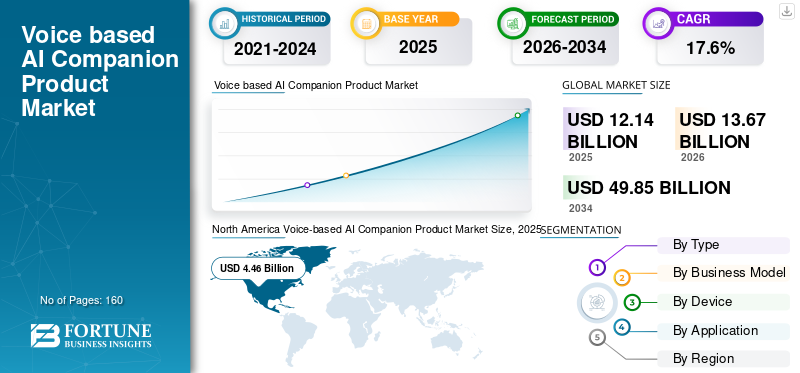
The global voice-based AI companion product market size was valued at USD 12.14 billion in 2025. The market is projected to grow from USD 13.67 billion in 2026 to USD 49.85 billion by 2034, exhibiting a CAGR of 17.6% during the forecast period. North America dominated the global voice-based AI companion product market with a market share of 36.74% in 2025.
The voice-based AI companion product market is rapidly evolving as intelligent, conversational technology becomes central to innovation across multiple sectors. Growing adoption of smart devices, connected vehicles, and IoT ecosystems is driving demand for AI companions that offer personalized, context-aware, and interactive user experiences. Unlike traditional virtual assistants, modern voice-based AI companion products leverage generative AI technology, emotional intelligence, and real-time adaptation, enabling new applications in mental health support, education, customer service, and home automation.
In recent years, the rise of smart homes, connected vehicles, and enterprise AI solutions has accelerated the need for companions that go beyond simple voice commands. Market leaders such as Luka, PolyAI, Amazon, Google, and Miko.ai are competing to deliver comprehensive voice AI platforms that combine advanced natural language processing, seamless cross-device integration, and scalable cloud-based architectures.
This growth is also fueled by increasing collaborations between AI companies and industries such as healthcare, automotive, education, and retail, which use voice companions to enhance engagement, provide real-time assistance, and improve operational efficiency. As demand for intelligent, emotionally aware, and context-driven voice interactions expands, the market is poised for transformative growth driven by technological innovation and broadening applications worldwide.
Download Free sample to learn more about this report.
Voice-based AI Companion Product Market Takeaways
 Global Market Size & Forecast
- 2025 Market Size: USD 12.14 billion
- 2026 Market Size: USD 13.67 billion
- 2034 Forecast Market Size: USD 49.85 billion
- CAGR: 17.6% from 2026–2034
 Market Share
- North America dominated the voice-based AI companion product market with a 36.74% share in 2025.
- The one-time purchase business model is expected to lead with a 64.2% share in 2026, supported by the market's 17.6% CAGR during 2026–2034.
- The standalone segment is projected to account for 52.8% of the global market in 2026.
 Key Regional Highlights
North America
North America is projected to reach USD 5.05 billion by 2026, maintaining its leadership position in the global voice-based AI companion product market.
Europe
Europe is projected to reach USD 3.10 billion by 2026, reflecting increasing demand for AI-enabled companion products across consumer and enterprise applications.
Asia Pacific
Asia Pacific is expected to remain the second-largest regional market, reaching USD 4.24 billion by 2026, supported by rising AI adoption and smartphone penetration.
U.S.
The voice-based AI companion product market is projected to reach USD 4.08 billion by 2026, fueled by strong consumer demand and continuous AI innovation.
Japan
The market is expected to witness steady growth through increasing adoption of AI assistants, smart devices, and voice-enabled technologies across households and businesses.
Read More

IMPACT OF GENERATIVE AI
Implementation of Generative AI Capabilities to Fuel Market Growth
Generative AI is reshaping the voice-based AI companion product market by enabling more natural, context-aware, and human-like interactions. It allows companions to maintain multi-turn conversations, adapt to user preferences and emotions, and proactively assist with tasks, making them more engaging and personalized. For instance,
- In January 2025, Lucid Motors launched the Lucid Assistant, a hands-free in-vehicle voice assistant powered by SoundHound Chat AI. It integrates generative AI for natural, conversational interactions, real-time data, and car controls, even offline.
This technology also broadens use cases, from mental health support to creative assistance and enterprise applications, while on-device processing enhances responsiveness and privacy. However, challenges such as misinformation, ethical concerns, and overdependence remain.
MARKET DYNAMICS
Voice-BASED AI COMPANION PRODUCT MARKET TRENDS
Expanding Global Reach through Multilingual and Accent Support is a Key Market Trend
AI voice companions are being increasingly designed to understand and communicate in multiple languages, regional dialects, and diverse accents, thereby significantly enhancing their global usability. By supporting local languages and accommodating variations in speech patterns, these companions can engage a broader user base, from international markets to multilingual households. For instance,
- In September 2025, Hyperfusion and CAMB.AI launched a sovereign, real-time voice AI platform in the UAE, enabling enterprises across the MENA region to build multilingual voice agents and assistants. Using CAMB.AI’s MARS7 technology, it supports Arabic dialects, live translation, and low-latency interactions for applications such as contact centers, banking, e-gov, and media.
This capability not only improves accessibility for users who are non-native speakers of dominant languages but also fosters more natural and comfortable interactions.
MARKET DRIVERS
Growing Adoption of Smart Devices / IoT to Propel Market Growth
The rapid growth of smart devices and the broader Internet of Things ecosystem is creating an ideal environment for voice-based AI companions.
- According to industry stats, the global number of IoT devices is projected to more than double from 19.8 billion in 2025 to over 40.6 billion by 2034, highlighting the rapid expansion of connected technology worldwide.
Smart speakers, connected appliances, thermostats, and other home automation devices are increasingly equipped with voice interfaces, allowing AI companions to serve as a central hub for managing these devices seamlessly.
- In August 2024, Samsung upgraded its Bixby voice assistant in 2024 home appliances to handle more complex commands, remember past interactions, and provide answers to product-related questions. The update applies to Bespoke AI Refrigerator, Laundry Combo, and Jet Bot Combo.
As more IoT devices adopt voice-enabled functionalities, users gain the convenience of controlling multiple aspects of their environment, such as lighting, security, entertainment, and climate, through natural conversational interactions.
MARKET RESTRAINTS
Ethical and Emotional Risks Hinder Voice-based AI Companion Product Market Growth
Voice-based AI companions products are designed to mimic human-like emotions, creating a sense of companionship and understanding. While this can enhance engagement, it also carries the risk of over-dependence, where users may rely on the AI for emotional support or social interaction instead of genuine human connections. For instance,
- In October 2025, A U.K. survey (n=750) found that nearly 5% rely on AI for emotional support, 20% have turned to AI for relationship advice instead of friends or therapists, and 2% have chosen AI companionship over spending time with a real person.
Incorrect guidance or misinterpretation of emotions by the AI can have negative psychological effects, particularly for vulnerable groups such as children, older people, or individuals with mental health challenges. These risks limit adoption unless companies establish clear ethical frameworks, provide appropriate disclaimers, and implement safeguards to ensure responsible and safe use of AI companions.
MARKET OPPORTUNITIES
Automotive and In-Vehicle Use Cases Create Lucrative Growth Opportunities
Voice-based AI companions are increasingly being explored for integration into vehicles, where they can provide a hands-free, interactive experience for drivers and passengers. These companions can assist with navigation, adjust climate controls, manage entertainment systems, handle calls or messages, and provide real-time information, all through natural voice commands. For instance,
- In November 2025, Amazon decided to partner with BMW to bring its next-generation Alexa Custom Assistant to vehicles, powered by Alexa+ and generative AI. This upgrade enables more natural, personalized, and context-aware in-car conversations, enhancing BMW’s voice assistant capabilities.
- In October 2025, Nissan announced the introduction of a physical AI companion called Epolo for the upcoming Japan Mobility Show, which acts as a conversational assistant and personal tour guide through your mobile phone. The egg-shaped device offers a friendly, tangible presence in the car, featuring collectible versions such as "Samurai Epolo" and "Uncle Epolo".
By reducing the need for manual interactions, they help minimize driver distraction, improving road safety while enhancing convenience. Beyond functional assistance, AI companions can offer personalized experiences by learning driver preferences, suggesting routes, or even providing reminders and updates tailored to the individual.
Download Free sample to learn more about this report.
Segmentation Analysis
By Application
Personal Assistance Dominates Owing to its Use for Consumers and Enterprises
Based on application, the market is classified into personal assistance, social interaction & companionship, mental health & wellness, education & learning, assisted living and enterprise-use.
To know how our report can help streamline your business, Speak to Analyst
The personal assistance segment dominates the voice-based AI companion market, as it addresses the most universal and frequent use cases for both consumers and enterprises. Personal assistant applications include managing daily schedules, setting reminders, providing real-time information, handling communications, and controlling smart home devices. These functionalities make AI companions an integral part of users’ daily lives, driving consistent engagement and high adoption rates.
The mental health & wellness segment is expected to grow at a CAGR of 24.6% over the forecast period.
By Type
Standalone AI Devices Lead Owing to Consumer Convenience
In terms of type, the market is categorized into standalone, multi-modal, and embedded.
The standalone segment captured the largest market share in 2025 and will maintain its position in 2026 an anticipated 52.8% share. Standalone device offers dedicated, optimized functionality without relying on other devices or platforms. They provide a personalized and immersive user experience, often featuring advanced features such as emotion recognition, contextual awareness, and proactive suggestions. They are widely adopted in homes, offices, and education due to their ease of use, portability, and ability to operate independently of smartphones or computers.
The embedded segment is expected to grow at a CAGR of 22.4% over the forecast period.
By Business Model
Majority Preference for One-Time Purchase Fuels the Business Model
In terms of business model, the market is categorized into subscription and one-time purchase.
In 2025, the one-time purchase business model captured the largest share of the market and will continue to dominate in 2026 with a 64.2% share. It offers consumers full ownership of the device without recurring costs, making it a straightforward and attractive option. Users prefer paying upfront for standalone AI companions that provide continuous, reliable functionality without subscription commitments. This model is popular for home and personal devices, where long-term usability and cost predictability are valued.
The subscription business model is expected to grow at a CAGR of 20.7% over the forecast period.
By Device
Smartphones at the Forefront of Voice AI Adoption
In terms of device, the market is categorized into smart speakers, smartphones, wearables, in-vehicle voice companions, and integrated with other consumer electronics.
The smartphones segment captured the largest share of the market in 2025. In 2026, the segment is expected to dominate with a 36.6% share, as they are the most widely available and convenient platform for AI interactions. Users can access voice assistants anytime, anywhere, without needing additional devices, making smartphones a natural hub for personal AI companions. The integration of advanced processors, high-quality microphones, and continuous internet connectivity enables accurate, real-time responses and rich AI functionality.
The in-vehicle voice companions segment is expected to grow at a CAGR of 27.1% over the forecast period.
Voice-based AI Companion Product Market Regional Outlook
By geography, the market is categorized into Europe, North America, Asia Pacific, Latin America, and Middle East & Africa.
North America
North America holds the majority of the voice-based AI companion product market share, driven by the presence of major technology companies, early adoption of advanced AI and IoT ecosystems, and a strong consumer base for smart devices. The region benefits from widespread deployment of smart speakers, connected home systems, and enterprise-focused voice AI solutions.
- In 2025, almost two-thirds (63%) of the U.S. homes are equipped with at least one smart home device.
North America Voice-based AI Companion Product Market Size, 2025 (USD Billion)
To get more information on the regional analysis of this market, Download Free sample
The North American market is projected to reach USD 5.05 billion by 2026, with the U.S. alone contributing USD 4.08 billion, highlighting its continued leadership in voice-based AI innovation and adoption across both consumer and enterprise applications.
Europe
Europe is projected to maintain steady growth, reaching USD 3.10 billion by 2026. The region’s growth is supported by strong regulatory frameworks for data privacy, increasing adoption of AI-based personal assistants, and investment in smart infrastructure. Major contributors include the U.K. (USD 0.47 billion), Germany (USD 0.49 billion), and France (USD 0.37 billion), driving regional innovation and adoption of voice-based AI solutions in both consumer and enterprise applications.
Asia Pacific
Asia Pacific (APAC) holds the second-largest share of the market and is expected to reach USD 4.24 billion by 2026. This growth is fueled by rapid digital transformation, high smartphone and IoT device penetration, and the increasing adoption of AI-powered voice solutions in the smart home, automotive, and education sectors. China (USD 1.32 billion) and India (USD 0.79 billion) are leading regional adoption, supported by expanding 5G networks, government initiatives, and increasing demand for localized, multilingual voice AI companions.
Middle East & Africa
The Middle East & Africa (MEA) is expected to experience the highest growth rate over the forecast period and reach USD 0.79 billion by 2026. Increasing mobile and internet penetration, smart city initiatives, and rising interest in AI-powered voice companions for education, healthcare, and enterprise use cases drive this growth.
- In the UAE, most residents see AI assistants as educational tools for children, with 72% supporting their role in learning, alongside expectations for help with daily tasks and smart home management.
The GCC countries are projected to account for USD 0.24 billion, supported by modernization efforts, government programs, and investments in AI and smart technologies.
Latin America
Latin America is projected to reach USD 0.49 billion by 2026, driven by the growing adoption of voice-based AI companions for education, customer service, and smart mobility applications. The increasing penetration of smartphones, expansion of IoT ecosystems, and rising awareness of AI-driven personal assistants in Brazil and Mexico continue to support the voice-based AI companion product market growth.
COMPETITIVE LANDSCAPE
Key Industry Players:
Innovative Ecosystems and Strategic Integration Drive Market Leadership
The market is led by major technology and AI companies that continuously innovate by integrating advanced natural language processing, machine learning, and expansive voice ecosystems. Leading players, including Luka, PolyAI, Amazon, Google, and Miko.ai, shape the market by providing intelligent, conversational solutions that combine contextual understanding, emotional intelligence, and multi-platform integration, serving millions of users across consumer, enterprise, and educational sectors.
These market leaders distinguish themselves through comprehensive platforms that integrate voice recognition, generative AI, cloud-based services, and personalized interaction capabilities. Their offerings emphasize real-time conversational intelligence, adaptive learning, and seamless integration with smart devices, home automation systems, automotive environments, and educational tools. For example, Luka’s emotionally aware AI companions, PolyAI’s enterprise-focused voice agents, Amazon’s Alexa ecosystem, Google’s Google Assistant, and Miko.ai’s child-friendly interactive robots collectively define the competitive landscape by driving continuous innovation, delivering highly engaging user experiences, and expanding the adoption of voice-based AI companions across diverse use cases.
LIST OF KEY VOICE-BASED AI COMPANION PRODUCT COMPANIES PROFILED
- Luka, Inc. (U.S.)
- Chai Research Corp (U.S.)
- Earkick (U.S.)
- PolyAI Ltd. (U.K.)
- Witlingo (U.S.)
- SoundHound AI Inc. (U.S.)
- Hume AI Inc (U.S.)
- Meela, Inc. (U.S.)
- Miko.ai (India)
- Intuition Robotics Inc. (Israel)
- Amazon, Inc. (U.S.)
- Google LLC (U.S.)
KEY INDUSTRY DEVELOPMENTS
- November 2025: Voize raised USD 50 million Series A to expand its AI voice companion for nurses into Europe and the U.S. The tool automates clinical documentation with 99.2% accuracy and is currently used by over 75,000 nurses in 1,100 facilities. By reducing administrative work by up to 30%, Voize aims to ease pressure amid global nursing shortages.
- November 2025: Samsung has launched the Vision AI Companion (VAC) for its 2025 TV lineup, transforming TVs into conversational, context-aware home hubs powered by enhanced Bixby and multiple AI models, including Copilot and Perplexity. VAC supports two-way dialogue, joint family interactions, real-time visual answers, Live Translate, AI Gaming Mode, and mood-adaptive generative wallpaper.
- October 2025: Microsoft has introduced Mico, an expressive visual avatar for its Copilot voice assistant in the Fall 2025 release. Mico reacts to users with facial expressions and color shifts to make conversations feel more natural and empathetic. It appears by default in voice mode, can be turned off, and is currently available only in the U.S., with a broader rollout planned.
- October 2025: Sesame AI, founded by Brendan Iribe and Ankit Kumar, raised USD 250 million in Series B funding to develop lifelike voice AI companions and lightweight wearable devices. The AI is designed to converse naturally, remember context, recognize emotional cues, and assist users in daily life.
- September 2025: Meela, an AI voice companion for seniors, raised USD 3.5 million in seed funding led by Bain Capital. It enables older adults to have real-time, human-like conversations over the phone without the need for extra devices or installations.
REPORT COVERAGE
The global market analysis provides an in-depth study of market size & forecast by all the market segments included in the report. It includes details on the market dynamics and market trends expected to drive the market in the forecast period. It offers information on the technological advancements, new product launches, key industry developments, and details on partnerships, mergers & acquisitions. The research report also includes a detailed competitive landscape, providing information on market share and profiles of key operating players.
Request for Customization to gain extensive market insights.
Report Scope & Segmentation
| Attribute | Details |
| Study Period | 2021-2034 |
| Base Year | 2025 |
| Forecast Period | 2026-2034 |
| Historical Period | 2019-2024 |
| Growth Rate | CAGR of 17.6% from 2026-2034 |
| Unit | Value (USD Billion) |
| Segmentation | By Type, Business Model, Device, Application. and Region |
| By Type |
|
| By Business Model |
|
| By Device |
|
| By Application |
|
| By Geography |
|
Frequently Asked Questions
Fortune Business Insights says that the global market value stood at USD 12.14 billion in 2025 and is projected to reach USD 49.85 billion by 2034.
In 2025, North America’s market value stood at USD 4.46 billion.
The market is expected to exhibit a CAGR of 17.6% during the forecast period of 2026-2034.
The personal assistance segment led the market by application.
Growing Adoption of Smart Devices / IoT to Propel the Market Growth
Luka, PolyAI, Miko AI, Amazon and Google are some of the prominent players in the market.
North America dominated the market in 2025 by holding the largest share.
The mental health & wellness application is expected to grow at the highest CAGR.



- 2021-2034
- 2025
- 2021-2024
- 160
Get 30-60 hrs Free Customization
Expand Regional and Country Coverage, Segments Analysis, Company Profiles, Competitive Benchmarking, and End-user Insights.




















Related Reports
-
US +1 833 909 2966 ( Toll Free )
-
Get In Touch With Us