Wave Energy Converters Market Size, Share & Industry Analysis, By Technology Type (Point Absorbers, Oscillating Water Columns (OWC), Attenuators, Oscillating Wave Surge Converters (OWSC), and Overtopping Devices), By Location (Nearshore and Offshore), By Application (Power Generation, Desalination & Water Treatment, Off-grid / Remote Power Supply, and Marine & Ocean Infrastructure Power), and Regional Forecast, 2026-2034
 Download Free Sample
Wave Energy Converters Market Size and Future Outlook
 Listen to Audio Version
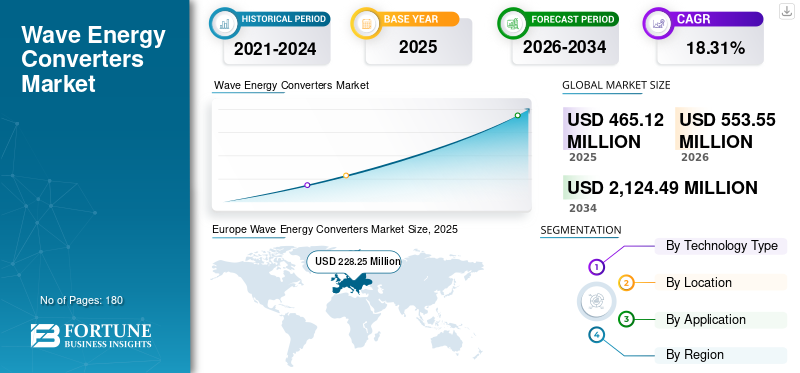
The global wave energy converters market size was valued at USD 465.12 million in 2025 and is expected to reach USD 553.55 million by 2026. The market is projected to reach USD 2,124.49 million by 2034, with a CAGR of 18.31% over 2026-2034. Europe dominated the wave energy converters market with a market share of 49.07% in 2025.
Europe is expected to dominate the market owing to the presence of major market players and government inclination toward renewable energy adoption.
Wave Energy Converters (WECs) are devices that harness kinetic and potential energy from ocean waves to generate electricity or other useful power. Key growth drivers include rising demand for renewable energy to meet net-zero goals, high energy density of waves, increased R&D investments, and advancements in technology enhancing efficiency.
- In February 2025, Bharat Petroleum Corporation Limited (BPCL) signed a landmark MoU with Eco Wave Power at India Energy Week 2025 to pioneer wave energy projects across India. The partnership starts with a feasibility study and 100–300 kW pilot at BPCL's Mumbai Oil Terminals, paving the way for commercial-scale deployments. BPCL handles approvals while Eco Wave provides patented technology, targeting India's vast coastal wave potential.
Ocean Power Technologies (OPT) is a prominent, pioneer player in the market, specializing in autonomous offshore power solutions for defense, oil & gas, and research energy sectors. While OPT holds a strong position, the market is highly competitive, featuring innovators such as CorPower Ocean, Eco Wave Power, and Carnegie Clean Energy, which focus on cost-efficient, resilient, and scalable power generation.
Download Free sample to learn more about this report.
Wave Energy Converters Market Key Takeaways
 Global Market Size & Forecast
- 2025 Market Size: USD 465.12 million
- 2026 Market Size: USD 553.55 million
- 2034 Forecast Market Size: USD 2,124.49 million
- CAGR: 18.31% from 2026–2034
 Market Share
- Europe dominated the market with a 49.07% share in 2025.
- Point Absorbers segment held a 41.66% share in 2025.
- Power Generation segment held a 56.76% share in 2025.
 Key Regional Highlights
North America
The market reached USD 99.53 million in 2025, driven by strong R&D activities and pilot wave energy projects.
Asia Pacific
The market reached USD 90.59 million in 2025, supported by government initiatives and rising renewable energy investments.
Europe
The market reached USD 228.25 million in 2025, driven by strong policy support and extensive investments in wave energy technologies.
U.S.
The market reached USD 87.01 million in 2025, supported by innovation hubs and increasing deployment of pilot projects.
Japan
The market reached USD 19.34 million in 2025, driven by government-backed R&D and growing focus on renewable energy adoption.
Read More

WAVE ENERGY CONVERTERS MARKET TRENDS
Increasing Transition from Pilot Projects to Pre-Commercial Deployments Drives the Market
The wave energy converters market is witnessing a gradual shift from isolated pilot demonstrations to pre-commercial multi-device deployments, particularly in Europe and North America. Developers are moving beyond single-unit prototypes toward small arrays to validate scalability, reliability, and grid integration. This trend is supported by government-backed test centers, improved device survivability, and advancements in power take-off systems. Additionally, hybrid renewable projects combining wave with wind or solar are emerging, improving overall energy consistency. Digital monitoring, predictive maintenance, and modular designs are also gaining traction, reducing operational risks. While full commercialization is still limited, the growing number of pilot arrays signals a transition phase where technology validation is increasingly aligned with commercial viability and long-term project financing.
MARKET DYNAMICS
MARKET DRIVERS
Download Free sample to learn more about this report.
Rising Demand for Reliable and Predictable Renewable Energy Sources to Boost Market Growth
Wave energy offers a more predictable and consistent energy profile compared to wind and solar, making it an attractive complement in renewable energy portfolios. As countries aim to stabilize grids with higher renewable penetration, the need for dependable baseload-like clean energy is increasing. Coastal nations with strong wave resources are particularly interested in leveraging this potential to reduce fossil fuel dependence.
- In March 2026, Seaturns launched the world's first pre-commercial, grid-connected wave energy farm in Mauritius under the NSEPCRET scheme. The 2 MW pilot, linked to the national grid via Central Electricity Board, tests surface wave technology reliability. Potential expansion to 10 MW follows successful performance, developed with local partner Taylor Smith.
Additionally, growing energy demand in island and remote coastal regions is driving adoption of decentralized wave energy systems. Government support through funding programs, grants, and marine energy roadmaps further accelerates deployment. The ability of wave energy to integrate with desalination, offshore operations, and hybrid systems strengthens its value proposition, making it a key driver in the global transition toward diversified renewable energy sources.
MARKET RESTRAINTS
High Capital Costs and Limited Commercial Scale Deployment Restrains Market Growth
Wave energy converters’ high capital expenditure is associated with device manufacturing, installation, and maintenance in harsh marine environment. Unlike mature renewable technologies, WEC systems lack economies of scale, resulting in higher cost per megawatt. Offshore deployment requires specialized vessels, robust anchoring systems, and durable materials, which increases costs. Additionally, limited commercial track record makes it difficult to secure private investment and project financing. Insurance and risk assessment also remain challenging due to uncertain long-term performance data. These cost-related barriers slow down large-scale adoption and delay commercialization timelines, especially in developing regions where funding and infrastructure support are limited.
MARKET OPPORTUNITIES
Expansion in Island Electrification and Desalination Applications is Expected to Create Lucrative Opportunities
Wave energy presents strong opportunities in island nations and water-scarce coastal regions where conventional energy supply is expensive or unreliable. Many islands rely on imported diesel for power generation, creating a significant opportunity to provide a sustainable and cost-effective alternative. Additionally, the integration of WEC systems with desalination plants offers a dual benefit of clean energy and freshwater production, particularly in the Middle East, North Africa, and parts of Asia Pacific. The modular nature of wave energy devices enables flexible deployment tailored to local needs. As governments and organizations focus on energy independence and climate resilience, these niche applications are expected to drive early commercialization and open new revenue streams for WEC developers.
MARKET CHALLENGES
Technical Complexity and Harsh Marine Operating Conditions Create Challenges for Market Growth
Wave energy converters face significant technical challenges due to the unpredictable and harsh conditions of the marine environment. Devices must withstand extreme weather events, corrosion, biofouling, and mechanical stress from continuous wave motion. Ensuring long-term durability and reliability while maintaining efficiency is a major engineering hurdle. Frequent maintenance and limited accessibility increase operational costs and downtime. Grid connection from offshore locations adds further complexity, requiring subsea cabling and stable transmission systems. Additionally, the lack of standardized designs and certification processes slows down industry-wide adoption. These technical challenges not only impact project feasibility but also create uncertainty among investors and stakeholders, making it difficult for the wave energy converters market growth.
Segmentation Analysis
By Technology Type
Point Absorbers Technology is Highly Preferred Due to its Efficiency
Based on technology type, the market is classified into point absorbers, Oscillating Water Columns (OWC), attenuators, Oscillating Wave Surge Converters (OWSC), and overtopping devices.
In 2025, the point absorbers technology held a dominant wave energy converters market share of 41.66%, due to their efficiency in harnessing omnidirectional waves and scalability for diverse marine environments. These devices excel in moderate wave conditions, driving widespread adoption and technological refinements.
The oscillating water columns (OWC) technology is poised for significant growth with a CAGR of 18.15% over the coming years, propelled by advancements in turbine designs, cost reductions, and integration with coastal infrastructure. OWC's fixed structure and air-driven power generation offer reliability in high-wave zones, attracting investments amid rising demand for predictable renewable sources. This shift underscores evolving priorities toward robust, site-specific solutions.
By Location
Offshore Holds Leading Share as it Provides High Energy Density
Based on location, the market is classified into nearshore and offshore.
In 2025, offshore claimed the largest revenue share, driven by the need to harness stronger, deeper-water wave resources that provide higher energy density compared to nearshore or shoreline locations.
Nearshore segment is set for significant growth with a CAGR of 17.3%, driven by its high efficiency, cost-effectiveness, and logistical ease of deployment compared to deeper offshore sites. These devices are highly sought after by coastal communities and industries to meet rising power demand while reducing reliance on fossil fuels, with many installations located within 0.3 to 2 km of the shore.
To know how our report can help streamline your business, Speak to Analyst
By Application
Power Generation Application Leads Due to Established Infrastructure and Policy Incentives
Based on application, the market is classified into power generation, desalination & water treatment, off-grid / remote power supply, and marine & ocean infrastructure power.
In 2025, the power generation application secured the largest share of 56.76%, propelled by its integration into national grids to deliver stable, utility-scale renewable energy amid decarbonization mandates. Established infrastructure and policy incentives have accelerated its dominance.
The off-grid / remote power supply application will grow with a CAGR of 19.95% during the forecast period, by addressing energy access in isolated islands, coastal communities, and offshore platforms. Miniaturized, modular WEC designs and hybrid storage solutions are unlocking these high-potential niches.
Wave Energy Converters Market Regional Outlook
By geography, the Market is categorized into North America, Europe, Asia Pacific, Latin America, and the Middle East & Africa.
Europe
Europe Wave Energy Converters Market Size, 2025 (USD Million)
To get more information on the regional analysis of this market, Download Free sample
Europe emerged as a dominant region with USD 228.25 million in 2025 by leveraging its extensive coastlines and strong policy support for ocean renewables. The EU set ambitious renewable energy targets under the Green Deal and Net-Zero Act to drive innovation, with the U.K., Portugal, and France pioneering pilot projects and R&D. Robust investments in testing centers and grid integration position the region as a frontrunner in commercializing reliable wave technologies.
Germany Wave Energy Converters Market
Germany accounted for USD 13.98 million and is projected to reach USD 16.72 million in 2026, representing approximately 3.01% of the global revenues.
Asia Pacific
Asia Pacific held the second largest share in 2025 at USD 90.59 million, and in 2026 will hit USD 109.44 million. The region emerges as a dynamic hub for wave energy converters, fueled by vast coastlines and surging renewable energy demands. Australia, Japan, China, and South Korea lead with robust government initiatives, R&D investments, and coastal projects harnessing indigenous wave resources. Favorable policies and energy security priorities position the region for rapid commercialization of innovative technologies.
China Wave Energy Converters Market
In 2025, China gained USD 29.87 million, accounting for roughly 6.42% of the global revenues. China leads wave energy converters development with abundant coastal resources and state-backed R&D. Pioneering prototypes such as Huaqing, Zhoushan, and megawatt-scale Nankun drive commercialization amid carbon neutrality goals.
India Wave Energy Converters Market
India's market revenues were at USD 9.99 million in 2025, representing approximately 2.15% % of the global market.
Japan Wave Energy Converters Market
The Japanese market in 2025 secured USD 19.34 Million, accounting for approximately 4.16% of global revenues.
North America
North America achieved USD 99.53 million in 2025 as it spearheads wave energy converters through robust U.S. and Canadian innovation hubs. Favorable policies, coastal resources, and R&D from Ocean Power Technologies and other companies drive pilot projects and grid integration. The region prioritizes scalable technologies amid clean energy transitions.
U.S. Wave Energy Converters Market
With North America's strong contribution and the U.S.’s dominance in the region, in 2025 the U.S. market acquired USD 87.01 million in 2025, accounting for roughly 18.71% of the global market.
Latin America
Latin America is expected to witness moderate growth during the forecast period and is estimated a market revenue of USD 41.12 million for 2026. Latin America advances wave energy converters by leveraging Pacific and Atlantic coastlines. Brazil, Mexico, and Chile pioneer pilot projects amid renewable diversification. Emerging investments target remote islands and coastal grids for sustainable power.
Brazil Wave Energy Converters Market
Brazil's market gained approximately USD 17.91 million by 2025, accounting for a minor share of the global market.
Middle East & Africa
The Middle East & Africa accounted for a market share of 1.21% in 2025 with a revenue of USD 5.64 million and is expected to witness significant growth during the forecast period. Middle East & Africa nurture wave energy converters potential through South Africa's Agulhas Current and Arabian Sea resources. Emerging pilots target desalination integration and remote grids, backed by renewable diversification strategies across coastal nations.
GCC Wave Energy Converters Market
The GCC market’s valuation was at USD 1.82 million in 2025, accounting for around 0.39% % of the global market.
COMPETITIVE LANDSCAPE
Key Industry Players
Leading Players are focused on Development of Pilot Project to Gain Market Share
The global market is consolidated, featuring a mix of major global players and numerous regional players. Few top names include Ocean Power Technologies, Carnegie Clean Energy, CorPower Ocean, and Eco Wave Power among others. For instance, in September 2024, The Water Power Technologies Office announced up to USD 112.5 million in funding to accelerate U.S. wave energy converter commercialization through open-water testing. Three topic areas target distributed marine applications, community power solutions, and utility-scale grid integration.
LIST OF KEY WAVE ENERGY CONVERTERS COMPANIES PROFILED
- Ocean Power Technologies (U.S.)
- Carnegie Clean Energy (Australia)
- CorPower Ocean (Sweden)
- Eco Wave Power (Israel)
- AW-Energy (Finland)
- Wello Oy (Finland)
- SINN Power (Germany)
- NEMOS GmbH (Germany)
- Wave Swell Energy (Australia)
- Havkraft (Norway)
- Bombora Wave Power (Australia)
- Oscilla Power (U.S.)
KEY INDUSTRY DEVELOPMENTS
- March 2026: Seaturns launched the world's first pre-commercial offshore wave energy project in Mauritius, selected under the NSEPCRET Round 3 scheme. It starts with a 2 MW grid-connected pilot farm, scalable to 10 MW, partnering with Taylor Smith Group for local manufacturing and operations to boost the island's renewable energy sources mix.
- December 2025: CorPower Ocean announced the POWER-Farm EU project, funded by ~USD 19 million from Horizon Europe, to validate wave energy converters in U.K. waters for large-scale deployment. The consortium, including EMEC and University of Edinburgh, targets farm bankability, supply chains, boosting jobs and net-zero goals.
- August 2025: Eco Wave Power installed its core energy conversion unit (ECU) at the Port of Los Angeles, advancing the first U.S. wave energy pilot with onshore tech that converts wave motion via hydraulics into electricity, prepping for operational tests.
- March 2025: CorPower Ocean and NTNU partnered on the Vinnova-funded WACE project to integrate AI for enhancing wave energy converter control and performance until November 2025. Using model-based design and HIL testing, it aims to lower LCOE by optimizing strategies amid growing wave farm developments.
- January 2025: Exowave and AquaX Energy Americas formed AquaX JV LLC, a transatlantic venture integrating wave energy converters with desalination for clean electricity (USD 60/MWh) and potable water (< USD 0.50/m³) across the Americas. Initial U.S. demonstrators launch in Monterey, CA, and Virginia Beach, VA, targeting a 20 MW pipeline by 2030 with near-zero emissions.
REPORT COVERAGE
The global wave energy converters market analysis provides an in-depth study of the market size & forecast by all the segments included in the report. It contains details on the market dynamics and industry trends expected to drive the market in the forecast period. It offers information on technological advancements, new product launches, key industry developments, and partnerships, mergers & acquisitions. The report also encompasses a detailed competitive landscape, including market share and profiles of key players.
Request for Customization to gain extensive market insights.
Report Scope & Market Segmentation
| ATTRIBUTE | DETAILS |
| Study Period | 2021-2034 |
| Base Year | 2025 |
| Estimated Year | 2026 |
| Forecast Period | 2026-2034 |
| Historical Period | 2021-2024 |
| Growth Rate | CAGR of 18.31% from 2026-2034 |
| Unit | Value (USD Million) |
| Segmentation | By Technology Type, Location, Application, and Region |
| By Technology Type |
|
| By Location |
|
| By Application |
|
| By Geography |
|
Frequently Asked Questions
Fortune Business Insights says that the global market value stood at USD 465.12 million in 2025 and is projected to reach USD 2,124.49 million by 2034.
In 2025, Europe’s market value stood at USD 228.25 million.
The market is expected to exhibit a CAGR of 18.31% during the forecast period of 2026-2034.
The power generation sub-segment led on the basis of application.
Increasing transition from pilot projects to pre-commercial deployments is driving the market.
Ocean Power Technologies, Carnegie Clean Energy, CorPower Ocean, and Eco Wave Power, are some of the prominent players.
Europe dominated the market in 2025 by holding the largest share.



- 2021-2034
- 2025
- 2021-2024
- 180
Get 30-60 hrs Free Customization
Expand Regional and Country Coverage, Segments Analysis, Company Profiles, Competitive Benchmarking, and End-user Insights.



















Related Reports
-
US +1 833 909 2966 ( Toll Free )
-
Get In Touch With Us