Pregelatinized Starch Market Size, Share & Industry Analysis, By Source (Corn, Wheat, Potato, Others), Application (Food & Beverage, Pharmaceutical, Cosmetics, and Others), and Regional Forecast, 2026-2034
 Download Free Sample
(Offer valid till 30th Sep 2026)

KEY MARKET INSIGHTS
 Listen to Audio Version
The global pregelatinized starch market size was USD 2092.19 million in 2025 and is projected to grow from USD 2184.03 million in 2026 to USD 3,159.16 million by 2034 at a CAGR of 4.72% during the 2026-2034 period. Europe dominated the pregelatinized starch market with a market share of 23.58% in 2026. Moreover, the pregelatinized starch market size in the U.S. is projected to grow significantly, reaching an estimated value of USD 583.18 million by 2032, driven by growing demand for starch across various industries, such as pharmaceutical, chemicals, and food and beverages, and particularly in cosmetic industries.
The global impact of COVID-19 impact has been unprecedented and staggering, with witnessing a negative impact on demand across all regions amid the pandemic. Based on our analysis, the global market exhibited higher growth of 3.22% in 2020 as compared to the average year-on-year growth during 2017-2019. The rise in CAGR is attributable to this market’s demand and growth, returning to pre-pandemic levels once the pandemic is over.
Pregelatinized starch is a carbohydrate that is cooked and dried, then converted into powder or flaked form. These starches are produced from potato, wheat and arrowroot. It is highly digestible and primarily used in food and beverage products such as soups, beverages, baby food, and bakery products. These starches are biodegradable, and thus do not pose any threat to the environment. Moreover, pregelatinized type of starch is also considered a non-GMO ingredient.
The COVID-19 pandemic has severely affected the food and beverages industry. The situation caused by the pandemic had an impact on the state of the industry globally. Disruptions in the supply of raw materials in connection with the closure of the borders of the regions are noted by producers who do not have their own storage facilities and who obtain raw materials in small quantities for specific orders.
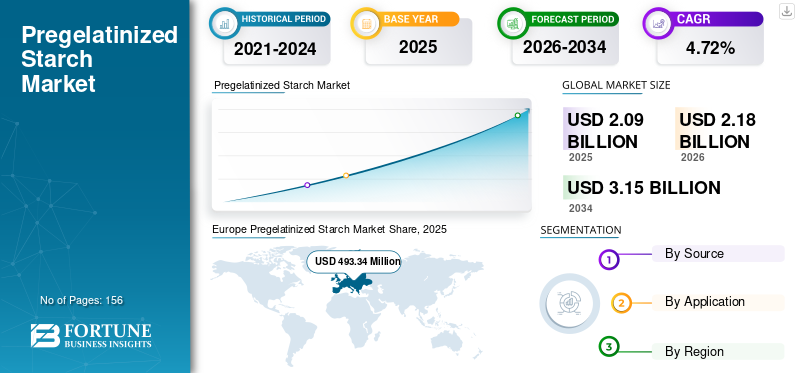
Download Free sample to learn more about this report.
Pregelatinized Starch Market KEY TAKEAWAYS
 Market Size & Forecast
- 2025 Market Size: USD 2,092.19 million
- 2026 Market Size: USD 2,184.03 million
- 2034 Forecast Market Size: USD 3,159.16 million
- CAGR: 4.72% from 2026–2034
 Market Share
- Europe dominated the pregelatinized starch market with a 23.58% share in 2026.
- The corn segment accounted for the largest market share.
- The food and beverage segment is projected to hold a 39.85% share in 2026.
 Key Regional Highlights
Asia Pacific
USD 655.69 million in 2025. Rising pharmaceutical activities and expanding industrial infrastructure drive regional growth.
North America
USD 633.72 million in 2025. Strong demand from the food & beverage, pharmaceutical, and cosmetics industries supports market growth.
Europe
23.58% market share in 2026. Growing demand for fortified and functional food products drives regional expansion.
U.S.
USD 470.42 million by 2026. Increasing starch demand across food, pharmaceutical, and cosmetic applications supports market growth.
Japan
USD 144.04 million by 2026. Expanding pharmaceutical and food processing industries drive market growth.
Read More

Pregelatinized Starch Market Trends
Growth of Textile Industry to Foster Industry Progress
Growing application in the textile industry is also projected to drive the industry growth in future. Increasing applications, including starch graft copolymers, starch esters, starch ethers, and cationic starches will increase the penetration of the product in the textile industry. The starches are utilized in printing and wrapping textile applications and have substituted polyvinyl alcohol. The modified product is used in the textile industry for textile sizing. Cotton yarn manufacturing especially requires modified starch. As the properties of pregelatinized starch can be tailored to meet specific requirements and its chemical properties are similar to those of rayon and cotton, it is used as the adhesive component in the size mix process. Thus, it is indispensable in the textile industry. Attributed to increasing fashion trends, there has been a massive surge in the textile industry, which, in turn, has surged the demand for products, thereby aiding the pregelatinized starch market growth.
Download Free sample to learn more about this report.
Pregelatinized Starch Market Growth Factors
Rising Demand for Pregelatinized Starch in Processed and RTE (Ready-to-Eat) Food to Support Market Growth
Pregelatinized starches are highly functional, native or modified, granular food starches, which dissolve instantly in cold water. They have been dried, precooked, and ground into flake or powder form. The starches dissolve quickly and thoroughly, developing their full viscosity without cooking. This provides convenience for consumer foods. The global rising population is increasing the demand for processed and convenience food. It is a primary ingredient that is utilized in ready-to-eat food products. The growing demand for processed food is resulting in the increased demand for modified starch, which is expected to boost the market growth. It also offers valuable properties such as appearance, taste, and consistency in processed foods, which help increase the shelf life of food products.
Ease of Product Incorporation in a Wide Range of Applications to Stimulate Product Demand
The market is growing faster as the product improves the sensory and textural characteristics of samples while cross‐linked starch affects the baking properties of the product in numerous applications such as personal care, food and beverage, textile, pharmaceuticals, and others. It is used as one of the constituents for the manufacturing of tablets. These starches act as a binding agent or a diluting agent during tablet manufacturing. The increasing old age population and growing demand for medicines are boosting the market growth. Other properties, such as self-lubricating, use in high shear wet granulation process, usage as a disintegrating agent, and others, are propelling the market growth for pregelatinized starch. Moreover, improvement in the healthcare infrastructure among developing nations such as Brazil, India, Australia, Singapore, and others is helping the pharmaceutical sector grow, which will ultimately boost the market growth.
RESTRAINING FACTORS
High Energy Requirement for Disintegration Process of Starch Molecules Is Restraining Market Growth
Pregelatinized starch goes through various processes before they are consumed or delivered to the end-user. The process requires heat treatment where the molecules of starch-containing hydrogen atoms need to be separated, which requires a high amount of energy. Since this starch is precooked to avoid a longer duration for post-cooking, they need to go through the healing process. Upon heating and dried, this starch is again converted into powder source to be served to the end-users. The loss of a large amount of energy in such a conversion process is expected to hinder the market growth.
Pregelatinized Starch Market Segmentation Analysis
By Source Analysis
Corn Hold Largest Market Share, Owing to Most Highly and Readily Available Raw Materials.
Corn is a staple food, and it is preferred across the globe due to its importance in the diets of several countries. The prices of corn starch are highly dependent upon its feedstock. Corn or maize accounts for nearly three-fourths of the total starch production globally. Corn starch is major source of starch used in food industry as a thickening agent or binder. It is used extensively in soups and liquid-based foods such as sauces, gravies, and custards. The Corn segment will account for 45.31% market share in 2026.
To know how our report can help streamline your business, Speak to Analyst
On the other hand, the wheat segment grows at a highest CAGR. Pregelatinized wheat starch can be used as a thickening agent in instant food products to eliminate heating stage in the production or in manufacturing of the products sensitive to high temperature.
By Application Analysis
Food and Beverage Sector to hold Largest Market Share due to Increasing Demand for Processed Food
The global food and beverage sector is continuously evolving due to the emerging trends of premiumization, functionality, convenience, and sustainability. It is extensively used in the food industry since it enhances the consistency of liquid medium at ambient temperatures. Therefore, it is suitable for instant foods products such as soups, baby foods, sauces, desserts, dry mixes, and cake powders. The increasing demand for processed and ready-to-eat food among consumers is creating a demand for the product. With the advancement of novel technologies and innovative experiments in the food and beverage sector, incorporating this starch across various industries is increasing. The food and beverage segment will account for 39.85% market share in 2026.
A variety of foods and beverages rely upon starch so as to deliver the additional nutrition and functional benefits that the consumers seek in order to stay healthy and keep diseases at bay. Asia Pacific and North America are among the two most important markets witnessing growth in the food & beverages market. In recent years, the demand statistics for functional foods have changed strikingly in these regions, owing to the suboptimal levels of nutrients being consumed by individuals via regular diet.
REGIONAL ANALYSIS
Europe Pregelatinized Starch Market Share, 2025
To get more information on the regional analysis of this market, Download Free sample
Europe
The Europe market accounted for USD 493.34 Million in 2025, representing 23.58% of the global industry, and is expected to reach USD 516.31 Million in 2026. The UK market is projected to reach USD 90.35 million by 2026, while the Germany market is projected to reach USD 102.38 million by 2026.
The development of innovative fortified and functional food products is a major food industry trend in Canada. This trend is driven by increased awareness among consumers about health deficiencies, heightened understanding of the possible health benefits of functional foods, development of new formulation technologies, changing consumer demographics and lifestyles, and relaxed international trade regulations. These factors have cumulatively driven the demand for starches in the country.
North America
In 2025, North America generated USD 633.72 Million, contributing 30.29% to global market revenue, and is projected to grow to USD 656.74 Million in 2026. The demand for the product is estimated to provide a good opportunity for several market players, including new entrants. The growing demand across various industries, such as pharmaceutical, chemicals, and food and beverages, and particularly in cosmetic industries, is projected to bolster market growth. Owing to the constant demand for the starch in food and beverages industry, the market is expected to grow at a rapid pace in this sector. Moreover, various factors, such as rise in demand for cosmetic products, the trend for packaged food items is providing ample opportunities for the market to grow. North America is estimated to be the prominent region, owing to the presence of major key players in the food and beverages industry such as Nestle, Kraft Heinz, and others. These food and beverage companies always seek the product to increase their production. The U.S. market is projected to reach USD 470.42 million by 2026.
To know how our report can help streamline your business, Speak to Analyst
Asia Pacific
Asia Pacific recorded a market size of USD 655.69 Million in 2025, capturing 31.34% of the global market share, and is projected to reach USD 689.5 Million in 2026. Asia Pacific will tend to show a considerable growth rate during the forecast period, owing to the rise in pharmaceutical sectors and development in the industrial infrastructure. The Japan market is projected to reach USD 144.04 million by 2026, the China market is projected to reach USD 201.33 million by 2026, and the India market is projected to reach USD 87.7 million by 2026.
Rest of the World
The Middle East & Africa market generated USD 102.31 Million in 2025, representing 4.89% of the global market landscape, and is expected to reach USD 105.49 Million in 2026. The market in South America reached USD 207.13 Million in 2025, representing 9.90% of total market revenue, and is projected to reach USD 216 Million in 2026.
List of Key Companies in Pregelatinized Starch Market
Companies to Focus On Growth in Their Production Capacity to Meet Global Demand
The pregelatinized starch market is consolidated owing to the presence of limited number of established and regional players. Key companies, such as Cargill Incorporated, Tate & Lyle, Visco Starch, and Grain Processing Corporation, are the prominent players in this market. These players are focusing to increase their production capacity to meet the global demand.
List of Top Pregelatinized Starch Companies:
- Cargill Incorporated (Iowa, U.S.)
- Tate & Lyle (London, U.K.)
- Visco Starch (Gujarat, India)
- Galam (Ma'anit, Israel)
- Banpong Tapioca Flour Industrial Co Ltd. (Bangkok, Thailand)
- Crest Cellulose (Andhra Pradesh, India)
- DFE Pharma (Tamil Nadu, India)
- Karandikars Cashell Private Limited (Maharashtra, India)
- Grain Processing Corporation (Iowa, U.S.)
- S A Pharmachem Pvt Ltd. (Maharashtra, India)
KEY INDUSTRY DEVELOPMENTS:
- January 2022: DFE Pharma expanded its nutraceutical product catalog by launching three starch-based excipients. The newly launched items are a native starch, Nutroféli ST100; partially pregelatinized starch, Nutroféli ST200; and a fully gelatinized starch, Nutroféli ST300.
- January 2020: Cargill Incorporated started using pregelatinized maize starch as a binding agent in the granulation of active ingredients. The development suggests that pregelatinized starches are excellent bioadhesives and can be used as a matrix for slow release. The developed brand was named as C☆PharmGel.
REPORT COVERAGE
The report provides qualitative and quantitative insights into the market. It also offers a detailed analysis of the market size and growth rate of all possible segments in the market. Various key insights presented in the report are an overview of related markets, recent industry developments such as mergers & acquisitions, regulatory scenario in critical countries, and key pregelatinized starch industry trends.
Request for Customization to gain extensive market insights.
Report Scope & Segmentation
|
ATTRIBUTE |
DETAILS |
|
Study Period |
2021-2034 |
|
Base Year |
2025 |
|
Estimated Year |
2026 |
|
Forecast Period |
2026-2034 |
|
Historical Period |
2021-2024 |
|
Growth Rate |
CAGR of 4.72% from 2026 to 2034 |
|
Unit |
Value (USD Million) |
|
Segmentation |
By Source
By Application
By Region
|
Frequently Asked Questions
Fortune Business Insights says that the global market size was USD 2092.19 million in 2025 and is projected to reach USD 3,159.16 million by 2034.
Registering a CAGR of 4.7.2%, the market will exhibit steady growth during the forecast period (2026-2034).
The corn segment is expected to be the leading segment based on type in the global market during the forecast period.
Rising demand for pregelatinized starch in processed and RTE food to drive the market growth.
Cargill Incorporated, Tate & Lyle, Visco Starch, and Grain Processing Corporation are the leading players in the market.
Europe dominated the market in terms of share in 2025.
Based on application, the food & beverage segment is set to lead the global market.
Prominent manufacturers focus on the expansion of production capacity to meet the growing demand for the product.



- 2021-2034
- 2025
- 2021-2024
- 156
-
(Offer valid till 30th Sep 2026)
Get 30-60 hrs Free Customization
Expand Regional and Country Coverage, Segments Analysis, Company Profiles, Competitive Benchmarking, and End-user Insights.




















Related Reports
-
US +1 833 909 2966 ( Toll Free )
-
Get In Touch With Us