Yeast Ingredients Market Size, Share & Industry Analysis, By Type (Yeast Extracts, Yeast Autolysates, Inactive Yeast Derivatives, Yeast Cell Wall Fractions and Specialty Functional Yeast Ingredients), By Form (Dry (Powder / Granules), Liquid Concentrates and Paste / Slurry), By End Use (Food Processing & Ingredient Manufacturing, Animal Nutrition & Feed Manufacturing, Nutraceutical & Supplement Manufacturing, Pharmaceutical & Biotech Processing and Personal Care & Industrial Applications) and Regional Forecast, 2026-2034
 Download Free Sample
(Offer valid till 15th Oct 2026)

Yeast Ingredients Market Size and Future Outlook
 Listen to Audio Version
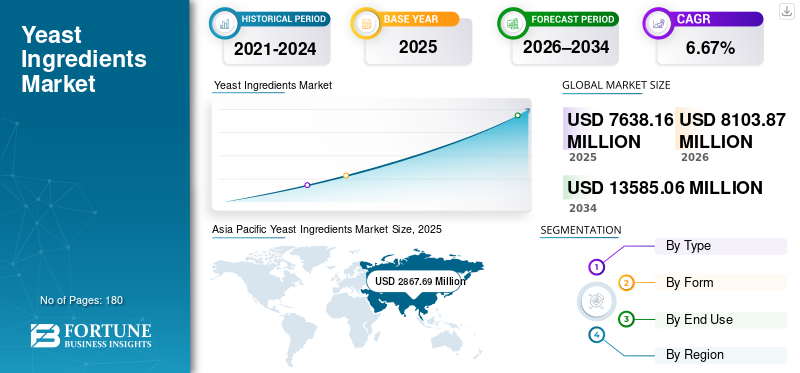
The global yeast ingredients market size was valued at USD 7,638.16 million in 2025 and is projected to grow from USD 8,103.87 million in 2026 to USD 13,585.06 million by 2034, exhibiting a CAGR of 6.67% during the forecast period. Asia Pacific dominated the yeast ingredients market with a market share of 37.54% in 2025.
Yeast ingredients are products made from yeast cells, mainly Saccharomyces cerevisiae. Such ingredients include yeast extracts, autolysates, inactive yeast, and yeast cell wall fractions, which are used in food, alcoholic beverages, animal nutrition, nutraceuticals, and pharmaceuticals. They help to enhance flavor, add nutrition, support processing, and provide health benefits. Ongoing advances in fermentation processing and specialty yeast products are helping these ingredients gain wider use in different industries.
Companies such as Koninklijke DSM N.V., Angel Yeast Co. Ltd., Lallemand Inc., Associated British Foods plc, Lesaffre Group, and others are some of the key players operating in this market. New product launch and production capacity expansion are the key strategies adopted to support the market development.
Download Free sample to learn more about this report.
Yeast Ingredients Market Key Takeaways
 Global Market Size & Forecast
- 2025 Market Size: USD 7,638.16 million
- 2026 Market Size: USD 8,103.87 million
- 2034 Forecast Market Size: USD 13,585.06 million
- CAGR: 6.67% from 2026–2034
 Market Share
- Asia Pacific dominated the yeast ingredients market with a 37.54% share in 2025.
- The Yeast Extracts segment held the largest market share in 2025.
- The Food Processing & Ingredient Manufacturing segment accounted for the largest market share in 2025.
 Key Regional Highlights
Asia Pacific
Asia Pacific reached USD 2,867.69 million in 2025, holding 37.54% of the global market.
North America
North America recorded USD 1,797.99 million in 2025.
Europe
Europe generated USD 2,113.19 million in 2025.
U.S
The market reached USD 1,491.60 million in 2025.
Japan
The market reached USD 410.85 million in 2025.
Read More

YEAST INGREDIENTS MARKET TRENDS
Rising Demand for Functionality, Sustainability, and Application-Specific Formulations Leads to Market Trend
Yeast ingredients are increasingly used in complicated recipes, especially in savory foods, where they are mixed with spices, plants, and other fermented ingredients. In animal nutrition, more consumers are interested in yeast products that have been proven to be effective during scientific studies. In different regions, the Asia Pacific, Middle East & Africa markets, more manufacturers are using yeast ingredients in food formulations, while North America and Europe are focusing on higher and better product formations to offer more value.
Download Free sample to learn more about this report.
MARKET DYNAMICS
MARKET DRIVERS
Increasing Clean-Label, Antibiotic-Free, and Functional Ingredient Demand Accelerates Market Growth
More companies are seeking clean-label, natural, and functional options for food, animal feed, and health products, driving the yeast ingredients market growth. Yeast extracts and derivatives are replacing artificial flavor enhancers because they provide a natural umami taste and are considered label-friendly. In animal nutrition, new rules limiting the use of antibiotic growth promoters have increased the use of yeast-based products, such as cell wall fractions, beta-glucans, and MOS, to support gut health and immunity. More processed foods, ready meals, savory snacks, and plant-based products are being produced, which is increasing demand for yeast ingredients because they add flavor and functionality. The growth of aquaculture, poultry, and pet food, especially in emerging markets, is also increasing the use of yeast ingredients. Consumers prefer yeast ingredients because they offer natural flavor enhancement and functional benefits while supporting clean-label, additive-free food formulations. This is boosting demand for yeast ingredients in natural and clean-label products, supplements, and nutraceuticals. As a result, yeast ingredients are now essential value-added components in many B2B sectors.
MARKET RESTRAINTS
High Raw Materials Costs and Inconsistent Access in low-Income Regions are Limiting Market Penetration
In feed and emerging markets, buyers are price-sensitive, making it harder for specialty yeast ingredients to gain traction and limiting profit growth. Fluctuations in raw-material costs, such as molasses and sugar, can affect production costs and make prices volatile. Producing yeast ingredients often requires specialized expertise and custom solutions to lead to production complexity. Getting regulatory approval for new yeast strains or health claims, especially in nutraceutical and pharmaceutical uses, can take a long time and often varies by region. Competition from other ingredients, such as hydrolyzed vegetable proteins, synthetic flavor enhancers, and probiotic substitutes, also intensifies market competition.
MARKET OPPORTUNITIES
Shift Toward Plant-Based Foods and Nutraceuticals Is Unlocking Premium Growth Opportunities
The yeast ingredients market is growing as consumers focus on higher-quality products and unique features. As more people choose plant-based foods, meat alternatives, and products with less sodium, there is a need for advanced yeast extracts that improve taste and texture and mask unwanted flavors. Similarly, there is a significant growth opportunity in the nutraceuticals and functional foods section, especially for beta-glucans and nutritional yeast that support immunity, energy, and gut health. Emerging markets in the Asia Pacific, Africa, and the Middle East have strong growth potential as their food processing and feed industries expand. Additionally, development in new strain selection, fermentation, and processing helps suppliers create customized yeast ingredients for specific uses, offering more value to customers.
Segmentation Analysis
By Type
Yeast Extracts Dominated the Segmentation Owing to High Usage in Several Different Industries
By type, the market is segmented into yeast extracts, yeast autolysates, inactive yeast derivatives, yeast cell wall fractions, and specialty functional yeast ingredients.
Yeast extracts are the largest segment, accounted for the largest yeast ingredients market share in 2025 owing to its flexibility and usage in several different industries. In food processing, it works as a natural flavor booster, adds savory taste to the food products, and helps make foods less salty. This is used in soups, sauces, snacks, ready-to-eat meals, and plant-based foods.
Inactive yeast derivatives are another major segment that is expected to grow at a CAGR of 6.62% during the forecast period. Inactive yeast derivatives are the second-largest segment in the yeast ingredients market because they are affordable, nutritious, and widely used in animal feed and basic foods. They are valued for their protein, B-complex vitamins, and benefits such as better digestibility and taste in feed. Although they are less complex than specialty yeast products, their wide use and high demand make them the second-largest part of the market.
By Form
Dry Form Leads the Market Owing to Its Longer Shelf Life, Lower Logistics Cost, and Easy Integration
Based on form, the market is divided into dry (powder/granules), liquid concentrates, and paste/slurry.
The dry form accounted for the largest market share in 2025, owing to easy transport and higher shelf life. Powdered and granulated forms are easier to store, move, and use than liquid or paste types, so they are often chosen for both local and international trade. This form can be measured easily and is commonly used in food, animal feed, and supplements.
Liquid concentrates form is another major segment, projected to showcase CAGR of 6.63% during the forecast period. Liquid yeast ingredients hold the second-largest market share due to their superior solubility, faster dispersion, and enhanced performance in large-scale, continuous processing environments. In industrial food manufacturing—particularly soups, sauces, ready meals, beverages, and flavor systems—liquid yeast extracts allow for more uniform mixing and quicker incorporation, improving process efficiency and product consistency.
By End Use
To know how our report can help streamline your business, Speak to Analyst
Food Processing & Ingredient Manufacturing Leads the Market Due to Widespread Use of Yeast-Based Flavor System
Based on end use, the market is categorized into food processing & ingredient manufacturing, animal nutrition & feed manufacturing, nutraceutical & supplement manufacturing, pharmaceutical & biotech processing, and personal care & industrial applications.
The food processing and ingredient manufacturing segment held the largest market share in 2025. This is due to yeast ingredients having a high value, used in many ways, and fit well with clean-label trends. Yeast extracts and autolysates are typical natural flavor enhancers in soups, sauces, snacks, ready meals, bakery goods, and plant-based foods. Yeast ingredients are also widely accepted by regulators as natural and label-friendly, which helps their adoption. Ongoing innovation in flavor-focused yeast products and fermentation-based ingredients is creating new uses, keeping food processing as the top revenue source for yeast ingredients.
Animal nutrition & feed manufacturing is the second largest segment, projected to hold a CAGR of 6.54% during the forecast period. This supports the industry’s move away from antibiotic growth promoters. Feed-grade yeast ingredients cost less than food-grade ones, but the high demand from livestock and aquaculture production makes this segment a major part of the market. Growth is strongest in emerging regions where people are eating more protein and industrial feed production is increasing.
Yeast Ingredients Market Regional Outlook
By region, the market is categorized into Europe, North America, Asia Pacific, South America, and the Middle East & Africa.
Asia Pacific
Asia Pacific Yeast Ingredients Market Size, 2025 (USD Million)
To get more information on the regional analysis of this market, Download Free sample
The Asia Pacific market was valued at USD 2,867.69 million in 2025 and is the fastest-growing and leading region in the world. Asia Pacific region leads the market driven by higher demand in food and animal nutrition. Urbanization, population growth, and increased consumption of processed foods boosted its usage in seasonings, instant noodles, sauces, and snacks. The aquaculture and poultry industries in this region are also high, so they use large amounts of feed-grade yeast products. Japan and South Korea focus more on high-value uses such as nutraceuticals and biotech, while China, India, and Southeast Asia drive most of the volume growth. The market is shifting from basic yeast products to more functional and specialty ingredients, which should increase value over time.
India Yeast Ingredients Market
The India market in 2025 was USD 277.69 million, accounting for roughly 3.64% of the global market share.
China Yeast Ingredients Market
China’s market in 2025 was USD 1,109.07 million, representing roughly 14.52% of global market sales.
Japan Yeast Ingredients Market
The Japan market in 2025 reached USD 410.85 million, accounting for roughly 5.38% of global market revenues.
North America
The North America yeast ingredients market reached a value of USD 1,797.99 million in 2025. The region’s market is shaped by a focus on value, with widespread use of clean-label foods, advanced animal nutrition, and strong demand for nutraceuticals. The region’s established processed food industry uses yeast extracts to replace synthetic flavor enhancers and help lower sodium levels. Prices are higher here than in other regions due to demand for specialty and premium ingredients. However, growth is steady rather than rapid, since the market is already mature. Yeast beta-glucan yeast derivatives are gaining traction due to their proven role in immune support, gut health, and antibiotic-free nutrition across food, feed, and health applications.
U.S. Yeast Ingredients Market
In 2025, the U.S. market reached USD 1,491.60 million. The U.S. leads the North American market, making up most of the region’s value thanks to its large food processing industry, nutraceutical production, and strong biotech sector. There is exceptionally high demand for yeast extracts in savory foods, ready meals, snacks, and plant-based products, where they help improve flavor and support clean-label claims. In animal nutrition, the fast growth of pet food and high-quality livestock feed is driving the use of functional yeast ingredients.
Europe
The European market was valued at USD 2,113.19 million in 2025. It is shaped by strict regulations and a focus on natural, sustainable, and functional products. The region adopted clean-label standards early, making yeast extracts key in soups, sauces, meat alternatives, and savory foods. Yeast-based solutions are also widely used in animal feed, especially after antibiotic growth promoters were restricted, which increased demand for cell wall fractions and MOS.
Germany Yeast Ingredients Market
The market in Germany in 2025 reached USD 441.21 million, representing roughly 5.78% of global market revenues.
U.K. Yeast Ingredients Market
The U.K. market reached USD 258.82 million in 2025, equivalent to be around 3.39% of global market sales.
South America and the Middle East & Africa
Over the forecast period, South America is expected to experience significant growth in this market. The South American market in 2025 was valued at USD 590.36 million. In South America, the market is driven by high volumes and price sensitivity, with most demand coming from food processing and animal nutrition. Brazil and Argentina lead the region because of their large poultry, livestock, and processed food sectors. As regional regulations align with global standards and awareness of alternatives to antibiotics grows, yeast cell wall fractions are seeing steady growth. Usage in the food and beverages industry, particularly in savory items and processed meats, offers some added value. Overall, the market is growing at a moderate pace, mainly due to higher production volumes rather than a shift toward premium products.
The Middle East and Africa region reached a value of USD 268.93 million in 2025. The yeast ingredients market in the Middle East and Africa relies heavily on imports and distributors, and is still developing in terms of value. Most demand comes from food processing and animal nutrition, mainly poultry feed, as countries work toward food security and protein self-sufficiency. The GCC countries and South Africa are the top markets, with higher prices and more advanced food industries. In comparison, much of Sub-Saharan Africa focuses on volume and is highly price-sensitive. Nutraceutical and specialty yeast uses are still new, but are growing as health awareness rises in cities.
South Africa Yeast Ingredients Market
The South African market is set to grow at a CAGR of 6.22% during the forecast period. Growth is robust in this country owing to the increasing protein consumption expansion in feed manufacturing.
COMPETITIVE LANDSCAPE
Key Industry Players
Strategic Acquisition and New Product Launch Are Reshaping the Global Yeast Ingredients Food Market
The global yeast ingredients market is semi-fragmented, with several multinational companies and local manufacturers competing to increase sales of their products. Key manufacturers operating in the market include Koninklijke DSM N.V., Angel Yeast Co. Ltd., Lallemand Inc., Associated British Foods plc, Lesaffre Group, and others. Apart from new product launches, companies are also acquiring complementary companies that help to complement their product offerings and influence the market's overall growth positively.
LIST OF YEAST INGREDIENTS COMPANIES PROFILED
- Lesaffre Group (France)
- Ohly (ABF Group) (Germany)
- AB Mauri (Associated British Foods) (U.K.)
- Lallemand Inc. (Canada)
- Angel Yeast Co., Ltd. (China)
- Kerry Group (Ireland)
- IFF (U.S.)
- Alltech (U.S.)
- Biorigin (Zilor Group) (Brazil)
- Novozymes (Novonesis) (Denmark)
KEY INDUSTRY DEVELOPMENTS
- May 2025: Yeastup AG acquired a Series A funding round amounting to USD 9 million that helped it establish a new production site that can manufacture protein and fiber ingredients from spent brewer’s yeast.
- October 2024: Lesaffre acquired the yeast extract business of DSM Firmenich. The company is one of the leading manufacturers of fermented products in the world.
- April 2024: Asahi Group Japan initiated the production of animal-free milk “LIKE MILK,” using proprietary yeast technology, which is manufactured using the technology platform “Makuake.”
- January 2023: Lallemand Health Solutions launched its first and unique organic version of probiotic yeast Saccharomyces boulardii that is used to develop innovative nutraceutical formulations.
- September 2021: DSM, one of the leading global solutions providers of specialty ingredients such as cultures, enzymes, yeast extracts, and others, acquired First Choice Ingredients, which is one of the leading suppliers of dairy-based savory flavorings for USD 453 million.
REPORT COVERAGE
Request for Customization to gain extensive market insights.
Report Scope & Segmentation
|
ATTRIBUTE |
DETAILS |
|
Study Period |
2021-2034 |
|
Base Year |
2025 |
|
Estimated Year |
2026 |
|
Forecast Period |
2026-2034 |
|
Historical Period |
2021-2024 |
|
Growth Rate |
CAGR of 6.67% from 2026-2034 |
|
Unit |
Value (USD Million) |
|
Segmentation |
By Type, By Form, By End Use, and Region |
|
By Type |
|
|
By Form |
|
|
By End Use |
|
|
By Region |
|
Frequently Asked Questions
Fortune Business Insights says that the global market value stood at USD 7,638.16 million in 2025 and is projected to reach USD 13,585.06 million by 2034.
In 2025, Asia Pacifics market value stood at USD 2,867.69 million.
The market is expected to exhibit a CAGR of 6.67% during the forecast period.
By end use, the food processing & ingredient manufacturing segment led the global market in 2025.
Rising clean-label, antibiotic-free, and functional ingredient demand is accelerating the adoption of yeast-based solutions.
Koninklijke DSM N.V., Angel Yeast Co. Ltd., Lallemand Inc., Associated British Foods plc, and Lesaffre Group are some of the top players in the market.
Asia Pacific held the largest market share in 2025.
Increasing focus on functionality, sustainability, and application-specific formulations is driving sales.



- 2021-2034
- 2025
- 2021-2024
- 180
-
(Offer valid till 15th Oct 2026)
Get 30-60 hrs Free Customization
Expand Regional and Country Coverage, Segments Analysis, Company Profiles, Competitive Benchmarking, and End-user Insights.



















Related Reports
-
US +1 833 909 2966 ( Toll Free )
-
Get In Touch With Us