Yoga and Exercise Mats Market Size, Share & Industry Analysis, By Type (Yoga, Pilates, Gym & General Fitness, and Outdoor & Travel), By End User (Individual Consumers, Health & Fitness Clubs, and Others), By Material (PVC, TPE, Natural Rubber, PU, and Others) By Distribution Channel (Supermarket & Hypermarket, Specialty Stores, Online Channels, and Others), and Regional Forecast, 2026-2034
 Download Free Sample
(Offer valid till 15th Oct 2026)

Yoga and Exercise Mats Market Size and Future Outlook
 Listen to Audio Version
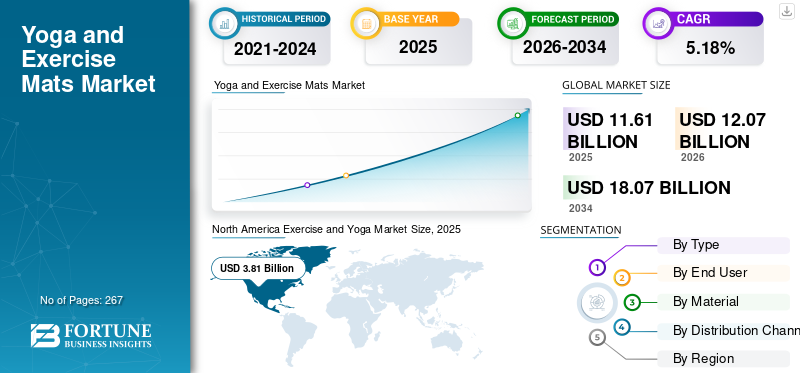
The global yoga and exercise mats market size was valued at USD 11.61 billion in 2025. The market is projected to grow from USD 12.07 billion in 2026 to USD 18.07 billion by 2034, exhibiting a CAGR of 5.18% during the forecast period. North America dominated the yoga and exercise mats market with a market share of 32.81% in 2025.
The global exercise and yoga market has witnessed strong growth in recent years, driven by rising health consciousness, the expansion of home fitness, and increased participation in yoga and wellness activities across all age groups. The market serves applications such as yoga, pilates, general fitness, and physiotherapy, with consumers demanding mats that combine comfort, durability, and eco-friendly materials. According to the 2022 Yoga Alliance and Yoga Journal study, over 300 million people worldwide practice yoga, reflecting its mainstream adoption beyond Asia and North America. This surge is reinforced by corporate wellness initiatives, influencer-led fitness movements, and the growing popularity of digital fitness platforms such as Alo Moves and Peloton, which have heightened the need for high-quality mats suitable for both home and studio use. Furthermore, sustainability concerns have encouraged innovation in materials such as natural rubber, cork, and thermoplastic elastomer (TPE), as brands respond to eco-conscious consumer preferences.
Key players in the market include Lululemon Athletica Inc., Manduka LLC, Gaiam (a division of Fit For Life LLC), Jade Yoga, and Adidas AG. These players focus on product innovation, sustainability, and brand lifestyle integration, with Lululemon and Adidas expanding through premium fitness ecosystems. At the same time, Manduka and Jade Yoga emphasize eco-friendly materials and ethical manufacturing.
Download Free sample to learn more about this report.
YOGA AND EXERCISE MATS MARKET KEY TAKEAWAYS
 Global Market Size & Forecast
- 2025 Market Size: USD 11.61 billion
- 2026 Market Size: USD 12.07 billion
- 2034 Forecast Market Size: USD 18.07 billion
- CAGR: 5.18% from 2026-2034
 Market Share
- North America held a 32.81% share of the yoga and exercise mats market in 2025.
- The PVS material segment led the market due to its cost-effectiveness, durability, and ease of mass production.
- Individual consumers accounted for the largest end-user market share, driven by increasing home fitness and wellness trends.
 Key Regional Highlights
North America
North America generated USD 3.81 billion in 2025.
Europe
Europe accounted for USD 2.88 billion in market value in 2025.
Asia Pacific
Asia Pacific ranked second, supported by strong consumer demand and increasing fitness awareness.
U.S.
The U.S. market was valued at USD 3.20 billion in 2025.
Japan
apan's market reached USD 0.30 billion in 2025.
Read More

YOGA AND EXERCISE MATS MARKET TRENDS
Integration of Smart and Technologically Enhanced Fitness Mats Create Lucrative Market Trends
The integration of technology to enhance user experience and improve performance tracking is a new trend in the market. Smart mats fitted with pressure mapping, sensors, and Bluetooth connectivity are gaining traction among fitness enthusiasts seeking real-time feedback on posture, balance, and movement. Innovations such as Yogifi Smart Yoga Mat and SmartMat use embedded sensors and AI-driven mobile apps to guide users through personalized sessions, correcting tracking and alignment. This aligns with the broader digital fitness revolution, where consumers increasingly blend traditional wellness practices with connected technologies.
Additionally, the adoption of smart mats reflects a growing interest in data-driven wellness and personalized training. As home workouts, remote fitness, and virtual yoga classes continue to expand, such products bridge the gap between physical and digital fitness ecosystems. This trend not only enhances user engagement but also encourages premium product positioning and recurring revenue through app subscriptions and updates. The convergence of fitness technology and mindfulness practices is therefore transforming yoga mats from simple accessories into interactive wellness tools that embody the future of connected fitness.
MARKET DYNAMICS
MARKET DRIVERS
Download Free sample to learn more about this report.
Rising Global Health and Wellness Awareness to Drive Market Growth
A key driver of the exercise and yoga market is the growing global emphasis on health, wellness, and holistic fitness. Consumers are increasingly prioritizing mental and physical well-being, with yoga and home workouts becoming integral parts of everyday routines. According to the World Health Organization (WHO), more than one in four adults worldwide do not meet recommended physical activity levels, prompting governments and organizations to promote regular exercise. According to a 2024 publication by the National Center for Complementary and Integrative Health (NCCIH), the rate of U.S. adults doing yoga rose from 5.0% in 2002 to 15.8% in 2022. As a result, the growing demand for yoga mats that provide comfort, grip, and sustainability has surged among both casual users and professional trainers.
Furthermore, the pandemic-driven home fitness boom and the rise of digital wellness platforms have significantly accelerated the market’s growth trajectory. Apps such as Nike Training Club, Peloton, and Alo Moves saw record engagement during and after COVID-19 lockdowns, as consumers sought accessible home-based fitness options. This has reinforced the trend toward personalized, eco-conscious products, with brands introducing mats made from natural rubber, cork, and TPE to meet environmental and performance needs. Collectively, these factors demonstrate how the global shift toward proactive health management and mindful living continues to sustain the upward momentum of the yoga and exercise mat market.
MARKET RESTRAINTS
Environmental Concerns and Material Sustainability Obstruct Market Growth
The environmental impact of synthetic materials used in the mass production of exercise and yoga mats is primarily hampering the yoga and exercise mats market growth. Many conventional mats are made using PVC, a non-biodegradable plastic that releases toxic chemicals during both manufacturing and disposal. This raises significant concerns among eco-conscious consumers and regulators advocating for sustainable alternatives. The U.S. Environmental Protection Agency (EPA) and the European Chemicals Agency (ECHA) have highlighted PVC’s environmental persistence and potential health risks, promoting stricter environmental standards and consumer scrutiny.
MARKET OPPORTUNITIES
Expansion of Eco-Friendly and Sustainable Product Lines Provides Market Growth Opportunities
Rising demand for eco-friendly, biodegradable mats, as consumers increasingly align their purchasing choices with environmental and ethical values, provides numerous growth opportunities for manufacturers. With global awareness of plastic waste and carbon footprints growing, brands adopting sustainable materials such as natural rubber, cork, organic cotton, and jute are gaining a competitive edge. Organizations such as the United Nations Environment Programme (UNEP) have emphasized the importance of sustainable production and responsible consumption under SDG 12, supporting innovation in recyclable and biodegradable fitness products.
This shift not only appeals to eco-conscious consumers but also opens the door to brand differentiation and premium pricing. Companies including Jade Yoga and Liforme have successfully leveraged sustainability as a core brand identity, making mats that are both eco-positive and high-performance. Moreover, advancements in materials science, such as plant-based polymers and closed-loop recycling systems, offer manufacturers the potential to scale green production without compromising quality. Consequently, sustainability has become not just a compliance goal but a strategic growth pathway for future market expansion.
Segmentation Analysis
By Type
Growing Awareness of Yoga and Healthy Lifestyle Adoption to Support Growth of Yoga Mats
Based on type, the market is segmented into yoga, pilates, gym & general fitness, and outdoor & travel. Others include mixed/all-in-one boxes, combining makeup, skincare, and body care.
The yoga mats segment dominates the global market. This growth is attributed to the widespread adoption of yoga as a holistic wellness practice promoting both physical and mental health. With increasing participation across all age groups and recognition of yoga’s therapeutic benefits, demand for high-quality mats that offer grip, comfort, and eco-friendly materials has surged. Supported by initiatives such as the United Nations International Day of Yoga, observed in over 190 countries, and endorsements from global fitness influencers, yoga has evolved from a niche discipline into a mainstream lifestyle trend. Additionally, the accessibility of yoga that requires minimal equipment has made it a preferred form of exercise during and after the pandemic, reinforcing its dominance in the mat market.
Meanwhile, the outdoor & travel segment is projected to be the fastest-growing over the forecast period, owing to a surge in adventure fitness tourism such as fitcation and demand for lightweight, portable mats suited for on-the-go wellness routines and outdoor workouts.
To know how our report can help streamline your business, Speak to Analyst
By Material
Affordability and Widespread Availability to Support Growth of PVC Material
By material, the market is segmented into PVC, TPE, natural rubber, PU, and others.
The PVS material segment dominates the market. The segment growth is driven by its cost-effectiveness, durability, and ease of mass production. PVC mats offer reliable cushioning, non-slip surfaces, and easy maintenance, making them the preferred choice for entry-level users, gyms, and institutional buyers. Their widespread availability across retail and online channels further strengthens their market position, particularly in price-sensitive regions across Asia and Latin America. Despite growing environmental concerns, PVC remains popular among consumers prioritizing affordability and functional performance over sustainability, ensuring its continued dominance in the short term.
By End User
Individual Consumers Segment Growth Boosted by Home Fitness and Lifestyle Integration
Based on end user, the market is segmented into individual consumers, health & fitness clubs, and others.
The individual consumer accounted for the majority of end-user market share, driven by the growing trend of home workouts, online fitness programs, and personal wellness routines. The pandemic accelerated this shift, with millions adopting yoga, pilates, and bodyweight exercises at home, supported by platforms such as YouTube, Peloton, and Nike Training Club. This segment benefits from increasing disposable income, digital fitness accessibility, and a heightened focus on mental and physical well-being. Moreover, social media-driven wellness culture and the popularity of aesthetically designed, eco-friendly mats have made personal ownership both a necessity and a lifestyle statement, reinforcing its market leadership.
The health & fitness clubs segment is anticipated to grow at the fastest CAGR over the forecast period. The growth is attributed by the resurgence of gym memberships and group fitness programs, as well as the professional replacement demand for high-quality, durable mats in studios and wellness centers.
By Distribution Channel
Demand for High-Quality and Eco-friendly Products Drive Specialty Stores Segment Growth
Based on distribution channel, the market is segmented into supermarket & hypermarket, specialty stores, online channels, and others.
The specialty stores segment dominates the market, driven by consumers seeking high-quality, performance-oriented, and eco-friendly products paired with expert guidance and tactile experience. Specialty outlets such as Lululemon, Manduka, and Decathlon provide curated assortments, allowing customers to assess texture, grip, and comfort before purchase, factors that strongly influence buying decisions for fitness equipment. These stores also serve as community hubs, hosting wellness events and yoga workshops that strengthen brand loyalty and reinforce lifestyle branding. The in-store experience, combined with personalized consultation and product demonstrations, has positioned specialty stores as the preferred channel for discerning and professional users.
In addition, the online channel is the fastest-growing channel during the study period. Growth is driven by the rising e-commerce penetration, digital fitness adoption, and social media-driven brand visibility, making premium and niche yoga mat brands more accessible to a global audience.
Yoga and Exercise Mats Market Regional Outlook
By region, the market is categorized into Europe, North America, Asia Pacific, South America, and the Middle East & Africa.
North America
North America Exercise and Yoga Market Size, 2025 (USD Billion)
To get more information on the regional analysis of this market, Download Free sample
The North America market held the dominant yoga and exercise mats market share in 2025, valued at USD 3.81 billion, and also led in 2026, with USD 3.92 billion. The market's growth in the region is supported by high health consciousness, a strong yoga culture, and a mature fitness industry. The area has one of the world’s largest bases of yoga practitioners, according to the National Center for Complementary and Integrative Health (NCCIH). Around 15.8% of U.S. adults practiced yoga in 2022, up from just 5% in 2002, illustrating the widespread integration of yoga into mainstream wellness routines. Additionally, the Physical Activity Council reports that over 70% of Americans participate in some form of fitness activity, reflecting a deeply ingrained fitness-oriented lifestyle. In 2025, the U.S. market reached USD 0.99 billion.
U.S. Yoga and Exercise Mats Market
The U.S. yoga mats market size reached USD 3.20 billion in 2025. The U.S. market accounted for around 27.56% of the global market sales in 2025.
Europe
Europe holds the third position, driven by a sustainability focus, a mature wellness culture, and high disposable incomes among health-conscious consumers. The European market was recorded to have reached USD 2.88 billion in 2025. Moreover, Europe’s increasing engagement in yoga and holistic fitness supports steady market expansion. Surveys by Statista and Yoga Alliance Professionals U.K. indicate that yoga participation in countries such as Germany, France, and the U.K. has grown consistently since the pandemic, particularly among urban adults seeking stress relief and physical wellness.
U.K. Yoga and Exercise Mats Market
The U.K. market in 2025 was valued at around USD 0.54 billion, representing approximately 4.65% of global product revenues.
Germany Yoga and Exercise Mats Market
Germany’s market reached approximately USD 0.63 billion in 2025, equivalent to around 5.43% of global product sales.
Asia Pacific
The Asia Pacific yoga mats market holds the second position, supported by its massive consumer base, cultural ties to yoga, and accelerating fitness awareness. The region’s dominance in production and export, especially from China and India, also strengthens its global influence. In countries such as India, Japan, and Australia, yoga and home fitness adoption have surged due to rising disposable incomes, digital fitness platforms, and wellness tourism.
Japan Yoga and Exercise Mats Market
The Japanese market in 2025 was valued at around USD 0.30 billion, accounting for roughly 2.58% of global product revenues.
China Yoga and Exercise Mats Market
China’s market is projected to be one of the largest worldwide, with revenues valued at around USD 1.24 billion in 2025, representing roughly 10.68% of global product sales.
India Yoga and Exercise Mats Market
The Indian market in 2025 was valued at around USD 1.12 billion, accounting for roughly 9.65% of global market revenues.
South America and the Middle East & Africa
Over the forecast period, South America and the Middle East & Africa regions would witness significant growth in this market. The South America market in 2025 reached USD 0.74 billion in valuation. Growth in the South American market is fueled by rising fitness culture, influencer-led wellness trends, and expanding access to affordable yoga and exercise products through online and retail channels across countries such as Brazil and Argentina. Additionally, the Middle East & Africa recorded to have reached USD 0.57 billion in 2025.
UAE Yoga and Exercise Mats Market
The UAE market size reached approximately USD 0.17 billion by 2025, accounting for roughly 1.46% of the global market revenues.
COMPETITIVE LANDSCAPE
Key Industry Players
Market Players Competing through Product Innovation, Lifestyle Branding, and Sustainability
The global yoga and exercise mats market is moderately fragmented, featuring a mix of established international brands and emerging regional players competing through product innovation, sustainability, and lifestyle branding. Leading companies such as Lululemon Athletica, Manduka LLC, Gaiam (Fit For Life), Adidas AG, and Jade Yoga dominate the premium segment, leveraging strategies centered on eco-friendly materials, ergonomic design, and community-based marketing. These brands emphasize high-performance mats made from natural rubber, TPE, and polyurethane, appealing to consumers who value both functionality and environmental responsibility.
Mid-tier and local manufacturers, especially in the Asia Pacific and Europe, focus on affordability, digital retail expansion, and private-label production to capture mass-market consumers. Many players are integrating online direct-to-consumer (D2C) models, influencer collaborations, and limited-edition releases to strengthen brand loyalty. The market is also witnessing an uptick in smart, tech-enabled mats, as well as partnerships with fitness studios and wellness platforms to expand brand reach. Overall, the competitive landscape reflects a shift toward sustainable innovation, digital engagement, and lifestyle-driven differentiation, shaping a dynamic yet environmentally conscious growth trajectory for the industry.
LIST OF KEY YOGA AND EXERCISE MATS COMPANIES PROFILED
- Lululemon Athletica Inc. (Canada)
- Manduka LLC (U.S.)
- Gaiam (Fit For Life LLC) (U.S.)
- Adidas AG (Germany)
- Jade Yoga (U.S.)
- Liforme Ltd. (U.K.)
- Nike Inc. (U.S.)
- Decathlon S.A. (France)
- Hugger Mugger Yoga Products (U.S.)
- Liforme Yoga Studio Pvt. Ltd. (India)
KEY INDUSTRY DEVELOPMENTS
- July 2025: Lululemon Athletica Inc., the Canadian premium athletic and yoga lifestyle brand, announced plans to enter the Indian market, marking a major step in its international expansion strategy. As reported by The Economic Times, Lululemon aims to establish a physical retail presence and e-commerce operations in India by partnering with Tata CLiQ Luxury, a leading Indian digital retail platform. The initiative underscores the brand’s intent to tap into India’s rapidly growing base of health-conscious consumers and yoga practitioners, a natural extension of the country’s deep cultural association with yoga and wellness.
- April 2025: Vikasa Yoga, a renowned international yoga community and wellness retreat brand, announced its transition to Manduka’s sustainably produced yoga mats across all its studios and training programs. This strategic upgrade reflects Vikasa’s broader commitment to environmental responsibility and sustainable operational practices, aligning with its philosophy of conscious living. The move involves replacing conventional mats with Manduka’s eKO and PRO series, both recognized for their durability, non-toxic materials, and eco-friendly manufacturing processes.
- November 2024: Manduka announced a strategic partnership with SuperCircle, a circular solutions company, to launch the yoga industry’s first end-of-life recycling program for yoga mats. This pioneering initiative is designed to create a closed-loop lifecycle for used mats by collecting, processing, and repurposing them into new materials, thereby diverting waste from landfills and reducing environmental impact. Through this program, consumers can return their old Manduka mats, which will then be responsibly recycled into products such as flooring materials or industrial padding, extending the usable life of the raw components.
- August 2024: Satori Concept introduced a new line of eco-friendly cork yoga mats, reinforcing its commitment to sustainable wellness products. The collection features mats crafted from biodegradable cork and natural rubber, offering a non-toxic, antimicrobial, and durable surface suitable for various yoga and fitness practices. Designed with nature-inspired aesthetics and enhanced grip technology, the new mats cater to consumers seeking both performance and environmental responsibility.
- July 2024: Manduka, one of the global yoga equipment brands, announced the enhancement and expansion of its flagship eKO Series, reaffirming its long-term commitment to sustainability and performance innovation. The updated eKO, eKO Lite, and eKO SuperLite mats are crafted from sustainably harvested natural rubber, now featuring a refined natural rubber compound containing 30% recycled content. This improvement not only enhances durability and cushioning but also significantly reduces the mats’ environmental footprint, aligning with Manduka’s ongoing mission to minimize reliance on non-renewable materials.
- July 2024: YogiFi announced the launch of its Smart Mat Gen 3, a next-generation yoga mat that merges artificial intelligence, sensor technology, and mobile connectivity to redefine the at-home yoga experience. The Smart Mat Gen 3 features embedded pressure sensors and posture recognition algorithms that connect seamlessly with the YogiFi mobile app, providing users with real-time feedback on poses, balance, and flexibility. By analyzing body alignment and weight distribution, the system offers instant corrections and personalized guidance, mimicking the experience of a live instructor.
- April 2024: Lululemon launched its new smart yoga mat model, the “Smart Align Mat” integrating pressure sensors to provide real-time alignment feedback during yoga sessions. This product push signifies a shift toward blending traditional yoga accessories with connected fitness technology.
REPORT COVERAGE
The global yoga mat market report analysis provides an in-depth study of market size & forecast by all the market segments included in the report. It includes details on the market dynamics and market trends expected to drive the market in the forecast period. It offers information on the technological advancements, new product launches, key industry developments, and details on partnerships, mergers & acquisitions. The market research report also encompasses porters five forces analysis, a detailed competitive landscape with information on the market share and profiles of key operating players.
Request for Customization to gain extensive market insights.
Report Scope & Segmentation
| ATTRIBUTE | DETAILS |
| Study Period | 2021-2034 |
| Base Year | 2025 |
| Estimated Year | 2026 |
| Forecast Period | 2026-2034 |
| Historical Period | 2021-2024 |
| Growth Rate | CAGR of 5.18% from 2026-2034 |
| Unit | Value (USD Billion) |
| Segmentation | By Type, Material, End User, Distribution Channel, and Region |
| By Type |
|
| By End User |
|
| By Material |
|
| By Distribution Channel |
|
| By Region |
|
Frequently Asked Questions
Fortune Business Insights says that the global market value stood at USD 11.61 billion in 2025 and is projected to reach USD 18.07 billion by 2034.
In 2025, the market value stood at USD 3.81 billion.
The market is expected to exhibit a CAGR of 5.18% during the forecast period.
The yoga segment led the market by type.
The key factors driving the market growth are rising health consciousness, the expansion of home fitness trends, and increasing participation in yoga and wellness activities.
Lululemon Athletica Inc., Manduka LLC, Gaiam (a division of Fit For Life LLC), Jade Yoga, and Adidas AG are some of the prominent players in the market.
North America dominated the market in 2025.
The global awareness of plastic waste and carbon footprints growing, brands adopting sustainable materials such as natural rubber, cork, organic cotton, and jute mostly to favor the product adoption.



- 2021-2034
- 2025
- 2021-2024
- 267
-
(Offer valid till 15th Oct 2026)
Get 30-60 hrs Free Customization
Expand Regional and Country Coverage, Segments Analysis, Company Profiles, Competitive Benchmarking, and End-user Insights.


















Related Reports
-
US +1 833 909 2966 ( Toll Free )
-
Get In Touch With Us