Zero Emission Aircraft Market Size, Share & Industry Analysis, By Range (Short Range, Medium Range, and Long Range), By Aircraft Type (Electric Aircraft, Hydrogen Fuel Cell Aircraft, Hybrid-Electric Aircraft, Solar-Powered Aircraft, and Hydrogen Combustion Aircraft), By Propulsion (Battery-Electric Propulsion, Hydrogen Fuel Cell Propulsion, and Solar-Electric Propulsion), By Application (Passenger Transport, Cargo & Logistics, Urban Air Mobility, Military & Defense Operations, Training & Research Aircraft, and Emergency Medical Services), and Regional Forecast, 2026-2034
 Download Free Sample
Zero Emission Aircraft Market Size and Future Outlook
 Listen to Audio Version
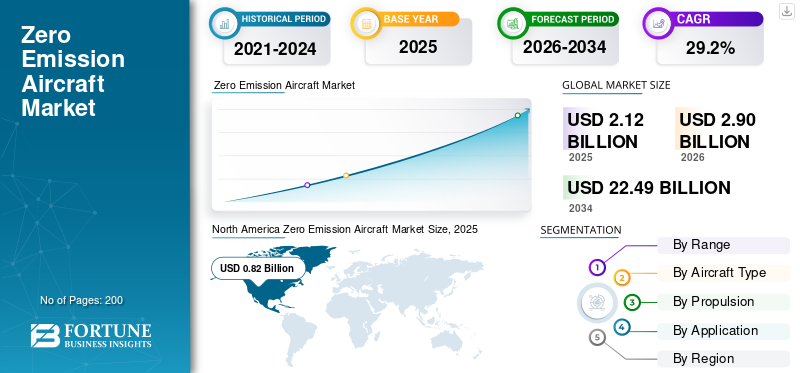
The global zero emission aircraft market size was valued at USD 2.12 billion in 2025 and is projected to grow from USD 2.90 billion in 2026 to USD 22.49 billion by 2034, exhibiting a CAGR of 29.2% during the forecast period. North America dominated the zero emission aircraft market with a market share of 38.68% in 2025.
The market is undergoing rapid transformation as the global aviation industry pivots toward sustainable propulsion technologies. Driven by mounting environmental concerns and tightening regulatory mandates, the market encompasses aircraft powered by hydrogen fuel cells, battery-electric systems, and hybrid-electric solutions. Growing investment from both public and private stakeholders, advancements in lightweight materials, and breakthroughs in energy storage are collectively accelerating development timelines. Regional and short-haul aviation segments are expected to pioneer early adoption, laying the foundation for a broader industry-wide transition to carbon-neutral flight.
Key players in the market include Airbus SE, ZeroAvia Inc., Heart Aerospace AB, Pipistrel, Joby Aviation Inc., Archer Aviation Inc., Wisk Aero LLC, magniX USA Inc., and AURA AERO SAS. These companies compete through advances in hydrogen fuel cell integration, battery-electric powertrain efficiency, extended flight range capabilities, urban air mobility platforms, and hybrid propulsion architectures. Their product portfolios span eVTOL vehicles, regional commuter aircraft, and retrofitted zero-emission powertrains tailored for passenger transport, cargo operations, and sustainable regional aviation.
Download Free sample to learn more about this report.
Zero Emission Aircraft Market Key Takeaways
 Global Market Size & Forecast
- 2025 Market Size: USD 2.12 billion
- 2026 Market Size: USD 2.90 billion
- 2034 Forecast Market Size: USD 22.49 billion
- CAGR: 29.2% from 2026–2034
 Market Share
- North America dominated the zero emission aircraft market with a market share of 38.68% in 2025.
- The medium range segment is anticipated to rise with a CAGR of 29.8% over the forecast period.
- The urban air mobility segment is projected to grow at a CAGR of 29.6% during the forecast period.
 Key Regional Highlights
North America
The region reached USD 0.82 billion in 2025 and is estimated at USD 0.97 billion in 2026, maintaining its leadership due to strong aerospace manufacturing, supportive government initiatives, and robust R&D investments.
Europe
The market is projected to reach USD 0.91 billion in 2026, supported by sustainable aviation policies, the Clean Aviation partnership, and expanding cross-border collaborations.
Asia Pacific
The region is forecast to reach USD 0.66 billion in 2026 and register the highest regional CAGR of 30.0%, driven by regional aviation expansion, fleet modernization, and increasing investment in low-emission technologies.
U.S.
The U.S. market is estimated at USD 0.97 billion in 2026, supported by clean fleet transition initiatives, battery-electric and hydrogen aircraft testing, and a strong aerospace innovation ecosystem.
Japan
The Japan market is estimated to reach USD 0.11 billion in 2026, with growth supported by advancements in hydrogen fuel cell technology and increasing adoption of electric and hydrogen-powered aircraft for regional aviation.
Read More

ZERO EMISSION AIRCRAFT MARKET TRENDS
Accelerating Shift Toward Hydrogen and Battery-Electric Propulsion is Reshaping Aircraft Development Pipelines
The market is witnessing strong adoption of predictive analytics, digital platforms, and advanced materials to enhance performance and accelerate certification readiness. Competition is intensifying as established aerospace firms and startups focus on scaling prototypes, forming energy partnerships, and moving toward commercialization. The shift from pilot programs to scalable zero-emission fleet deployments, alongside rapid acceleration in hydrogen-powered flight testing and certification, are emerging as key trends shaping market direction. Battery-powered aircraft are dominating early commercialization pathways as energy density improves and storage costs decline, while hydrogen systems gain momentum as cryogenic storage challenges gradually ease.
MARKET DYNAMICS
MARKET DRIVERS
Download Free sample to learn more about this report.
Stringent Environmental Regulations and Government Clean Aviation Mandates are Accelerating Zero-Emission Aircraft Adoption
Governments worldwide are accelerating the adoption of clean aviation technologies through financial incentives, grants, and policy frameworks, helping reduce financial barriers for companies developing zero-emission aircraft. Programs such as the EU's Horizon Europe and the U.S. Sustainable Aviation Fuel Grand Challenge promote innovation and industry collaboration. Increasing concerns regarding carbon emissions from air travel, along with stringent environmental regulations, are expected to drive the demand for zero emission aircraft. These regulatory imperatives, combined with airline decarbonization commitments and rising fuel price volatility, are compelling manufacturers to accelerate investments in alternative propulsion technologies.
MARKET RESTRAINTS
High Development Costs and Immature Refueling Infrastructure are Limiting the Pace of Market Adoption
One significant restraint is the high cost associated with the development and production of zero-emission aircraft technologies. Research and development efforts require substantial capital investment, which can be a barrier for many companies, especially startups. The initial price of electric and hydrogen-powered aircraft is currently higher than conventional aircraft, which can deter airlines from making the switch. Restraints also include infrastructure gaps for hydrogen refueling and electric charging systems. Until economies of scale are achieved and supporting ground infrastructure is widely deployed, the pace of commercial adoption is expected to remain constrained across key markets.
MARKET OPPORTUNITIES
Expanding Regional Air Connectivity and Urban Air Mobility Creating Significant Commercial Opportunities
The market presents a substantial opportunity due to increasing demand for sustainable aviation solutions, driven by consumer preferences and corporate responsibility initiatives. Regulatory frameworks, such as government mandates on emissions reductions and support for sustainable aviation fuels, are accelerating industry progress. Short-haul flights are expected to witness the most immediate adoption of zero-emission technologies, as they can be effectively powered by battery or hydrogen-fueled systems, minimizing infrastructure costs. Medium-haul aircraft are projected to transition successfully as technology matures, striking a balance between efficiency and range. Urban air mobility networks and regional commuter routes represent significant untapped commercial opportunities for next-generation zero-emission platforms.
MARKET CHALLENGES
Battery Energy Density Limitations and Complex Certification Pathways are Posing Technical and Regulatory Hurdles
The zero emission aircraft market growth struggles with the limitations of current battery technology, where weight-to-power ratios restrict long-range operations. It also confronts challenges in hydrogen storage, requiring cryogenic tanks and complex safety systems that add weight and cost. EASA is developing parallel guidance on cryogenic safety, but international harmonization remains incomplete. Capital efficiency suffers when manufacturers fund duplicative test programs for different jurisdictions, and the resulting schedule uncertainty weighs on investor confidence and may slow order conversions. Overcoming these compounding technical and regulatory barriers remains central to achieving commercial viability at scale.
Segmentation Analysis
By Range
Technological Maturity and Cost-Effective Operations over Short Distances are Driving Demand for the Short Range Segment
Based on range, the market is segmented into short range, medium range, and long range.
The short range segment accounted for the largest zero emission aircraft market share in 2025. Short-haul flights are expected to witness the most immediate adoption of zero-emission technologies, as they can be effectively powered by battery or hydrogen-fueled systems, minimizing infrastructure costs. Current propulsion systems are most viable over shorter distances, making this segment the natural entry point for commercialization and fleet electrification across regional and commuter aviation networks.
The medium range segment is anticipated to rise with a CAGR of 29.8% over the forecast period.
To know how our report can help streamline your business, Speak to Analyst
By Aircraft Type
Rising Airline Decarbonization Commitments and Advancements in Propulsion Technology are Driving Demand for the Electric Aircraft Segment
Based on aircraft type, the market is segmented into electric aircraft, hydrogen fuel cell aircraft, hybrid-electric aircraft, solar-powered aircraft, and hydrogen combustion aircraft.
In 2025, the electric aircraft segment dominated the global market. As aircraft operators seek to reduce operational costs and carbon emissions, there will be significant growth in investment, testing, and adoption of all-electric aircraft. Electric aircraft offer lower operating costs, reduced noise, and zero direct emissions, making them increasingly attractive to regional carriers and urban air mobility operators pursuing sustainability mandates and fleet modernization goals.
The hybrid-electric aircraft segment is projected to grow at a CAGR of 30.3% over the forecast period.
By Propulsion
Rapid Improvements in Energy Density and Falling Battery Costs are Driving Demand for the Battery-Electric Propulsion Segment
Based on propulsion, the market is segmented into battery-electric propulsion, hydrogen fuel cell propulsion, hybrid-electric propulsion, hydrogen combustion propulsion, and solar-electric propulsion.
The battery-electric propulsion segment is anticipated to witness a dominating market share over the forecast period. Battery-powered aircraft dominate early commercialization due to advances in energy density and falling storage costs. The battery-electric propulsion segment benefits from well-established supply chains and a simpler certification pathway compared to hydrogen systems, accelerating its deployment in light aircraft, general aviation, and short-haul commercial platforms.
The hybrid-electric propulsion segment is projected to grow at a high CAGR of 30.1% over the forecast period.
By Application
Growing Air Travel Demand and Corporate Sustainability Goals are Driving Demand for the Passenger Transport Segment
Based on application, the market is segmented into passenger transport, cargo & logistics, urban air mobility, military & defense operations, training & research aircraft, and emergency medical services.
The passenger transport segment dominated the market share in 2025. Further, the segment is expected to contribute the highest share in the market, due to economic growth, rising living standards, and rapid urbanization, thus increasing demand for air travel, especially locally. Airlines and air mobility operators are actively pursuing zero-emission passenger platforms to align with net-zero commitments and meet rising traveler expectations for sustainable aviation experiences.
In addition, the urban air mobility segment is projected to grow at a CAGR of 29.6% during the forecast period.
Zero Emission Aircraft Market Regional Outlook
By region, the market is categorized into North America, Europe, Asia Pacific, and the Rest of the World.
North America
North America Zero Emission Aircraft Market Size, 2025 (USD Billion)
To get more information on the regional analysis of this market, Download Free sample
North America held the dominant share in 2024, valuing at USD 0.59 billion, and also maintained the leading share in 2025, with USD 0.82 billion. The region holds the largest market share in the market, supported by the presence of major aerospace manufacturers, helpful government initiatives, and rising demand for environmentally friendly aviation solutions. Strong R&D ecosystems and policy backing further reinforce its leadership position.
U.S. Zero Emission Aircraft Market
Based on North America’s strong contribution and the U.S. dominance within the region, the U.S. market can be analytically approximated at around USD 0.97 billion in 2026, representing roughly 28.9% of CAGR over the forecast period. The U.S. holds a leading position, driven by strong interest from regional carriers in clean fleet transitions and ongoing test campaigns involving battery-electric and hydrogen fuel-cell aircraft. Extensive aerospace innovation ecosystems and regulatory frameworks further support market expansion.
Europe
Europe is estimated to reach USD 0.91 billion in 2026 and secure the position of second-largest region in the market. Europe is expected to emerge as the growing regional market, driven by a strong policy push for sustainable aviation and focus on emerging technologies under the Clean Aviation partnership, with countries such as Germany and France at the forefront. Additional factors such as cross-border collaborations are accelerating local manufacturing and export capabilities.
U.K. Zero Emission Aircraft Market
The U.K. market growth in 2026 is estimated at around USD 0.25 billion, representing roughly 29.6% of CAGR over the forecast period. The U.K. records steady growth, with a focus on urban air mobility and low-emission aviation projects. Government-backed initiatives such as the Jet Zero Taskforce are reinforcing the U.K.'s ambition to become an international leader in clean aviation.
Germany Zero Emission Aircraft Market
Germany’s market is projected to reach approximately USD 0.22 billion in 2026. Germany shows strong growth, fueled by advancements in hybrid-electric and hydrogen-powered aircraft technologies. Its established aerospace manufacturing base and Clean Aviation partnership participation positions it as a key European hub for zero-emission aircraft development.
Asia Pacific
Asia Pacific is projected to record a CAGR of 30.0% during the forecast period, which is the highest among all regions, and is set to reach a valuation of USD 0.66 billion by 2026. The region is emerging as the fastest-growing region, with growth underpinned by the development of regional aviation networks, growing demand for low-emission transportation, and increasing private carrier investment for fleet modernization. Expanding renewable energy infrastructure further supports zero-emission aviation feasibility.
China Zero Emission Aircraft Market
China’s market is projected to be one of the largest in Asia Pacific, with 2026 revenues to be estimated at around USD 0.29 billion. China's dominance in electric vehicle manufacturing and battery supply chains is fueling significant growth in the market, supported by large-scale government programs targeting carbon reduction and sustainable aviation technology development.
Japan Zero Emission Aircraft Market
The Japan market share in 2026 is estimated at around USD 0.11 billion, accounting for roughly 29.1% of CAGR during the forecast period. Japan's innovation in hydrogen fuel cell technology is a key enabler of its market, with airlines and manufacturers actively exploring electric and hydrogen aircraft for short-haul domestic and regional routes.
India Zero Emission Aircraft Market
The India market in 2026 is estimated at around USD 0.09 billion. India has an increasing momentum in the market, underpinned by efforts to improve the sustainability of its regional aviation sector. Growing domestic air travel demand and green mobility policy initiatives are creating a strong foundation for future adoption.
Rest of the World
The rest of the world region includes the Middle East & Africa and Latin America. These regions are expected to witness moderate growth in this market space during the forecast period. The Middle East & Africa and Latin America market is set to reach a valuation of USD 0.12 billion and USD 0.10 billion, respectively, in 2026. The rest of the world region is projected to experience robust growth, with countries in these regions actively developing aerospace capabilities and implementing supportive policies, driven by rising air passenger traffic in emerging economies. Investment in sustainable aviation infrastructure is gradually accelerating across Latin America and the Middle East.
COMPETITIVE LANDSCAPE
Key Industry Players
Key Players Focus on Hydrogen-Electric Propulsion, Battery-Electric Aircraft, and Certification-Ready Platforms to Boost Market Growth
The zero emission aircraft market is being strengthened by key players that are moving clean aviation from experimental demonstrators toward certifiable aircraft, propulsion systems, and early commercial operating models. Companies such as Airbus, ZeroAvia, Heart Aerospace, Pipistrel, Joby Aviation, Archer Aviation, Wisk Aero, magniX, H2FLY, and AURA AERO are focusing on hydrogen fuel cell propulsion and battery-electric aircraft. Other focus areas include hybrid-electric regional platforms, eVTOL commercialization, lightweight power electronics, battery systems, and airport charging or hydrogen-readiness partnerships. Airbus is advancing its ZEROe program around hydrogen fuel cell propulsion for future commercial aircraft, while ZeroAvia is developing hydrogen-electric powertrains for regional aviation applications. Heart Aerospace is positioning the ES-30 as a hybrid-electric regional aircraft for short-haul routes, and Textron’s Pipistrel is supporting near-term adoption through the certified Velis Electro training aircraft.
Meanwhile, companies such as Joby Aviation, Archer Aviation, and Boeing-backed Wisk Aero are accelerating the electric air-taxi segment through FAA certification progress, conforming aircraft testing, autonomous eVTOL development, and city-air-mobility partnerships.
LIST OF KEY ZERO EMISSION AIRCRAFT COMPANIES PROFILED
- Airbus SE (Netherlands)
- ZeroAvia, Inc. (U.S.)
- Heart Aerospace AB (Sweden)
- Pipistrel (U.S.)
- Joby Aviation, Inc. (U.S.)
- Archer Aviation Inc. (U.S.)
- Wisk Aero LLC (U.S.)
- Joby Aviation (Germany)
- magniX USA Inc. (U.S.)
- AURA AERO SAS (France)
KEY INDUSTRY DEVELOPMENTS
- March 2026: Surf Air Mobility Inc., a leading air mobility company, entered into an aircraft purchase agreement with BETA Technologies, a developer of electric aviation solutions. The partnership is intended to accelerate the deployment of advanced air mobility aircraft with a focus on safety, reliability, and commercial viability. Under the agreement, Surf Air Mobility placed a firm order for 25 all-electric ALIA CTOL aircraft, with options to purchase an additional 75 aircraft. These aircrafts are expected to support the expansion of Surf Air Mobility’s regional flight operations.
- November 2025: ZeroAvia and Hybrid Air Vehicles (HAV) signed an MoU to jointly develop a hydrogen-electric variant of the Airlander 10 airship, powered by four of ZeroAvia's ZA600 powertrains.
- June 2025: Airbus and MTU Aero Engines signed an MoU outlining a three-step roadmap for developing a hydrogen-powered fuel cell engine for the commercial aviation market.
- June 2025: ZeroAvia and Loganair signed an agreement to explore zero-emission flights and airport hydrogen infrastructure in Scotland, aligning with ZeroAvia's development of the ZA2000 engine.
- March 2025: Bharat Petroleum Corporation Limited entered into a quadripartite partnership with BluJ Aerospace to launch a hydrogen-powered VTOL (Vertical Takeoff and Landing) aviation ecosystem in India.
REPORT COVERAGE
The global zero emission aircraft market research offers a detailed analysis of emerging trends and rapidly adopted technologies in the industry across key regions. The report outlines key drivers of market growth and challenges to expansion, delivering a detailed overview of the industry landscape. The study highlights recent advancements to boost industry insights and support stakeholders in making well-informed decisions.
Request for Customization to gain extensive market insights.
Report Scope & Segmentation
| ATTRIBUTE | DETAILS |
| Study Period | 2021-2034 |
| Base Year | 2025 |
| Estimated Year | 2026 |
| Forecast Period | 2026-2034 |
| Historical Period | 2021-2024 |
| Growth Rate | CAGR of 29.2% from 2026-2034 |
| Unit | Value (USD Billion) |
| Segmentation | By Range, By Aircraft Type, By Propulsion, By Application, and Region |
| By Range |
|
| By Aircraft Type |
|
| By Propulsion |
|
| By Application |
|
| By Region |
|
Frequently Asked Questions
According to Fortune Business Insights, the global market value stood at USD 2.12 billion in 2025 and is projected to reach USD 22.49 billion by 2034.
In 2025, the market value stood at USD 0.82 billion.
The market is expected to exhibit a CAGR of 29.2% during the forecast period.
By range, the short range segment is expected to dominate the market.
Stringent environmental regulations and government clean aviation mandates are accelerating zero-emission aircraft adoption.
Airbus SE (Netherlands), ZeroAvia, Inc. (U.S.), Heart Aerospace AB (Sweden), Pipistrel (U.S.), Joby Aviation, Inc. (U.S.), and Archer Aviation Inc. (U.S.) are a few major players in the global market.
North America dominated the market in 2025.



- 2021-2034
- 2025
- 2021-2024
- 200
Get 30-60 hrs Free Customization
Expand Regional and Country Coverage, Segments Analysis, Company Profiles, Competitive Benchmarking, and End-user Insights.



















Related Reports
-
US +1 833 909 2966 ( Toll Free )
-
Get In Touch With Us