Acrylamide Market Size, Share & Industry Analysis, By End Use Industry (Water & Wastewater Treatment, Oil & Gas, Pulp & Paper, Mining, and Others), and Regional Forecast, 2026-2034
 Download Free Sample
(Offer valid till 15th Oct 2026)

Acrylamide Market Size and Future Outlook
 Listen to Audio Version
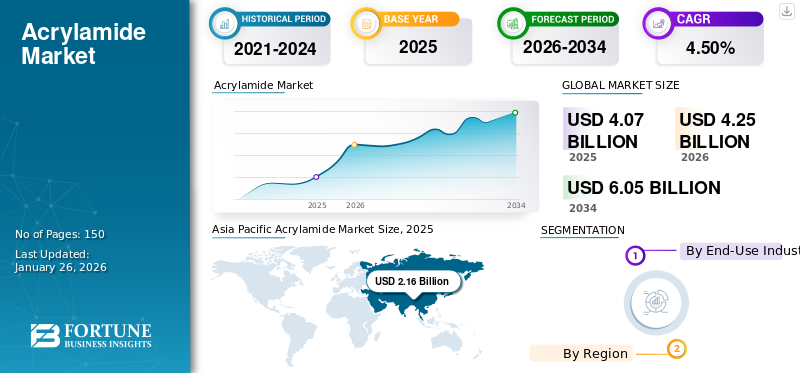
The global acrylamide market size was valued at USD 4.04 billion in 2025. The market is projected to grow from USD 4.22 billion in 2026 to USD 6.01 billion by 2034, exhibiting a CAGR of 4.5% during the forecast period. Asia pacific dominated the with a market share of 52.97% in 2025.
Acrylamide is a colorless, odorless organic substance produced primarily through a chemical reaction called the hydration of acrylonitrile. It is primarily used as an intermediate in the production of polyacrylamide and other acrylamide-based polymers. These polymers are valued for their flocculation, thickening, binding, retention, friction-reduction, and rheology-control properties. Such exceptional properties drive its demand across water and wastewater treatment, oil and gas, and pulp and paper industries. The rising need for efficient industrial water management, stricter wastewater-discharge requirements, expanding mineral-processing activities, and increasing use of enhanced oil recovery technologies are supporting global acrylamide demand. Municipal and industrial treatment facilities use polyacrylamide-based products to improve solid-liquid separation, sludge dewatering, clarification, and contaminant removal. Similarly, mining operations, paper mills, and oilfield service companies require acrylamide-based polymers to improve process efficiency and resource recovery. Therefore, market growth is increasingly supported by the expanding use of high-performance, application-specific polymer grades across various industries.
The global market is shaped by a relatively concentrated group of integrated chemical manufacturers with strong capabilities in acrylonitrile conversion, acrylamide production, polyacrylamide formulation, and downstream application development. Key players include SNF Group, CHINAFLOC, Nuoer Group, BASF SE, Black Rose Industries Ltd., and several major Chinese producers supplying both domestic and international markets. Continuous investments in production efficiency, high-purity grades, bio-catalytic manufacturing processes, and application-specific polymer solutions continue to strengthen their competitive positioning.
Download Free sample to learn more about this report.
ACRYLAMIDE MARKET TRENDS
Growing Shift Toward Bio-Catalytic Acrylamide Production while Maintaining Product Performance to Drive Product Adoption
Acrylamide manufacturers are increasingly adopting bio-catalytic production processes using nitrile hydratase enzymes to convert acrylonitrile into acrylamide under controlled operating conditions. Compared with conventional chemical synthesis, this route can improve reaction selectivity, reduce unwanted by-products, and support the production of high-purity acrylamide suitable for demanding polymer applications. Bio-based products can be used in industrial applications such as conventional ones, including water treatment, paper manufacturing, textiles, construction materials, and other specialty chemical applications. Thus, manufacturers are optimizing enzyme stability, conversion efficiency, and process controls to ensure that the resulting acrylamide maintains consistent polymerization behavior and downstream product performance. This is particularly important for polyacrylamide grades requiring controlled molecular weight, solubility, charge density, and residual monomer levels. Consequently, the ability to combine efficient production with reliable application performance is encouraging broader acceptance of bio-catalytically produced acrylamide among water-treatment, paper, mining, and specialty polymer manufacturers.
MARKET DYNAMICS
MARKET DRIVERS
Download Free sample to learn more about this report.
Expanding Water and Wastewater Treatment Infrastructure to Drive Market Growth
Rising investments in municipal water treatment processes, industrial effluent management, sewage processing, and sludge-handling infrastructure are strengthening demand for acrylamide-based polymers. Polyacrylamide flocculants and coagulant aids improve solid-liquid separation, clarification, filtration, and sludge dewatering, helping treatment facilities increase operational efficiency and meet discharge-quality requirements. Demand is also supported by water-intensive industries, including chemicals, textiles, pulp and paper, mining, and food processing, where wastewater streams require effective removal of suspended solids and contaminants. As urban populations and industrial activities expand, governments and utilities are upgrading existing treatment plants and developing additional capacity. As a result, the expanding water and wastewater treatment infrastructure and acrylamide being an essential ingredient in this application are set to drive the global acrylamide market growth during the forecast period.
Market Drivers - Impact & CAGR Contribution (2026–2034)
| Rank | Market Drivers | CAGR Contribution | Overall Impact | Impact: 2026-2028 | Impact: 2029-2031 | Impact: 2032-2034 |
|---|---|---|---|---|---|---|
| 1 | Expansion of Municipal and Industrial Water & Wastewater Treatment Infrastructure | High | 1.85% | High | High | High |
| 2 | Rising Demand for Polyacrylamide in Mining and Mineral Processing | High | 1.40% | High | High | High |
| 3 | Increasing Use of Acrylamide-Based Polymers in Enhanced Oil Recovery and Oilfield Operations | High | 1.20% | Medium | High | High |
| 4 | Growth of Pulp, Paper, Packaging, and Recycled-Fiber Processing | Medium | 1.00% | Medium | Medium | Medium |
| 5 | Expanding Adoption of High-Performance Flocculants and Process Chemicals Across Industrial Applications | Medium | 0.95% | Medium | Medium | High |
| 6 | Others | Low | 0.70% | Low | Low | Low |
| Total Positive Growth Contribution | 7.10% | |||||
Source: Fortune Business Insights
Download Free sample For In-Depth Market Drivers & Impact Forecasts
MARKET RESTRAINTS
Health and Environmental Concerns Associated with Residual Acrylamide is Restricting Market Expansion
Concerns surrounding residual acrylamide monomer in polyacrylamide products remain a significant limitation for market participants, particularly in potable water, food contact, agricultural, and environmentally sensitive applications. Although properly manufactured polyacrylamide generally exhibits low toxicity, unreacted acrylamide is associated with neurological and carcinogenic risks, resulting in strict controls on residual monomer content, product dosage, worker exposure, storage, and handling. Manufacturers must therefore invest in advanced polymerization controls, purification systems, quality testing, and regulatory compliance to ensure that products remain within permitted limits. These requirements increase production complexity and can restrict smaller or technologically less-advanced suppliers from serving regulated applications. Moreover, public concerns regarding chemical residues may encourage end users to evaluate alternative treatment agents, thereby limiting acrylamide adoption in markets where environmental safety and human exposure receive heightened scrutiny.
Market Restraints - Impact & Negative CAGR Contribution (2026–2034)
| Rank | Market Restraints | CAGR Impact | Overall Impact | Impact: 2026-2028 | Impact: 2029-2031 | Impact: 2032-2034 |
|---|---|---|---|---|---|---|
| 1 | Health and Environmental Concerns Associated with Residual Acrylamide Monomer | High | -0.95% | High | High | High |
| 2 | Volatility in Acrylonitrile Feedstock Prices and Energy Costs | High | -0.75% | High | Medium | Medium |
| 3 | Stringent Regulatory, Handling, and Product-Purity Requirements | Medium | -0.60% | Medium | Medium | High |
| 4 | Others | Low | -0.30% | Low | Low | Low |
| Total Negative Growth Impact | -2.60% | |||||
Source: Fortune Business Insights
Download Free sample For In-Depth Market Restraints & Risk Analysis
MARKET OPPORTUNITIES
Expansion of Enhanced Oil Recovery Projects is Creating New Growth Opportunity in the Market
The expansion of enhanced oil recovery projects presents considerable growth potential for acrylamide producers, particularly through growing demand for partially hydrolyzed polyacrylamide used in polymer flooding. During this process, polymer is added to injected water to increase its viscosity, improve the water-to-oil mobility ratio, and achieve more uniform reservoir displacement. This allows operators to mobilize additional oil from mature fields where conventional primary and secondary recovery methods have become less effective. Opportunities are especially relevant in regions with large aging onshore reservoirs and established waterflooding infrastructure. Growing emphasis on maximizing production from existing assets can encourage oil producers to adopt customized polymers designed for high salinity, elevated temperature, and challenging reservoir conditions. This creates opportunities for high-performance acrylamide grades supported by reservoir-specific formulation and technical services.
Segmentation Analysis
By End Use Industry
To know how our report can help streamline your business, Speak to Analyst
Water & Wastewater Treatment Dominated the Market Due to Extensive Use of Polyacrylamide-Based Flocculants
Based on end use industry, the market is segmented into water & wastewater treatment, oil & gas, pulp & paper, mining, and others.
The water & wastewater treatment segment accounted for the largest global acrylamide market share in 2025, supported by the widespread use of polyacrylamide-based flocculants, coagulant aids, and sludge-dewatering agents. Municipal treatment plants use these polymers to improve clarification, sedimentation, filtration, and solid–liquid separation, while industrial facilities apply them to manage complex effluent streams. Rising urbanization, stricter discharge standards, and growing investments in sewage and water-reuse infrastructure continue to strengthen consumption. Demand is also expanding across chemicals, textiles, food processing, and power generation, where effective wastewater handling is essential. These broad and recurring applications enable the segment to retain its dominant market position.
Oil & gas represents a prominent end-use segment as acrylamide-based polymers are increasingly utilized in enhanced oil recovery, drilling fluids, friction reduction, and produced-water treatment. Partially hydrolyzed polyacrylamide improves the viscosity of injected water, allowing operators to achieve better reservoir sweep efficiency and recover additional hydrocarbons from mature fields. In drilling operations, these polymers support fluid-loss control, shale stabilization, and improved wellbore performance. Demand is also influenced by the need to maximize production from existing assets rather than relying only on new field development. Supported by these factors, the oil & gas segment is expected to expand at a CAGR of 4.4% during 2026-2034.
The mining segment is creating steady demand for acrylamide-based flocculants in mineral separation, ore beneficiation, thickening, dewatering, and tailings treatment. These polymers accelerate the settling of suspended particles, improve water recovery, and enhance the efficiency of solid-liquid separation across coal, copper, iron ore, gold, and other mineral-processing operations. Their importance is rising as mining companies seek to reduce freshwater consumption, improve tailings stability, and comply with stricter environmental standards. Expansion of critical mineral production for batteries, renewable-energy systems, and electronics is further supporting chemical consumption. Reflecting these favorable conditions, the mining segment is forecast to grow at a CAGR of 4.8% during 2026-2034.
The others segment comprises various end-use industries, including adhesives and sealants, cosmetic and personal care, electronics, and others. The chemical compound is used in the personal care and cosmetics industry for its ability to act as a forming agent and emulsion stabilizer. Similarly, owing to its several exceptional properties, its use in various niche applications is expected to drive the segment’s growth steadily at a CAGR of 4.1% during the forecast period.
Acrylamide Market Regional Outlook
By region, the market is segmented into North America, Europe, Asia Pacific, Latin America, and the Middle East & Africa.
Asia Pacific
Asia Pacific Acrylamide Market Size, 2025 (USD Billion)
To get more information on the regional analysis of this market, Download Free sample
Asia Pacific dominated the global market in 2025, reaching USD 2.14 billion, and is projected to expand at a CAGR of 4.9% over the forecast period. The region benefits from its large water and wastewater treatment industry, substantial mining and mineral-processing base, expanding paper manufacturing capacity, and significant production of polyacrylamide. China, Japan, India, and other Southeast Asian economies are increasing investments in municipal sewage treatment, industrial effluent management, and water-reuse systems. In addition, extensive coal, metal, and mineral-processing activities generate sustained demand for acrylamide-based flocculants. The presence of major integrated chemical producers and comparatively strong downstream polymer manufacturing capabilities further reinforces the region’s leading position.
China Acrylamide Market
China reached approximately USD 1.69 billion in 2026, accounting for around 40.0% of global market revenue. Its strong position is supported by large-scale domestic polyacrylamide production and extensive consumption across municipal wastewater treatment, mining, paper manufacturing, and oilfield applications. Continued expansion of industrial wastewater treatment capacity and tighter environmental compliance requirements are encouraging the use of high-performance flocculants. China’s broad acrylonitrile and downstream chemical manufacturing base also supports cost-efficient acrylamide production and reliable supply to domestic and export markets.
To know how our report can help streamline your business, Speak to Analyst
Japan Acrylamide Market
Valued at nearly USD 0.20 billion in 2026, Japan represented approximately 4.8% of global demand. The market is characterized by strong consumption of high-purity and technically advanced acrylamide-based polymers rather than only commodity-volume demand. Stringent water-quality standards and the country’s emphasis on efficient sludge treatment and resource recovery support consistent polymer use. Established chemical companies with advanced bio-catalytic production capabilities further strengthen Japan’s position in premium acrylamide grades.
North America
North America recorded a market size of approximately USD 0.87 billion in 2025 and is expected to grow at a CAGR of 4.1% from 2026-2034. Regional demand is supported by established municipal water infrastructure, extensive industrial wastewater treatment, mature oil and gas operations, and a significant pulp and paper sector. Upgrades to aging treatment facilities and the growing adoption of water-reuse practices are increasing the use of polyacrylamide-based flocculants and dewatering agents.
U.S. Acrylamide Market
The U.S. market was valued at around USD 0.80 billion in 2026, representing approximately 19.0% of global revenue. Demand is distributed across municipal wastewater treatment, shale oil and gas operations, pulp and paper manufacturing, mining, and industrial effluent management. The extensive use of hydraulic fracturing and produced-water treatment supports consumption of acrylamide-based friction reducers and separation chemicals.
Europe
Europe generated approximately USD 0.70 billion in 2025, with the market forecast to expand at a CAGR of 3.9% from 2026-2034. Stringent environmental regulations, advanced municipal wastewater infrastructure, and increasing attention to industrial water recycling are shaping the regional market. Demand is concentrated across wastewater treatment, pulp and paper, specialty chemicals, mining, and selected oilfield applications. Ongoing modernization of treatment facilities and efforts to reduce freshwater withdrawal and wastewater discharge are supporting steady market growth.
Germany Acrylamide Market
Germany reached nearly USD 0.17 billion in 2026, accounting for around 4.0% of global demand. Its market is supported by advanced municipal treatment facilities and a broad industrial base including chemicals, paper, metals, food processing, and manufacturing. These industries require efficient flocculation, clarification, and sludge-dewatering solutions to comply with strict discharge standards. Germany’s focus on circular water use and process-water recovery is also strengthening demand for high-performance polyacrylamide products.
U.K. Acrylamide Market
At approximately USD 0.10 billion in 2026, the U.K. accounted for close to 2.5% of global revenue. Consumption is primarily linked to municipal sewage treatment, industrial effluent management, paper processing, and selected oil and gas activities. Investments aimed at improving aging water infrastructure and reducing untreated discharges are supporting the adoption of flocculants and sludge-conditioning chemicals.
Latin America
Latin America reached approximately USD 0.15 billion in 2025 and is anticipated to grow at a CAGR of 4.4% from 2026-2034. Regional demand is driven by mining, pulp and paper manufacturing, municipal wastewater treatment, and oilfield activities. Countries with significant production of copper, iron ore, gold, and other minerals use acrylamide-based flocculants for thickening, tailings treatment, and process-water recovery. Expanding urban populations are also increasing the need for sewage-treatment capacity. Although regional consumption remains smaller than in Asia Pacific, North America, and Europe, investments in industrial water management and mineral-processing efficiency are creating a stable growth pathway.
Brazil Acrylamide Market
Brazil is estimated to generate around USD 0.07 billion by 2026, equal to approximately 1.7% of global market revenue. Demand is supported by the country’s sizable mining and pulp and paper industries, along with its municipal water-treatment sector. Acrylamide-based polymers are widely used in ore beneficiation, tailings dewatering, paper-machine retention, and sludge management. Continued expansion of pulp production and efforts to improve water efficiency at mining operations are strengthening consumption.
Middle East & Africa
The Middle East & Africa market was valued at approximately USD 0.18 billion in 2025 and is projected to register a CAGR of 4.6% from 2026-2034. In the Middle East, acrylamide demand is strongly associated with oilfield chemicals, enhanced oil recovery, produced-water treatment, and desalination-related wastewater management. African consumption is more closely connected to mineral processing, tailings treatment, municipal water purification, and infrastructure development. Water scarcity across several countries is encouraging investment in water reuse and improved treatment efficiency.
COMPETITIVE LANDSCAPE
Key Industry Players
Integrated Global Producers and Cost-Competitive Asian Manufacturers Shape the Competitive Landscape
The global acrylamide market is moderately consolidated, with competition led by integrated multinational producers and large-scale Asian manufacturers. Key companies operating in the market include SNF Group, CHINAFLOC, Nuoer Group, BASF SE, and Black Rose Industries Ltd. SNF Group maintains a prominent position through its extensive acrylamide and polyacrylamide portfolio, global manufacturing footprint, and strong presence across water treatment, mining, oil and gas, and paper applications. Chinese suppliers, including CHINAFLOC and Nuoer Group, benefit from cost-efficient production, broad product availability, and established domestic and export networks. Competition is primarily based on product purity, residual monomer control, molecular-weight customization, pricing, supply reliability, regulatory compliance, and technical support. Manufacturers are increasingly investing in bio-catalytic production, process optimization, quality consistency, and application-specific polymer grades. Hence, companies with integrated production capabilities, diversified end-use exposure, and strong regional distribution networks are expected to retain stronger competitive positioning.
LIST OF KEY ACRYLAMIDE COMPANIES PROFILED
- SNF Group (France)
- CHINAFLOC (China)
- NUOER GROUP (China)
- BASF (Germany)
- Black Rose Industries Ltd. (India)
- Kemira Oyj (Finland)
- Mitsubishi Chemicals (Japan)
- Mitsui Chemicals, Inc. (Japan)
- Solenis (U.S.)
- Zhejiang Xinyong Biochemical Co., Ltd. (China)
KEY INDUSTRY DEVELOPMENTS
- April 2026: Nuoer introduced customized water-treatment solutions based on anionic, cationic, and nonionic polyacrylamide, emulsion flocculants, and high-efficiency dewatering products. The solutions include customer-specific product development, process optimization, and technical support for municipal wastewater, industrial wastewater, sludge dewatering, and mining applications.
- November 2024: Solenis completed the acquisition of BASF’s mining-flocculants business, adding the Magnafloc, Rheomax, Alclar, Alcotac, Jetwet, Aerowet, and Alcotech product families. The acquired solutions support solid–liquid separation, tailings dewatering, water recovery, and material handling in mining and mineral-processing operations.
- March 2024: SNF announced plans to invest approximately USD 0.49 billion across its global manufacturing network during 2024. The investment program was directed toward expanding and modernizing water-soluble polymer production capabilities, including polyacrylamide products used in water treatment, mining, oil recovery, and industrial separation applications.
- August 2023: Mitsui Chemicals expanded its production capacity for biocatalysts used in acrylamide manufacturing through Polaris Chemicals in Wakayama, Japan. The new facility began production and completed its first shipment in July 2023, using technology and manufacturing expertise transferred from Mitsui Chemicals’ Omuta Works.
- July 2023: Solenis completed its acquisition of Diversey Holdings in a transaction valued at approximately USD 4.60 billion. The combination expanded Solenis’ water management, cleaning, hygiene, and specialty chemical capabilities, strengthening its access to industrial and institutional customers that use treatment chemicals, including acrylamide-based flocculation and separation solutions.
REPORT COVERAGE
The global acrylamide market analysis provides an in-depth study of market size & forecast across all market segments included in the report. It includes details on the market dynamics and market trends expected to drive the market in the forecast period. It offers information on technological advancements, new product launches, key industry developments, and partnerships, mergers & acquisitions. The market research report also encompasses a detailed competitive landscape, including market share and profiles of key operating players.
Request for Customization to gain extensive market insights.
Report Scope & Segmentation
| ATTRIBUTE | DETAILS |
| Study Period | 2021-2034 |
| Base Year | 2025 |
| Estimated Year | 2026 |
| Forecast Period | 2026-2034 |
| Historical Period | 2021-2024 |
| Growth Rate | CAGR of 4.5% from 2026-2034 |
| Unit | Value (USD Billion) and Volume (Kiloton) |
| Segmentation | By End Use Industry and Region |
| By End Use Industry |
|
| By Region |
|
Frequently Asked Questions
Fortune Business Insights says that the global market size was valued at USD 4.04 billion in 2025 and is projected to reach USD 6.01 billion by 2034.
In 2025, Asia Pacific’s market value stood at USD 2.14 billion.
Recording a CAGR of 4.5%, the market is slated to exhibit steady growth during the forecast period.
By end use industry, the water & wastewater treatment segment led in 2025.
Expanding water and wastewater treatment infrastructure is set to drive market growth.
SNF Group, CHINAFLOC, Nuoer Group, BASF SE, and Black Rose Industries Ltd. are some of the prominent players in the market.
Asia Pacific held the highest market share in 2025.
Growing shift toward bio-catalytic acrylamide production while maintaining product performance to drive product adoption.



- 2021-2034
- 2025
- 2021-2024
- 220
-
(Offer valid till 15th Oct 2026)
Get 30-60 hrs Free Customization
Expand Regional and Country Coverage, Segments Analysis, Company Profiles, Competitive Benchmarking, and End-user Insights.


















Related Reports
-
US +1 833 909 2966 ( Toll Free )
-
Get In Touch With Us