Adaptogenic Snack Bar Market Size, Share & Industry Analysis, By Ingredient Type (Botanical Adaptogens, Functional Mushrooms, Botanical Superfoods, and Others), By Product Type (Functional Protein Bars, Functional Energy Bars, Functional Fruit & Nut Bars, Functional Granola / Cereal Bars, and Others), By Functional Benefit (Energy & Stamina Support, Stress & Relaxation Support, Focus & Cognitive Support, and Others), By Distribution Channel (Supermarkets & Hypermarkets, Health & Specialty Stores, Online Retail, and Others), and Regional Forecast, 2026-2034
 Download Free Sample
(Offer valid till 30th Sep 2026)

Adaptogenic Snack Bar Market Size and Future Outlook
 Listen to Audio Version
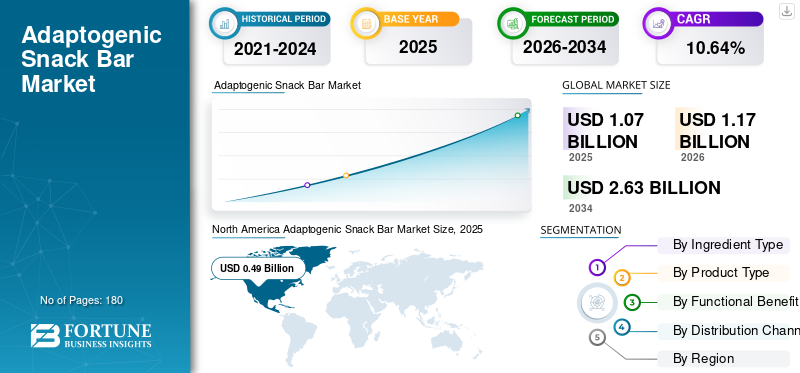
The global adaptogenic snack bar market size was valued at USD 1.07 billion in 2025. The market is projected to grow from USD 1.17 billion in 2026 to USD 2.63 billion by 2034, exhibiting a CAGR of 10.64% during the forecast period. North America dominated the adaptogenic snack bar market with a market share of 45.79% in 2025.
Adaptogenic snack bars are functional snack bars which are formulated with adaptogenic ingredients such as ashwagandha, ginseng, rhodiola, maca, reishi mushroom, and holy basil. These ingredients help the body manage stress, energy balance, and mental focus. Such bars typically combine adaptogens with proteins, nuts, seeds, fruits, and natural sweeteners. The market is growing rapidly due to growing consumer focus on stress management, mental wellness, and functional nutrition. Consumers are also opting for snacks that offer several benefits such as boosting energy, supporting brain health, and helping immunity which is boosting the demand for such products.
Companies such as Wise Bar, IQBAR, Inc., and Verb Energy are some of the players in the global market size. New product launch is the key strategy which is boosting product sales and supporting the popularity of adaptogenic snack bar products.
Download Free sample to learn more about this report.
Adaptogenic Snack Bar Market Takeaways
 Global Market Size & Forecast
- 2025 Market Size: USD 1.07 billion
- 2026 Market Size: USD 1.17 billion
- 2034 Forecast Market Size: USD 2.63 billion
- CAGR: 10.64% from 2026–2034
 Market Share
- North America dominated the global market with a market share of 45.79% in 2025.
- The botanical adaptogens segment held the largest adaptogenic snack bar market share in 2025.
- Functional protein bars segment accounted for the largest market share in 2025.
 Key Regional Highlights
North America
The market in North America reached a valuation of USD 0.49 billion in 2025 and is the leading region in the world.
Europe
The European market reached a valuation of USD 0.25 billion in 2025.
Asia Pacific
The Asia Pacific market was valued at USD 0.22 billion in 2025.
U.S.
In 2025, the U.S. market reached USD 0.41 billion.
Japan
The Japanese market reached a valuation of USD 0.04 billion in 2025, accounting for roughly 3.59% of global market revenues.
Read More

ADAPTOGENIC SNACK BAR MARKET TRENDS
Texture Improvement and Flavor Innovation to Emerge as a Significant Market Trend
Manufacturers are transforming their products by using more specific functional ingredients that provide benefits such as calm energy, stress support, focus, or recovery. The market players are also focusing on texture innovation as certain ingredient such as botanical powders make bars dry or gritty. As a result, manufacturers are using nut butters, fruit pastes, protein crisps, and chocolate coatings to improve sensory quality while preserving clean labeling.
MARKET DYNAMICS
MARKET DRIVERS
Download Free sample to learn more about this report.
Demand for Everyday Wellness Snacking are Driving Adoption of Adaptogen-Infused Protein and Energy Bars
The demand for adaptogenic snack bars is boosted by consumers who prefer functional benefits in a convenient ready to eat snack bar format. Such bars help consumers meet their nutritional adaptogens requirement during work, travel, gym routines, or busy schedules. Ingredients including maca, ginseng, rhodiola, ashwagandha, reishi, and holy basil help manufacturers market their bars for stamina, focus, stress relief, and recovery. Functional protein bars are also growing in popularity as they combine adaptogens with protein, nuts, seeds, and natural carbs, offering several benefits and supporting the global adaptogenic snack bar market growth.
MARKET RESTRAINTS
Bitter Botanical Taste, Potency Variation, and Claim Restrictions are Limiting Product Scalability
The market is constrained by formulation challenges, inconsistent botanical potency, and claim limitations. Many adaptogens have bitter, earthy, woody, or medicinal notes that can affect taste and texture in bar formats. Therefore, manufacturers often add cocoa, dates, nut butters, spices, or natural flavors to mask the taste. As botanical extracts can vary depending on the supplier’s quality standards it is difficult to maintain consistent product benefits from batch to batch. Varying regulations across countries also restricts brands to market products and mention benefits such as stress, sleep, anxiety, or hormones.
MARKET OPPORTUNITIES
Occasion-Specific Benefits and Transparent Adaptogen Dosing are Creating Premium Product Differentiation
Brands have the opportunity to create products for specific occasions such as morning energy, afternoon focus, post-workout recovery, evening relaxation, women’s wellness, or immune support. Smaller brands have the opportunity to showcase clear adaptogen amounts, using well-known extracts, and highlighting when to use their products. This approach can help to shift the marketing of this product from novelty snacks to products designed for real functional nutrition.
Segmentation Analysis
By Ingredient Type
Stress Management and Wellness Benefits Boosted Dominance of Botanical Adaptogens Segment
By ingredient type, the market is segmented into botanical adaptogens, functional mushrooms, botanical superfoods, ayurvedic / traditional herbal blends, nootropic / mood-support botanicals, and mixed botanical functional blends.
The botanical adaptogens segment held the largest adaptogenic snack bar market share in 2025. Ingredients such as ashwagandha, ginseng, rhodiola, maca, holy basil, and other adaptogenic herbs are directly associated with stress support, energy balance, focus, and resilience. Their inclusion helps brands to position products effectively and justify premium pricing.
The botanical superfoods segment holds the second-largest market share, and is expected to grow at a CAGR of 10.83% during the forecast period. Botanical superfoods include ingredients such as berries, cacao, turmeric, spirulina, and moringa which are known for their antioxidant, immunity, and nutritional benefits.
By Product Type
Rising Demand for Functional Nutrition Led to Dominance of Functional Protein Bars Segment
Based on product type, the market is segmented into functional protein bars, functional energy bars, functional fruit & nut bars, functional granola / cereal bars, functional confectionery / indulgence bars, and others.
Functional protein bars segment accounted for the largest market share in 2025 due to combining adaptogenic benefits with the familiar nutrition of protein. Protein bars are popular among fitness enthusiasts, busy professionals, and health-conscious consumers. With the addition of adaptogens such as ashwagandha, maca, or reishi such bars gain a premium wellness appeal. Such bars help consumers by supporting muscle recovery, reducing stress, and provide steady energy.
Functional energy bars segment makes up the second-largest share of the market and is expected to grow at a CAGR of 10.92% during the forecast period. Functional energy bars follow since they appeal to consumers seeking stamina, focus, and fatigue support. Adaptogens fit well in this format, especially ingredients such as ginseng and rhodiola. However, energy bars are more occasion-specific than protein bars, limiting their overall consumption frequency.
By Functional Benefit
Demand for Sustained Functional Energy Led to Dominance of Energy & Stamina Support Segment
By functional benefit, the market is segmented into energy & stamina support, stress & relaxation support, focus & cognitive support, immunity & general wellness support, and others.
The energy & stamina support segment led the global market in 2025 as consumers prefer quick and convenient snack to fuel them during work, exercise, travel, or busy day. As a result, brands promote these bars as both functional snacks and performance boosters, which helps drive repeat purchases and support overall growth.
Stress & relaxation support is another major segment that has a CAGR of 11.06% during the forecast period. Stress and relaxation support follows since ingredients such as ashwagandha, holy basil, and reishi are strongly linked with mood balance and calmness. However, relaxation is a more specific consumption need and may not fit all snacking occasions, limiting purchase in comparison to energy-focused bars.
To know how our report can help streamline your business, Speak to Analyst
By Distribution Channel
Direct-to-Consumer Wellness Marketing Led to Dominance of Online Retail Segment
By distribution channel, the market is segmented into supermarkets & hypermarkets, health & specialty stores, online retail, and others.
The online retail segment led the global market in 2025. Online stores account for the highest market share as adaptogenic snack bars are a still an evolving category. E-commerce allows brands to educate consumers about the ingredient benefits such as stress support, focus, energy balance, and clean-label positioning in more detail than physical shelves therefore increasing demand for functional products.
Supermarkets & hypermarkets segment accounted for the second largest market share in 2025 and are expected to register a CAGR of 10.65% during the forecast period. They offer adaptogenic snack bars with good shelf visibility, quick access, and reach to health-conscious shoppers. These stores let shoppers compare different types of snack bars, such as protein, energy, clean-label, and functional options.
Adaptogenic Snack Bar Market Regional Outlook
By geography, the market is categorized into Europe, North America, Asia Pacific, South America, and the Middle East & Africa.
North America
North America Adaptogenic Snack Bar Market Size, 2025 (USD Billion)
To get more information on the regional analysis of this market, Download Free sample
The market in North America reached a valuation of USD 0.49 billion in 2025 and is the leading region in the world. North America leads the market since functional snacking is already popular here, especially with protein bars, energy bars, and wellness snacks.
The U.S. has the highest demand, and brands use ingredients such as ashwagandha, maca, reishi, lion’s mane, and rhodiola. Online retail plays a major role as adaptogenic benefits require explanation around stress, focus, stamina, and recovery. Consumers are willing to pay premium prices for bars positioned around clean-label, low sugar, plant protein, and mental wellness.
U.S. Adaptogenic Snack Bar Market
In 2025, the U.S. market reached USD 0.41 billion. In the U.S., online-focused snack brands lead the market by adding ashwagandha, maca, reishi, lion’s mane, and rhodiola to protein and energy bars. These products are especially popular with fitness fans, busy professionals, and wellness shoppers looking for support with stress, focus, and steady energy.
Asia Pacific
The Asia Pacific market was valued at USD 0.22 billion in 2025. The region is one of the fastest emerging market as herbal and botanical wellness is already part of many local food cultures. However, adaptogenic snack bars are still not widely developed. In Japan and South Korea, there is demand for premium functional bars that help with focus, energy, beauty, and reducing fatigue. Australia is the most developed market in the region, helped by strong consumer interest in sports nutrition and clean-label snacks. The manufacturers have the opportunity to localize adaptogens manufacturing and expand their sales in emerging markets in this region.
India Adaptogenic Snack Bar Market
The Indian market was valued at USD 0.03 billion in 2025, accounting for roughly 3.17% of global market revenues.
China Adaptogenic Snack Bar Market
China’s market was valued at USD 0.06 billion in 2025, representing roughly 5.72% of global market share. In China, interest is growing due to growth in the e-commerce wellness brands and rising interest in traditional ingredients to maintain health and boost immunity.
Japan Adaptogenic Snack Bar Market
The Japanese market reached a valuation of USD 0.04 billion in 2025, accounting for roughly 3.59% of global market revenues.
Europe
The European market reached a valuation of USD 0.25 billion in 2025. Europe’s market is more cautious and regulation-sensitive than North America. Demand is concentrated in the U.K., Germany, France, Netherlands, and Nordic countries, where functional foods, vegan snacks, and natural wellness products already have strong retail presence. Plant based protein bars with botanical ingredients are comparatively popular in this region. European consumers prefer products with clean and simple ingredients.
Germany Adaptogenic Snack Bar Market
The market in Germany reached USD 0.04 billion in 2025, representing roughly 4.13% of global market demand. In Germany, the market is cautious and closely monitors regulations. Adaptogenic snack bars sell better in Germany when they focus on plant based protein, organic ingredients, and balanced energy, rather than making direct claims about stress or mood.
U.K. Adaptogenic Snack Bar Market
The U.K. market is another key market which reached a valuation of USD 0.05 billion in 2025, equivalent to around 4.64% of global market sales.
South America and Middle East & Africa
Over the forecast period, South America is expected to experience significant growth in this market. The South America market in 2025 recorded USD 0.05 billion. The market in South America is still in its early stages and is mostly found in wealthier urban areas of Brazil, Chile, Argentina, and Colombia. Consumers are more familiar with ingredients including maca, cacao, guarana, and yerba mate than with imported adaptogens such as reishi or rhodiola. This creates an opportunity for local brands to make adaptogenic bars using familiar ingredients. The Middle East & Africa region reached a valuation of USD 0.06 billion in 2025. In the Middle East, most demand comes from the UAE, Saudi Arabia, and Qatar, where high-end wellness stores, gyms, expats, and online shopping help drive interest in functional snacks. Demand is mostly limited to health stores, gyms, and some online shops in cities in South Africa, Kenya, and Nigeria.
South Africa Adaptogenic Snack Bar Market
South Africa market is set to grow at a CAGR of 8.98% during the forecast period. Demand mainly comes from gyms, wellness stores, online shops, and expatriate shoppers. People prefer bars that provide energy, focus, and fitness benefits, rather than those with strong herbal or medicinal flavors.
COMPETITIVE LANDSCAPE
Key Industry Players
D2C Sales and Transparent Dosing are Key Trends Adopted by Key Manufacturers to Expand Market Share
The market is heavily fragmented with some of the prominent players operating in the market include Wise Bar, IQBAR, Inc., Verb Energy, and others. Brands compete by highlighting product benefits, using trusted ingredients, focusing on taste, and growing their online presence. Brands set themselves apart by creating products that support stress relief, focus, stamina, mood, and recovery. Selling directly to consumers online is a major strategy adopted by the manufacturers as brands depend on educational marketing to explain the benefits of adaptogens and support higher prices. Smaller wellness-focused brands are competing effectively against traditional protein bar companies by offering transparent dosing, plant-based ingredients, and low-sugar formulations.
LIST OF ADAPTOGENIC SNACK BAR COMPANIES PROFILED IN REPORT
- Wise Bar (U.S.)
- IQBAR, Inc. (U.S.)
- Verb Energy (U.S.)
- GoMacro (U.S.)
- Laird Superfood (U.S.)
- Eat Mezcla, Inc. (U.S.)
- Taos Bakes (U.S.)
- Botany Food Sdn. Bhd., (Malaysia)
- Nutri-Nation (Canada)
- Pulsin Ltd (U.K.)
KEY INDUSTRY DEVELOPMENTS
- February 2026: Bish Bar launched its first protein bar which is specifically designed to support hormone and menstrual health. These bars contain plant-based protein, prebiotic fiber, vitamins minerals, and adaptogens including ashwagandha.
- October 2025: Ten PM snack launched oat-based bar which contains Ashwagandha plants that helps to combat stress. The product is available in cherry flavor in the market.
- May 2023: CORE Foods, launched CORE Oat Bars + Adaptogens in the market. The company showcased its new CORE Chocolate Truffle in a trade show in California.
- July 2022: Laird Superfood launched plant-based protein bars as a part of its snack food product line up. This bar contains adaptogens, hemp seeds, and pumpkin seeds.
- March 2021: Tattooed Chef launched new Oat Butter Bars in a refrigerated format in the U.S. Each of these bars contains adaptogens such as ashwagandha, holy basil, reishi, and vitamin D3 that helps to improve mood and focus.
REPORT COVERAGE
The global adaptogenic snack bar market report provides an in-depth study of market size & forecast by all the market segments included in the report. The market analysis includes details on the market demand and market trends expected to drive the market during the forecast period. It offers information on the new product launches, key industry developments, and details on partnerships, mergers & acquisitions. The market forecast also encompasses detailed competitive landscape with information on the market segmentation, market share and profiles of key operating players.
Request for Customization to gain extensive market insights.
Report Scope & Segmentation
| ATTRIBUTE | DETAILS |
| Study Period | 2021-2034 |
| Base Year | 2025 |
| Estimated Year | 2026 |
| Forecast Period | 2026-2034 |
| Historical Period | 2021-2024 |
| Growth Rate | CAGR of 10.64% from 2026-2034 |
| Unit | Value (USD Billion) |
| Segmentation | By Ingredient Type, By Product Type, By Functional Benefit, By Distribution Channel, and By Region |
| By Ingredient Type |
|
| By Product Type |
|
| By Functional Benefit |
|
| By Distribution Channel |
|
| By Region |
|
Frequently Asked Questions
Fortune Business Insights says that the global market value stood at USD 1.07 billion in 2025 and is projected to reach USD 2.63 billion by 2034.
In 2025, the North America’s market value stood at USD 0.49 billion.
The market is expected to exhibit a CAGR of 10.64% during the forecast period.
By product type, functional protein bars segment led the global market in 2025.
Demand for everyday wellness snacking driving adoption of adaptogen-infused protein and energy bars is driving the market.
Wise Bar, IQBAR, Inc., and Verb Energy are the top players in the market.
North America held the largest market share in 2025.
Occasion-specific benefits and transparent adaptogen dosing to emerge as a significant market trend.


- 2021-2034
- 2025
- 2021-2024
- 180
-
(Offer valid till 30th Sep 2026)
Get 30-60 hrs Free Customization
Expand Regional and Country Coverage, Segments Analysis, Company Profiles, Competitive Benchmarking, and End-user Insights.



















Related Reports
-
US +1 833 909 2966 ( Toll Free )
-
Get In Touch With Us