Aerospace Product Design and Testing Digital Twin Market Size, Share & Industry Analysis, By Offering (Software, Services, Cloud/HPC and Data Infrastructure, Integrated Test Environments), By Digital twin Type (Physics-Based, System-Level, Hybrid, Software/Embedded), By Application (Product Design & Concept Validation, Virtual Testing & Simulation), By Product Type (Commercial Aircraft, Military Aircraft, Unmanned Aerial Systems, Space Systems), By End User (Aircraft OEMs, Spacecraft & Satellite OEMs, Propulsion System Manufacturers, Defense Contractors) & Regional Forecast, 2026-2034
 Download Free Sample
Aerospace Product Design and Testing Digital Twin Market Size and Future Outlook
 Listen to Audio Version
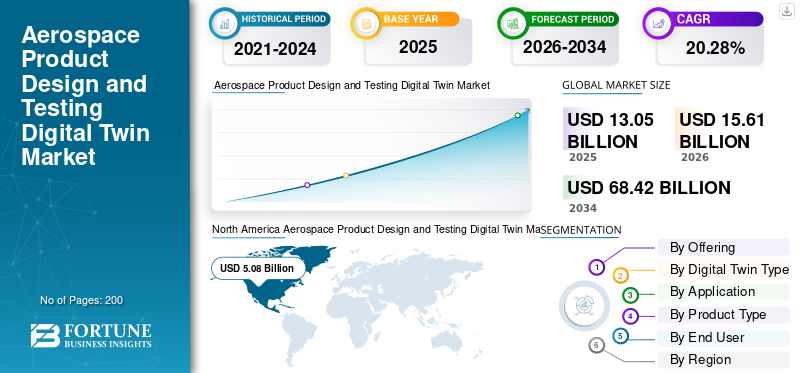
The global aerospace product design and testing digital twin market size was valued at USD 13.05 billion in 2025. The market is projected to grow from USD 15.61 billion in 2026 to USD 68.42 billion by 2034, exhibiting a CAGR of 20.28% during the forecast period. North America dominated the aerospace product design and testing digital twin market with a market share of 38.92% in 2025.
An aerospace product design and testing digital twin is a dynamic virtual replica of an aircraft, spacecraft, system, subsystem, or component that is used to simulate, validate, and optimize performance before and during testing. The market covers software, services, and infrastructure computational fluid dynamics (CFD), finite element analysis (FEA), model-based systems engineering (MBSE), and multi-physics co-simulation tools, digital thread integration, AI analytics, and virtual test environments. It supports commercial aircraft, rotorcraft, UAVs, space vehicles, propulsion systems, and defense platforms.
Key users include OEMs, Tier-1 suppliers, defense contractors, space companies, and MRO providers. Major players include Siemens, Dassault Systèmes, Boeing, Airbus, Rolls-Royce, and Lockheed Martin.
Download Free sample to learn more about this report.
Aerospace Product Design and Testing Digital Twin Market Takeaways
 Global Market Size & Forecast
- 2025 Market Size: USD 13.05 billion
- 2026 Market Size: USD 15.61 billion
- 2034 Forecast Market Size: USD 68.42 billion
- CAGR: 20.28% from 2026–2034
 Market Share
- North America dominated the market with a market share of 38.92% in 2025.
- The software platforms segment is anticipated to account for the largest market share.
- In 2025, the physics-based digital twins segment dominated the global market.
 Key Regional Highlights
North America
North America held the dominant share in 2024, valued at USD 4.26 billion. The region also maintained its leading share in 2025, reaching USD 5.08 billion.
Europe
Europe is projected to record a steady growth rate of 20.33% during the forecast period. The market is expected to reach a valuation of USD 3.76 billion in 2026.
Asia Pacific
Asia Pacific region is estimated to reach USD 3.45 billion in 2026, making it the third-largest market and fastest growing region during the study period.
U.S.
Based on North America’s strong contribution and the U.S. dominance within the region, the U.S. market is likely to reach around USD 3.75 billion in 2026, growing at a CAGR of 20.54% during the forecast period.
Japan
Japan is expected to strengthen its market position through growing investments in aerospace digital engineering, simulation technologies, and advanced digital twin adoption across aircraft development programs.
Read More

AEROSPACE PRODUCT DESIGN AND TESTING DIGITAL TWIN MARKET TRENDS
AI-Driven Immersive Simulation is a Key Market trend
Generative AI, physics-based simulation, and immersive design environments are reshaping aerospace digital twin workflows. Tools such as Siemens NX Immersive Designer combine AR, voice commands, and AI to enable engineers interact directly with 3D aircraft models. This is shifting key design, testing, and certification decisions into the digital environment, allowing issues to be identified and resolved before physical parts are produced. Startups such as JetZero are using digital twin software to shorten aircraft development timelines, while initiatives such as the U.K. Digital Twin Centre in Belfast show growing public-private investment in digital twin standardization and adoption across the aerospace industry.
MARKET DYNAMICS
MARKET DRIVERS
Download Free sample to learn more about this report.
Rising Implementation of Digital Twin Platforms in Next-Generation Aircraft Programs to Drive Market Growth
The most significant demand drivers for aerospace product design and testing digital twins are defense and civil aviation authorities. Prime contractors are required to implement digital twin platforms from the concept stage onward under the U.S. Department of Defense's Digital Engineering Strategy, which requires model-based methods in all major acquisition programs. In order to lessen reliance on expensive physical test campaigns, the FAA and EASA are concurrently admitting more simulation evidence in certification procedures. The Boeing 777X and Airbus A321XLR are examples of next-generation commercial programs that further increase platform investment as OEMs deal with record backlogs that necessitate accelerated development timetables that can only be realistically supported by high-fidelity virtual validation environments.
MARKET RESTRAINTS
Lack of Standardization and Export-Control Regulations to Restrain Market Expansion
Structural barriers hamper the pace of aerospace digital twin adoption despite strong demand signals. Multinational supply chains spanning hundreds of Tier-1 and Tier-2 suppliers, each operating different CAD and simulation toolchains, create persistent data exchange gaps that undermine unified digital thread continuity across programs. Export-control regulations governing defense-related models and datasets compel prime contractors to maintain air-gapped on-premises infrastructure, limiting the cost and scalability advantages of cloud-based deployment. Additionally, sensitive aircraft operational and maintenance data remains tightly guarded by airlines and MROs, restricting the availability of observational datasets that OEMs and platform vendors require to validate and improve their digital twin models.
MARKET OPPORTUNITIES
Record Commercial Aircraft Backlogs and Sustainability Mandates to Create Market Opportunities
Decarbonization requirements and production backlog pressures have created a critical turning point for the aerospace digital twin business. With a combined order backlog of more than 15,000 airplanes, Airbus and Boeing are forcing manufacturers to expedite digital transformation, as manpower expansion is insufficient to narrow the delivery gap. Sustainability criteria generate a parallel opening, as digital twins allow the virtual optimization of fuel consumption, structural weight, and propulsion efficiency prior to the commitment of real hardware.
MARKET CHALLENGES
Data Sensitivity and Regulatory Delays to Challenge Industry Expansion
Two persistent obstacles continue to hinder the adoption of aerospace product design and testing digital twins. First, program teams are unsure of acceptable evidence packages as certification frameworks have not kept up with simulation capacity. While FAA and EASA are making progress, guidance on the use of simulation-based validation evidence for safety-critical structures remains limited. Second, airlines and defense operators classify aircraft operating, maintenance, and performance data as highly sensitive, limiting the access that developers require to develop, validate, and continuously improve twin fidelity during service life. Together, limited data access and regulatory delays lengthen certification periods and reduce the precision of prediction models based on limited operational statistics.
Segmentation Analysis
By Offering
Integrated Simulation Environments Within a Single Digital Thread to Boost Software Platforms Segment Growth
Based on offering, the market is segmented into software platforms, services, cloud/HPC and data infrastructure, integrated test environments, and others.
The software platforms segment is anticipated to account for the largest aerospace product design and testing digital twin market share. Growth is being driven by aerospace OEMs consolidating fragmented engineering toolchains onto unified software platforms that integrate CAD, CAE, and systems modeling under a single digital thread. For instance, Dassault Systèmes and Airbus extended their strategic partnership in April 2025, placing the 3DEXPERIENCE platform as the foundation of lifecycle management for new Airbus civil and military programs. With over 20,000 users collaborating on virtual twins to shorten development cycles and reduce costs.
The cloud/HPC and data infrastructure segment is anticipated to grow at a CAGR of 20.95% over the forecast period.
By Digital Twin Type
Regulatory Validation Encouraged Physics-Based Digital Twins Segment Growth
Based on digital twin type, the market is segmented into physics-based digital twins, system-level digital twins, hybrid digital twins, software/embedded system digital twins, and others.
In 2025, the physics-based digital twins segment dominated the global market. Growth in the segment is driven by the need among regulators and OEMs for simulation outputs based on governing physics equations, including CFD, FEA, and thermodynamics modeling. These capabilities support structural and aerodynamic claims while reducing reliance on extensive physical testing.
The hybrid digital twins segment is projected to grow at a high CAGR of 20.95% over the forecast period.
By Application
High Programs Cost and Scheduled Pressures to Drive Product Design and Concept Validation Segment Growth
Based on the application, the market is segmented into product design and concept validation, virtual testing and simulation, verification, validation, and certification support, fault injection and failure analysis, physical test correlation, and others.
The product design and concept validation segment is anticipated to dominate the market over the forecast period. Growth is being driven by OEMs replacing physical prototypes with high-fidelity virtual models that reveal design defects before hardware manufacture starts due to multi-billion-dollar program expenditures and tight schedules.
The fault injection and failure analysis segment is projected to grow at a high CAGR of 21.13% over the forecast period.
By Product Type
Record Backlogs and Development Pressure Boosted Commercial Aircraft Segment Growth
Based on product type, the market is segmented into commercial aircraft, military aircraft, unmanned aerial systems, space systems, advanced air mobility platforms, propulsion systems, and others.
The commercial aircraft segment dominated the market, as aircraft OEMs face simultaneous pressure from record backlogs and next-generation program development, making physical-only validation economically untenable at the required pace. For instance, Boeing's T-7A program demonstrated an 80% reduction in assembly hours and a 75% increase in first-time quality through digital twin-led design. The program compressed the path from design to first flight to just 36 months, establishing a benchmark that commercial narrowbody and widebody programs seek to match.
Unmanned aerial systems are projected to grow at a CAGR of 21.13% during the forecast period.
By End User
To know how our report can help streamline your business, Speak to Analyst
Aircraft OEMs Segment Dominated due to OEMs Certification and Regulatory Responsibility
Based on end user, the market is segmented into aircraft OEMs, spacecraft & satellite OEMs, propulsion system manufacturers, defense contractors & government R&D/Test Organizations, and others.
The aircraft OEMs segment dominated the market. Growth is driven by the fact that OEMs, as certification holders and design authorities, bear ultimate responsibility for structural and systems integrity, compelling them to own the most deeply integrated digital twin environments across every program phase.
The spacecraft & satellite OEMs segment is projected to grow at a CAGR of 20.89% during the forecast period.
Aerospace Product Design and Testing Digital Twin Market Regional Outlook
By geography, the market is categorized into Europe, North America, Asia Pacific, and Rest of the World.
North America
North America Aerospace Product Design and Testing Digital Twin Market Size, 2025 (USD Billion)
To get more information on the regional analysis of this market, Download Free sample
North America held the dominant share in 2024, valued at USD 4.26 billion. The region also maintained its leading share in 2025, reaching USD 5.08 billion. North America leads aerospace digital twin adoption, driven by its mature aerospace ecosystems, substantial defense investments, and early technology integration. The U.S. Department of Defense uses digital twins for equipment lifecycle management across naval and aerospace platforms. Lockheed Martin employs digital twins for F-35 design validation and smart manufacturing, reducing production costs significantly.
U.S. Aerospace Product Design and Testing Digital Twin Market
Based on North America’s strong contribution and the U.S. dominance within the region, the U.S. market is likely to reach around USD 3.75 billion in 2026, growing at a CAGR of 20.54% during the forecast period. The U.S. is the dominant market due to advanced aerospace infrastructure and strong government support. NASA pioneered digital twin technology during the Apollo program and continues developing spacecraft/system digital twins through JSTAR to accelerate development and expand testing without physical hardware constraints.
Europe
Europe is projected to record a steady growth rate of 20.33% during the forecast period, which is the second-highest among all regions. The market is expected to reach a valuation of USD 3.76 billion in 2026. Europe has strong digital twin adoption, driven by leading aerospace manufacturers and government-backed innovation programs. In April 2025, Airbus added Collins Aerospace to its Digital Alliance for Aviation, alongside Airbus, Delta TechOps, GE Aerospace, and Liebherr, to jointly develop Skywise-powered digital solutions for predictive maintenance, health monitoring, and maintenance-repair operations across Airbus and mixed fleets.
U.K. Aerospace Product Design and Testing Digital Twin Market
The U.K. market in 2026 is estimated to reach around USD 1.15 billion, representing roughly 20.73% CAGR during the forecast period. The U.K. actively advances digital twin capabilities in aeronautics through academic-industry partnerships. In 2019, the Alan Turing Institute conducts research on digital twins for aircraft engines, wings, and drones, focusing on physically representative models for performance optimization.
Germany Aerospace Product Design and Testing Digital Twin Market
Germany’s market is projected to reach approximately USD 1.04 billion in 2026. Germany leverages strong manufacturing expertise and simulation technology leadership. Siemens provides digital twin solutions for aerospace engineering covering the full lifecycle from concept to production, enabling closed-loop manufacturing processes.
Asia Pacific
Asia Pacific region is estimated to reach USD 3.45 billion in 2026, making it the third-largest market and fastest growing region during the study period. The Asia Pacific region is rapidly expanding digital twin adoption in aerospace, supported by government initiatives and growing manufacturing capabilities. The region benefits from large-scale aerospace programs in China, India, and Japan, with increasing focus on digital transformation across the value chain.
China Aerospace Product Design and Testing Digital Twin Market
China’s market is projected to be one of the largest in Asia Pacific, with 2026 revenues standing at around USD 1.09 billion. China has established itself as a major aerospace power through state-owned aerospace corporations such as CASC, which designs and manufactures spacecraft, launch vehicles, and ground equipment for the China’s space program.
India Aerospace Product Design and Testing Digital Twin Market
The Indian market in 2026 is estimated to reach around USD 0.96 billion. India's aerospace sector is growing through government initiatives such as UDAN and IN-SPACe, which promote digital platforms for accelerating the space economy. Aerospace and defense organizations in India are developing long-term digital twin roadmaps to improve design efficiency, reduce development time, and enhance operational performance.
Rest of the World
The rest of the world include Middle East & Africa and Latin America. The Middle East & Africa are emerging markets for digital twin applications, with energy and aerospace sectors driving the aerospace product design and testing digital twin market growth. Major technology providers such as Siemens, GE Digital, AVEVA, Honeywell, and Dassault Systèmes are active in the region, providing aerospace-relevant digital twin solutions for predictive maintenance and design optimization. Latin America shows growing interest in industrial digitalization for aerospace and manufacturing applications. The Middle East & Africa and Latin America market is set to reach a valuation of USD 1.44 billion and USD 0.89 billion, respectively, in 2026.
COMPETITIVE LANDSCAPE
Key Industry Players
Industry Participants Focus on Partnerships to Strengthen their Aftermarket Positions
The aerospace product design and testing digital twin market is moderately consolidated, with a mix of major aerospace OEMs, defense contractors, and specialized technology suppliers competing across OEM, defense, and aftermarket channels. Key companies include Boeing, Airbus, Lockheed Martin, Honeywell, Collins Aerospace, Rolls-Royce, Safran, Dassault Systèmes, Parker Hannifin, and Liebherr Aerospace, with competition centered on system integration capability, regulatory certification, product reliability, and lifecycle support.
Innovation and partnerships continue to drive growth in the aerospace digital twin markets. Suppliers are investing in integrated thermal management systems, advanced heat exchangers, and electrification-ready architectures to support next generation aircraft development. Strategic partnerships with OEMs, MRO providers, and defense contractors secure long-term programs and enable co-development.
Key collaborations include the extension of Airbus-Dassault Systèmes partnership for next-generation programs (April 2025), Collins Aerospace joining Airbus's Digital Alliance for predictive health monitoring, Safran-Delta TechOps for power generation maintenance, JAXA-SpaceData's open-source "Space Digital Twin," and Altair-University of Nottingham MoU for electric propulsion. These partnerships strengthen aftermarket positions while enabling virtual testing that cuts development cycles and prototyping costs.
LIST OF KEY AEROSPACE PRODUCT DESIGN AND TESTING DIGITAL TWIN COMPANIES PROFILED
- Boeing (U.S.)
- Airbus SE (Netherlands)
- Lockheed Martin Corporation (U.S.)
- Dassault Systèmes (France)
- Honeywell International Inc.(U.S.)
- Collins Aerospace (U.S.)
- Rolls-Royce Holdings plc (U.K.)
- Safran (France)
- Siemens AG(Germany)
- General Electric (GE Aviation)(U.S.)
KEY INDUSTRY DEVELOPMENTS
- April 2026: The Digital Twin Consortium established a liaison agreement with the National Aerospace Research & Technology Park (NARTP) to advance the design, development, and validation of multi-agent digital twin systems for aviation applications. This partnership combines Rowan University DEHub, AMD edge HPC, and DTC composability frameworks to field on-premise AI intelligence for cybersecurity, autonomy, and air traffic control.
- September 2025: Altair and the National Institute for Aviation Research (NIAR) at Wichita State University (WSU) signed a memorandum of understanding (MoU) to accelerate innovation in the aerospace and defense sectors. The Memorandum of Understanding is intended to support product development and certification, boost digital twin adoption for startups, and accelerate aerospace innovation.
- April 2025: Bombardier chosen CapitalTM software for electronic/electrical systems design and Siemens' NXTM software for 3D modeling, simulation, and production during aircraft development. Siemens' Teamcenter product lifecycle management (PLM) software has been utilized by Bombardier.
- October 2024: The Japan Aerospace Exploration Agency and SpaceData Inc. announced a joint effort under the JAXA Space Innovation Partnership (J-SPARC) with the goal of creating the first "Space Digital Twin" in history. Through this collaboration, SpaceData's state-of-the-art digital twin platform would incorporate environmental data received from the Japanese Experiment Module "Kibo" onboard the International Space Station (ISS), including temperature, humidity, airflow, and illumination.
- July 2024: Altair and the University of Nottingham in the U.K. inked a memorandum of understanding (MoU) to develop a digital twin project solution for the aerospace industry. The digital twin, which is expected to be the first of its kind, would be a complete solution that the industry can use to quickly design, validate, and test the electric propulsion systems of new aircraft or advanced air mobility (AAM) vehicles, and to assess the retrofit of existing ones.
REPORT COVERAGE
The global aerospace product design and testing digital twin industry analysis includes a comprehensive study of the market size & forecast by all the market segments included in the report. It includes details on the market dynamics and market trends expected to drive the market over the forecast period. It provides information on key aspects, including an overview of technological advancements the regulatory environment, porter’s five forces analysis, company profiles and retrofitting program. Additionally, it details partnerships, mergers & acquisitions, and key aviation industry developments and prevalence by key regions. The global market report also provides a depth competitive landscape with information on the market share and profiles of key operating players.
Request for Customization to gain extensive market insights.
Report Scope & Segmentation
| ATTRIBUTE | DETAILS |
| Study Period | 2021-2034 |
| Base Year | 2025 |
| Estimated Year | 2026 |
| Forecast Period | 2026-2034 |
| Historical Period | 2021-2024 |
| Growth Rate | CAGR of 20.28% from 2026-2034 |
| Unit | Value (USD Billion) |
| Segmentation | By Offering, Digital Twin Type, Application, Product Type, End User, and Region |
| By Offering |
|
| By Digital Twin Type |
|
| By Application |
|
| By Product Type |
|
| By End User |
|
| By Region |
|
Frequently Asked Questions
According to Fortune Business Insights, the global market value stood at USD 13.05 billion in 2025 and is projected to reach USD 68.42 billion by 2034.
In 2025, the market value stood at USD 5.08 billion.
The market is expected to grow at a CAGR of 20.28% during the forecast.
By offering, the software platforms segment is expected to dominate the market.
Rising implementation of digital twin platforms in next-generation aircraft programs is a key factor driving market growth.
Boeing, Airbus, Lockheed Martin, Honeywell, Collins Aerospace, Rolls-Royce, Safran, and Dassault Systèmes are key players in the global market.
North America dominated the market



- 2021-2034
- 2025
- 2021-2024
- 200
Get 30-60 hrs Free Customization
Expand Regional and Country Coverage, Segments Analysis, Company Profiles, Competitive Benchmarking, and End-user Insights.




















-
US +1 833 909 2966 ( Toll Free )
-
Get In Touch With Us