Aerospace Testing, Inspection, and Certification Market Size, Share & Industry Analysis, By Service Type (Testing Services, Inspection Services, and Certification Services), By Sourcing Type (In-house TIC, Outsourced / Third-Party TIC, and On-site TIC Services), By Platform (Commercial Aircraft, Military Aircraft, and Unmanned Aerial Systems), By Component (Airframe & Structures, Engines & Propulsion Systems, Avionics & Electronics, and Landing Gear Systems), By End User (Aircraft OEMs, Engine OEMs, Component & System Suppliers, and MRO Service Providers), and Regional Forecast, 2026-2034
 Download Free Sample
Aerospace Testing, Inspection, and Certification Market Size and Future Outlook
 Listen to Audio Version
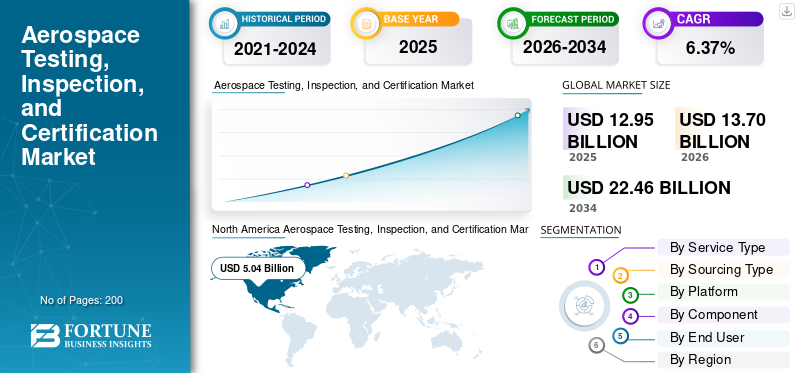
The global aerospace testing, inspection, and certification market size was valued at USD 12.95 billion in 2025. The market is projected to grow from USD 13.70 billion in 2026 to USD 22.46 billion by 2034, exhibiting a CAGR of 6.37% during the forecast period. North America dominated the aerospace testing, inspection, and certification market with a market share of 38.92% in 2025.
The market covers technical services used to verify the safety, reliability, and compliance of aerospace systems before production, delivery, and in-service use. It includes Aerospace Quality Assurance, Certification Services, Aerospace Inspection Solutions, Aerospace Validation Services, Aerospace Component Testing, Aerospace Quality Control, and Aviation Testing Services for Aircraft, engines, avionics, airframes, space systems, UAVs, and eVTOL platforms. These services are used by OEMs, component suppliers, airlines, MRO providers, defense agencies, and space companies to reduce failure risk, meet regulatory requirements, and maintain operational reliability across the product lifecycle.
Key players, including Element, SGS, Bureau Veritas, Intertek, and DEKRA, are expanding aerospace labs, NDT, certification, digital reporting, and compliance support.
Download Free sample to learn more about this report.
AEROSPACE TESTING, INSPECTION, AND CERTIFICATION MARKET TRENDS
Digital Certification, Remote Inspection, and Tamper-Proof Test Records are a Market Trend
A key market trend is the shift toward digital inspection workflows, automated documentation, and secure test-report traceability. Aerospace programs now involve multi-site suppliers, complex materials, software-heavy systems, and tighter audit requirements, making manual reporting less efficient. Providers are increasingly using digital platforms, AI-assisted defect detection, remote reviews, and tamper-proof certificates to improve confidence in test evidence. The adoption of Aircraft Inspection Services and Non-Destructive Testing (NDT) is also expanding as operators seek faster, safer, and more accurate inspection methods for critical structures and components.
MARKET DYNAMICS
MARKET DRIVERS
Download Free sample to learn more about this report.
Rising Aircraft Deliveries and Continued Airworthiness Requirements Drive the Market Growth
The main aerospace testing, inspection, and certification market growth driver is the rising need for aviation regulatory compliance as commercial aviation, defense programs, UAVs, and space platforms move through stricter approval and operating requirements. Every new platform or major modification requires Aerospace Compliance Testing, design validation, production conformity checks, and documented proof of safety before entry into service. Aircraft safety certification remains central to this demand, especially as OEMs increase deliveries, airlines modernize fleets, and MRO providers handle higher inspection workloads for aging and high-utilization fleets.
MARKET RESTRAINTS
High Cost of Accredited Testing Infrastructure Restrains Market Expansion
The market is restrained by the high cost of accredited laboratories, specialized equipment, and qualified technical personnel. Aerospace testing requires calibrated instruments, certified procedures, controlled facilities, experienced engineers, and regulator-accepted documentation, which increases operating costs for TIC providers and customers. Smaller suppliers often face difficulty funding advanced environmental chambers, fatigue rigs, EMC labs, radiography systems, and specialized inspection equipment. The shortage of certification engineers, NDT technicians, and compliance specialists can also create bottlenecks, particularly for complex propulsion, avionics, defense, and advanced air mobility programs.
MARKET OPPORTUNITIES
UAVs, eVTOL, and Space Qualification Create a High-Growth Market Opportunity
The strongest opportunity is emerging from UAVs, eVTOL aircraft, and space platforms, where certification pathways are still developing and testing requirements are more complex than traditional aircraft components. These platforms require battery safety testing, flight-control software validation, structural qualification, cybersecurity assessment, autonomy verification, and operating-risk documentation. The FAA’s Advanced Air Mobility workstreams include certification, airspace, infrastructure, hazardous materials safety, and community engagement, while EASA continues to update VTOL means of compliance. This creates demand for specialist TIC providers that can support early design validation through regulatory approval, especially for OEMs lacking mature in-house certification teams.
MARKET CHALLENGES
Certification Bottlenecks and Skilled Workforce Shortage to Challenge Market Growth
The biggest challenge is the shortage of experienced aerospace certification engineers, test specialists, NDT technicians, software compliance experts, and regulatory documentation teams. Aircraft and space programs are becoming more complex, while regulators still require objective evidence, traceability, test witnessing, inspections, and design compliance reviews. This creates bottlenecks when OEMs, suppliers, and TIC labs compete for the same technical talent. EASA states that certification compliance demonstrations may include analysis, simulation, ground tests, flight tests, document reviews, and test witnessing, making the process resource-intensive. The challenge is sharper for eVTOL, UAS, AI-enabled avionics, and software-defined systems where standards and methods are still evolving.
Segmentation Analysis
By Service Type
Expanding Certification and Product Validation Requirements to Support Growth of Testing Services Segment
Based on the service type, the market is segmented into testing services, inspection services, certification services, auditing & compliance services, consulting & technical advisory services, and others.
The testing services segment is anticipated to account for the largest aerospace testing, inspection, and certification market share in the forecast period. The segment is growing as aerospace programs require proof before certification, delivery, and service entry. Materials, structures, engines, avionics, batteries, software, electronics, and environmental systems must be tested under realistic operating conditions. For instance, EASA’s certification process includes simulations, ground tests, flight tests, fatigue tests, and other compliance demonstrations, making testing the foundation of aerospace TIC demand.
The consulting & technical advisory services segment is anticipated to rise with a high CAGR of 7.12% over the forecast period.
By Sourcing Type
Program Confidentiality and Critical IP Protection to Support Growth of In-house TIC Segment
Based on sourcing type, the market is segmented into in-house TIC, outsourced / third-party TIC, on-site TIC services, remote / digital TIC services, hybrid TIC services, and others.
In 2025, the in-house TIC segment dominated the global market. The segment is growing as OEMs, engine manufacturers, defense primes, and space companies prefer to retain sensitive testing and certification work internally. Flight-critical systems, classified defense programs, proprietary materials, and advanced propulsion technologies often need controlled test environments.
The remote / digital TIC services segment is projected to grow at a high CAGR of 7.12% over the forecast period.
By Platform
Aircraft Production Recovery and Fleet Modernization to Support Growth of Commercial Aircraft Segment
Based on the platform, the market is segmented into commercial aircraft, military aircraft, unmanned aerial systems, space platforms, advanced air mobility / eVTOL, and others.
The commercial aircraft segment is anticipated to witness a dominating market share over the forecast period. The segment is growing as aircraft delivery recovery, backlog execution, cabin upgrades, avionics modernization, and continued airworthiness checks are increasing TIC workloads. Commercial aircraft require testing across airframes, engines, interiors, electronics, software, and supplier parts before delivery and throughout service life.
The space platforms segment is projected to grow at a high CAGR of 6.68% over the forecast period.
By Component
Composite Adoption and Fatigue-Critical Structures to Support Growth of Airframe & Structures Segment
Based on component, the market is segmented into airframe & structures, engines & propulsion systems, avionics & electronics, landing gear systems, flight control & electrical systems, and others.
The airframe & structures segment dominated the market share in 2025. The segment is growing as airframes carry the highest safety burden across aircraft design, production, and maintenance. Fuselage sections, wings, empennage, nacelles, doors, control surfaces, and composite panels require fatigue testing, stress validation, dimensional inspection, NDT, impact testing, and corrosion checks.
In addition, the flight control & electrical systems segment is projected to grow at a high CAGR of 6.96% during the forecast period.
By End User
To know how our report can help streamline your business, Speak to Analyst
Program Ownership and Regulatory Accountability to Support Growth of Aircraft OEMs Segment
Based on end user, the market is segmented into aircraft OEMs, engine OEMs, component & system suppliers, airlines & aircraft operators, MRO providers, and others.
The aircraft OEMs segment dominated the market share in 2025. The segment is growing as OEMs remain accountable for design approval, airworthiness evidence, production conformity, supplier qualification, and final certification readiness. They coordinate testing across structures, engines, avionics, interiors, and software suppliers.
In addition, the airlines & aircraft operators segment is projected to grow at a CAGR of 6.68% during the forecast period.
Aerospace Testing, Inspection, and Certification Market Regional Outlook
By region, the market is categorized into Europe, North America, Asia Pacific, and the Rest of the World.
North America
North America Aerospace Testing, Inspection, and Certification Market Size, 2025 (USD Billion)
To get more information on the regional analysis of this market, Download Free sample
North America held the dominant share in 2024, valuing at USD 4.83 billion, and also maintained the leading share in 2025, with USD 5.04 billion. North America remains a key aerospace TIC region due to the presence of major aircraft OEMs, engine manufacturers, defense contractors, space companies, airlines, and MRO networks. The U.S. FAA’s role in airworthiness certification, AAM integration, and aircraft production oversight keeps testing and certification activity structurally strong.
U.S. Aerospace Testing, Inspection, and Certification Market
Based on North America’s strong contribution and the U.S. dominance within the region, the U.S. market can be analytically approximated at around USD 3.31 billion by 2026. Further, accounting for roughly a CAGR of 6.25% over the forecast period. The U.S. market is supported by Boeing, GE Aerospace, RTX, Lockheed Martin, Northrop Grumman, SpaceX, NASA-linked suppliers, defense primes, commercial airlines, and a large MRO base. Growth is driven by production recovery, FAA certification oversight, military aerospace qualification, eVTOL testing, and space launch activity.
Europe
Europe is projected to record a steady growth rate of 6.42% during the forecast period, which is the second-highest among all regions, and is set to reach a valuation of USD 3.30 billion by 2026. Europe is a major TIC market due to Airbus, Safran, Rolls-Royce, Leonardo, Dassault Aviation, MBDA, ESA-linked suppliers, and strong regulatory oversight from EASA. Growth is supported by commercial aircraft programs, defense modernization, space qualification, and stricter certification pathways for AI, UAS, and VTOL aircraft.
U.K. Aerospace Testing, Inspection, and Certification Market
The U.K. market in 2026 is estimated at around USD 1.05 billion, representing roughly a CAGR of 6.86% during the forecast period. The U.K. market benefits from Rolls-Royce, BAE Systems, Airbus U.K., Leonardo U.K., GKN Aerospace, strong defense aviation activity, and a mature certification ecosystem. The U.K. CAA’s role in advanced air mobility certification coordination strengthens demand for advisory, testing, and compliance services.
Germany Aerospace Testing, Inspection, and Certification Market
Germany’s market is projected to reach approximately USD 0.91 billion in 2026. Germany’s TIC growth is supported by Airbus operations, MTU Aero Engines, Diehl Aviation, HENSOLDT, OHB, strong industrial testing culture, and high aerospace supplier quality requirements. TÜV Rheinland, TÜV SÜD, DEKRA, and other German-origin TIC groups strengthen the country’s position in certification, safety assurance, cybersecurity, and quality management, further supporting aircraft and space-related sensing applications.
Asia Pacific
The Asia Pacific region is estimated to reach USD 3.03 billion in 2026, securing the position of the third-largest region in the market and fastest-growing during the forecast period. Asia Pacific is growing strongly as China, India, Japan, South Korea, Singapore, and Australia expand aircraft production, defense aviation, MRO, UAVs, and space programs. Regional TIC demand is moving beyond final inspection toward supplier qualification, materials testing, aviation software compliance, and local certification readiness.
China Aerospace Testing, Inspection, and Certification Market
China’s market is projected to be one of the largest in Asia Pacific, with 2026 revenues to be estimated at around USD 0.96 billion. China’s market is driven by domestic aircraft production, COMAC programs, Airbus lifecycle services, civil aviation expansion, and rising supplier localization. COMAC states that the C919 received its CAAC Type Certificate and has entered commercial service, creating ongoing demand for production conformity, airworthiness, supplier testing, and lifecycle inspections.
India Aerospace Testing, Inspection, and Certification Market
The India market in 2026 is estimated at around USD 0.84 billion. India is gaining TIC relevance as civil aviation expands, airline fleets grow, airports modernize, drone use cases scale, and defense aerospace manufacturing increases. DGCA remains the civil aviation safety regulator, while drone type certification and aviation safety oversight are expanding the compliance base. Furthermore, India’s aircraft component manufacturing, MRO growth, UAV ecosystem, and defense programs are expected to increase demand for accredited material testing, inspection, supplier audits, and certification support.
Rest of the World
The rest of the world include the Middle East & Africa and Latin America. The Middle East is building aviation and MRO capability around major carriers and defense aviation programs, while Latin America is supported by Embraer’s aerospace ecosystem and regional airline maintenance demand. Africa is gradually adding drone logistics, humanitarian aviation, and regulatory compliance needs, supported by initiatives such as Bureau Veritas’s Wings for Aid partnership in East Africa. The Middle East & Africa and Latin America markets are set to reach a valuation of USD 1.24 billion and USD 0.81 billion, respectively, by 2026.
COMPETITIVE LANDSCAPE
Key Industry Players
Key Players Focus on Innovation and Capacity Expansion to Shape Market Positioning
TIC companies, including Element Materials Technology, SGS, Bureau Veritas, Intertek, and DEKRA, are continuously competing alongside aerospace-focused laboratories, NDT specialists, certification bodies, and engineering service providers. From a company perspective, innovation and capacity expansion are the main growth levers. Providers are investing in aerospace materials labs, NDT capacity, EMC/radio testing, blockchain-verified reports, drone-based inspection, remote inspection, and software-linked compliance tools.
Element is expanding aerospace testing capacity in the U.S. and Europe and SGS strengthened its North American technical services footprint through ATS. Whereas, Bureau Veritas is supporting aircraft lifecycle and drone compliance programs and Intertek is advancing drone-enabled inspection and defense testing. The market is shifting toward fewer but stronger providers that can handle complex, multi-site aerospace compliance programs.
LIST OF KEY AEROSPACE TESTING, INSPECTION, AND CERTIFICATION COMPANIES PROFILED
- Element Materials Technology Group Limited (U.K.)
- SGS SA (Switzerland)
- Bureau Veritas SA (France)
- Intertek Group plc (U.K.)
- DEKRA SE (Germany)
- TÜV SÜD AG (Germany)
- TÜV Rheinland AG (Germany)
- Applus Services, S.A. (Spain)
- MISTRAS Group, Inc. (U.S.)
- UL Solutions Inc. (U.S.)
KEY INDUSTRY DEVELOPMENTS
- May 2026: Element Materials Technology announced an investment of more than USD 20 million in its Charlotte, North Carolina facility to expand aerospace and defense materials testing capacity, including stress rupture, creep, tensile, machining, and metallurgical testing.
- January 2026: SGS completed the acquisition of Applied Technical Services, a specialized North American testing, inspection, calibration, and forensics provider. ATS adds technical service depth in materials testing, inspection, calibration, and industrial aerospace quality assurance across regulated industries.
- October 2025: Intertek partnered with the University of Houston to design and develop drones for industrial inspection applications. The collaboration supports drone technology that can be used by Intertek personnel for inspecting large assets and infrastructure.
- September 2025: Intertek, ADPO, and Helicus launched a cargo drone transport route in the Port of Antwerp. The route connects ADPO’s terminal with Intertek’s laboratory, allowing samples to move faster and more safely across the port environment.
- June 2025: Bureau Veritas partnered with Wings for Aid to support drone-based humanitarian logistics in East Africa. Bureau Veritas is helping strengthen regulatory compliance and organizational readiness as Wings for Aid moves from pilot projects to scalable field missions.
REPORT COVERAGE
The global aerospace testing, inspection, and certification industry analysis includes a comprehensive study of the market size & forecast by all the market segments included in the report. It includes details on the market dynamics and market trends expected to drive the market over the forecast period. It provides information on key aspects, including an overview of technological advancements, the regulatory environment, porter’s five forces analysis, company profiles and retrofitting program. Additionally, it details partnerships, mergers & acquisitions, as well as key aviation industry developments and prevalence by key regions. The global market report also provides a depth competitive landscape with information on the market share and profiles of key operating players.
Request for Customization to gain extensive market insights.
Report Scope & Segmentation
| ATTRIBUTE | DETAILS |
| Study Period | 2021-2034 |
| Base Year | 2025 |
| Estimated Year | 2026 |
| Forecast Period | 2026-2034 |
| Historical Period | 2021-2024 |
| Growth Rate | CAGR of 6.37% from 2026-2034 |
| Unit | Value (USD Billion) |
| Segmentation | By Service Type, Sourcing Type, Platform, Component, End User, and Region |
| By Service Type |
|
| By Sourcing Type |
|
| By Platform |
|
| By Component |
|
| By End User |
|
| By Region |
|
Frequently Asked Questions
According to Fortune Business Insights, the global market value stood at USD 12.95 billion in 2025 and is projected to reach USD 22.46 billion by 2034.
In 2025, the market value stood at USD 5.04 billion.
The market is expected to exhibit a CAGR of 6.37% during the forecast period.
By service type, the testing services segment is expected to dominate the market.
The rising aircraft deliveries and continued airworthiness requirements are the key factors driving the market growth.
Element Materials Technology, SGS, Bureau Veritas, Intertek, and DEKRA are few key players in the global market.
North America dominated the market in 2025.



- 2021-2034
- 2025
- 2021-2024
- 200
Get 30-60 hrs Free Customization
Expand Regional and Country Coverage, Segments Analysis, Company Profiles, Competitive Benchmarking, and End-user Insights.




















Related Reports
-
US +1 833 909 2966 ( Toll Free )
-
Get In Touch With Us