AI in Breast Imaging Market Size, Share & Industry Analysis, By Component (Software and Services), By Deployment (Cloud-Based, On-Premise, and Hybrid), By Technology (Computer Vision, Machine Learning & Deep Learning, and Others), By Modality (Mammography/DBT, Breast Ultrasound, Breast MRI, Multi-modality, and Others), By Application (Cancer Detection & Triage, Breast Density Assessment, Risk Stratification, Workflow Prioritization, and Others), By End User (Hospitals & Health Systems, Diagnostic Imaging Centers, Breast Screening Centers, and Others), and Regional Forecast, 2026-2034
 Download Free Sample
AI in Breast Imaging Market Size and Future Outlook
 Listen to Audio Version
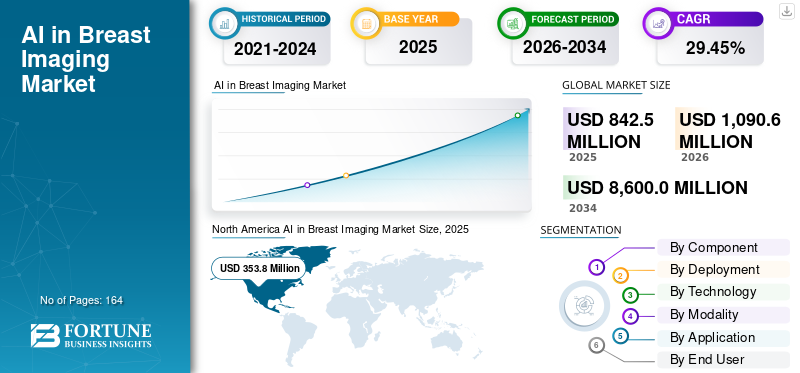
The global AI in breast imaging market size was valued at USD 842.5 million in 2025. The market is projected to grow from USD 1,090.6 million in 2026 to USD 8,600.0 million by 2034, exhibiting a CAGR of 29.45% during the forecast period. North America dominated the AI in breast imaging market with a market share of 41.99% in 2025.
The global market comprises software solutions and associated services designed to support breast imaging applications and modalities. The market is propelled by increasing breast cancer screening rates, pressure on radiologists' workloads, a greater need for early cancer detection, and broader use of 3D mammography and digital breast tomosynthesis. AI is progressively being utilized to enhance reading efficiency, decrease missed cancer detections, assist in evaluating dense breast tissues, and aid imaging facilities in managing high-volume screening programs with greater consistency and quality.
Key market players in the global market include Hologic, Inc., GE Healthcare, and Lunit Inc.. The leadership of these companies is supported by U.S. FDA/CE-cleared AI algorithms, integration with mammography and PACS/RIS workflows, partnerships with hospitals and screening programs, and strong product portfolios.
Download Free sample to learn more about this report.
AI in Breast Imaging Market Key Takeaways
 Global Market Size & Forecast
- 2025 Market Size: USD 842.5 million
- 2026 Market Size: USD 1,090.6 million
- 2034 Forecast Market Size: USD 8,600.0 million
- CAGR: 29.45% from 2026–2034
 Market Share
- North America dominated the AI in breast imaging market with a 41.99% share in 2025.
- The services segment is projected to grow at a CAGR of 25.99%.
- The hybrid segment is projected to grow at a CAGR of 28.71%.
 Key Regional Highlights
North America
North America led the market with a valuation of USD 353.8 million in 2025.
Europe
Europe is projected to grow at a CAGR of 27.15% during the forecast period.
Asia Pacific
Asia Pacific is expected to reach USD 261.7 million in 2026.
U.S.
The market is expected to reach USD 416.1 million in 2026, accounting for approximately 38.2% of global sales.
Japan
The market is projected to reach USD 39.0 million in 2026, accounting for approximately 3.6% of global revenues.
Read More

AI in BREAST IMAGING MARKET TRENDS
Rising Adoption of AI-powered Diagnostic Technologies is a key Market Trend
The increasing use of AI-driven diagnostic technologies is emerging as a significant trend in the market, as hospitals, imaging centers, and screening initiatives seek solutions that enhance cancer detection and lessen radiologists’ workloads. Breast imaging produces large amounts of mammography, DBT, ultrasound, and MRI scans, with AI assisting radiologists prioritize concerning cases, identify subtle lesions, evaluate breast density, and ensure consistent reporting quality. This trend is gaining traction as healthcare systems face increasing screening volumes, a lack of breast imaging experts, and the need to identify cancers at earlier stages. AI tools are advancing from mere detection to predicting risks and supporting workflows, enhancing their utility throughout the entire breast imaging process. With additional AI solutions gaining regulatory approvals and being incorporated into PACS, mammography workstations, and screening processes, their adoption is anticipated to rise in hospitals and diagnostic imaging facilities. These factors are supporting the overall global AI in breast imaging market growth during the forecast period.
- For instance, in November 2025, RadNet and DeepHealth announced results from a large real-world analysis of AI-driven breast cancer screening in the U.S., showing that DeepHealth’s AI-powered breast cancer detection workflow increased cancer detection rates with consistent benefits across patient populations. This supports the rising clinical adoption of AI-powered diagnostic technologies in breast imaging.
MARKET DYNAMICS
MARKET DRIVERS
Download Free sample to learn more about this report.
Growing Demand for Early Disease Detection Solutions is Driving Market Growth
The increasing need for early disease detection solutions is a significant factor propelling the global AI in breast imaging market, as healthcare systems concentrate on diagnosing breast cancer at earlier and more treatable stage. Screening programs produce significant amounts of mammography and DBT images, making it challenging to consistently detect small or subtle lesions, particularly in dense breast tissue. AI-driven breast imaging technology assist radiologists in identifying concerning findings earlier, prioritizing high-risk cases, and minimizing the risk of overlooked cancers during routine screenings. This is boosting their acceptance in hospitals, breast screening facilities, and diagnostic imaging networks. The market driver is further facilitated by the shift toward personalized and risk-oriented screening, in which AI can integrate image patterns, density, and risk indicators to inform follow-up choices. Consequently, there is an increasing demand for AI solutions that enhance diagnostic accuracy, reduce diagnosis time, and promote improved patient outcomes. All these factors collectively drive the overall market growth.
- For instance, in May 2025, a UCLA-led study reported that AI used during routine mammography screening could help identify mammographically visible breast cancers earlier and potentially reduce interval breast cancers by around 30%, supporting the role of AI in early breast cancer detection.
MARKET RESTRAINTS
High Cost of Implementation to Hamper Market Growth
Significant implementation expenses represent a key represent for the global AI in breast imaging market, as adoption involves more than acquiring an algorithm license. Hospitals and imaging facilities need to invest in the integration of PACS/RIS, cloud-based or on-premises infrastructure, cybersecurity assessments, workflow evaluations, training for radiologists, and continuous software upkeep. These expenses can be challenging for smaller diagnostic imaging centers and breast screening facilities, particularly when reimbursement for AI-assisted breast imaging is ambiguous or not specifically included. Consequently, numerous healthcare providers might postpone implementation despite demonstrated clinical benefits of AI tools in cancer detection, breast density evaluation, or prioritizing workflows. The financial burden is even greater for DBT-based AI solutions, as extensive 3D image files demand enhanced storage, processing, and connectivity capabilities. Consequently, substantial initial and ongoing implementation expenses can hinder market entry, especially in healthcare systems that are sensitive to price and have limited resources.
- For example, in February 2026, a survey of breast radiologists published in the Journal of Breast Imaging reported that although respondents recognized the benefits of AI in breast imaging, cost, integration, and trust remained key barriers to adoption. This finding directly supports the view that high implementation costs remain a key restraint on the wider clinical deployment of AI-based breast imaging tools.
MARKET OPPORTUNITIES
Expansion of AI-assisted 3D Breast Tomosynthesis Solutions to Offer Market Growth Opportunities
The growth of AI-enhanced 3D breast tomosynthesis solutions presents a significant opportunity in the AI in breast imaging market, as DBT is increasingly being adopted for breast cancer screening as it offers detailed layered 3D images of breast tissue. Nonetheless, DBT also raises image volume and examination time for radiologists, creating need for AI tools that can identify suspicious lesions, emphasize subtle findings, and aid in quicker case review. AI-enhanced DBT solutions are particularly beneficial in dense breast situations, where detecting cancers can be more challenging with standard 2D mammography. This presents a chance for suppliers to provide AI algorithms that enhance detection precision, minimize false negatives, and seamlessly incorporate into mammography workstations and PACS processes. With the transition of additional imaging networks from 2D mammography to DBT-based screening programs, the potential market for AI-driven DBT software is anticipated to grow. The opportunity is further bolstered by increasing regulatory approvals and the practical implementation of AI tools designed for DBT applications across hospitals, outpatient radiology clinics, and breast screening facilities.
- For instance, in August 2025, Akumin selected Lunit INSIGHT DBT, an AI solution for digital breast tomosynthesis, to enhance its nationwide breast imaging operations and support early breast cancer detection across its outpatient imaging network. This shows how imaging providers are adopting AI-assisted 3D breast tomosynthesis solutions to improve screening efficiency and expand access to precision diagnostics.
MARKET CHALLENGES
Limited Availability of High-Quality Annotated Imaging Datasets Pose a Prominent Challenge to Market Growth
A major challenge for the global AI in breast imaging market is the restricted avavilability of high-quality annotated imaging datasets, as AI models require extensive, varied, and clinically validated datasets to function reliably across different patient groups, imaging systems, and healthcare settings. Creating breast imaging datasets is challenging as mammography, DBT, ultrasound, and MRI examinations require expert radiologist labeling, precise lesion annotation, pathology validation, and long-term follow-up. Numerous existing datasets are constrained by small sample sizes, inconsistent labeling, variations in file formats, and insufficient demographic or scanner diversity, which can diminish model generalizability. This makes it difficult for the companies to train AI tools that perform reliably across dense breasts, various age groups, numerous vendors, and diverse screening protocols. The challange is even greater for 3D breast tomosynthesis, where image volumes are larger and the annotation processes are more time-intensive. Consequently, suppliers might encounter extended development timelines, increased validation expenses, and delayed regulatory or clinical acceptance., thereby hinder industry expansion.
Segmentation Analysis
By Component
Software Segment Dominated Due to Wider Use of AI Tools with PACS
In terms of component, the market is divided into services and software.
The software segment accounted for the dominant global AI in breast imaging market share in 2025. Hospitals, diagnostic imaging facilities, and breast screening initiatives are progressively integrating AI software to enhance reading efficiency, minimize overlooked findings, and handle increasing mammography/DBT workloads. Additionally, software solutions provide greater scalability, as a single platform can be deployed across various imaging locations, modalities, and radiology processes. The segment is also bolstered by the increasing integration of AI tools with PACS, mammography workstations, cloud platforms, and enterprise imaging systems, enabling radiologists to incorporate AI-generated insights into standard reading workflows.
- For instance, in April 2025, ScreenPoint Medical announced that its FDA-cleared Transpara Breast AI capabilities, including breast density assessment and temporal comparison, would be showcased at the Society of Breast Imaging Symposium.
The services segment is anticipated to rise with a CAGR of 25.99% over the forecast period.
To know how our report can help streamline your business, Speak to Analyst
By Deployment
Cloud-Based Segment Dominated due to Its Ability to Access AI Tools Without Heavy Upfront Investment in Complex IT Infrastructure
On the basis of deployment, the market is divided into cloud-based, on-premise, hybrid.
The cloud-based segment dominated the global market in 2025. Cloud deployment allows hospitals, diagnostic imaging centers, and breast screening networks to access AI tools without heavy upfront investment in local servers and complex IT infrastructure. It also supports faster software updates, centralized model improvements, easier multi-site rollout, and smoother integration with enterprise imaging platforms. Additionally, cloud-based platforms offer greater flexibility for expanding AI use from cancer detection to density assessment, risk stratification, and workflow prioritization. Furthermore, the segment is set to hold 54.2% share by 2026.
- For instance, in April 2024, iCAD announced the commercial availability of ProFound Cloud, a SaaS platform designed to provide secure, cost-effective, and scalable access to its ProFound Breast Health Suite of AI solutions.
The hybrid segment is growing at a CAGR of 28.71% over the forecast period.
By Technology
Computer Vision Segment Dominated Due to Its Abolity to Analyze Visual Patterns in Ultrasound and MRI images
Based on technology, the market is classified into machine learning & deep learning, computer vision, natural language processing (NLP), and others.
The computer vision segment held the dominating share of the global market in 2025. This is owing to the fact that AI in breast imaging is mainly used to analyze visual patterns in mammography, DBT, ultrasound, and MRI images. Computer vision algorithms help detect suspicious masses, calcifications, asymmetries, architectural distortions, and other subtle breast abnormalities that may be difficult to identify consistently in high-volume screening workflows. The segment is also supported by increasing clinical evidence showing improved cancer detection rates when AI-based image analysis is used with radiologist interpretation. Furthermore, the segment is set to hold 57.8% share by 2026.
- For instance, in March 2025, Lunit announced results from a large-scale, multicenter prospective study showing that its AI-based computer-aided detection solution, Lunit INSIGHT MMG, helped radiologists detect 13.8% more screen-detected breast cancers in mammography screening.
The machine learning & deep learning segment is anticipated to rise with a CAGR of 27.91% over the forecast period.
By Modality
Growing Use in Breast Cancer Screening Workflows Supported Mammography/DBT Segment Growth
In terms of modality, the market is divided into mammography/DBT, breast ultrasound, breast MRI, multi-modality, and others.
The mammography/DBT segment captured the highest share of the global market in 2025. This can be attributed to the fact that mammography remains the primary imaging method used for routine breast cancer screening, while DBT is increasingly adopted to improve visualization of overlapping breast tissue. Additionally, these modalities generate large screening volumes and create a strong need for automated lesion detection, triage, density assessment, and workflow prioritization. Furthermore, the segment is set to hold 61.8% share by 2026.
- For instance, in April 2025, Hologic announced new data on its AI-powered mammography technology, including Genius AI Detection 2.0 for digital breast tomosynthesis, to be presented at the Society of Breast Imaging Symposium. The company highlighted the use of AI in mammography to improve screening accuracy, support early detection, and strengthen clinical integration of 3D breast imaging workflows.
The breast ultrasound segment is anticipated to rise with a CAGR of 30.46% over the forecast period.
By Application
Increasing Clinical Evidence to Improve Cancer Detection Rates Boosted Cancer Detection & Triage Segment Growth
On the basis of application, the market is divided into cancer detection & triage, breast density assessment, risk stratification, workflow prioritization, reporting & quality support, and others.
The cancer detection & triage segment captured the highest share of the global market in 2025. This segment has stronger adoption than reporting or quality support solitions as it directly influences diagnostic accuracy, recall decisions, and time to follow-up. Hospitals and imaging centers are also using AI-based triage to reduce reading pressure on radiologists and speed up assessment of higher-risk cases. The segment is further supported by increasing clinical evidence showing that AI can help maintain or improve cancer detection rates while reducing workload within screening programs. As early diagnosis remains the main goal of breast imaging, cancer detection & triage continues to be the leading application segment. Furthermore, the segment is set to hold 42.8% share by 2026.
- For instance, in February 2025, the U.K. Department of Health and Social Care announced a large AI breast cancer screening trial involving nearly 700,000 women to test how AI tools can help radiologists catch breast cancer earlier.
The reporting & quality support segment is anticipated to rise with a CAGR of 31.11% over the forecast period.
By End User
High Volume of Breast Imaging Procedures Supported the Hospitals & Health Systems Segment Expansion
In terms of end user, the market is segmented into hospitals & health systems, diagnostic imaging centers, breast screening centers, academic & research institutes, and others.
In 2025, the hospitals & health systems segment held the largest share of the global market. The segment’s dominance can be attributed to the high volume of breast imaging procedures performed across mammography/DBT, ultrasound, MRI, biopsy follow-up, and oncology referral pathways. The segment is also supported by increasing partnerships between AI vendors and large hospital networks to support population-level breast screening programs. As hospitals continue to adopt digital imaging and AI-enabled diagnostic workflows, they are expected to remain the leading end-user segment. Furthermore, the segment is set to hold 42.8% share by 2026.
- For instance, in March 2025, Lunit signed a multi-year contract with Abu Dhabi Health Services Company (SEHA), the UAE’s largest healthcare network, to deploy Lunit INSIGHT MMG across its national AI breast cancer screening program. The agreement aimed to analyze more than 100,000 mammograms over a five-year period, showing how large hospital and health system networks are adopting AI to scale breast cancer screening and enhance diagnostic support.
The breast screening centers segment is projected to grow at a growth rate of 31.11% during the forecast period.
AI in Breast Imaging Market Regional Outlook
By geography, the market is divided into North America, Latin America, Asia Pacific, Europe, and the Middle East & Africa.
North America
North America AI in Breast Imaging Market Size, 2025 (USD Million)
To get more information on the regional analysis of this market, Download Free sample
The North America market reached USD 279.8 million in 2024 and led the global market. In 2025, the region held its leading position, with USD 353.8 million. Strong adoption of digital mammography, 3D breast tomosynthesis, and AI-enabled radiology workflows across hospitals and imaging networks support the regional market growth.
U.S. AI in Breast Imaging Market
The U.S. market dominated the North American market and is expected to reach around USD 416.1 million in 2026, accounting for roughly 38.2% of global sales.
Europe
Europe market is anticipated to grow at CAGR of 27.15% during the forecast period. Europe is witnessing steady growth due to organized national breast screening programs, strong adoption of population-based mammography screening, and increasing regulatory acceptance of AI-enabled diagnostic tools.
U.K. AI in Breast Imaging Market
The U.K. market is poised to reach around USD 44.0 million in 2026, representing roughly 4.0% of global revenues.
Germany AI in Breast Imaging Market
Germany’s market is projected to reach approximately USD 52.7 million in 2026, equivalent to around 4.8% of global sales.
Asia Pacific
The market in Asia Pacific is expected to reach a valuation of USD 261.7 million in 2026. Asia Pacific is expected to record strong growth due to rising breast cancer incidence, expanding diagnostic imaging infrastructure, and increasing investments in digital health and AI-based medical imaging.
Japan AI in Breast Imaging Market
The Japanese market is poised to reach around USD 39.0 million in 2026, accounting for roughly 3.6% of global revenues.
China AI in Breast Imaging Market
China’s market is projected to reach around USD 94.2 million in 2026, representing roughly 8.6% of global sales.
India AI in Breast Imaging Market
The Indian market is estimated to reach around USD 38.2 million in 2026, accounting for roughly 3.5% of global revenues.
Latin America and Middle East & Africa
The Middle East & Africa and Latin America regions are likely to witness a slower growth throughout the forecast period. The market in Latin America is projected to attain a valuation of USD 55.7 million in 2026. Prominent factors such as improving access to breast cancer screening & reducing delays in diagnosis, growing investments in healthcare modernization, cancer screening programs, and AI-enabled hospital infrastructure are boosting market growth in these regions.
In the Middle East and Africa region, the GCC market is projected to reach approximately USD 13.9 million in 2026, representing about 1.3% of worldwide revenues.
COMPETITIVE LANDSCAPE
Key Industry Players
Market Players Focus on Regulatory Clearances to Improve Early Cancer Detection
The global AI in breast imaging market reflects a moderately fragmented structure with the presence of leading companies such as Hologic, Inc., GE Healthcare, and Lunit Inc. The dominance of these companies is owing to their strong portfolios across AI-assisted applications in breast imaging workflow. These players are focusing on regulatory clearances, PACS and mammography workstation integration, cloud-based deployment, and partnerships with hospitals, imaging networks, and screening programs to improve early cancer detection and reduce radiologist workload.
- For instance, in November 2024, GE HealthCare and RadNet’s DeepHealth announced a strategic collaboration to combine DeepHealth’s AI-powered breast cancer screening workflow with GE HealthCare’s Senographe Pristina mammography system, supporting broader adoption of AI-enabled breast imaging workflows.
Additional key contributors include ScreenPoint Medical B.V., CureMetrix, Inc., Clairity, and Therapixel. These companies are also emphasizing DBT-focused AI, independent second-reading tools, breast density and risk platforms, and enterprise-wide breast imaging solutions to strengthen their market presence.
LIST OF KEY AI in BREAST IMAGING COMPANIES PROFILED
- Hologic, Inc. (U.S.)
- General Electric Company (U.S.)
- RadNet, Inc. (DeepHealth) (U.S.)
- Lunit Inc. (South Korea)
- ScreenPoint Medical B.V. (Netherlands)
- CureMetrix, Inc. (U.S.)
- Clairity (U.S.)
- Whiterabbit (U.S.)
- Densitas Inc. (U.S.)
- Therapixel (France)
KEY INDUSTRY DEVELOPMENTS
- April 2026: ScreenPoint Medical secured USD 16 million in funding to advance its AI solutions for breast cancer detection and risk assessment. The funding supports the company’s next phase of AI development across the breast imaging continuum.
- April 2026: Quibim entered an exclusive strategic partnership with Vara to bring Vara’s AI breast cancer screening infrastructure to Spain. The partnership focuses on population-based mammography screening and wider AI adoption in European breast screening programs.
- October 2025: Vara received a new CE certificate for its breast-imaging AI, allowing it to operate as an independent second reader for both screening and diagnostic mammography use in Europe. This strengthened its commercial position in organized breast screening programs.
- September 2025: ScreenPoint Medical’s Transpara Breast AI was selected as the technology for the PRISM randomized trial, funded by PCORI. The trial is focused on evaluating AI use in screening mammography, supporting broader clinical validation of breast imaging AI.
- May 2025: RamSoft and Therapixel announced a commercial partnership to integrate MammoScreen into RamSoft’s PowerServer and OmegaAI platforms. The integration is aimed at improving cancer detection, breast density assessment, image quality review, and radiologist workflow efficiency.
REPORT COVERAGE
The global AI in breast imaging market analysis encompasses an extensive examination of the market size and projections for all market segments featured in the report. It provides information on the market dynamics and trends that are anticipated to propel the market during the forecast period. It offers insights into crucial elements, such as innovations in products, the regulatory landscape, and the introduction of new products. Furthermore, it outlines collaborations, mergers & acquisitions, along with significant advancements in the industry within the market. The global market forecast report additionally offers a comprehensive competitive landscape with details on market share and profiles of major active participants.
Request for Customization to gain extensive market insights.
Report Scope & Segmentation
| ATTRIBUTE | DETAILS |
| Study Period | 2021-2034 |
| Base Year | 2025 |
| Estimated Year | 2026 |
| Forecast Period | 2026-2034 |
| Historical Period | 2021-2024 |
| Growth Rate | CAGR of 29.45% from 2026 to 2034 |
| Unit | Value (USD Million) |
| Segmentation | By Component, Deployment, Technology, Modality, Application, End User, and Region |
| By Component |
|
| By Deployment |
|
| By Technology |
|
| By Modality |
|
| By Application |
|
| By End User |
|
| By Region |
|
Frequently Asked Questions
According to Fortune Business Insights, the global market value stood at USD 842.5 million in 2025 and is projected to reach USD 8,600.0 million by 2034.
In 2025, the market value stood at USD 353.8 million.
The market is expected to exhibit a CAGR of 29.45% during the forecast period.
By component, the software segment led the market.
Growing need for early disease detection solutions are the key factors driving market growth.
Hologic, Inc., General Electric Company, Lunit Inc. and RadNet, Inc. (DeepHealth) are some of the prominent players in the global market.
North America dominated the market in 2025.



- 2021-2034
- 2025
- 2021-2024
- 164
Get 30-60 hrs Free Customization
Expand Regional and Country Coverage, Segments Analysis, Company Profiles, Competitive Benchmarking, and End-user Insights.













.webp)






Related Reports
-
US +1 833 909 2966 ( Toll Free )
-
Get In Touch With Us