AI in Defense Market Size, Share & Industry Analysis, By Offering (Hardware, Software, and Services), By Technology (Machine Learning and Deep Learning, Computer Vision, Natural Language Processing, Generative and Agentic AI, and Predictive and Knowledge-Based AI), By Application (Intelligence, Surveillance, and Reconnaissance, Threat Detection and Target Recognition, Command, Control, and Decision Support, and Autonomous Combat and Support Operations), By Operational Domain (Land, Air, Maritime, Space, Cyber, and Joint and Multi-Domain Operations), and Regional Forecast, 2026-2034
 Download Free Sample
AI in Defense Market Size and Future Outlook
 Listen to Audio Version
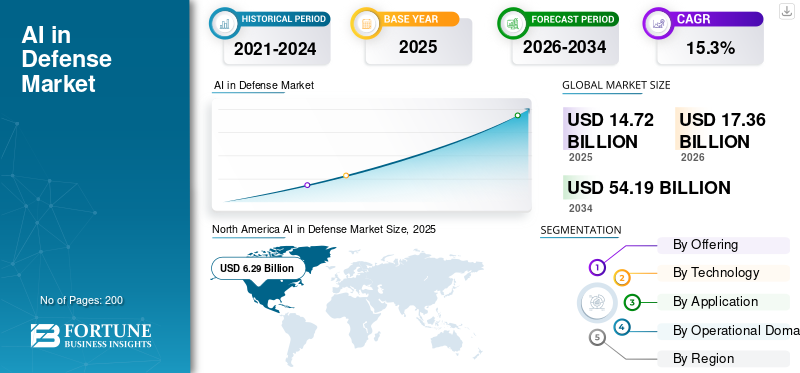
The global AI in defense market size was valued at USD 14.72 billion in 2025. The market is projected to grow from USD 17.36 billion in 2026 to USD 54.19 billion by 2034, exhibiting a CAGR of 15.3% during the forecast period. North America dominated the AI in defense market with a market share of 42.73% in 2025.
The market encompasses the development and integration of artificial intelligence technologies across military and defense operations, including autonomous systems, predictive maintenance, decision-support platforms, cybersecurity, and intelligence analysis. This market brings together defense contractors, technology firms, and government agencies working to enhance situational awareness, operational efficiency, and mission readiness. AI applications span command-and-control systems, unmanned platforms, logistics optimization, threat detection, and data fusion across multi-domain operations. As modern warfare increasingly relies on real-time data processing and rapid decision-making, AI is becoming a foundational capability embedded within weapons systems, surveillance networks, and battlefield management tools, reshaping how defense organizations plan, train, and execute missions.
Key players in the market include Lockheed Martin, RTX, Northrop Grumman, BAE Systems, and L3Harris Technologies. These companies compete through advanced autonomous platforms, AI-enabled sensor fusion, predictive analytics for maintenance and logistics, machine learning-based threat detection, and integrated command-and-control solutions. Their offerings span unmanned aerial and ground systems, electronic warfare, cybersecurity, and intelligence processing tailored for army, navy, air force, and joint operations. Continuous investment in research, strategic partnerships, and acquisitions strengthens their technology portfolios, enabling them to deliver mission-critical AI capabilities that improve situational awareness, operational speed, and decision-making accuracy across defense and homeland security applications.
Download Free sample to learn more about this report.
AI in Defense Market Key Takeaways
 Global Market Size & Forecast
- 2025 Market Size: USD 14.72 Billion
- 2026 Market Size: USD 17.36 Billion
- 2034 Forecast Market Size: USD 54.19 Billion
- CAGR: 15.3% from 2026-2034
 Market Share
- North America dominated the market with a revenue share of 42.73% in 2025.
- The software segment is projected to grow at a CAGR of 15.8% during the forecast period.
- Generative and agentic AI is expected to expand at a CAGR of 18.0% during the forecast period.
 Key Regional Highlights
Asia Pacific
Asia-Pacific is projected to reach USD 4.45 billion in 2026, growing at a CAGR of 16.3%.
North America
North America led the market in 2025 with a value of USD 6.29 billion, supported by strong defense technology investments.
Europe
Europe is estimated to reach USD 4.19 billion in 2026, supported by increasing adoption of AI-enabled defense systems.
U.S.
The market is estimated to reach USD 7.03 billion in 2026, with a projected CAGR of approximately 14.5%.
Japan
The market is estimated to reach USD 0.85 billion in 2026 and is projected to grow at a CAGR of approximately 16.6%.
Read More

AI in Defense Market Trends
Growing Adoption of Autonomous and Unmanned Systems across Defense Forces is Emerging as a Key Trend
Defense organizations globally are increasingly deploying AI-powered autonomous platforms, including unmanned aerial vehicles, ground robots, and maritime systems, to reduce human exposure to high-risk environments. This trend reflects a broader shift toward network-centric warfare, where AI enables real-time data sharing, swarm coordination, and autonomous decision-making across multiple platforms simultaneously. Integration of AI with existing legacy systems is also gaining momentum, allowing militaries to modernize capabilities without complete infrastructure overhauls. Additionally, growing collaboration between defense agencies and technology companies is accelerating the pace of innovation, pushing autonomous and semi-autonomous systems from experimental programs into operational deployment across air, land, and sea domains.
AI in Defense Market Dynamics
Market Drivers
Download Free sample to learn more about this report.
Rising Need for Real-Time Situational Awareness and Faster Decision-Making to Drive Market Growth
Modern military operations demand rapid processing of vast amounts of sensor, satellite, and battlefield data to support timely decision-making. AI enables defense forces to analyze this information in real time, identifying threats, patterns, and anomalies far faster than manual methods allow. This capability is critical in contested and multi-domain environments where delays can compromise mission outcomes. Additional drivers include the need to counter increasingly sophisticated adversary tactics, support autonomous weapons and surveillance systems, and enhance cybersecurity resilience. All of these factors reinforce the growing reliance on AI as a core enabler of modern defense strategy and operational superiority, further driving the AI in defense market growth.
Market Drivers - Impact & CAGR Contribution (2026–2034)
| Rank | Market Drivers | Overall impact rank | CAGR contribution (2026–2034) | Impact: 2026-2028 | Impact: 2029-2031 | Impact: 2032-2034 |
|---|---|---|---|---|---|---|
| 1 | Growing Demand for Real-Time Battlefield Intelligence and Accelerated Decision-Making to Fuel Market Growth | High | 4.15% | High | High | High |
| 2 | Expansion of autonomous systems, collaborative autonomy & human-machine teaming | High | 3.65% | High | High | High |
| 3 | Increasing Demand for Reduced-Sugar, Plant-Based, and Better-for-You Bubble Tea Broadens the Consumer Base | Medium-High | 3.35% | Medium-High | High | High |
| 4 | Rising cyber-defense, electronic-warfare & adversarial-AI requirements | High | 3.05% | High | High | High |
| 5 | Defense digital modernization, data fabrics, cloud & tactical-edge computing | High | 3.10% | High | High | Medium |
| 6 | Expanding predictive maintenance, logistics, training & enterprise AI use cases | High | 2.80% | Medium | High | High |
| Total Positive Growth Contribution | 20.10% | |||||
Source: Fortune Business Insights
Download Free sample For In-Depth Market Drivers & Impact Forecasts
Market Restraints
High Implementation Costs and Complex System Integration Requirements to Limit Market Growth
The deployment of AI within defense infrastructure requires substantial investment in specialized hardware, software development, skilled personnel, and secure data infrastructure. Many defense organizations face budgetary constraints that limit the pace of AI adoption, particularly for smaller nations or agencies with competing priorities. Integrating AI with legacy platforms and systems that were not originally designed for such technology adds further complexity and cost. Additionally, stringent procurement processes and lengthy approval cycles common in defense sectors can slow down technology adoption, creating a gap between AI innovation and its practical, large-scale deployment across military organizations.
Market Restraints - Impact & Negative CAGR Contribution (2026–2034)
| Rank | Market Restraints | Overall impact rank | Negative CAGR contribution (2026–2034) | Impact: 2026-2028 | Impact: 2029-2031 | Impact: 2032-2034 |
|---|---|---|---|---|---|---|
| 1 | High Deployment Costs and Complex Integration with Legacy Defense Systems to Restrain Market Growth | High | -1.35% | High | High | Medium |
| 2 | Testing, evaluation, verification & validation (TEV&V), model assurance, cybersecurity & human-accountability requirements | High | -1.25% | High | High | High |
| 3 | Legacy-system integration, long acquisition cycles & mission-certification complexity | High | -1.15% | High | High | Medium |
| 4 | Shortage of cleared AI talent plus compute, semiconductor & secure-infrastructure constraints | Medium-High | -1.05% | High | Medium | Medium |
| Total Negative Growth Impact | -4.80% | |||||
Source: Fortune Business Insights
Download Free sample For In-Depth Market Restraints & Risk Analysis
Market Opportunities
Expanding Scope for AI-enabled Predictive Maintenance and Logistics Optimization to Create Significant Market Opportunities
Significant opportunity exists in applying AI to predictive maintenance, supply chain management, and logistics planning within defense operations. AI-driven analytics can forecast equipment failures before they occur, reducing downtime and maintenance costs while improving fleet readiness. This creates opportunities for technology providers to develop specialized software platforms tailored to military logistics networks. Additionally, emerging defense markets in developing nations present opportunities for AI integration as these countries modernize their armed forces. Partnerships between established defense contractors and AI-focused technology startups further open avenues for innovation, enabling smaller firms to contribute niche capabilities while larger players scale these solutions across broader defense infrastructure.
Market Challenges
Ensuring Reliability, Security, and Ethical Oversight of AI Systems to Pose Challenges to Market Growth
Deploying AI in defense settings raises concerns around system reliability, cybersecurity vulnerabilities, and the ethical implications of autonomous decision-making in combat scenarios. Ensuring that AI algorithms perform consistently under unpredictable battlefield conditions remains a significant technical challenge. Additionally, adversarial attacks targeting AI models, data poisoning, and system spoofing pose serious security risks that defense organizations must continuously address. Establishing clear governance frameworks, accountability structures, and international standards for responsible AI use in warfare adds further complexity. This is because militaries must balance the pursuit of technological advantage with the need to maintain trust, transparency, and compliance with legal and ethical norms.
AI in Defense Market Segmentation Analysis
By Offering
Growing Complexity of AI-enabled Defense Platforms is Driving Demand for the Hardware Segment
Based on offering, the market is segmented into hardware, software, and services.
The hardware segment dominated in 2025, accounting for the largest AI in defense market share. Demand for the segment is rising as AI applications in defense require high-performance processors, sensors, and computing infrastructure capable of handling intensive real-time data processing. As autonomous systems and edge-computing platforms expand across military operations, robust and ruggedized hardware becomes essential to support reliable AI performance in demanding field conditions.
The software segment is anticipated to grow at a CAGR of 15.8% over the forecast period.
To know how our report can help streamline your business, Speak to Analyst
By Technology
Increasing Need for Advanced Pattern Recognition and Predictive Capabilities is Driving Demand for the Machine Learning and Deep Learning Segment
Based on technology, the market is segmented into machine learning and deep learning, computer vision, natural language processing, generative and agentic AI, and predictive and knowledge-based AI.
In 2025, the machine learning and deep learning segment dominated the global market. Demand for the segment is rising as defense forces require systems capable of identifying threats, analyzing imagery, and predicting outcomes from complex datasets. These technologies enable faster, more accurate decision-making in surveillance, cybersecurity, and autonomous operations, making them increasingly central to modern military intelligence and mission planning.
The generative and agentic AI segment is projected to grow at a CAGR of 18.0% over the forecast period.
By Application
Rising Demand for Continuous Battlefield Awareness is Driving Demand for the Intelligence, Surveillance, and Reconnaissance Segment
Based on application, the market is segmented into intelligence, surveillance, and reconnaissance (ISR), threat detection and target recognition, command, control, and decision support, autonomous combat and support operations, and logistics and predictive maintenance.
The intelligence, surveillance, and reconnaissance (ISR) segment is anticipated to witness a dominating market share over the forecast period. Demand for the segment is rising as military forces require persistent, real-time monitoring of borders, adversary movements, and operational environments. AI enhances ISR platforms by enabling automated target recognition, data fusion, and rapid analysis, improving situational awareness and reducing the burden on human analysts during critical missions.
The autonomous combat and support operations segment is projected to grow at a high CAGR of 16.6% over the forecast period.
By Operational Domain
Growing Emphasis on Ground Force Modernization is Driving Demand for the Land Segment
Based on operational domain, the market is segmented into land, air, maritime, space, cyber, and joint and multi-domain operations.
The land segment dominated the market share in 2025. Demand for the segment is rising as armies are integrating AI into ground vehicles, robotics, and soldier-support systems to enhance mobility, threat detection, and operational efficiency. As land-based conflicts remain a core component of modern warfare, AI-enabled equipment helps reduce risk to personnel while improving accuracy and responsiveness in combat and reconnaissance operations.
In addition, joint and multi-domain operations are projected to grow at a CAGR of 17.6% during the forecast period.
AI in Defense Market Regional Outlook
By region, the market is categorized into North America, Europe, Asia Pacific, and the Rest of the World.
North America
North America AI in Defense Market Size, 2025 (USD Billion)
To get more information on the regional analysis of this market, Download Free sample
North America held the dominant share in 2024, valued at USD 5.39 billion, and also maintained the leading share in 2025, with USD 6.29 billion. The region leads AI defense adoption due to strong defense budgets, established contractors, and continuous investment in advanced military technologies, autonomous systems, and cybersecurity infrastructure supporting national security priorities.
U.S. AI in Defense Market
Given North America's strong contribution and the U.S.'s dominance within the region, the U.S. market can be analytically approximated at around USD 7.03 billion in 2026, exhibiting a CAGR of roughly 14.5% over the forecast period. The country dominates due to substantial defense budgets, advanced technology ecosystems, and strong government support for AI integration across autonomous systems, data privacy, and intelligence operations.
Asia Pacific
Asia Pacific is projected to record a CAGR of 16.3% during the forecast period, reaching a valuation of USD 4.45 billion in 2026. The region’s demand is expanding rapidly as countries increase defense spending, pursue military modernization, and prioritize indigenous AI development to strengthen regional security and counter evolving geopolitical tensions.
China AI in Defense Market
China’s market is projected to be one of the largest in Asia Pacific, with 2026 revenues estimated at around USD 1.92 billion. The country exhibits rapid growth driven by aggressive military modernization, significant government investment, and strategic emphasis on indigenous AI development for defense and surveillance applications.
Japan AI in Defense Market
Japan's market size in 2026 is estimated at around USD 0.85 billion and is projected to grow at a CAGR of roughly 16.6% during the forecast period. The country’s demand is rising due to evolving regional security concerns, increased military expenditures, and growing focus on AI-enabled detection and unmanned defense technologies.
India AI in Defense Market
The Indian market value in 2026 is estimated at around USD 0.74 billion. The country is witnessing increasing demand as it prioritizes smart defense systems, indigenous technology development, and AI integration to strengthen border security and military operational capabilities.
Europe
Europe is estimated to reach USD 4.19 billion in 2026, securing the third-largest position in the global market. The region is witnessing steady demand as nations modernize defense capabilities amid evolving security concerns, collaborative defense initiatives, and increased focus on AI-driven surveillance, logistics, and multi-domain operational readiness.
U.K. AI in Defense Market
The U.K. market in 2026 is estimated at around USD 1.02 billion, exhibiting a CAGR of roughly 14.9% over the forecast period. The country demonstrates steady demand driven by defense digitalization programs, strategic partnerships, and investment in AI-enabled monitoring, data protection, and autonomous defense platforms supporting national security objectives.
Germany AI in Defense Market
Germany’s market is projected to reach approximately USD 0.85 billion in 2026. The growing demand is driven by the country’s efforts to strengthen its defense capabilities through increased spending, technological innovation, and participation in collaborative European defense modernization initiatives.
Rest of the World
The Rest of the World includes the Middle East & Africa and Latin America regions. These regions are expected to witness moderate growth in this market space during the forecast period. The Middle East & Africa and Latin America markets are set to reach a valuation of USD 0.99 billion and USD 0.35 billion by 2026, respectively. Demand is gradually growing as nations in these regions invest in modernizing armed forces, border security, and surveillance capabilities using emerging AI-enabled defense technologies.
AI in Defense Market Competitive Landscape
Key Industry Players
Key Players Focus on Mission Autonomy, AI-Enabled Decision Support, Trusted AI, and Open Architectures to Boost Market Growth
The AI in defense market is being strengthened by key players that are shifting artificial intelligence from isolated research projects toward operational, mission-ready capabilities. These capabilities are deployed across sensors, command networks, weapons, autonomous platforms, cyber systems, and logistics operations. Companies are focusing on mission autonomy, edge AI, computer vision, multi-domain data fusion, human-machine teaming, predictive analytics, electronic warfare, and AI-enabled command and control. Lockheed Martin, RTX, Northrop Grumman, and BAE Systems are integrating AI into missile defense, radar warning, tactical autonomy, air combat, and joint all-domain operations. Meanwhile, L3Harris is developing open-architecture software for controlling large numbers of autonomous systems. Palantir is expanding AI-powered battlefield data integration and decision support through Maven Smart System, while Thales and Leonardo are advancing sovereign and trusted AI for critical sensors, electronic warfare, command systems, swarm intelligence, and multi-domain defense.
List of Key AI in Defense Companies Profiled
- Lockheed Martin (U.S.)
- RTX (U.S.)
- Northrop Grumman (U.S.)
- BAE Systems (U.K.)
- L3Harris Technologies (U.S.)
- Palantir Technologies (U.S.)
- Thales (France)
- Leonardo (Italy)
- Elbit Systems (Israel)
- Anduril Industries (U.S.)
AI in Defense Market Key Industry Developments
- July 2026: U.S. CENTCOM and the UAE announced an Abu Dhabi-based AI and cybersecurity task force called Talon Synapse focused on regional intelligence sharing and infrastructure protection.
- July 2026: Everforth ECS secured a USD 115 million, three-year contract to support the U.S. Army Research Laboratory on advanced trusted AI development.
- May 2026: The U.S. Department of Defense signed strategic cloud and AI deployment agreements with eight leading firms: SpaceX, OpenAI, Google, NVIDIA, Reflection, Microsoft, Amazon Web Services (AWS), and Oracle. This agreement aimed to embed frontier AI capabilities securely onto classified IL6/IL7 networks for lawful operational use.
- June 2025: OpenAI landed a high-profile, one-year USD 200 million contract with the U.S. Department of Defense to roll out administrative, cyber defense, and healthcare-focused AI tools under its new government division.
- December 2024: OpenAI entered an official partnership with defense tech startup Anduril to integrate advanced AI models into anti-drone counter-systems.
AI in Defense Market Report Coverage
This research offers a detailed analysis of emerging trends and rapidly adopted technologies in the industry across key regions. The report outlines key drivers of market growth and challenges to expansion, delivering a detailed overview of the industry landscape. The study highlights recent advancements to boost industry insights and support stakeholders in making well-informed decisions.
Request for Customization to gain extensive market insights.
AI in Defense Market Report Scope & Segmentation
| ATTRIBUTE | DETAILS |
| Study Period | 2021-2034 |
| Base Year | 2025 |
| Estimated Year | 2026 |
| Forecast Period | 2026-2034 |
| Historical Period | 2021-2024 |
| Growth Rate | CAGR of 15.3% from 2026-2034 |
| Unit | Value (USD Billion) |
| Segmentation | By Offering, By Technology, By Application, By Operational Domain, and Region |
| By Offering |
|
| By Technology |
|
| By Application |
|
| By Operational Domain |
|
| By Region |
|
Frequently Asked Questions
According to Fortune Business Insights, the global market value stood at USD 14.72 billion in 2025 and is projected to reach USD 54.19 billion by 2034.
In 2025, the market value stood at USD 6.29 billion.
The market is expected to exhibit a CAGR of 15.3% during the forecast period.
By offering, the hardware segment is expected to dominate the market.
Rising need for real-time situational awareness and faster decision-making is the key factor driving the market growth.
Lockheed Martin (U.S.), RTX (U.S.), Northrop Grumman (U.S.), and BAE Systems (U.K.) are a few major players in the global market.
North America dominated the market in 2025.



- 2021-2034
- 2025
- 2021-2024
- 200
Get 30-60 hrs Free Customization
Expand Regional and Country Coverage, Segments Analysis, Company Profiles, Competitive Benchmarking, and End-user Insights.




















Related Reports
-
US +1 833 909 2966 ( Toll Free )
-
Get In Touch With Us