Hypersonic Missiles Market Size, Share & Russia Ukraine War Impact Analysis, By Type (Hypersonic Boost Glide Weapons, Hypersonic Cruise Missile, & Hypersonic Ballistic Missile), By Launch Platform (Land-launched, Sea-launched, and Air-launched), By Component (Propulsion, Airframe, Thermal Protection, & Material Systems, Guidance, Launch & Integration, Instrumentation, & Modeling), By Range (Short-range (Less than 1,000 km), Medium-range (1,000–3,000 km), and Long-range (More than 5,500 km)), By Speed), By End User (Army, Navy, and Air Force), and Regional Forecast, 2026-2034
 Download Free Sample
 Hypersonic Missiles Market Size and Future Outlook
 Listen to Audio Version
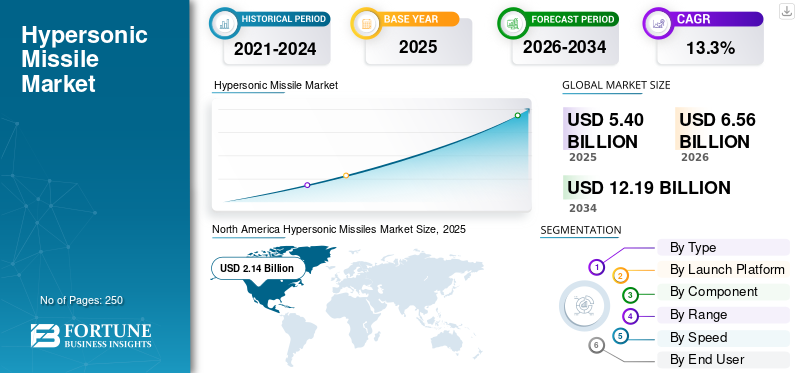
The global hypersonic missiles market size was valued at USD 5.40 billion in 2025. The market is projected to grow from USD 6.56 billion in 2026 to USD 12.19 billion by 2034, exhibiting a CAGR of 13.3% during the forecast period. North America dominated the hypersonic missiles market with a market share of 39.62% in 2025.
Hypersonic missiles, including cruise missiles and ballistic missiles are advanced weapons that travel at speed exceeding Mach 5 (over 6,000 km/h), capable of maneuvering mid-flight to evade defenses, making them harder to intercept than traditional missiles.
The global market is experiencing a strong growth, driven by intensifying geopolitical tensions, accelerated defense modernization initiatives, and the demand for next-generation weapons capable of evading advanced air defenses.
- For instance, in early 2026, The UK Ministry of Defence has awarded a USD 16.01 million contract to Warrington-based Amentum UK, supported by Ebeni and Synthetik, to accelerate hypersonic flight testing and research & design for extreme-speed prototypes missiles.
Lockheed Martin Corporation, Raytheon Technologies Corporation (RTX), Northrop Grumman Corporation, and MBDA are focused on innovations such as scramjet engines for sustained Mach 5+ flight, maneuverable glide vehicles for unpredictable trajectories, and advanced thermal protection systems to withstand extreme heat.
Download Free sample to learn more about this report.
Global Hypersonic Missiles Market KEY TAKEAWAYS
 Market Size & Forecast
- 2025 Market Size: USD 5.40 billion
- 2026 Market Size: USD 6.56 billion
- 2034 Forecast Market Size: USD 12.19 billion
- CAGR: 13.3% from 2026–2034
 Market Share
- North America dominated the global market with a 39.62% share in 2025 and a market value of USD 2.14 billion.
- The hypersonic boost glide weapon segment dominated the market, supported by high speed.
- The land-launched segment held the largest market share in 2025.
 Key Regional Highlights
North America
The region dominated the market with a value of USD 2.14 billion in 2025 and is expected to reach USD 2.56 billion in 2026.
Europe
The market is projected to grow at a CAGR of 13.7% from 2026 to 2034.
Asia Pacific
The market reached USD 1.74 billion in 2025 and is expected to be the fastest-growing regional market.
U.S.
The market reached approximately USD 2.05 billion in 2025.
Japan
The market reached approximately USD 0.33 billion in 2025.
Read More

Impact of Russia Ukraine War
The Russia-Ukraine conflict has significantly accelerated global market expansion by demonstrating real-world operational viability and exposing defensive vulnerabilities. Increased geopolitical tensions prompted major powers to increase R&D investments, elevating market CAGR projections and prioritizing propulsion, thermal management, and maneuverability technologies.
Demand surged for counter-hypersonic defenses alongside offensive parity, driving production scaling, international collaborations, and a shift toward multi-platform integration across land, air, and sea domains.
- For instance, in January 2026, Russia launched its new intermediate-range Oreshnik hypersonic missile during a massive overnight attack on western Ukraine near the EU border, marking its first combat use. The Russian Oreshnik is an intermediate-range ballistic missile (IRBM) with Mach 10 speeds (12,300 km/h), a range of 3,000-5,500 km
HYPERSONIC MISSILES MARKET TRENDS
Sovereign Development Programs In Hypersonic Missiles Emerges as a Defining Market Trend
The market is witnessing a pivotal shift toward accelerated sovereign development programs by major countries. This shift is exemplified by the U.K.’s recent USD 16 million contract awarded in February 2026 to Amentum UK, bolstered by Ebeni and Synthetik for advanced engineering, flight testing, and prototype maturation of hypersonic systems engineered for extreme velocities and thermal regimes. They reflect a collective initiative driven by geopolitical imperatives and defense reviews, prioritizing rapid demonstrator-to-deployment cycles over protracted international dependencies.
MARKET DYNAMICS
MARKET DRIVERS
Download Free sample to learn more about this report.
Escalating Geopolitical Tensions and Rising Defense Budgets to Drive Market Growth
Intensifying geopolitical tensions and surging global defense budgets serve as the major driver propelling the market forward. This is compelling nations to invest heavily in next-generation strategic weapons which is boosting the adoption of such missiles.
The increased rivalries particularly highlight the need for hypersonic systems that deliver high speed, maneuverability, and penetration against advanced air defenses, ensuring credible long-range precision strikes. This is further supported by modernization strategies by defense forces of various countries, such as the U.K.’s Strategic Defence Review, which prioritize sovereign strike capabilities for non-nuclear deterrence. In addition, defense expenditures are being reallocated toward hypersonics, with annual investments fostering research and development and technological advancement and procurement of hypersonic missiles.
- For instance, in January 2026, Japan's 2026 defense budget includes JPY 3.1 billion (USD 19.8 million) for initial hypersonic missile production, advanced from 2031 due to cited regional security concerns, plus JPY 73.2 billion (USD 467 million) for development and JPY 162.6 billion (USD 1.04 billion) for scaling production, as per Ministry of Defense documents.
MARKET RESTRAINTS
High Research, Development, Testing, and Evaluation (RDT&E) Costs to Limit Market Expansion
High Research, Development, Testing, and Evaluation (RDT&E) costs coupled with technical hurdles in materials science and propulsion, represent the foremost restraint impeding scalable proliferation of hypersonic missiles. There are high development costs due to the exigencies of sustaining Mach 5+ velocities, managing plasma-induced blackouts, and engineering composites resilient to temperatures surpassing 2,000°C. These challenges prolong timelines, inflate budgets, and increase program risks and restrain the hypersonic missiles market growth during the forecast period.
MARKET OPPORTUNITIES
Advancements In Scramjet Engines And Enhanced Guidance Systems Presents Growth Opportunities for the Market
Advancement in air-breathing scramjet engines, along with AI-driven guidance and multi-platform integration, creates significant opportunities for defense contractors in the evolving market landscape. These innovations facilitate seamless deployment from air-launched, sea-based, and ground-mobile vectors, aligning with joint all-domain command-and-control architectures for hypersonic weapon systems. The advancements in engines support joint all-domain operations by delivering precision strikes at intercontinental ranges with reduced detectability. Moreover, there is a rise in increased development and testing of advanced engines to enhance national deterrence while fostering industrial partnerships for materials and manufacturing scale-up.
- For instance, in January 2026, India's DRDL, under DRDO, successfully tested an actively-cooled scramjet full-scale combustor at its Hyderabad facility, achieving sustained operation for over 12 minutes.
MARKET CHALLENGES
Guidance, Navigation, and Control (GNC) Integration Poses a Key Market Challenge
A critical market challenge lies in developing robust Guidance, Navigation, And Control (GNC) systems capable of functioning amid plasma sheaths and hypersonic airflow disruptions at Mach 5+. These extreme conditions cause GPS blackouts and communication failures, requiring innovative solutions like advanced Inertial Measurement Units (IMUs), celestial navigation, and AI-driven autonomy for precision targeting over intercontinental ranges. Collaborative international RDT&E efforts are emerging to share data and standardize solutions, yet progress remains incremental due to classified testing limitations.
Segmentation Analysis
By Type
Post-Boost Maneuverability and Air Defense Penetration to Propel Dominance of Hypersonic Boost Glide Weapon
Based on type, the market is divided into hypersonic boost glide weapons, hypersonic cruise missile, and hypersonic ballistic missile.
The hypersonic boost glide weapon segment is expected to lead the global hypersonic weapons market share due to its ability to combine very high speed with post-boost maneuverability, improving penetration against defended air and missile defense environments. This segment is also benefiting from sustained priority in major defense programs, as the U.S. continues to advance LRHW and CPS, while Japan is building out Hyper Velocity Gliding Projectile (HVGP) capabilities and related long-range missile units. In addition, demand is further supported by the requirement to strike time-urgent, hardened, and high-value targets at long distances without relying on traditional ballistic trajectories.
- For instance, in April 2025, The US Army's Long-Range Hypersonic Weapon (LRHW), officially named Dark Eagle completed its first overseas deployment during Exercise Talisman Sabre 25 in Australia last July. This mobile ground-launched boost-glide system, designed to counter A2/AD defenses and high-value targets, exceed Mach 5 speed and 2,775 km range,
Hypersonic ballistic missile segment is anticipated to rise with a fastest CAGR of 12.9% over the forecast period.
By Launch Platform
Mobile and Rapid Deployable Deep-Strike Capabilities Makes Land-launched the Most Preferred Platform
By launch platform, the market is segmented into land-launched, sea-launched, and air-launched.
Land-launched segment held largest share in the global market in 2025 due to rising demand for mobile, distributed, and rapidly deployable deep-strike capabilities. The land-launched segment is expected to witness solid growth due to the increasing preference for mobile, flexible, and ground-based long-range strike systems.
Air-launched segment growth is driven due to their high flexibility and rapid deployment from fighters and bombers. These platforms enable swift responses to threats without fixed infrastructure, integrate easily into existing fleets, and offer extended strategic ranges amid rising geopolitical tensions.
- For instance, in February 2026, Ursa Major, a Colorado-based defense firm, introduced the HAVOC missile system enabling hypersonic strikes from fighter planes, bombers, ground launchers, and even space platforms. This multi-domain weapon enhances U.S. rapid-response military capabilities across air, land, and orbital vectors.
Sea-launched segment is projected to be fastest growing segment with a CAGR of 14.6% over the forecast period.
To know how our report can help streamline your business, Speak to Analyst
By Component
With Its Critical Role in Hypersonic Weapon Development, Propulsion Takes the Leading Position in Component Segment
By component, the market is segmented into propulsion, airframe, thermal protection, and material systems, guidance, navigation, & control, launch & integration, and test, instrumentation & modeling.
Propulsion segment was the leading segment in the market in 2025. The segment is growing significantly in the market as it represents one of the most critical enabling technologies in hypersonic weapon development. Performance at hypersonic speed depends heavily on propulsion efficiency, thermal endurance, fuel management, and stable operation across extreme aerodynamic conditions. The segment is also supported by the broader need to improve range, sustained speed, maneuverability, and operational reliability in future missile systems. In addition, the advancement in manufacturing processes and optimizing machining processes is driving the development of hypersonic propulsion.
- For instance, in February 2026, L3Harris Technologies has used additive manufacturing under the DoD's GAMMA-H program, to reduce production time for airbreathing hypersonic propulsion components by a factor of 10, using optimized 3D printing, robotics, and streamlined processes.
The airframe, thermal protection, and material systems segment is projected to be grow with steady CAGR of 13.7% over the forecast period.
By Range
Medium Range (1,000–3,000 Km) Is The Highest Used Range Type Due To Its Regional Deterrence And Theater Precision Strike Requirements
Based on range, the market is segmented into short-range (less than 1,000 km), medium-range (1,000–3,000 km), intermediate-range (3,000–5,500 km), and long-range (more than 5,500 km).
The medium-range (1,000–3,000 km) segment dominated the market in 2025 as it aligns closely with the operational requirements of regional deterrence and theater-level precision strike missions. This range band provides a practical balance between reach, response time, and deployment feasibility, making it highly relevant for modern conflict environments. The demand for hypersonic missiles with Mach 8-12 speed is increasing for missions involving high-value target engagement, anti-access operations, and stand-off strike
- For instance, in January 2026, India's DRDO unveiled its Long-Range Anti-Ship Missile (LR-AShM) at the Republic Day parade featuring a 1,500 km range and Mach 5+ hypersonic glide vehicle capability. The system employs a two-stage solid rocket booster for quasi-ballistic trajectory with terminal maneuvers to strike static or moving naval targets undetected
Intermediate-range (3,000–5,500 km) segment is expected to grow with a fastest CAGR of 15.5% over the forecast period.
By Speed
Significant Military Value Achieved Through Mach 8-12 Speed is Boosting Its Growth
Based on speed, the market is segmented into Mach 5–8, Mach 8–12, and Mach 12+.
The Mach 8–12 segment held the largest share in market in 2025 owing to need for systems that achieve significant hypersonic performance without imposing disproportionate cost, manufacturing, or sustainment challenges. With this speed band, hypersonic systems can deliver significant military value through reduced reaction times, higher target penetration capability, and improved survivability against defensive interception.
Mach 5–8 segment is projected grow with steady CAGR of 12.4% over the forecast period.
By End User
Land Forces’ Role In Long-Range Precision Strike And Ability To Engage in Critical Targets is Sustaining the Leadership of Army Segment
On basis of end user, the market is segmented into army, navy, and air force.
Army segment is expected to acquire majority share in market. The segment is growing as land forces increasingly expand their role in long-range precision strike and multi-domain combat operations. Hypersonic missiles offer armies the ability to engage critical targets at extended distances while reducing reliance on air and naval platforms for deep-strike missions. This aligns with the broader modernization shift toward mobile land-based fires, dispersed force structures, and rapid-response strike capability.
The navy segment is projected to emerge as the fastest-growing segment with a CAGR of 15.2% over the forecast period.
Hypersonic Missiles Market Regional Outlook
By geography, the market is segmented into North America, Europe, Asia Pacific, and Rest of the World.
North America
North America Hypersonic Missiles Market Size, 2025 (USD Billion)
To get more information on the regional analysis of this market, Download Free sample
North America dominated the market in 2025 with a valuation of USD 2.14 billion, and expected to be growing to USD 2.56 billion by 2026, driven by high defense spending capacity with a deep technology base across weapons development, testing, integration, and subsystem engineering. Regional growth is being driven by sustained emphasis on prompt, survivable, and highly maneuverable strike capabilities that can operate against advanced anti-access and missile defense environments.
U.S Hypersonic Missiles Market
Based on North America’s strong contribution and the U.S. dominance within the region, the U.S. market was approximated at around USD 2.05 billion in 2025. Increased focus on hypersonic development and broader long-range fires modernization, which supports continued investment across both weapon systems and enabling infrastructure drives the growth of the market in U.S.
- For instance, in February 2026, Pentagon awarded the USD 68 million worth contracts through its Joint Hypersonics Transition Office (JHTO) in partnership with Naval Surface Warfare Center Crane Division. JHTO selected the six vendors- Leidos, GoHypersonic, Kratos, Purdue Applied Research Institute, Halo Engines, and Special Aerospace Services under Other Transaction Agreements to advance Mach 5+ maneuverability and propulsion technologies.
Europe
Europe is projected to record a growth rate of 13.7% during 2026 to 2034. The region is expected to witness steady growth as regional defense planning increasingly prioritizes long-range strike, strategic deterrence, and the ability to penetrate sophisticated air and missile defense networks.
The regional market is also being supported by a stronger push for sovereign missile capability, which is encouraging investment in high-speed propulsion, advanced materials, and next-generation airborne strike architectures. In addition, the region’s growth is reinforced by collaboration across missile warning, interception, and broader defense-industrial programs, which strengthens the technological base around hypersonic-related capabilities.
- For instance, in March 2026, UK Defence Minister Luke Pollard and Germany's Jens Plötner agreed to develop a family of stealth cruise and hypersonic weapons exceeding 2,000 km range under the Deep Precision Strike program, part of the 2024 Trinity House Agreement.
U.K. Hypersonic Missiles Market
The U.K. market in 2025 was estimated at around USD 0.13 billion, representing roughly 2.4% of global market revenues.
Germany Hypersonic Missiles Market
Germany market reached approximately USD 0.08 billion in 2025, equivalent to around 1.4%of global market sales.
Asia Pacific
Asia Pacific market reached USD 1.74 billion in 2025. Asia Pacific is expected to be the fastest-growing regional market due to the combination of intense regional security competition, expanding missile arsenals, and rapidly rising defense modernization priorities. The region benefits from strong demand for stand-off strike systems that can support deterrence, maritime security, island defense, and theater-level response in highly contested environments.
- For instance, in September 2025, China displayed the scramjet-powered CJ-1000 hypersonic missile at its Beijing military parade, boasting a range exceeding 3,500 miles sufficient to strike U.S. territory from coastal launch sites.
Japan Hypersonic Missiles Market
The Japan market in 2025 reached around USD 0.33 billion, accounting for roughly 6.2% of global market revenues.
China Hypersonic Missiles Market
China’s market is projected to be one of the largest worldwide, with 2025 revenues reached around USD 0.81 billion, representing roughly 15.0% of market sales.
India Hypersonic Missiles Market
The India market in 2025 reached around USD 0.27 billion, accounting for roughly 5.0% of global market revenues.
Rest of the World
Rest of the World is expected to remain the smallest regional segment, but it still offers selective growth opportunities as missile proliferation concerns and deterrence requirements intensify in parts of the Middle East and other emerging security theaters. The market growth is accelerated by technology partnerships, subsystem work, selective testing, and future acquisition interest tied to long-range strike and defense-penetration requirements.
Middle East & Africa Hypersonic Missiles Market
The Middle East & Africa market in 2025 reached around USD 0.22 billion, accounting for roughly 4.1% of global market revenues.
COMPETITIVE LANDSCAPE
Key Industry Players
Strategic Alliances, Propulsion Innovation, and Rapid Fielding By Prominent Market Players is Driving Their Leadership
The global hypersonic missiles market features intense rivalry among prime defense contractors and specialized propulsion firms delivering boost-glide, cruise, and ballistic systems for strategic deterrence. Leading players like Lockheed Martin, Raytheon, Northrop Grumman, and L3Harris prioritize Common-Hypersonic Glide Body (C-HGB) integration, scramjet/airbreathing advancements, and multi-platform launch compatibility across army, navy, and air force requirements. Focus on additive manufacturing scale-up, thermal protection materials, and digital twin simulations accelerates transition from prototypes to mass production amid U.S., China, Russia, and India operational deployments.
LIST OF KEY HYPERSONIC MISSILES COMPANIES PROFILED
- Lockheed Martin (U.S.)
- Northrop Grumman (U.S.)
- RTX / Raytheon (U.S.)
- L3Harris Technologies (U.S.)
- Leidos (Dynetics) (U.S.)
- General Atomics Electromagnetic Systems (U.S.)
- MBDA (France)
- BAE Systems (U.K.)
- Kratos Defense & Security Solutions (U.S.)
- Nammo (Norway)
- ArianeGroup (France)
- CASIC – China Aerospace Science and Industry Corporation (China)
- Rostec (Russia)
KEY INDUSTRY DEVELOPMENTS
- March 2026: Rocket Lab secured a USD 190 million contract from U.S. Pentagon for 20 hypersonic test flights over four years. The deal leverages Rocket Lab's launch services and spacecraft capabilities for hypersonic experimentation.
- March 2026: Palladyne AI Corp.'s subsidiary GuideTech received a U.S. Navy contract on March 18th, 2026, to develop the Air-Launched Rapid Response Missile (ALRRM), a low-cost, air-launched near-hypersonic weapon. The ALRRM targets over 350 nautical miles range at high altitude, sustained cruise beyond Mach 4.0, and a 150 lb warhead using solid fuel ramjet propulsion.
- November 2025: The U.S. Air Force selected Raytheon Missiles & Defense and Northrop Grumman to produce the Hypersonic Attack Cruise Missile (HACM), incorporating the Southern Cross Integrated Flight Research Experiment in U.S.-Australia collaboration. HACM employs scramjet propulsion for sustained Mach 5+ flight, enabling rapid long-range strikes that challenge adversary defenses.
- October 2024: The U.S. Air Force awarded Raytheon worth USD 73 million contract to expand its manufacturing capacity for the Hypersonic Attack Cruise Missile (HACM) under the Eglin Wide Agile Acquisition Contract, amounting to USD 46 billion for weapons procurement vehicle running through the year 2031.
- January 2024: The U.S. Air Force awarded Raytheon a USD 407.6 million contract modification on December 2023’s project for enhancements to the Hypersonic Attack Cruise Missile (HACM), building on the original development contract of nearly USD 1 billion in 2022.
Request for Customization to gain extensive market insights.
Report Scope & Segmentation
| ATTRIBUTE | DETAILS |
| Study Period | 2021-2034 |
| Base Year | 2025 |
| Estimated Year | 2026 |
| Forecast Period | 2026-2034 |
| Historical Period | 2021-2024 |
| Growth Rate | CAGR of 13.3% from 2026-2034 |
| Unit | Value (USD Billion) |
| Segmentation | By Type, By Launch Platform, By Component, By Range, By Speed, By End User, and Region |
| By Type |
|
| By Launch Platform |
|
| By Component |
|
| By Range |
|
| By Speed |
|
| By End User |
|
| By Region |
|
Frequently Asked Questions
According to Fortune Business Insights, the global market value stood at USD 5.40 billion in 2025 and is projected to reach USD 12.19 billion by 2034.
In 2025, the market value stood at USD 2.14 billion.
The market is expected to exhibit a CAGR of 13.3% during the forecast period.
By launch platform, the land-launched segment is expected to lead the market.
Escalating geopolitical tensions and rising defense budget is driving market expansion.
Escalating geopolitical tensions and rising defense budget is driving market expansion.
North America dominated the market in 2025.



- 2021-2034
- 2025
- 2021-2024
- 250
Get 30-60 hrs Free Customization
Expand Regional and Country Coverage, Segments Analysis, Company Profiles, Competitive Benchmarking, and End-user Insights.




















-
US +1 833 909 2966 ( Toll Free )
-
Get In Touch With Us