AI-Powered Mental Health Chatbot Market Size, Share & Industry Analysis, By Component (Software, Services), By Deployment (Cloud-Based, On-Premise & Hybrid), By Technology (LLMs & NLP, Machine Learning, Deep Learning, Speeh/Voice AI), By Indication (Depression, Anxiety, Stress & Burnout, Substance Use Disorders, Sleep Disorders), By Application (Self-guided Mental Health, Screening & Triage, Crisis Escalation, Care Navigation, Therapy Support/CBT Coaching), By End User (Healthcare Providers, Payers, Employers/EAPs, Direct-to-Consumer/Individuals), and Regional Forecast, 2026-2034
 Download Free Sample
AI-Powered Mental Health Chatbot Market Size and Future Outlook
 Listen to Audio Version
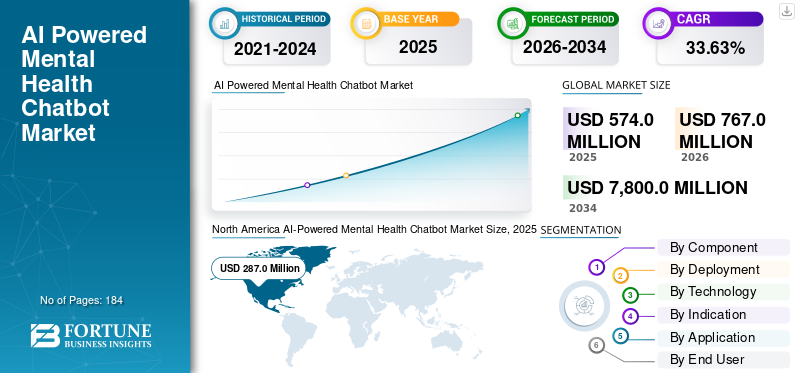
The global AI-powered mental health chatbot market size was valued at USD 574.0 million in 2025. The market is projected to grow from USD 767.0 million in 2026 to USD 7,800.0 million by 2034, exhibiting a CAGR of 33.63% during the forecast period. North America dominated the AI powered mental health chatbot market with a market share of 50% in 2025.
The global market includes software platforms and related services used to support emotional wellbeing, behavioral health screening, self-guided support, care navigation, therapy support, crisis escalation, and between-session mental health engagement. The market is driven by rising demand for accessible mental health support, shortage of therapists and behavioral health professionals, increasing stress, anxiety, depression, burnout, and sleep-related concerns, and growing adoption of digital mental health tools by employers, payers, healthcare providers, and direct-to-consumer users. AI chatbots are increasingly being used to provide 24/7 confidential support, guide users through CBT-based exercises, triage symptoms, route high-risk users to appropriate care, and improve engagement between clinical sessions.
Key market players in the global market consist of Wysa, Limbic, Headspace, and Spring Care Inc. The leadership of these companies is supplemented by conversational AI capabilities, evidence-based CBT and behavioral health content, employer and payer partnerships, clinical triage workflows, privacy-focused design, and safety escalation protocols.
Download Free sample to learn more about this report.
AI Powered Mental Health Chatbot Market Takeaways
 Global Market Size & Forecast
- 2025 Market Size: USD 574.0 million
- 2026 Market Size: USD 767.0 million
- 2034 Forecast Market Size: USD 7,800.0 million
- CAGR: 33.63% (2026–2034)
 Market Share
- North America dominated the AI-powered mental health chatbot market with a market share of 50% in 2025.
- The software segment accounted for the dominant global AI-powered mental health chatbot market share in 2025.
- The cloud-based segment dominated the global market in 2025 and is set to hold a 76.1% share in 2026.
 Key Regional Highlights
North America
The North America market reached USD 220.1 million in 2024 and led the global market. In 2025, the region continued to hold its leading position, with USD 287.0 million.
Europe
The Europe market is anticipated to grow at a CAGR of 32.94% during the forecast period.
Asia Pacific
The Asia Pacific AI-powered mental health chatbot market is expected to reach a valuation of USD 168.7 million by 2026.
U.S.
The U.S. market dominated the North American market and is expected to reach around USD 351.4 million in 2026, accounting for roughly 45.8% of global sales.
Japan
The Japanese market in 2026 is estimated to reach around USD 35.3 million, accounting for roughly 4.6% of global revenues.
Read More

AI-POWERED MENTAL HEALTH CHATBOTS MARKET TRENDS
Growing Adoption of AI-powered Healthcare Applications is a Key Market Trend
Growing adoption of AI-powered healthcare applications is becoming a key trend in the global market, as healthcare providers, payers, employers, and consumers increasingly look for scalable digital tools that can support users beyond traditional clinic hours. Mental health systems are facing rising demand, long wait times, and limited availability of trained professionals, which is encouraging the use of AI chatbots for first-level support, symptom screening, guided self-help, care navigation, and between-session engagement. These tools help users access immediate, private, and low-friction support while allowing clinical teams to focus on higher-risk or more complex cases. As AI applications become more embedded in broader healthcare platforms, mental health chatbots are also shifting from standalone wellness apps to integrated solutions connected with therapy, coaching, medication management, and provider networks. This trend is boosting market growth as AI-powered applications can improve access, reduce administrative burden, personalize support, and help organizations deliver behavioral health services at scale.
- For instance, in June 2025, Wysa launched Wysa Gateway in the U.S., an AI-powered chatbot designed to streamline how therapy providers and health plans facilitate patient access to mental healthcare. The solution supports patient intake and access workflows.
MARKET DYNAMICS
MARKET DRIVERS
Download Free sample to learn more about this report.
Growing Demand for Accessible Digital Therapy Solutions is Driving Market Growth
Rising demand for accessible digital therapy solutions is a major driver for the global market, as many users face long waiting times, high therapy costs, stigma, and limited availability of trained mental health professionals. AI chatbots help reduce these access barriers by offering 24/7 support through mobile apps, web platforms, and employer or payer programs. They are especially useful for early-stage support, mild-to-moderate anxiety, stress, burnout, depression screening, guided CBT exercises, and care navigation. As mental health needs continue to rise, healthcare providers and insurers are adopting chatbot-based tools to manage intake, prioritize users, and route people to the right level of care faster. This improves access for patients while reducing administrative pressure on care teams. Therefore, demand for scalable and lower-friction digital therapy solutions is directly supporting the adoption of AI-powered mental health chatbots.
- For instance, in October 2024, Manah Wellness launched myBuddy, an AI-based multilingual chatbot designed to support employees with mental health concerns. The chatbot uses psychologist-created knowledge resources and aims to provide verified mental wellbeing support for workplace users.
MARKET RESTRAINTS
Data Privacy Concerns Related to Sensitive Mental Health Information to Hamper Market Growth
Data privacy concerns related to sensitive mental health information act as a key restraint for the global AI-powered mental health chatbot market growth, as these platforms often collect highly personal data such as mood patterns, anxiety symptoms, depression indicators, crisis-related conversations, medication history, and therapy preferences. Users may hesitate to share such information if they are unsure how the data is stored, used, shared, or protected. This concern becomes stronger when chatbot platforms use AI models, third-party analytics, cloud hosting, or advertising-linked technologies. For healthcare providers, payers, and employers, privacy risks can slow adoption as mental health data requires strict compliance with HIPAA, GDPR, consent, data minimization, and cybersecurity standards. Any misuse or unclear handling of user data can reduce trust and lead to regulatory scrutiny. Therefore, privacy concerns can limit adoption, especially among vulnerable users and regulated healthcare organizations.
- For example, in April 2024, the U.S. Federal Trade Commission (FTC) began sending refunds under its USD 7.8 million settlement with BetterHelp. FTC has alleged that the company shared consumers’ sensitive mental health information with advertisers despite privacy promises.
MARKET OPPORTUNITIES
Expansion of Mobile-Based Digital Mental Health Systems to Offer Several Growth Opportunities
The growth of mobile-centric digital mental health systems is generating a significant market potential for the worldwide AI-driven mental health chatbot sector, as users show a rising preference for mental health assistance that is accessible via smartphones, applications, and integrated digital platforms. Mobile-based systems facilitate chatbot support, allowing users to access help during times of stress, anxiety, low mood, or sleep issues, without needing to wait for an appointment. This enables businesses to integrate AI chatbots with meditation, journaling, mood monitoring, therapy scheduling, coaching, and care navigation into a single digital platform. As a result, AI chatbots are evolving into gateways to larger mental health platforms rather than independent wellness solutions. This chance is particularly significant for direct-to-consumer users, employers, and health plans seeking scalable, less cumbersome support systems. It further enhances user engagement since mobile apps can offer reminders, tailored prompts, and ongoing support between sessions.
- For instance, in October 2024, Headspace launched Ebb, an empathetic AI companion integrated into the Headspace app to provide instant, personalized support for self-reflection and emotional processing.
MARKET CHALLENGES
Ethical Considerations Regarding AI-driven Emotional Interactions Pose a Prominent Challenge to Market Growth
Ethical issues related to AI-facilitated emotional interactions pose a significant challenge for the global market, as these applications engage with users during vulnerable moments such as anxiety, depression, loneliness, self-harm ideation, or crises. In contrast to human therapists, AI chatbots can misunderstand intentions, generate replies lacking complete clinical context, or foster an illusion of emotional insight. User may develop excessive reliance, receive misguided guidance or fail to fully recognize that they are engaging with software instead of a qualified expert. The issue intensifies when at-risk individuals, such as teenagers or those in distress, depend significantly on chatbot interactions for emotional assistance. Consequently, businesses need to allocate resources toward clinical guardrails, crisis response strategies, protections suitable for various ages, clear disclosures, and human oversight mechanisms. These ethical standards can heighten development complexity and hinder adoption by healthcare providers and regulators.
- For instance, in December 2024, Character.AI faced another lawsuit alleging that its chatbot interactions contributed to mental health harm among teenagers, including anxiety, depression, and self-harm concerns. The case highlighted broader ethical concerns around emotionally engaging AI systems, compulsive user interaction, and the need for stronger safeguards when chatbots interact with vulnerable users.
Segmentation Analysis
By Component
Software Segment Dominated Due to Wider Use of AI Platforms Across Digital Mental Health Workflows
In terms of component, the market is divided into services and software.
The software segment accounted for the dominant global AI-powered mental health chatbot market share in 2025. These software platforms support self-guided mental health support, symptom screening, triage, care navigation, therapy support, mood tracking, journaling, and crisis escalation workflows. Compared with services, software offers higher scalability, as one platform can support large user groups across geographies, indications, and care settings. The segment is also supported by growing integration of AI chatbots with broader behavioral health ecosystems, including coaching, therapy, medication management, provider networks, and employer analytics. As mental health organizations shift toward digital-first and AI-assisted care delivery, software remains the core revenue-generating component in this market.
- For instance, in April 2025, Spring Health unveiled its responsible AI approach across its integrated mental health and workplace wellness platform, including its purpose-built EHR, personalized member app, and real-time employer analytics.
The services segment is anticipated to rise with a CAGR of 29.75% over the forecast period.
To know how our report can help streamline your business, Speak to Analyst
By Deployment
Scalable Access and Faster Rollout Across Digital Mental Health Platforms Led to Cloud-Based Segment Dominance
On the basis of deployment, the market is divided into cloud-based, on-premise, and hybrid.
The cloud-based segment dominated the global market in 2025. Cloud deployment allows users to access support anytime and from any location, which is important for stress, anxiety, burnout, sleep issues, and early emotional support. It also helps companies roll out updates, add new AI features, manage large user volumes, and integrate chatbot tools with therapy, coaching, care navigation, and analytics platforms more efficiently. As mental health support becomes more digital, continuous, and app-based, cloud deployment remains the preferred model for AI chatbot delivery. Furthermore, the segment is set to hold a 76.1% share in 2026.
- For instance, in October 2025, Lyra Health introduced Lyra AI, a clinical-grade AI mental health experience offering 24/7 support through its Lyra Empower platform. The company stated that Lyra AI builds on its integrated AI-powered platform and would support members with mild and moderate challenges such as burnout, sleep, and stress, showing how cloud-based digital platforms are enabling scalable, anytime mental health support.
The hybrid segment is growing at a CAGR of 30.52% over the forecast period.
By Technology
LLMs & Natural Language Processing Segment Dominated Due to Their Central Role in Conversational Mental Health Support
Based on technology, the market is classified into machine learning & deep learning, LLMs & natural language processing, speech/voice AI, and others.
The LLMs & natural language processing segment held the dominating share of the global market in 2025, as AI-powered mental health chatbots mainly depend on understanding user language, intent, tone, and emotional context. These technologies allow chatbots to hold human-like conversations, identify signs of stress, anxiety, low mood, or crisis, and provide relevant responses through guided self-help, CBT-based prompts, journaling, and care navigation. Furthermore, the segment is set to hold a 64.1% share in 2026.
- For instance, in July 2025, Slingshot AI launched Ash, an AI designed for therapy and built on a model for psychology, while also announcing total funding of USD 93 million. The company stated that Ash was developed over 18 months with 50,000 beta users and is available as a free iOS and Android app, showing how LLM-based conversational platforms are becoming central to AI-enabled mental health support.
The machine learning & deep learning segment is anticipated to rise with a CAGR of 31.39% over the forecast period.
By Indication
High Prevalence and Strong Fit with Chatbot-Based Support Boosted Anxiety Disorders Segment Growth
In terms of indication, the market is divided into depression, anxiety disorders, stress & burnout, substance use disorders, sleep disorders, and others.
The anxiety disorders segment captured the highest share of the global market in 2025. This can be attributed to the fact that anxiety is one of the most common mental health concerns addressed through digital and chatbot-based support. The segment is also supported by rising workplace stress, social anxiety, panic-related symptoms, and long waiting times for behavioral health services. As AI chatbots can offer 24/7 support and guide users to higher levels of care when needed, anxiety disorders remain a leading indication in the market. Furthermore, the segment is set to hold a 31.0% share in 2026.
- For instance, in March 2025, Researchers at Dartmouth Geisel School of Medicine reported results from a randomized clinical trial of Therabot, a generative AI mental health chatbot, in users with mental health conditions including generalized anxiety disorder. The study found that participants using the chatbot experienced significant mental health benefits, supporting the use of AI chatbot tools for anxiety-related support and accessible digital care.
The sleep disorders segment is anticipated to rise with a CAGR of 35.99% over the forecast period.
By Application
Self-guided Mental Health Support Segment Dominated as it Help Users Facing Mild To Moderate Issues
On the basis of application, the market is divided into self-guided mental health support, screening & triage, crisis escalation & safety routing, care navigation, therapy support/CBT coaching, and others.
The self-guided mental health support segment captured the highest share of the global market in 2025. Chatbots enhanced by AI are commonly utilized for routine emotional assessments, managing stress, supporting anxiety, tracking mood, providing guided journaling, conducting breathing exercises, and offering coping strategies. This makes the segment extremely scalable among direct-to-consumer users, employers, payers, and digital wellness platforms. In contrast to clinical triage or crisis assistance, self-guided resources have wider applicability as they can help users facing mild to moderate issues and daily emotional difficulties. The segment is bolstered by the adoption of mobile apps, increasing familiarity with conversational AI, and an expanding demand for assistance beyond therapy sessions. Furthermore, the segment is set to hold a 27.9% share in 2026.
- For instance, in November 2025, HelloBetter launched Ello, a personal AI-powered companion for mental and emotional well-being. The company stated that Ello was designed to support people facing everyday challenges such as stress, poor sleep, rumination, and relationship conflicts, showing how AI chatbots are being positioned as self-guided tools for continuous mental health support.
The therapy support/CBT coaching segment is anticipated to rise with a CAGR of 32.71% over the forecast period.
By End User
Rising Use of AI Chatbots for Intake, Triage, and Clinical Workflow Support, Propelled the Healthcare Providers Segment Growth
In terms of end user, the market is segmented into healthcare providers, payers, employers/EAPs, direct-to-consumer/individuals, and others.
In 2025, the healthcare providers segment held the leading position in the global market. The segment’s dominance can be attributed to the high usage of AI-powered mental health chatbots by these end users to manage rising patient demand. These tools help providers automate intake, collect symptom information, support screening, prioritize high-risk users, and guide patients to the right level of care. They also reduce administrative workload for clinicians by handling repetitive pre-assessment and follow-up tasks. The segment is also supported by growing pressure on mental health systems caused by workforce shortages and long waiting lists. Furthermore, the segment is set to hold a 36.0% share in 2026.
- For instance, March 2025, Limbic announced results from a real-world multisite study showing that its generative AI-powered mental health chatbot, Limbic Access, had supported more than 400,000 NHS patients entering care and released over 70,000 clinical hours for NHS services. This shows how healthcare providers are adopting AI chatbot tools to improve access, support triage, and reduce clinical workload in mental health services.
The payers segment is projected to witness 35.96% growth rate during the forecast period.
AI-Powered Mental Health Chatbot Market Regional Outlook
By geography, the market is divided into North America, Latin America, Asia Pacific, Europe, and the Middle East & Africa.
North America
North America AI-Powered Mental Health Chatbot Market Size, 2025 (USD Million)
To get more information on the regional analysis of this market, Download Free sample
The North America market reached USD 220.1 million in 2024 and led the global market. In 2025, the region continued to hold its leading position, with USD 287.0 million. North America is expected to remain a leading region due to high awareness of digital mental health solutions, strong adoption of AI-based healthcare platforms, and rising demand for scalable behavioral health support.
U.S. AI-Powered Mental Health Chatbot Market
The U.S. market dominated the North American market and is expected to reach around USD 351.4 million in 2026, accounting for roughly 45.8% of global sales.
Europe
The Europe market is anticipated to grow at a CAGR of 32.94% during the forecast period. The region is growing due to rising focus on mental health access, workplace wellbeing, and digitally enabled behavioral healthcare. The region also has strong demand for clinically validated and privacy-compliant AI solutions due to strict data protection regulations.
U.K. AI-Powered Mental Health Chatbot Market
The U.K.’s market in 2026 is likely to reach around USD 34.1 million, representing roughly 4.4% of global revenues.
Germany AI-Powered Mental Health Chatbot Market
Germany’s market is projected to reach approximately USD 36.8 million in 2026, equivalent to around 4.8% of global sales.
Asia Pacific
The Asia Pacific AI-powered mental health chatbot market is expected to reach a valuation of USD 168.7 million by 2026. Asia Pacific is expected to register strong growth due to increasing smartphone penetration, expanding digital health ecosystems, and rising awareness of mental health conditions. Additionally, regional growth is also supported by telehealth expansion, employer wellness programs, and rising acceptance of app-based healthcare services.
Japan AI-Powered Mental Health Chatbot Market
The Japanese market in 2026 is estimated to reach around USD 35.3 million, accounting for roughly 4.6% of global revenues.
China AI-Powered Mental Health Chatbot Market
China’s market is projected to reach around USD 56.4 million in 2026, representing roughly 7.4% of global sales.
India AI-Powered Mental Health Chatbot Market
The Indian market in 2026 is estimated to touch around USD 22.0 million, accounting for roughly 2.9% of global revenues.
Latin America and Middle East & Africa
The Middle East & Africa and Latin America regions are likely to witness a slower growth throughout the forecast period. The market in Latin America is projected to attain a valuation of USD 39.2 million in 2026. These regions are gradually emerging as governments, providers, and employers invest in digital health transformation and mental wellbeing programs. Moreover, increasing mental health awareness and expansion of digital healthcare adoption further support market growth.
In the Middle East and Africa region, the GCC market is projected to reach approximately USD 6.6 million in 2026, representing about 0.9% of worldwide revenues.
COMPETITIVE LANDSCAPE
Key Industry Players
Broad Product Offerings Coupled with Emphasis on Collaborations to Support Players’ Market Position
The global AI powered mental health chatbot market reflects a moderately fragmented competitive landscape, consisting of digital mental health companies, AI chatbot developers, virtual care providers, and employer-focused behavioral health platforms. Some of the leading players include Wysa, Limbic, Spring Care Inc., and Headspace Inc. These players are focusing on clinically validated AI models, privacy-focused design, mobile-based access, provider partnerships, employer and payer adoption, and responsible AI frameworks to strengthen trust and market reach.
- For instance, in October 2025, Spring Health and its expert council released VERA-MH, an open-source evaluation framework for validating ethical and responsible AI in mental health, supporting greater transparency and safety standards in the market.
Other prominent players include Sonia Health, Slingshot AI, Koko, and Woebot Health. These companies are also focusing on evidence-based chatbot support, healthcare-provider deployment, and clinical workflow integration to strengthen their market presence.
LIST OF KEY AI-POWERED MENTAL HEALTH CHATBOT COMPANIES PROFILED
- Wysa Ltd. (U.S.)
- Woebot Health (U.S.)
- Limbic (U.S.)
- Cass (U.S.)
- Headspace Inc. (U.S.)
- Spring Care, Inc. (U.S.)
- Koko (U.S.)
- Slingshot AI (U.S.)
- Earkick (U.S.)
- Sonia Health (U.S.)
KEY INDUSTRY DEVELOPMENTS
- March 2026: Limbic announced a Nature Medicine randomized, double-blind study evaluating its clinical reasoning system for AI therapy agents. The study focused on enabling AI agents to deliver CBT at a level rated superior to human clinicians and leading LLMs, strengthening Limbic’s position in evidence-based AI mental healthcare.
- March 2026: Banyan Treatment Centers and HoloMD reported 90-day pilot results for Banyan Companion, an AI-supported monitoring and reporting tool used for early intervention and continuity of care in post-discharge recovery for substance use disorder and co-occurring mental health care.
- March 2025: Wysa announced that it was merging with April Health to combine Wysa’s AI-enabled mental health chatbot with April Health’s primary-care-integrated behavioral health services.
- December 2024: Jimini Health launched with USD 8 million in pre-seed funding to support a clinician-led therapy model augmented by responsible AI.
- November 2024: Rogers Behavioral Health announced a collaboration with Limbic to offer Limbic Access, an AI-powered chatbot that helps prospective patients complete screening and receive next-step guidance as a front door to treatment.
REPORT COVERAGE
The global AI-powered mental health chatbot market analysis encompasses an extensive examination of the market size and projections for all market segments featured in the report. It provides information on the market dynamics and trends that are anticipated to propel the market during the forecast period. It offers insights into crucial elements, such as innovations in products, the regulatory landscape, and the introduction of new products. Furthermore, it outlines collaborations, mergers & acquisitions, along with significant advancements in the industry within the market. The global market forecast report additionally offers a comprehensive competitive landscape with details on market share and profiles of major active participants.
Request for Customization to gain extensive market insights.
Report Scope & Segmentation
| ATTRIBUTE | DETAILS |
| Study Period | 2021-2034 |
| Base Year | 2025 |
| Estimated Year | 2026 |
| Forecast Period | 2026-2034 |
| Historical Period | 2021-2024 |
| Growth Rate | CAGR of 33.63% from 2026-2034 |
| Unit | Value (USD Million) |
| Segmentation | By Component, Deployment, Technology, Indication, Application, End User, and Region |
| By Component |
|
| By Deployment |
|
| By Technology |
|
| By Indication |
|
| By Application |
|
| By End User |
|
| By Region |
|
Frequently Asked Questions
According to Fortune Business Insights, the global market value stood at USD 574.0 million in 2025 and is projected to reach USD 7,800.0 million by 2034.
In 2025, the market value stood at USD 287.0 million.
The market is expected to exhibit a CAGR of 33.63% during the forecast period.
By component, the software segment led the market.
Rising demand for accessible mental health support, shortage of therapists and behavioral health professionals, and growing adoption of digital mental health tools are key factors driving market expansion.
Wysa, Limbic, Spring Care Inc., and Headspace Inc. are some of the top players in the global market.
North America dominated the market in 2025.



- 2021-2034
- 2025
- 2021-2024
- 184
Get 30-60 hrs Free Customization
Expand Regional and Country Coverage, Segments Analysis, Company Profiles, Competitive Benchmarking, and End-user Insights.













.webp)






Related Reports
-
US +1 833 909 2966 ( Toll Free )
-
Get In Touch With Us