Air Quality Control System Market Size, Share & Industry Analysis, By Offering (Equipment, Services, and Software), By Technology (Flue-Gas Desulfurization Systems, Fabric Filtration Systems, Electrostatic Precipitators, and Selective Catalytic Reduction Systems), By Pollutant Type (Particulate Matter, Sulfur Oxides & Acid Gases, Nitrogen Oxides, and VOCs & Hazardous Air Pollutants), By Installation Type (Existing Facilities and New Construction), By End-Use Industry (Power Generation, Metals & Mining, Chemicals & Petrochemicals, and Oil & Gas Processing), and Regional Forecast, 2026-2034
 Download Free Sample
Air Quality Control System Market Size and Future Outlook
 Listen to Audio Version
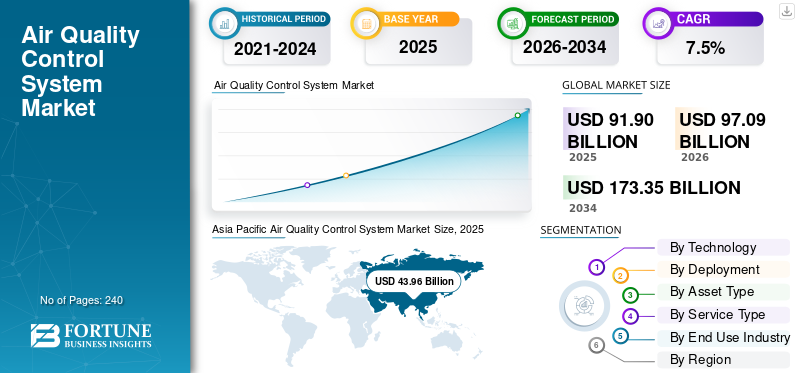
The global air quality control system market size was valued at USD 91.90 billion in 2025. The market is projected to grow from USD 97.09 billion in 2026 to USD 173.35 billion by 2034, exhibiting a CAGR of 7.5% during the forecast period.
The market for air quality control system is comprised of solutions that include hardware, technologies, software, and services to capture, clean, convert, measure, and regulate pollutants produced from processes in the industry and stationary sources of combustion. These systems aim at controlling particulates, sulfur oxides, nitrogen oxides, volatile organic compounds, acid gases, mercury, heavy metals, fumes, and hazardous air pollutants prior to the emission of processed gases into the atmosphere. They assist in compliance with environmental legislation, improving ambient air quality in the workplace and surrounding area, limiting exposure to hazardous air pollutants, ensuring safety in process, and assuring continuous operation of plants.
Moreover, Mitsubishi Heavy Industries, GE Vernova, and Babcock & Wilcox Enterprises dominated the market owing to their wide range of technologies, large installed bases, exceptional project execution, and strong presence in power generation and heavy industries.
Download Free sample to learn more about this report.
AIR QUALITY CONTROL SYSTEM MARKET TRENDS
Rising Use of Integrated Multi-Pollutant Treatment Systems Emerges as a Major Trend
Industries are progressively switching from independently developed systems for pollutant control to integrated air quality control systems which are able to address multiple types of pollutants through one process. In particular, such systems integrate various techniques, including flue gas desulfurization, fabric filters, electrostatic precipitators, selective catalytic reduction, carbon injection, and thermal and catalytic oxidation. Integrated systems assist in reducing the footprint of equipment, simplifying system operation, improving pollutant removal efficiency, and optimizing energy, chemical, residue, and maintenance needs.
- For example, in December 2025, ANDRITZ was commissioned to provide two spray dry absorbers for Units 8 and 9 of the Tennessee Valley Authority’s Shawnee Fossil Plant with the aim to remove multiple acid-gas pollutants.
MARKET DYNAMICS
MARKET DRIVERS
Download Free sample to learn more about this report.
Stringent Limitations on Pollutant-Specific Emission and Monitoring to Boost Market Development
Governments across the globe have been implementing more stringent emission standards, monitoring requirements, and operating permit conditions for large industries. Under the EU Industrial Emissions Directive 2.0, regulated companies are required to implement efficient techniques at least once or twice a year to meet obligatory limitations for different pollutants and to pass inspections.
Strict emission mandates are imposing limits on the emission of nitrogen oxides, volatile organic compounds, and other hazardous compounds. These requirements stimulate the installation of air quality control systems for flue gas desulfurization, SCR, fabric filters, electrostatic precipitators, scrubbers, and continuous emission monitoring. For example, in June 2025, ANDRITZ was ordered to install a new flue-gas cleaning system at the waste-to-energy plant of Technische Betriebe Solingen. The TurboSorp system is supposed to reduce emissions of sulfur oxides, hydrogen chloride, hydrogen fluoride, dioxins, furans, heavy metals, and mercury at the plant.
Market Drivers - Impact & CAGR Contribution (2026–2034)
| Rank | Market Drivers | Expected Impact on Market Growth | Estimated Gross CAGR Contribution | Impact: 2026-2028 | Impact: 2029-2031 | Impact: 2032-2034 |
|---|---|---|---|---|---|---|
| 1 | Stricter industrial emission limits, compulsory monitoring, and stronger enforcement requirements | High | 3.05% | High | High | High |
| 2 | Modernization, replacement, and retrofitting of aging pollution-control infrastructure | High | 2.35% | High | High | Medium |
| 3 | Expansion of emission-intensive industrial capacity across emerging economies | Medium-High | 1.90% | Medium | High | High |
| 4 | Growth of waste-to-energy, hazardous-waste treatment, and industrial incineration facilities | Medium | 1.45% | Medium | High | High |
| 5 | Increasing adoption of continuous emission monitoring, digital optimization, and automated compliance reporting | Medium | 1.10% | Medium | High | High |
| 6 | Others, including carbon-capture pre-treatment, rising health awareness, and integrated multi-pollutant systems | Low | 0.55% | Low | Low | Low |
| Total Gross Growth Contribution | 10.40% | |||||
Source: Fortune Business Insights
MARKET RESTRAINTS
High Capital Investments to Pose Hindrance in Market Expansion
The implementation of air quality control measures involves substantial capital investments for installing several essential components such as control systems, ducting, fans, pumps, reagent delivery systems, and monitoring systems. In addition to this, the capital also includes the cost related to the civil work and commissioning activities. For advanced systems such as multi-pollutant systems, there are also recurring expenses associated with electricity use, catalyst and filter change-out, limestone and lime supply, ammonia injection, waste management, and maintenance. Such costs can hinder the implementation of such technology in small and medium-sized enterprises or old plants with residual working life and low capacity utilization, thereby hampering the air quality control system market growth.
Market Restraints - Impact & Negative CAGR Contribution (2026–2034)
| Rank | Market Restraints | Expected Restraining Impact | Estimated Negative CAGR Contribution | Impact: 2026-2028 | Impact: 2029-2031 | Impact: 2032-2034 |
|---|---|---|---|---|---|---|
| 1 | Uneven environmental regulations, delayed implementation, and inconsistent enforcement across countries | High | -1.10% | High | High | Medium |
| 2 | Macroeconomic volatility and cyclical delays in capital expenditure across heavy industries | Medium-High | -0.80% | High | Medium | Medium |
| 3 | Transition toward cleaner fuels, electrified processes, and inherently lower-emission production technologies | Medium | -0.60% | Low | Medium | High |
| 4 | Others, including geopolitical disruptions, project-permitting delays, and constrained public-sector funding | Low | -0.40% | Low | Low | Low |
| Total Negative CAGR Contribution | -2.90% | |||||
Source: Fortune Business Insights
MARKET OPPORTUNITIES
Expansion of Waste-to-Energy and Incineration Facilities to Create New Market Opportunities
Growing municipal and industrial waste volumes, limited landfill availability, and increasing emphasis on circular waste management are encouraging investment in waste-to-energy and incineration facilities. These plants generate complex flue-gas streams containing particulate matter, nitrogen oxides, sulfur oxides, hydrogen chloride, mercury, heavy metals, dioxins, and furans. Consequently, they require multi-stage air quality control systems combining SCR or SNCR, acid-gas scrubbers, activated-carbon injection, fabric filters, and emission-monitoring systems. Expansion of new waste-to-energy capacity, together with the modernization of aging incineration plants, is therefore creating substantial opportunities for AQCS equipment, engineering, aftermarket services, and digital-monitoring providers.
- For instance, in July 2026, according to the report published by Maha Sarakham Provincial Energy Office, the Maha Sarakham waste-to-energy plant in Thailand is working at full capacity with Babcock & Wilcox’s environmental technologies including adaptive SNCR (Selective Non-Catalytic Reduction) technology to reduce nitrogen oxides.
MARKET CHALLENGES
Technical Difficulties in Implementation to Restrict Market Expansion
The process of incorporating these systems into existing industrial plants poses a high level of technical difficulty owing to lack of adequate space for installation, aged infrastructure, short shutdown time, as well as variation in fuel quality, gas temperature, pressure, volume, and pollutant concentration. Faulty design and commissioning of the systems can result in higher pressure losses, higher power usage, corrosion, equipment fouling, maintenance cost, and unexpected shut downs. Consequently, the need for engineering customized to specific plants leads to increased project costs and timelines, reducing capacity of suppliers to scale their solutions.
Segmentation Analysis
By Technology
Flue-Gas Desulfurization Systems Segment Led Owing to Their Broad Industrial Adoption
Based on technology, the market is segmented into flue-gas desulfurization systems, fabric filtration systems, electrostatic precipitators, selective catalytic reduction systems, and other air pollution control systems.
In 2025, the flue-gas desulfurization systems market segment held the largest position accounting to 28.3% market share due to wide-scale use of these systems in coal-fired power stations, refineries, metal processing plants, chemical plants, and industrial boilers. These systems eliminate the emissions of sulfur dioxide and acid gases emitted due to burning of coal, petroleum coke, fuel oil, and sulfur-containing feeds.
Selective catalytic reduction systems segment is expected to grow at the CAGR of 8.2% from 2026-2034, due to increasingly stringent nitrogen oxide emission norms from power plants, gas turbines, cement kilns, refineries and waste-to-energy plants. High NOx removal efficiency, increase in gas-fired power generation capacity, retrofits, and multi-pollutant control system installations are some factors driving segment growth.
By Offering
Equipment Segment Led Owing to the Mandatory Physical Emission-Control Needs
By offering, the market is segmented into equipment, services, and software.
The equipment segment dominated the market with 62.5% share in 2025 as industrial plants need physical air pollution monitoring systems to filter out and neutralize hazardous air pollutants prior to release of flue gases into the environment. Flue-gas desulfurization systems, fabric filters, electrostatic precipitators, selective catalytic reduction systems, scrubbers, and oxidizers represent the key equipment that forms the backbone of this industry for compliance purposes. The growing usage of these equipment in power plants, metals and mining plants, cement plants, chemical plants, oil & gas production plants, waste management plants, and pulp & paper plants drives their demand. Furthermore, every installation consists of several pieces of ancillary equipment, such as reactors, filters, catalysts, fans, pumps, ductwork, reagent feeders, and sensors.
The software segment is estimated grow at the fastest CAGR of 8.7% from 2026 to 2034 due to rising need for continuous emission monitoring, automated compliance reporting, remote monitoring of systems, and optimal working of the air quality control system. Data is gathered and analyzed through software that uses emissions monitors, continuous monitoring system, scrubber, filter, precipitator, and catalyst reduction unit. Through this, any abnormality can be detected at the earliest possible stage.
By Pollutant Type
Particulate Matter Dominated Owing to Broad Variety of Particulates Generation
On the basis of pollutant type, the market is segmented into particulate matter, sulfur oxides and acid gases, nitrogen oxides, volatile organic compounds and hazardous air pollutants, and others.
Particulate matter held the largest air quality control systems market share accounting for 32% in 2025, owing to the broad generation of particulates at power plants, cement kilns, metals industries, mining sites, pulp and paper mills, waste treatment sites, and other industrial activities. Particulates such as dust, fly ash, soot, fumes, and fines are generated during combustion, crushing, grinding, handling, and processing. Hence, there is an extensive installation of fabric filters and electrostatic precipitators in both large and small industrial facilities.
Volatile organic compounds & hazardous air pollutants is projected to witness the highest CAGR of 8.7% during 2026 to 2034 due to rising regulation of toxic and carcinogens emissions from refineries, chemical industries, pharmaceutical manufacturing, coatings applications, semiconductor industries, and waste treatment industries. Increasing use of regenerative thermal oxidizers, catalytic oxidizers, adsorption systems, activated carbon units, and leak detection systems is contributing to the segment growth.
By Installation Type
Existing Facilities Segment Dominated Owing to Increasing Number of Emission-Intensive Industrial Activities
On the basis of installation type, the market is segmented into existing facilities and new construction.
The existing facilities segment dominated the market on account of the high emission-intensive industrial activities. The aging pollution-control equipment, stringent emission norms, and the need to enhance the efficiency of removal systems have been making operators invest in the upgradation, replacement, and renovation of their current systems of FGD systems, fabric filters, electrostatic precipitators, SCR systems, scrubbers, and monitoring devices.
The new construction segment is estimated to show the fastest CAGR of 8.2% from 2026 to 2034, owing to the growth in the capacities of industries, urbanization, infrastructural development, and new waste-to-energy, metals, cement, chemical, and manufacturing plants in emerging economies.
By End Use Industry
To know how our report can help streamline your business, Speak to Analyst
Power Generation Segment Led Owing to Large Flue-Gas Volumes and Extensive Pollution-Control Requirements
On the basis of end use industry, the market is segmented into power generation, metals & mining, non-metallic mineral, chemicals & petrochemicals, oil & gas, waste management, pulp & paper, and other industries.
The power generation segment dominated the market by accounting for 27.13% in 2025. The growth of this segment is mainly attributed to high flue gas production in coal-based, oil-based, biomass-based, and gas-based power plants. This application needs multiple air quality control systems like flue gas desulfurization system, electrostatic precipitator, fabric filter, selective catalytic reduction, and continuous emission monitoring system. High installation base of thermal power plant, need for retrofits, and replacement of the equipment, catalysts, and maintenance are additional factors boosting the segment’s dominance.
Waste management is forecast to witness the highest CAGR of 8.9% during the forecast period owing to increased investments in waste-to-energy plants, municipal solid waste incinerators, hazardous waste treatment plants, and sewage sludge combustion plants. Plants in this sector produce flue gases. Increasing waste generation, shortage of landfills, and energy generation from waste are also some of the other factors driving the demand in the waste management sector.
Air Quality Control System Market Regional Outlook
Based on geography, the market is classified into North America, Europe, Asia Pacific, South America, and the Middle East & Africa.
North America
Asia Pacific Air Quality Control System Market Size, 2025 (USD Billion)
To get more information on the regional analysis of this market, Download Free sample
In 2026, the North America market is expected to reach USD 20.10 billion, ranking second globally. The growth of the North American market is primarily attributed to the modernization of aging pollution control systems. Power plants, refineries, chemical plants, pulp and paper mills, metal processing plants, and industrial boilers are upgrading their existing scrubbers, precipitators, fabric filters, and NOX control systems to stay compliant and improve efficiency. In addition, the market demand is leaning toward the continuous emission monitoring, predictive maintenance, automated reporting, catalyst replacement, and life cycle services. Hence, the large installed base of the region and the major focus on plant reliability create ample opportunities for retrofitting, aftermarket services, and software application needs.
U.S. Air Quality Control System Market
In 2026, the market in U.S. is projected to reach USD 16.63 billion, accounting for approximately 17.12% of global revenues.
Europe
Europe is projected to record a 7.6% growth rate during the forecast period, the second-highest globally, reaching USD 19.14 billion in 2026. The market in Europe is witnessing growth owing to the presence of stringent emission norms and the acceptance of the newest methods in waste-to-energy, cement, chemicals, metals, and pulp and paper industries. Moreover, there is a growing trend of replacing old pollution-control systems with new generation multi-pollutant systems that efficiently eliminate a variety of pollutants, such as particulate matter, nitrogen oxides, sulfur oxides, and others. In addition, the rise and modernization of waste-to-energy and municipal waste incineration facilities has contributed to the demand for fabric filters, scrubbers, and various other systems used in air quality control systems.
U.K. Air Quality Control System Market
The market in U.K. is expected to reach USD 3.29 billion in 2026, accounting for 3.39% of global revenues.
Germany Air Quality Control System Market
The market in Germany is projected to reach USD 3.89 billion in 2026, accounting for approximately 4.01% of global revenues.
France Air Quality Control System Market
The market in France market is projected to reach USD 2.60 billion in 2026, accounting for approximately 2.68% of global revenues.
Asia Pacific
Asia Pacific accounted for the largest air quality control system market share in 2025, valued at USD 43.96 billion and is expected to maintain its dominance in coming years. Growth in the Asia Pacific market can be attributed mainly to the rise in power-generation and emission-intensive industries in China, India, Indonesia, Vietnam, and other developing economies. The increase in demand for electricity, steel and precious metals production, cement production, chemical processing, and waste-to-energy has resulted in the mounting number of industries that need control systems for particulate matter, sulfur oxide, nitrogen oxide, and acid gas emission. China has developed a massive industry base which will lead to retrofitting and renewal needs for control systems, while the contribution from India and Southeast Asia will be made in the form of additional capacity for power and manufacturing. Rapid urbanization and deteriorating industrial air quality is prompting governments to ramp up their emission monitoring and increase control efficiency levels.
China Air Quality Control System Market
The market in China is expected to reach nearly USD 21.64 billion in 2026, accounting for 22.28% of global revenues.
Japan Air Quality Control System Market
The market in Japan is projected to reach USD 4.38 billion in 2026, accounting for 4.51% of global revenues.
India Air Quality Control System Market
The market in India is projected to reach USD 9.64 billion in 2026, accounting for 9.93% of global revenues.
South America and Middle East & Africa
Both South America and the Middle East & Africa are expected to grow moderately in the coming years. The South America market is predicted to reach USD 6.55 billion in 2026. The market is growing owing to ongoing processes such as mining, metallurgy, cement, oil and gas, petrochemical sectors, power generating process, and waste management processes in many parts of the world. In South America, growth is mainly driven by the mining and mineral processing, especially in Brazil, Chile, and Peru, as well as the improvement in cement, pulp and paper, and industrial boiler production. In the Middle East and Africa new refinery, petrochemical, metal, cement, and power generation projects are emerging, especially in Saudi Arabia, UAE, Turkey, South Africa and Egypt.
GCC Air Quality Control System Market
In 2026, the market in GCC is expected to reach USD 2.52 billion, accounting for 2.60% of total revenues.
COMPETITIVE LANDSCAPE
Key Industry Players
Integrated Pollution-Control Portfolios, Retrofit Capabilities, and Well-Established Presence to Strengthen the Market Position of Prominent Players
The market for air quality control systems was dominated in 2025 by Mitsubishi Heavy Industries Ltd./Mitsubishi Power, G.E. Vernova Inc. and Babcock & Wilcox Enterprises, Inc. Their commanding presence is attributed to their large product line of flue-gas desulfurization and particulate-control systems, nitrogen oxide-control systems and multi-pollutant systems, as well as their exceptional engineering skills, large installed base, and established brand. In addition, ANDRITZ AG, Valmet Oyj, Thermax Limited, CECO Environmental Corp., Fujian Longking Co., Ltd., Donaldson Company, Inc. and KC Cottrell Co., Ltd. are working on the development of cutting-edge technology portfolios, partnership agreements, and acquisitions.
LIST OF KEY AIR QUALITY CONTROL SYSTEM COMPANIES PROFILED
- Mitsubishi Heavy Industries Ltd./Mitsubishi Power (Japan)
- GE Vernova Inc. (U.S.)
- Babcock & Wilcox Enterprises, Inc. (U.S.)
- ANDRITZ AG (Austria)
- Valmet Oyj (Finland)
- Thermax Limited (India)
- CECO Environmental Corp. (U.S.)
- Fujian Longking Co., Ltd. (China)
- Donaldson Company, Inc. (U.S.)
- KC Cottrell Co., Ltd. (South Korea)
KEY INDUSTRY DEVELOPMENTS
- June 2026: CECO Environmental Corp. completed its strategic acquisition of Thermon Group Holdings, expanding its global platform across industrial air quality, emissions control, environmental monitoring, and thermal-management solutions.
- January 2026: Fujian Longking Co., Ltd. collaborated with Xiamen University of Technology to advance large-scale fluidized-bed purification reactors and coordinated multi-tower systems for energy-efficient, ultra-low-emission industrial flue-gas treatment.
- June 2025: Valmet Oyj introduced a new carbon-capture pre-treatment solution combining a condensing flue-gas scrubber and wet electrostatic precipitator to clean and condition industrial flue gases before carbon capture.
- February 2025: Fujian Longking Co., Ltd. introduced AI-enabled air-pollution-control technologies, including a smart environmental-island control system, intelligent high-voltage controls for electrostatic precipitators, and an intelligent dry flue-gas purification system.
- February 2025: ANDRITZ AG acquired LDX Solutions, adding wet electrostatic precipitators, regenerative thermal oxidizers, fabric filters, scrubbers, and related services while expanding its clean-air technology presence in North America.
REPORT COVERAGE
The air quality control system market report provides a detailed assessment of all market segments, highlighting key drivers, trends, opportunities, restraints, and challenges shaping industry growth. It also covers technological advancements, major industry developments, market share analysis, and comprehesnsive profiles of leading companies.
Request for Customization to gain extensive market insights.
Report Scope & Segmentation
| ATTRIBUTE | DETAILS |
| Study Period | 2021-2034 |
| Base Year | 2025 |
| Estimated Year | 2026 |
| Forecast Period | 2026-2034 |
| Historical Period | 2021-2024 |
| Growth Rate | CAGR of 7.5% from 2026 to 2034 |
| Unit | Value (USD Billion) |
| Segmentation | By Offering, Technology, Pollutant Type, Installation Type, End Use Industry, and Region |
| By Technology |
|
| By Offering |
|
| By Pollutant Type |
|
| By Installation Type |
|
| By End Use Industry |
|
| By Region |
|
Frequently Asked Questions
Fortune Business Insights says that the global market value stood at USD 91.90 billion in 2025 and is projected to reach USD 173.35 billion by 2034.
In 2025, the market value of Asia Pacific stood at USD 43.96 billion.
The market is expected to grow at a CAGR of 7.5% over the forecast period.
Power generation segment led the market by end use industry.
Stringent industrial emission regulations, increasing modernization of aging pollution-control infrastructure, and growing demand for continuous emission monitoring and multi-pollutant control systems are driving market growth.
Mitsubishi Heavy Industries Ltd./Mitsubishi Power, GE Vernova Inc., and Babcock & Wilcox Enterprises, Inc. are among the prominent players in the market.
Asia Pacific dominated the market in 2025.



- 2021-2034
- 2025
- 2021-2024
- 240
Get 30-60 hrs Free Customization
Expand Regional and Country Coverage, Segments Analysis, Company Profiles, Competitive Benchmarking, and End-user Insights.















Related Reports
-
US +1 833 909 2966 ( Toll Free )
-
Get In Touch With Us