Aircraft Electric Taxiing System Market Size, Share & Industry Analysis, By System Type (Main Landing Gear Taxiing System, Nose Landing Gear Taxiing System, and Wheel-Drive Taxiing System), By Component (Electric Motors, Power Electronics & Inverters, and Control Units), By Aircraft Type (Narrow-Body Aircraft, Regional Aircraft, and Wide-Body Aircraft), By Power Source (APU Powered, Battery Powered, and Hybrid APU-Battery Powered), By Fitment (Line-Fit / OEM and Retrofit Installation), By End User (Commercial Airlines, Cargo Airlines, and Aircraft OEMs), and Regional Forecast, 2026-2034
 Download Free Sample
Aircraft Electric Taxiing System Market Size and Future Outlook
 Listen to Audio Version
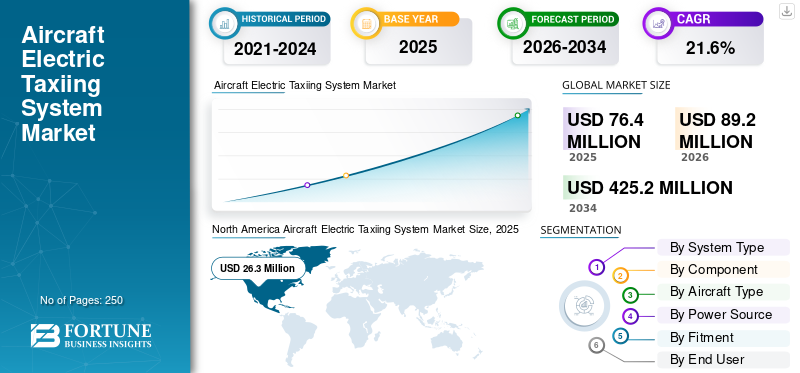
The global aircraft electric taxiing system market size was valued at USD 76.4 million in 2025. The market is projected to grow from USD 89.2 million in 2026 to USD 425.2 million by 2034, exhibiting a CAGR of 21.6% during the forecast period. North America dominated the aircraft electric taxiing system market with a market share of 34.42% in 2025.
The aircraft electric taxiing systems comprise onboard and external engine-off taxiing technologies that enable aircraft to move on the ground with reduced or no use of their main engines. These systems support safer, cleaner, and more fuel-efficient aircraft operations across airport aprons, taxiways, gate areas, and runway holding positions. Aircraft electric taxiing solutions are primarily designed for narrow-body aircraft, regional aircraft, wide-body aircraft, business jets, and military or special mission aircraft, enabling commercial airlines, cargo airlines, aircraft OEMs, leasing companies, and MRO providers to reduce taxi fuel burn, lower emissions, minimize engine wear, reduce ground noise, and improve operational efficiency during taxi-in, taxi-out, pushback, and aircraft repositioning operations.
Key industry players such as Safran Landing Systems SAS, WheelTug plc, and Green Taxi Solutions, Inc. are developing advanced taxiing solutions that include main landing gear electric taxiing systems, nose landing gear electric taxiing systems, onboard wheel-drive electric taxiing systems, taxiing assistance systems, and external semi-robotic taxiing systems. These solutions integrate electric motors, power electronics and inverters, control units and software, wheel drive and gear assemblies, cockpit interfaces, sensors, and electrical wiring harnesses to improve the efficiency of aircraft ground operations.
Download Free sample to learn more about this report.
AIRCRAFT ELECTRIC TAXIING SYSTEM MARKET TRENDS
Shift Toward Engine-Off Taxiing and Sustainable Airport Ground Operations is Emerging as a Key Market Trend
The market is witnessing a clear shift from conventional main-engine taxiing toward engine-off taxiing, semi-robotic taxiing, and aircraft-installed electric taxiing systems. Airlines, airports, aircraft OEMs, and electric ground handling operators are increasingly evaluating these systems to reduce fuel burn, apron emissions, noise, and engine wear during taxi-in and taxi-out operations. This trend is particularly evident at congested airports where long taxi distances, sustainability targets, and high aircraft movements create a stronger operating case for TaxiBot-type systems and onboard electric taxiing solutions.
- For instance, in July 2025, Airbus stated that TaxiBot trials were active at Amsterdam Airport Schiphol, New York John F. Kennedy International Airport, Indira Gandhi International Airport, Paris Charles de Gaulle Airport, and Brussels Airport. Airbus also confirmed that retrofit modifications for its single-aisle aircraft had been certified and made available to customers.
This trend is expected to increase demand for external semi-robotic taxiing systems, onboard wheel-drive electric taxiing systems, aircraft retrofit kits, control units, power electronics, cockpit interfaces, and airport integration services. Electric taxiing will become more closely linked with airport decarbonization programs, airline fuel-saving initiatives, ground-emission reduction targets, and next-generation aircraft efficiency strategies over the forecast period.
MARKET DYNAMICS
MARKET DRIVERS
Download Free sample to learn more about this report.
Rising Need to Reduce Taxi Fuel Burn, CO₂ Emissions, and Airport Noise is Propelling Market Growth
The market is being driven by the need to reduce unnecessary fuel burn during aircraft ground movement. Aircraft engines consume fuel even when the aircraft is moving slowly between the gate and runway, and this creates avoidable CO₂, NOx, ultrafine particle emissions, noise, and maintenance burden. Electric taxiing systems address these issues by allowing aircraft to taxi with their main engines switched off or operating at reduced power, making them an attractive option for airlines and airports focused on operating-cost reduction and sustainability compliance.
This driver is expected to support demand from commercial passenger airlines, airport operators, aircraft OEMs, MRO providers, and leasing companies. Demand will remain strong for narrow-body aircraft, especially the Airbus A320 and Boeing 737 families, as these aircraft operate high-frequency short- and medium-haul routes where repeated taxi cycles provide greater opportunities for fuel savings and emission reductions.
MARKET RESTRAINTS
Certification Complexity and Airport Infrastructure Readiness to Limit Market Expansion
A key restraint for the market is the complex certification process and airport infrastructure readiness required for electric taxiing adoption. Unlike standard ground support equipment, aircraft electric taxiing systems interact directly with aircraft landing gear, braking, steering, avionics, cockpit controls, airport taxi procedures, ground-handling operations, and air traffic coordination. This creates a need for stringent approval and slows near-term adoption, especially at airports that lack suitable taxi routes, designated uncoupling points, markings, driver training, and operational procedures.
This restraint is likely to slow large-scale adoption, particularly at airports with constrained apron layouts, complex taxiway networks, limited ground-handling capacity, or mixed aircraft fleets. The market will remain difficult for suppliers that cannot support aircraft certification, fleet-specific integration, airport procedure redesign, operator training, and long-term maintenance services.
MARKET OPPORTUNITIES
Retrofit and Existing Fleet Conversion Present Several Growth Opportunities
A major opportunity lies in the expansion of retrofit-ready electric taxiing systems for existing aircraft fleets. This creates opportunities for system developers, MRO providers, certification specialists, landing gear suppliers, power electronics companies, and aircraft OEMs to support retrofit kits, software updates, wiring modifications, cockpit interfaces, and supplemental type certification programs.
- For instance, in June 2025, Green Taxi Solutions and StandardAero announced a partnership to certify Green Taxi’s Zero Engine Taxi system, supported by a USD 5.6 million FAA Continuous Lower Energy, Emissions, and Noise (CLEEN) program.
The system allows aircraft to taxi using the aircraft power unit (APU) instead of the main engines and is positioned as a retrofit-ready solution that can reduce fuel burn, emissions, brake wear, noise, and turnaround time without requiring major airport infrastructure changes. This opportunity is expected to increase demand for aircraft-installed electric taxiing systems, modular retrofit installations, power electronics, electric motors, control software, aircraft wiring updates, certification services, and MRO-led installation programs.
MARKET CHALLENGES
Operational Integration and Multi-stake Coordination Challenge Large Scale Deployment
A major challenge for the market is integrating electric taxiing technologies into live airport operations without disrupting turnaround times, runway sequencing, aircraft dispatch, or safety procedures. Electric taxiing represents more than a technology upgrade; it requires close coordination among pilots, tug drivers, ground handlers, air traffic control, airport operations teams, airlines, and aircraft maintenance teams.
This challenge is expected to remain significant as the market transitions from pilot programs to repeatable commercial deployment. Electric taxiing suppliers must demonstrate fuel-saving performance, operational reliability, compatibility with different aircraft platforms, turnaround-time efficiency, pilot acceptance, ground-handler readiness, ATC coordination, and seamless integration with airport infrastructure.
Segmentation Analysis
By System Type
External Semi-Robotic Taxiing System Segment Dominated due to Lower Adoption Barriers
Based on system type, the market is divided into main landing gear electric taxiing system, nose landing gear electric taxiing system, onboard wheel-drive electric taxiing system, and external semi-robotic taxiing system.
The external semi-robotic taxiing system segment held a leading aircraft electric taxiing system market share in 2025, as TaxiBot-type systems were the most commercially established and operationally proven electric taxiing solution. These systems allow aircraft to move between the gate, taxiway, and runway holding point with reduced main-engine usage while maintaining for pilots to retain full control through standard cockpit inputs. Their dominance is supported by lower near-term adoption barriers compared with fully onboard electric taxiing systems, as external systems can be deployed through airport-level programs, airline partnerships, and limited aircraft interface modifications.
The main landing gear electric taxiing system segment is anticipated to grow at a CAGR of 22.7% over the forecast period.
By Component
Wheel Drive/Gear Assembly Segment Led due to Landing Gear Interface and High-Torque Taxiing Load Requirements
Based on component, the market is divided into electric motors, power electronics & inverters, control units & software, wheel drive/gear assembly, cockpit interface & sensors, wiring & electrical harnesses, and others.
The wheel drive/gear assembly segment held a leading share of the market in 2025, as electric taxiing depends heavily on the mechanical interface between the aircraft wheels, landing gear, drive assembly, and ground movement system. In both onboard and external electric taxiing systems, the wheel-drive structure must support high aircraft loads, controlled torque transfer, braking coordination, steering response, and safe maneuvering during taxi-in and taxi-out operations.
- For instance, in April 2023, Air India signed an agreement with KSU Aviation to launch TaxiBot operations at Delhi and Bengaluru airports for Airbus A320-family aircraft.
The power electronics & inverters segment is anticipated to grow at a CAGR of 25.0% over the forecast period.
By Aircraft Type
Narrow-Body Aircraft Segment Led due to Frequent Short-Haul Operations and High Compatibility with Leading Aircraft Families
Based on aircraft type, the market is divided into narrow-body aircraft, regional aircraft, wide-body aircraft, business jets, and military & special mission aircraft.
The narrow-body aircraft segment held a leading market share in 2025 due to the strong compatibility of electric taxiing systems with Airbus A320-family and Boeing 737-family operations. Narrow-body aircraft operate high-frequency short- and medium-haul routes, where repeated taxi cycles create stronger opportunities for fuel savings, engine-wear reduction, reduced aircraft emissions, and improved ground operation efficiency.
The regional aircraft segment is anticipated to grow at a CAGR of 20.5% over the forecast period.
By Power Source
Auxiliary Power Unit Powered Segment Led due to Utilization of Existing Aircraft Electrical Architecture
Based on power source, the market is divided into auxiliary power unit powered, aircraft battery powered, and hybrid APU-battery powered.
The auxiliary power unit powered segment held the largest market share in 2025, as APU-powered taxiing utilizes the aircraft’s existing electrical architecture while keeping the main engines shut down during ground movement. This power-source approach is attractive for airlines as it reduces fuel burn, engine usage, emissions, and apron noise without requiring a full battery-electric aircraft architecture. It is especially relevant for near-term adoption across existing commercial aircraft fleets.
The aircraft battery powered segment is anticipated to grow at a CAGR of 23.9% over the forecast period.
To know how our report can help streamline your business, Speak to Analyst
By Fitment
Retrofit Installation Segment Dominated, Driven by Strong Demand from Existing Aircraft Fleet and Certified Modification Availability
Based on fitment, the market is divided into line-fit/OEM installation, retrofit installation, and modular retrofit installation.
The retrofit installation segment held a leading share of the market in 2025, as the near-term market opportunity is concentrated in existing aircraft fleets rather than new aircraft line-fit programs. Airlines and airports are increasingly evaluating electric taxiing solutions through retrofit kits, avionics modifications, wiring updates, cockpit interface integration, and airport operating procedures.
The line-fit/OEM installation segment is anticipated to grow at a CAGR of 24.0% over the forecast period.
By End User
Commercial Passenger Airlines Segment Dominated due to Significant Fuel Savings and High Daily Taxi Cycles
Based on end user, the market is divided into commercial passenger airlines, cargo airlines, aircraft OEMs, leasing companies, and MRO providers.
The commercial passenger airlines segment held a leading share of the market in 2025, as airlines are the primary beneficiaries of lower taxi fuel consumption, reduced engine wear, lower emissions, improved turnaround efficiency, and reduced dependency on conventional pushback operations. Commercial passenger airlines operate large narrow-body fleets with frequent daily flight cycles, making electric taxiing economically more attractive than for lower-utilization aircraft categories.
- For instance, in October 2025, WheelTug and Aipron Consulting announced a partnership to develop data-driven business cases for airlines and airports, supporting aircraft energy efficiency, CO₂ emission reduction, and ground-handling safety.
The aircraft OEMs segment is anticipated to grow at a CAGR of 24.8% over the forecast period.
Aircraft Electric Taxiing System Market Regional Outlook
By geography, the market is segmented into North America, Europe, Asia Pacific, and Rest of the World.
North America
North America Aircraft Electric Taxiing System Market Size, 2025 (USD Million)
To get more information on the regional analysis of this market, Download Free sample
North America dominated the market in 2025, with a valuation of USD 26.3 million, and is projected to reach USD 30.7 million in 2026. Aircraft electric taxiing system market growth is supported by the development of aircraft-installed electric taxiing, FAA-backed certification initiatives, strong MRO capabilities, and the presence of aerospace engineering and certification partners. North America is especially important for onboard electric taxiing systems, autonomous taxiing technology, nose landing gear electric taxiing concepts, APU-powered taxiing architectures, and retrofit certification programs.
U.S. Aircraft Electric Taxiing System Market
Based on North America’s strong contribution and the U.S. dominance within the region, the U.S. market stood at around USD 23.9 million in 2025. The U.S. held the largest share within North America due to FAA-backed technology development, StandardAero’s certification role, green aviation solutions, WheelTug-related development activity, and a large base of commercial airlines, aircraft lessors, MRO providers, and airport operators. Demand is expected to remain concentrated in onboard electric taxiing systems, retrofit installation, control units, power electronics, aircraft wiring integration, and certification-led deployments for narrow-body and regional aircraft.
Europe
Europe holds the second-largest share of the market due to extensive TaxiBot trial activities, Airbus single-aisle retrofit readiness, Safran’s eTAXI positioning, and major airport sustainability programs across Schiphol Airport, Paris Charles de Gaulle Airport, Brussels Airport, and other leading European aviation hubs. The region has emerged as an early adopter of external semi-robotic taxiing systems, retrofit installations, cockpit interface modifications, and airport-level engine-off taxiing procedures. Market demand is mainly supported by extensive narrow-body aircraft operations, airline fuel-saving programs, airport emissions reduction targets, and the EU’s continued focus on sustainable aviation technologies.
U.K. Aircraft Electric Taxiing System Market
The U.K. market stood at around USD 2.8 million in 2025, representing roughly 3.7% of global revenues.
Germany Aircraft Electric Taxiing System Market
Germany’s market was valued at USD 5.5 million in 2025, equivalent to around 7.2% of global sales.
Asia Pacific
Asia Pacific is projected to record the fastest growth in the market, supported by fleet expansion, aircraft production localization, engine MRO investments, growing airline maintenance requirements, and defense aerospace manufacturing in China, India, Japan, South Korea, and Southeast Asia. The region is expected to witness increasing adoption of line maintenance tools, base maintenance tooling, engine overhaul tools, aircraft-specific special tools, assembly fixtures, calibration systems, and aircraft manufacturing equipment.
- For instance, in May 2021, Delhi International Airport completed 1,000 TaxiBot movements using a semi-robotic hybrid special-purpose vehicle, demonstrating the technology’s ability to reduce fuel consumption and carbon emissions during aircraft ground movement.
Japan Aircraft Electric Taxiing System Market
The Japan market in 2025 stood at around USD 1.9 million, accounting for roughly 2.4% of global revenues.
China Aircraft Electric Taxiing System Market
China’s market is projected to be one of the largest worldwide, with 2025 revenues standing at around USD 4.4 million, representing roughly 5.8% of global sales.
India Aircraft Electric Taxiing System Market
The Indian market in 2025 reached around USD 8.4 million, accounting for roughly 11.0% of global revenues.
Rest of the World
The Rest of the World region, which includes Latin America and Middle East & Africa, remains at an early stage of product adoption compared with Europe, Asia Pacific, and North America. Market demand is expected to be driven gradually by airport modernization initiatives, airline sustainability programs, and future fleet-efficiency measures. Within the region, the Middle East is expected to account for a larger share due to high international hub traffic and long taxi distances at major airports.
Middle East & Africa Aircraft Electric Taxiing System Market
The market in Middle East & Africa stood at around USD 2.9 million in 2025, accounting for roughly 3.9% of global revenues.
COMPETITIVE LANDSCAPE
Key Industry Players
Certification Ready Taxiing Solutions and Retrofit Integration Capabilities Define Competitive Landscape
The aircraft electric taxiing system market is characterized by competition among onboard electric taxiing system developers, landing gear system suppliers, semi-robotic taxiing solution providers, aircraft electric drive companies, airport ground-operation technology providers, certification partners, and MRO integration specialists. Competitive leadership is increasingly shaped by companies that can deliver certified or certification-ready taxiing solutions, aircraft-compatible wheel-drive architectures, reliable cockpit-controlled operation, retrofit integration capability, APU/battery-powered system design, and measurable fuel, emissions, noise, and engine-wear reduction benefits across commercial airline and airport operations.
LIST OF KEY AIRCRAFT ELECTRIC TAXIING SYSTEM COMPANIES PROFILED
- Safran Landing Systems SAS (France)
- WheelTug plc (U.S.)
- Green Taxi Solutions, Inc. (U.S.)
- StandardAero, Inc. (U.S.)
- Israel Aerospace Industries Ltd. (Israel)
- TLD Group SAS (France)
- Smart Airport Systems SAS (France)
- Airbus SE (Netherlands)
- Honeywell International Inc. (U.S.)
- KSU Aviation Pvt. Ltd. (India)
KEY INDUSTRY DEVELOPMENTS
The global aircraft electric taxiing system market report provides an in-depth study of market size & forecast by all segments covered in the study. It includes details on the market dynamics, market trends, and regional developments expected to drive the market during the forecast period. The report also includes Porter’s five forces analysis to illustrate the potency of buyers and suppliers in the market. Market forecast offers information on the technological advancements, new product launches, key trends, major aviation sector developments, and details on partnerships, mergers & acquisitions. The market analysis also encompasses a detailed competitive landscape with information on the market share and profiles of key players.
Request for Customization to gain extensive market insights.
Report Scope & Segmentation
| ATTRIBUTE | DETAILS |
| Study Period | 2021-2034 |
| Base Year | 2025 |
| Estimated Year | 2026 |
| Forecast Period | 2026-2034 |
| Historical Period | 2021-2024 |
| Growth Rate | CAGR of 21.6% from 2026-2034 |
| Unit | Value (USD Million) |
| Segmentation | By System Type, By Component, By Aircraft Type, By Power Source, By Fitment, By End User, and Region |
| By System Type |
|
| By Component |
|
| By Aircraft Type |
|
| By Power Source |
|
| By Fitment |
|
| By End User |
|
| By Geography |
|
Frequently Asked Questions
According to Fortune Business Insights, the global market value stood at USD 76.4 million in 2025 and is projected to reach USD 425.2 million by 2034.
In 2025, the market value stood at USD 26.3 million.
The market is expected to exhibit a CAGR of 21.6% during the forecast period.
By aircraft type, the narrow-body aircraft segment led the market.
Rising need to reduce taxi fuel burn, co₂ emissions, and airport noise are the key factors driving market expansion.
Safran Landing Systems SAS, WheelTug plc, and Green Taxi Solutions, Inc. are some of the major players in the global market.
North America dominated the market in 2025.



- 2021-2034
- 2025
- 2021-2024
- 250
Get 30-60 hrs Free Customization
Expand Regional and Country Coverage, Segments Analysis, Company Profiles, Competitive Benchmarking, and End-user Insights.




















Related Reports
-
US +1 833 909 2966 ( Toll Free )
-
Get In Touch With Us