Aircraft Manufacturing Market Size, Share & Industry Analysis, By Aircraft Type (Commercial Aircraft, Military Aircraft, and Business & General Aviation Aircraft), By Component (Airframe & Aerostructures, Engines & Propulsion Systems, Avionics & Flight-Control Systems, and Landing Gear Systems), By Manufacturing Stage (Component & Subassembly Manufacturing, Aerostructure Assembly, Systems Integration, and Final Aircraft Assembly), By Manufacturing Technology (Conventional Machining & Forming, Composite Material Manufacturing, and Additive Manufacturing), and Regional Forecast, 2026-2034
 Download Free Sample
Aircraft Manufacturing Market Size and Future Outlook
 Listen to Audio Version
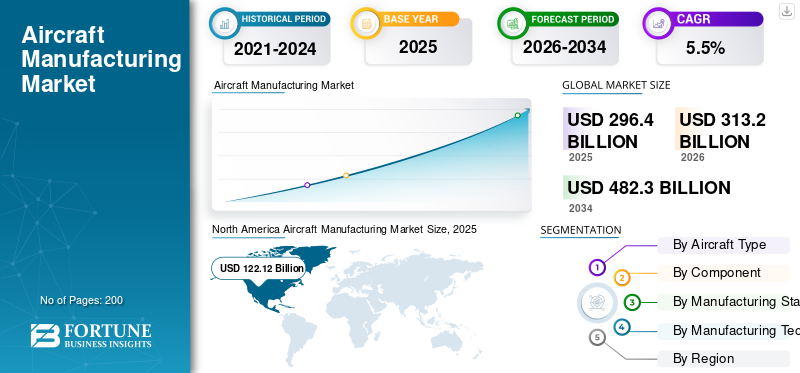
The global aircraft manufacturing market size was valued at USD 296.4 billion in 2025. The market is projected to grow from USD 313.2 billion in 2026 to USD 482.3 billion by 2034, exhibiting a CAGR of 5.5% during the forecast period. North America dominated the aircraft manufacturing market with a market share of 41.2% in 2025.
Aircraft manufacturing integrates a complex value chain involving airframe production, propulsion systems, avionics, materials engineering, and final assembly operations conducted by Original Equipment Manufacturers (OEMs) and their extensive supplier networks. The market encompasses the design, engineering, fabrication, assembly, and delivery of commercial, military, and general aviation aircraft, along with associated structures, components, and support infrastructure. The market serves a diverse set of end users, including commercial airlines, defense forces, cargo operators, and private aviation clients. Continuous advancements in materials science, automation, digital engineering, and sustainable aviation technologies are reshaping manufacturing processes, enabling companies to enhance efficiency, precision, and product performance across aircraft platforms.
Key players in the market include Airbus, Boeing, Lockheed Martin, Northrop Grumman, and BAE Systems. These companies compete through advanced airframe engineering, expanded commercial and defense aircraft portfolios, next-generation propulsion integration, digital manufacturing and automation capabilities, and strong global supply chain networks tailored for commercial aviation, military, surveillance, and defense-related applications.
Download Free sample to learn more about this report.
Aircraft Manufacturing Market KEY TAKEAWAYS
 Global Market Size & Forecast
- 2025 Market Size: USD 296.4 billion
- 2026 Market Size: USD 313.2 billion
- 2034 Forecast Market Size: USD 482.3 billion
- CAGR: 5.5% from 2026–2034
 Market Share
- North America dominated the aircraft manufacturing market with a 41.2% share in 2025.
- The avionics and flight-control systems segment is projected to grow at a CAGR of 6.7% over the forecast period.
- The military aircraft segment is anticipated to grow at a CAGR of 5.5% over the forecast period.
 Key Regional Highlights
Asia Pacific
Asia Pacific is projected to reach USD 76.4 billion in 2026 and record a CAGR of 6.5% over the forecast period.
North America
North America held the leading market position in 2025 with a market value of USD 122.12 billion.
Europe
Europe is estimated to reach USD 84.0 billion in 2026, supported by strong commercial aviation programs.
U.S.
The U.S. aircraft manufacturing market is analytically approximated at around USD 121.1 billion in 2026.
Japan
Japan's aircraft manufacturing market is estimated at around USD 13.7 billion in 2026.
Read More

AIRCRAFT MANUFACTURING MARKET TRENDS
Growing Adoption of Digital Manufacturing and Automation in Aircraft Production is a Key Market Trend
Aircraft manufacturers are increasingly integrating digital twins, robotics, and additive manufacturing into production lines to improve precision and reduce assembly time. Automation is being deployed across drilling, riveting, and composite layup processes, minimizing human error while enhancing repeatability across large-scale aircraft structures. Manufacturers are also adopting predictive maintenance and data-driven quality control systems to monitor production health in real time. This shift toward smart factories reflects a broader industry move to streamline complex, multi-tier supply chains and shorten production cycles, positioning digital transformation as a defining trend shaping the future of aircraft manufacturing operations globally.
MARKET DYNAMICS
MARKET DRIVERS
Download Free sample to learn more about this report.
Rising Global Air Travel and Fleet Modernization Requirements Propel Market Growth
Increasing passenger air travel and growing cargo movement are driving airlines to expand and modernize their fleets with newer, more efficient aircraft. Airlines are prioritizing aircraft that offer improved fuel efficiency, lower emissions, and reduced operating costs, prompting manufacturers to ramp up production of advanced narrow-body and wide-body platforms. Simultaneously, aging aircraft fleets across regions are being phased out in favor of technologically superior models equipped with modern avionics and materials. These combined factors are reinforcing sustained demand for new aircraft manufacturing, encouraging OEMs to scale production capabilities and strengthen long-term order backlogs across commercial and defense segments. This is expected to boost the aircraft manufacturing market growth in the coming years.
Market Drivers - Impact & CAGR Contribution (2026–2034)
| Rank | Market Drivers | Overall Impact Rank | CAGR Contribution | Impact: 2026-2028 | Impact: 2029-2031 | Impact: 2032-2034 |
|---|---|---|---|---|---|---|
| 1 | Growing Air Passenger Demand and Accelerating Fleet Renewal Drive Market Expansion | High | 1.95% | High | High | High |
| 2 | Large commercial aircraft backlogs and OEM production ramp-up | High | 1.51% | High | High | Medium |
| 3 | Defense modernization and higher military aircraft procurement | High | 1.20% | High | High | High |
| 4 | Rapid aviation demand growth and aerospace industrialization in Asia Pacific and emerging markets | High | 1.05% | Medium | High | High |
| 5 | Advanced manufacturing, composites, automation, digital engineering, and production-efficiency gains | Medium | 0.90% | Medium | High | High |
| 6 | Others — business aviation growth, cargo fleet renewal, sustainable-aircraft programs, and manufacturing localization | Medium | 0.60% | Medium | Medium | Medium |
| Total Positive Growth Contribution | 7.21% | |||||
Source: Fortune Business Insights
Download Free sample For In-Depth Market Drivers & Impact Forecasts
MARKET RESTRAINTS
High Production Costs and Complex Regulatory Certification Processes to Hinder Market Growth
Aircraft manufacturing involves substantial capital investment in specialized tooling, skilled labor, and advanced materials, resulting in high production and development costs. Stringent regulatory certification requirements imposed by aviation authorities further extend development timelines, as new aircraft models must undergo rigorous safety, performance, and environmental testing before entering service. These lengthy certification cycles increase time-to-market and add financial pressure on manufacturers, particularly for new or emerging players. Additionally, fluctuating raw material prices and the need for continuous compliance with evolving safety standards restrain the pace of production scale-up, limiting flexibility for manufacturers operating in a highly regulated industry environment.
Market Restraints - Impact & Negative CAGR Contribution (2026–2034)
| Rank | Market Restraints | Overall Impact Rank | Negative CAGR Contribution (2026–2034) | Impact: 2026-2028 | Impact: 2029-2031 | Impact: 2032-2034 |
|---|---|---|---|---|---|---|
| 1 | High Aircraft Manufacturing Costs and Stringent Certification Requirements Restrain Market Growth | High | -0.56% | High | Medium | Low |
| 2 | High aircraft development, certification, tooling, and manufacturing-capital requirements | High | -0.45% | High | High | High |
| 3 | Skilled-labor availability, quality-control requirements, and production-execution risk | Medium | -0.37% | High | Medium | Medium |
| 4 | Others — geopolitical tensions, tariffs/trade restrictions, commodity and FX volatility, and program delays | Medium | -0.33% | Medium | Medium | Medium |
| Total Negative Growth Impact | -1.71% | |||||
Source: Fortune Business Insights
Download Free sample For In-Depth Market Restraints & Risk Analysis
MARKET OPPORTUNITIES
Expansion of Sustainable Aviation and Next-Generation Aircraft Platforms
Growing emphasis on sustainable aviation presents significant opportunities for manufacturers to develop lighter, fuel-efficient aircraft using advanced composites and alternative propulsion technologies. Interest in electric, hybrid-electric, and hydrogen-powered aircraft is opening new avenues for innovation, encouraging manufacturers to invest in research and next-generation platforms. Additionally, rising demand for regional and narrow-body aircraft in emerging economies offers manufacturers opportunities to expand production capacity and strengthen supplier partnerships. As airlines and defense agencies seek modernized fleets, manufacturers capable of delivering efficient, technologically advanced aircraft are well positioned to capture new contracts and long-term growth opportunities.
MARKET CHALLENGES
Persistent Supply Chain Disruptions and Skilled Workforce Shortages are Key Market Challenges
Aircraft manufacturers continue to face challenges related to global supply chain disruptions, including delays in sourcing critical raw materials, components, and semiconductor-based systems. These disruptions often lead to production bottlenecks and extended delivery timelines for both commercial and defense aircraft programs. Compounding this issue is a shortage of skilled engineers, technicians, and assembly-line workers, driven by an aging workforce and insufficient talent pipelines in advanced manufacturing disciplines. Together, these challenges strain production schedules and increase operational costs, requiring manufacturers to invest in workforce training programs and diversified sourcing strategies to maintain consistent output and delivery reliability.
Segmentation Analysis
By Aircraft Type
Increasing Global Passenger Traffic Fueled Commercial Aircraft Segment Growth
Based on aircraft type, the market is segmented into commercial aircraft, military aircraft, and business and general aviation aircraft.
The commercial aircraft segment accounted for the largest aircraft manufacturing market share in 2025, as airlines require larger, fuel-efficient fleets to accommodate growing passenger volumes and route expansion. Replacement of aging aircraft with technologically advanced, lower-emission models further strengthens this demand, as carriers prioritize operational efficiency and long-term cost savings.
The military aircraft segment is anticipated to rise with a CAGR of 5.5% over the forecast period.
To know how our report can help streamline your business, Speak to Analyst
By Component
Rising Need for Lightweight & Durable Structures Boosted Airframe and Aerostructures Segment Growth
Based on component, the market is segmented into airframe and aerostructures, engines and propulsion systems, avionics and flight-control systems, landing gear systems, and aircraft interiors and cabin systems.
In 2025, the airframe and aerostructures segment dominated the global market, as manufacturers require stronger yet lighter structural components to improve fuel efficiency and payload capacity. Growing use of advanced composites and alloys supports structural performance, encouraging suppliers to expand aerostructure production to meet evolving aircraft design requirements.
The avionics and flight-control systems segment is projected to grow at a CAGR of 6.7% over the forecast period.
By Manufacturing Stage
Rise in Defense Budgets Boosted Component and Subassembly Manufacturing Segment Growth
Based on manufacturing stage, the market is segmented into component and subassembly manufacturing, aerostructure assembly, systems installation and integration, final aircraft assembly, and testing, certification, and delivery.
The component and subassembly manufacturing segment is anticipated to witness a dominating market share over the forecast period 2026-2034. The demand for component and subassembly manufacturing in the aircraft market is surging, driven by a post-pandemic rebound in commercial aviation and rising defense budgets. Airlines require next-generation, fuel-efficient engines and lightweight composite structures. This pressures tiers 1 and 2 suppliers to accelerate production, scale operations, and integrate automation to clear historic backlogs.
The testing, certification, and delivery segment is projected to grow at a high CAGR of 7.4% over the forecast period.
By Manufacturing Technology
Continued Reliance on Precision Fabrication Boosted Conventional Machining and Forming Segment Growth
Based on manufacturing technology, the market is segmented into conventional machining and forming, composite material manufacturing, additive manufacturing, automated assembly and robotics, digital twin and virtual manufacturing, and advanced joining and bonding technologies.
The conventional machining and forming segment dominated the market share in 2025, as manufacturers depend on these processes to produce precise structural and engine components essential for aircraft assembly. Despite growing automation, conventional techniques remain crucial for complex geometries, sustaining their role within established aircraft production workflows.
The digital twin and virtual manufacturing segment is projected to grow at a CAGR of 8.1% during the forecast period.
Aircraft Manufacturing Market Regional Outlook
By geography, the market is categorized into North America, Europe, Asia Pacific, and Rest of the World.
North America
North America Aircraft Manufacturing Market Size, 2025 (USD Billion)
To get more information on the regional analysis of this market, Download Free sample
North America held the dominant share in 2024, valued at USD 112.32 billion, and also maintained the leading share in 2025, with USD 122.12 billion. Market growth in North America is attributed to established OEM presence, robust defense spending, and continuous commercial fleet modernization. Strong aerospace supply chains and R&D investment further reinforce the region's leading manufacturing capacity and sustained production output.
U.S. Aircraft Manufacturing Market
Based on North America’s strong contribution and the U.S. dominance within the region, the U.S. market can be analytically approximated at around USD 121.1 billion in 2026. It is expected to register roughly 4.8% CAGR over the forecast period.
Europe
Europe is estimated to reach USD 84.0 billion in 2026 and secure the position of second-largest region in the market, supported by strong commercial aviation programs, defense collaboration, and advanced engineering capabilities. Emphasis on sustainable aviation technologies and expanding aerostructure production further strengthens the region's manufacturing base and innovation pipeline.
U.K. Aircraft Manufacturing Market
The U.K. market size in 2026 is estimated at around USD 15.5 billion. The market is projected to grow at 5.6% CAGR over the forecast period.
Germany Aircraft Manufacturing Market
The market in Germany is projected to reach approximately USD 14.4 billion in 2026 due to strong aerospace supplier networks, precision engineering capabilities, and active participation in major commercial aircraft programs across Europe.
Asia Pacific
Asia Pacific is projected to record a CAGR of 6.5% during the forecast period and reach a valuation of USD 76.4 billion in 2026. Market expansion in Asia Pacific is driven by expanding air travel, rising defense budgets, and increasing domestic aircraft production capabilities. Government support for aerospace industrialization further accelerates regional manufacturing growth and supplier development.
China Aircraft Manufacturing Market
The market in China is projected to be one of the largest in Asia Pacific, with 2026 revenues estimated at around USD 27.5 billion.
Japan Aircraft Manufacturing Market
The Japanese market size in 2026 is estimated at around USD 13.7 billion, accounting for roughly 6.2% CAGR during the forecast period. Advanced material expertise, strong aerostructure supply contributions, and growing participation in international aircraft component manufacturing programs are driving market growth in the country.
India Aircraft Manufacturing Market
The India market in 2026 is estimated at around USD 10.8 billion, driven by expanding domestic aviation, rising defense modernization efforts, and growing government initiatives to boost indigenous aerospace manufacturing capabilities.
Rest of the World
The rest of the world include Middle East & Africa and Latin America. These regions are expected to witness moderate growth in this market space during the forecast period. The Middle East & Africa and Latin America markets are set to reach a valuation of USD 15.3 billion and USD 8.9 billion in 2026. The rest of the world shows gradually increasing aircraft manufacturing demand supported by fleet expansion, defense modernization, and growing regional aviation connectivity. Emerging aerospace initiatives and infrastructure investments continue to support incremental manufacturing growth across these developing markets.
COMPETITIVE LANDSCAPE
Key Industry Players
Top Companies Focus on Production Ramp-Up, Digital Manufacturing, Supply-Chain Resilience, and Next-Generation Aircraft to Boost Market Growth
The aircraft manufacturing market is being strengthened by key players that are shifting aircraft production from conventional, labor-intensive assembly toward digitally integrated, automated, and high-rate manufacturing ecosystems. Companies such as Airbus, Boeing, Lockheed Martin, Northrop Grumman, and Raytheon Technologies Corporation are focusing on production-capacity expansion, supplier stabilization, advanced aerostructures, composite materials, additive manufacturing, digital twins, robotics, and model-based engineering.
Airbus and Boeing are prioritizing commercial aircraft production ramp-ups, quality control, supplier coordination, and manufacturing-system stability to address large order backlogs and airline fleet-replacement demand. Lockheed Martin, Northrop Grumman, BAE Systems, and Leonardo are supporting defense aircraft growth through higher production capacity, digital engineering, advanced mission-system integration, autonomous capabilities, and participation in multinational fighter, trainer, transport, and special-mission aircraft programs. Digital threads, virtual testing, artificial intelligence, and advanced manufacturing are increasingly being used to reduce development cycles, production costs, and engineering rework.
LIST OF KEY AIRCRAFT MANUFACTURING COMPANIES PROFILED
- Airbus (Netherlands)
- Boeing (U.S.)
- Lockheed Martin (U.S.)
- Northrop Grumman (U.S.)
- BAE Systems (U.K.)
- Leonardo S.p.A. (Italy)
- Embraer (Brazil)
- Bombardier (Canada)
- Dassault Aviation (France)
- Raytheon Technologies Corporation (U.S.)
- Commercial Aircraft Corporation of China (COMAC) (China)
KEY INDUSTRY DEVELOPMENTS
- July 2026: DRDO (CABS) with AIESL and Adani Defence inked critical production and conversion contracts in New Delhi for six A321 commercial-to-green airframe configurations under the Airborne Early Warning & Control (AEW&C) Mk II program.
- July 2026: Embraer & Strata Manufacturing signed a Memorandum of Agreement (MoA) at the Farnborough International Airshow to evaluate composite aerostructures collaboration for the Embraer E2 commercial jet family.
- July 2026: Syensqo & Airbus finalized a long-term composite material supply agreement spanning commercial aircraft, defense, space, and helicopter manufacturing lines.
- June 2026: Dassault Aviation & Tata Advanced Systems signed four production transfer agreements to manufacture Rafale fighter jet fuselage assemblies in Hyderabad, India.
- March 2026: Syensqo & Boeing secured a multi-year contract extension to supply advanced lightweight composite and adhesive solutions for Boeing's commercial and defense programs.
REPORT COVERAGE
The aircraft manufacturing market research offers a detailed analysis of emerging trends and rapidly adopted technologies in the industry across key regions. The report outlines key drivers of market growth and challenges to expansion, delivering a detailed overview of the industry landscape. The study highlights recent advancements to boost industry insights and support stakeholders in making well-informed decisions.
Request for Customization to gain extensive market insights.
Report Scope and Segmentation
| ATTRIBUTE | DETAILS |
| Study Period | 2021-2034 |
| Base Year | 2025 |
| Estimated Year | 2026 |
| Forecast Period | 2026-2034 |
| Historical Period | 2021-2024 |
| Growth Rate | CAGR of 5.5% from 2026 to 2034 |
| Unit | Value (USD Billion) |
| Segmentation | By Aircraft Type, By Component, By Manufacturing Stage, By Manufacturing Technology, and Region |
| By Aircraft Type |
|
| By Component |
|
| By Manufacturing Stage |
|
| By Manufacturing Technology |
|
| By Region |
|
Frequently Asked Questions
According to Fortune Business Insights, the global market value stood at USD 296.4 billion in 2025 and is projected to reach USD 482.3 billion by 2034.
In 2025, the market value in North America stood at USD 122.12 billion.
The market is expected to exhibit a CAGR of 5.5% during the forecast period of 2026-2034.
By aircraft type, the commercial aircraft segment dominated the market.
Rising global air travel and fleet modernization requirements drive market growth.
Airbus, Boeing, Lockheed Martin, and Northrop Grumman are a few major players in the global market.
North America dominated the market in 2025



- 2021-2034
- 2025
- 2021-2024
- 200
Get 30-60 hrs Free Customization
Expand Regional and Country Coverage, Segments Analysis, Company Profiles, Competitive Benchmarking, and End-user Insights.




















Related Reports
-
US +1 833 909 2966 ( Toll Free )
-
Get In Touch With Us