Aircraft Seat Upholstery Market Size, Share & Industry Analysis, By Material (Fabric, Leather, & Vinyl), By Cover Type (Seat Covers, Dress Covers, Seat Cushion Covers, Headrest Covers, & Armrest Covers)), By Seat Type (Passenger Seats, Pilot Seats, & Cabin Crew Seats), By Cabin Class (Economy Class, Premium Economy Class, Business Class, & First Class), By Aircraft Type (Commercial Aircraft (Narrow-Body Aircraft, Wide-Body Aircraft, & Regional Aircraft), Business Jets, General Aviation Aircraft, Military Aircraft, & Helicopters), By End User (OEM & Aftermarket), & Regional Forecast, 2026-2034
 Download Free Sample
Aircraft Seat Upholstery Market Size and Future Outlook
 Listen to Audio Version
The global aircraft seat upholstery market size was valued at USD 1.13 billion in 2025. The market is projected to grow from USD 1.22 billion in 2026 to USD 2.12 billion by 2034, exhibiting a CAGR of 7.1% during the forecast period. North America dominated the aircraft seat upholstery market with a market share of 30.97% in 2025.
Aircraft seat upholstery comprises premium, fire-retardant fabrics, leathers, and composite materials engineered for passenger comfort, durability, and regulatory compliance in commercial, business, and military aviation interiors. The global market is experiencing strong growth, driven by surging air passenger traffic worldwide, rising demand for lightweight and sustainable materials amid emission regulations, and extensive aircraft cabin refurbishments for enhanced passenger comfort. Moreover, increasing aircraft retrofit programs directly drive upholstery upgrades as a core component of cabin modernization, which propels industry growth.
- For instance, in August 2025, Air India launched a USD 400 million retrofit program for its widebody fleet, starting with the first B787-8 (VT-ANT) at a Boeing facility in California, featuring new three-class interiors, advanced IFE, and upholstery upgrades for enhanced reliability.
Key players such as Sabeti Wain Aerospace, ACM Aerospace, and SOISA Aircraft Interiors are focused on innovations such as bio-based composites for weight reduction, antimicrobial and self-cleaning textiles for hygiene, and a customizable modular range of designs with integrated sensors for premium economy and business class seats.
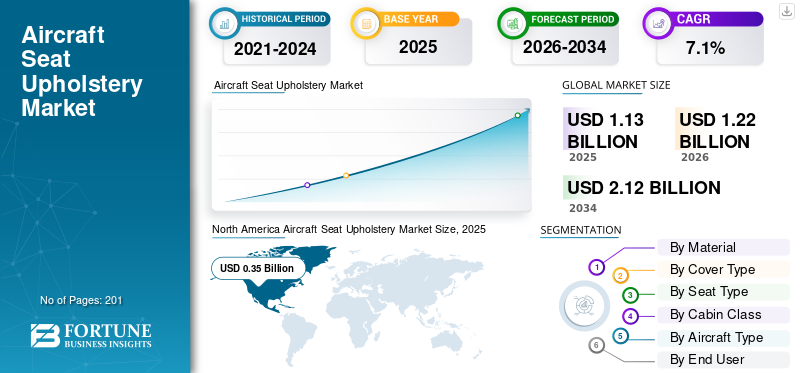
Download Free sample to learn more about this report.
Aircraft Seat Upholstery Market Key Takeaways
 Global Market Size & Forecast
- 2025 Market Size: USD 1.13 billion
- 2026 Market Size: USD 1.22 billion
- 2034 Forecast Market Size: USD 2.12 billion
- CAGR: 7.1% from 2026-2034
 Market Share
- North America dominated the aircraft seat upholstery market with a 30.97% share in 2025.
- The vinyl segment is projected to grow at the fastest CAGR of 8.6% during the forecast period.
- The dress covers segment is expected to register the fastest CAGR of 8.4% during the forecast period.
 Key Regional Highlights
North America
North America accounted for USD 0.35 billion in 2025 and is projected to reach USD 0.38 billion in 2026.
Asia Pacific
Asia Pacific was valued at USD 0.30 billion in 2025.
Europe
Europe is projected to grow at a CAGR of 7.8% during 2026–2034.
U.S.
The market was valued at approximately USD 0.32 billion in 2025.
Japan
The market was valued at USD 0.04 billion in 2025.
Read More

AIRCRAFT SEAT UPHOLSTERY MARKET TRENDS
Rapid Adoption of Sustainable Materials is a Prominent Market Trend
A prominent trend shaping the market is the rising adoption of sustainable materials, including recycled fabrics, bio-based leathers, and biodegradable textiles. This shift is propelled by stringent environmental regulations, such as EU and FAA mandates on aviation emissions, alongside airlines' commitments to net-zero carbon goals by 2050.
Manufacturers are prioritizing these materials to minimize production footprints, enhance end-of-life recyclability, and meet rising passenger expectations for eco-conscious travel. Innovations integrate antimicrobial coatings and lightweight composites, ensuring compliance with fire-safety standards.
MARKET DYNAMICS
MARKET DRIVERS
Download Free sample to learn more about this report.
Rise in Demand for Air Travel and Surging Passenger Traffic & Fleet Expansion to Drive Market Growth
Rising demand for air travel acts as a significant driver propelling market growth. Global passenger traffic continues to surge, driven by economic expansion, rising disposable incomes, and the proliferation of low-cost carriers in emerging markets. IATA forecasts global passenger traffic to reach 5.2 billion in 2026, up 4.4% from 2025 estimates. This sustained increase in air travel volumes necessitates fleet modernization and expansion, with airlines ordering new aircraft fleets to meet growing demand on both domestic and international routes. Narrow-body and wide-body jets, operating at near-full capacity, require durable, comfortable upholstery that meets aviation safety standards while enhancing passenger satisfaction, which drives market growth.
MARKET RESTRAINTS
Stringent Regulatory Compliance to Limit Market Expansion
High compliance costs associated with aviation safety regulations represent a key restraint for the aircraft seat upholstery market growth. Regulatory bodies such as the FAA and EASA enforce rigorous standards, including FAR 25.853 on flammability and smoke toxicity, which require extensive material testing and certification. These processes delay product launches and inflate development expenses for manufacturers. Upholstery materials must also meet durability thresholds under repeated wear and tear, abrasion, and extreme conditions, further escalating R&D investments. This regulatory burden impacts innovation in sustainable or novel textiles and hampers market growth.
MARKET OPPORTUNITIES
Surge in Retrofit Programs Presents Lucrative Market Growth Opportunities
Surge in retrofit programs emerges as a compelling market opportunity. Airlines globally are prioritizing cabin upgrades on aging fleets to extend aircraft lifespans and meet rising passenger expectations for modern aircraft interiors.
- For instance, in March 2023, Emirates, the world's largest A380 operator with 120 aircraft, introduced its first fully refurbished A380 on the Dubai-London route, featuring a new premium economy cabin with 56 seats on the main deck. The aircraft showcases the airline's latest interiors across all classes, including cream-colored leather upholstery in First and Business Class on the upper deck.
Strategic alliances between upholstery manufacturers and MRO providers facilitate streamlined certification pathways, enabling suppliers to secure multi-year, high-volume contracts across key regions across the globe.
MARKET CHALLENGES
Volatility in Raw Material Supply Chains Acts as a Challenge for Market
Volatility in raw material supply chains poses a persistent market challenge, exacerbated by geopolitical tensions and fluctuating commodity prices. Specialty fabrics such as flame-retardant polyesters, leathers, and composites rely on global sourcing from petrochemical derivatives and natural fibers, subjecting suppliers to disruptions from trade restrictions and energy market swings. Dependence on limited suppliers in regions halts production lines and restricts market growth.
Segmentation Analysis
By Material
Cost-Effectiveness, Durability, and Synthetic Advancements Boosted Fabric Segment Growth
By material, the market is divided into fabric, leather, and vinyl.
The fabric segment holds the largest aircraft seat upholstery market share. Segment growth is driven by the cost-effectiveness relative to leather and vinyl alternatives, enabling high-volume procurement for expansive economy class fleets. The high durability of fabric under high-cycle usage, along with ease of maintenance and cleaning, aligns with airlines' operational efficiency, which drives their demand. Moreover, focus on advancements in synthetic fabrics offering customizable aesthetics, colorfastness, and breathability to passenger comfort drives segment growth.
The vinyl segment is anticipated to rise with the fastest growth, with a CAGR of 8.6% over the forecast period.
To know how our report can help streamline your business, Speak to Analyst
By Cover Type
Foundational Support and High Abrasion Resistance Propel Seat Covers Segment Dominance
By cover type, the market is segmented into seat covers, dress covers, seat cushion covers, headrest covers, and armrest covers.
The seat covers segment dominates the market due to the foundational role of seat covers in passenger support and wear resistance across all cabin classes. Bottom covers endure maximum abrasion from ingress-egress cycles, driving demand for resilient, high-denier textiles in high-utilization aircraft. Airlines and aircraft manufacturers or operators are partnering with upholstery manufacturers to supply advanced seat covers. For instance, in June 2023, Soisa Aircraft Interiors secured a deal with aircraft lessor Avolon to supply seat covers for Spectrum model seats on Boeing 787-9 Dreamliners, with potential for expanded orders. The agreement highlights Soisa's nearshoring advantages in Mexico and the UAE, enabling faster logistics and cost savings.
The dress covers segment is projected to be the fastest-growing segment with a CAGR of 8.4% over the forecast period.
By Seat Type
Economy Dominance and Retrofit Modernizations Fueled Passenger Seats Segment Expansion
By seat type, the market is segmented into passenger seats, pilot seats, and cabin crew seats.
The passenger seats segment held the largest market share in 2025. The segment is growing significantly in the market through economy class dominance, fueled by narrow-body fleet proliferation for short-haul networks serving surging regional traffic. In addition, aging commercial fleets across categories promote recurring retrofit investments, which drive upholstery upgrades and further propel segment growth. For instance, in November 2025, Lufthansa Technik introduced a dedicated upgrade program for the aging Airbus ACJ318 Elite at its Hamburg VIP Center, offering optical refreshes such as new wood veneers, carpets, and upholstery alongside technical upgrades to modernize millennium-era interiors.
The pilot seats segment is projected to rise with a steady CAGR of 6.2% over the forecast period.
By Cabin Class
High LCC Volumes and Regional Penetration Sustain Economy Class Segment Leadership
Based on cabin class, the market is segmented into economy class, premium economy class, business class, and first class.
The economy class segment dominated the market in 2025, owing to high volume from low-cost carriers' fleet buildups and high-frequency regional networks. Abrasion-resistant fabrics are used for this class for durability support dense seating without frequent replacements, controlling lifecycle costs.
- For instance, in April 2025, RECARO Aircraft Seating and Aer Lingus marked the entry into service of the R3 long-range economy seat on the Airbus A321XLR featuring customized dress covers and branded upholstery detailing.
Moreover, LCC penetration in Asia Pacific and Latin America also provides opportunities for the segment growth.
The premium economy class segment is expected to grow at the fastest CAGR of 8.9% over the forecast period.
By Aircraft Type
Narrow-Body Dominance and Network Expansion Accelerated Commercial Aircraft Segment Growth
Based on aircraft type, the market is segmented into commercial aircraft, business jets, general aviation aircraft, military aircraft, and helicopters.
The commercial aircraft segment held the largest share of the market in 2025. The commercial aircraft segment is expected to grow, as narrow-body platforms hold a dominant fleet share and are well-suited to high-frequency short-to-medium-haul routes that underpin global network expansion. These platforms facilitate rapid deployment in response to surging regional air traffic, necessitating upholstery optimized for intensive utilization cycles and cost-effective maintenance.
The business jets segment is projected to grow at the fastest rate, with a CAGR of 8.9% over the forecast period.
By End User
Fleet Standardization and Recurring Retrofits Programs Supported OEM Segment Growth
On the basis of end user, the market is segmented into OEM and aftermarket.
The OEM segment held the largest share of the market. Ground handling operators as end-users drive significant growth in the market through their operational demands and modernization needs. In addition, there is a rise in the acquisition and expansion of aircraft upholstery players to enhance customer solutions and market strength. For instance, in April 2025, Insperial Group announced the acquisition of U.K. aircraft upholstery specialist MGR Foamtex at AIX 2025, bolstering its cabin interiors portfolio with the Oxfordshire firm's 40-year engineering legacy.
The aftermarket segment is projected to be the fastest-growing, with a CAGR of 7.7% over the forecast period.
Aircraft Seat Upholstery Market Regional Outlook
By geography, the market is segmented into North America, Europe, Asia Pacific, Latin America, and the Middle East & Africa.
North America
North America Aircraft Seat Upholstery Market Size, 2025 (USD Billion)
To get more information on the regional analysis of this market, Download Free sample
North America dominated the market in 2025 with a valuation of USD 0.35 billion, growing to USD 0.38 billion in 2026, driven by extensive fleet modernization programs, surging air passenger traffic at major U.S. hubs, and widespread cabin retrofit initiatives across legacy narrow-body and wide-body aircraft. Demand escalates from refurbishments enhancing passenger comfort in high-density economy sections, coupled with the adoption of lightweight, flame-retardant fabrics to meet FAA emissions and weight-reduction standards at airports. In addition, there is a surge in market expansion to support growing global demand for luxury interiors and premium aircraft seating solutions.
- For instance, in October 2024, Collins Aerospace announced an investment of USD 2 million to double its Medley, Florida upholstery production space to 30,000 sq ft, adding advanced machining that boosts efficiency and cuts waste at its 150,000 sq ft executive aircraft seating
U.S. Aircraft Seat Upholstery Market
Based on North America’s strong contribution and the U.S. dominance within the region, the U.S. market can be approximated at around USD 0.32 billion in 2025. The U.S. leads the regional market, propelled by capacity expansions among leading carriers and MRO providers prioritizing ergonomic interiors for rapid aircraft turnaround. Investments in sustainable, antimicrobial upholstery materials align with federal aviation sustainability mandates, driving the market growth in the U.S.
Europe
Europe is projected to record a growth rate of 7.8% during 2026 to 2034. Europe exhibits robust growth in the market, fueled by aggressive cabin refurbishment programs across the continent and stringent EU regulations promoting low-weight, eco-compliant materials. Major hubs upgrade upholstery fleets to accommodate rising intra-European traffic. Cost-effective retrofit programs in the region for cabin upgrades directly boost upholstery demand as aging VIP/business jets require full seat cover replacements.
- For instance, in December 2025, Lufthansa Technik unveiled a comprehensive upgrade package for the ACJ318 corporate jet at its Hamburg VIP Center, featuring refreshed interiors, HD entertainment systems, and advanced LEO satcom connectivity via Airbus' Gogo Galileo terminal. The program modernizes veneers, upholstery, cabin management, and IFE architecture for Airbus' smallest A320-family jet.
U.K. Aircraft Seat Upholstery Market
The U.K. market in 2025 was valued at USD 0.05 billion, representing roughly 4.8% of global revenues.
Germany Aircraft Seat Upholstery Market
The Germany market was valued at USD 0.08 billion in 2025, equivalent to around 7.1% of global sales.
Asia Pacific
The Asia Pacific market was valued at USD 0.30 billion in 2025. The market in Asia Pacific is growing significantly due to increasing explosive air travel demand, massive fleet orders from low-cost and full-service carriers, and rapid airport infrastructure development across India, China, and Southeast Asia. Growth accelerates through new narrow-body deliveries and extensive cabin retrofits to support high-density economy configurations during surging middle-class passenger volumes. For instance, in November 2025, Emirates announced the execution of the world's largest in-house aircraft refurbishment of its 260+ Boeing 777 fleet, driven by post-COVID supply delays keeping older jets flying longer, with new upholstery, seats, carpets, and sidewalls at its Dubai engineering facility.
Japan Aircraft Seat Upholstery Market
The Japan market in 2025 was valued at USD 0.04 billion, accounting for roughly 3.9% of global revenues.
China Aircraft Seat Upholstery Market
China’s market is projected to be one of the largest worldwide, with 2025 revenues valued at around USD 0.13 billion, representing roughly 11.3% of global sales.
India Aircraft Seat Upholstery Market
The India market in 2025 was valued at USD 0.06 billion, accounting for roughly 5.4% of global revenues.
Latin America and Middle East & Africa
The Latin America market registers modest yet steady growth, driven by tourism recovery, LCC penetration in Brazil and Mexico, and regional fleet renewals targeting narrow-body efficiency. The market demand grows due to cabin refresh programs enhancing passenger appeal on intra-regional routes while navigating economic volatility. In addition, the Middle East & Africa market is fueled by Gulf carriers' wide-body expansions, premium cabin overhauls, and emerging African hub developments. Furthermore, premium upholstery demand rises for long-haul business class refreshes, complemented by economy upgrades at high-traffic Middle Eastern airports to meet diverse passenger demographics.
- For instance, in November 2023, Soisa Aircraft Interiors expanded its Dubai South facility, increasing the site footprint fourfold and adding dedicated production lines for dress cover lamination, curtains, and cutting operations. The expansion represents a direct increase in capacity for aircraft upholstery and dress cover manufacturing.
COMPETITIVE LANDSCAPE
Key Industry Players
Adoption of Lightweight Fabrics, Sustainability, and Modular Designs to Accelerate Market Expansion
The global aircraft seat upholstery market revolves around specialized textile manufacturers and aviation interiors innovators delivering durable, regulatory-compliant materials optimized for cabin longevity and passenger comfort. Leading players prioritize flame-retardant, lightweight fabrics, sustainable bio-based composites, and modular cover systems adaptable across the economy to premium configurations.
Key participants, including SOISA Aircraft Interior, Tapis Corporation, and Lantal Textiles, supply certified upholstery that has undergone extensive FAA/EASA testing protocols. Advancements in antimicrobial coatings, recyclable synthetics, and ergonomic weaves underscore the shift from traditional leathers toward eco-efficient, digitally-monitored cabin refreshment paradigms.
LIST OF KEY AIRCRAFT SEAT UPHOLSTERY COMPANIES PROFILED
- Sabeti Wain Aerospace (U.K.)
- ACM Aerospace (Germany)
- Generation Global (New Zealand)
- SOISA Aircraft Interiors (Mexico)
- Lantal Textiles (Switzerland)
- Tapis Corporation (U.S.)
- Industrial NEOTEX (Spain)
- Kiara Aviation (Italy)
- Epsilon Aerospace (India)
- Airworthy (U.S.)
KEY INDUSTRY DEVELOPMENTS
- July 2025: Gen Phoenix introduced its Essence seat cover material on Wizz Air’s first Airbus A321XLR, marking a commercial airline deployment of fully recyclable aircraft seat upholstery.
- June 2025: Replin by Hainsworth launched a new aviation transport fabric collection designed for aircraft seating and other cabin interior surfaces. The range was developed to address evolving airline requirements for upholstery aesthetics, durability, comfort, and lower-impact material solutions.
- September 2024: Soisa Aircraft Interiors expanded its upholstery-related service offering through a buyer-furnished equipment dress cover management program for airlines. The initiative was introduced to reduce lead times, improve supply chain coordination, and strengthen aftermarket support for aircraft seat upholstery programs.
- April 2024: PriestmanGoode and Gen Phoenix unveiled Essence Nappa at Aircraft Interiors Expo 2025, showcasing the new upholstery material on the Geven Comoda seat platform.
- April 2024: RECARO Aircraft Seating and Aer Lingus marked the entry into service of the R3 long-range economy seat on the Airbus A321XLR featuring customized dress covers and branded upholstery detailing.
Request for Customization to gain extensive market insights.
Report Scope & Segmentation
| ATTRIBUTE | DETAILS |
| Study Period | 2021-2034 |
| Base Year | 2025 |
| Estimated Year | 2026 |
| Forecast Period | 2026-2034 |
| Historical Period | 2021-2024 |
| Growth Rate | CAGR of 7.1% from 2026 to 2034 |
| Unit | Value (USD Billion) |
| Segmentation | By Material, By Cover Type, By Seat Type, By Cabin Class, By Aircraft Type, By End User, and Region |
| By Material |
|
| By Cover Type |
|
| By Seat Type |
|
| By Cabin Class |
|
| By Aircraft Type |
|
| By End User |
|
| By Region |
|
Frequently Asked Questions
According to Fortune Business Insights, the global market value stood at USD 1.13 billion in 2025 and is projected to reach USD 2.12 billion by 2034.
In 2025, the market value of North America stood at USD 0.35 billion.
The market is expected to exhibit a CAGR of 7.1% during the forecast period of 2025-2034.
By aircraft type, the commercial aircraft segment led the market.
Rise in demand for air travel and surging passenger traffic & fleet expansion are driving market expansion.
Lantal Textiles AG, Sabeti Wain Aerospace, ACM Aerospace, and Generation Global are some of the major players in the global market.
North America dominated the market in 2025.



- 2021-2034
- 2025
- 2021-2024
- 201
Get 30-60 hrs Free Customization
Expand Regional and Country Coverage, Segments Analysis, Company Profiles, Competitive Benchmarking, and End-user Insights.




















Related Reports
-
US +1 833 909 2966 ( Toll Free )
-
Get In Touch With Us