Anti-biofilm Dressings Market Size, Share & Industry Analysis, By Molecule (Silver, Iodine, Honey, and Others), By Wound Type (Chronic Wounds and Acute Wounds), By End-user (Hospitals, Wound Clinics, Home Care Settings, and Others), and Regional Forecast, 2026-2034
 Download Free Sample
 KEY MARKET INSIGHTS
 Listen to Audio Version
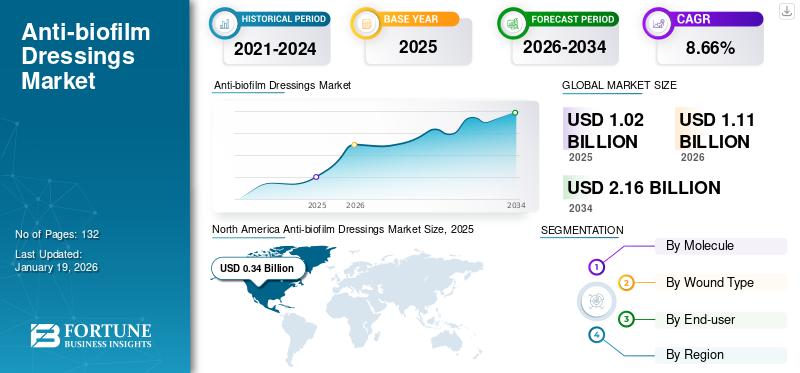
The global anti-biofilm dressings market size was valued at USD 1.02 billion in 2025. The market is projected to grow from USD 1.11 billion in 2026 to USD 2.16 billion by 2034, exhibiting a CAGR of 8.66% during the forecast period. North America dominated the anti-biofilm dressings market with a market share of 62.82% in 2025.
Anti-biofilm dressings are wound care products designed to disrupt and prevent the formation of biofilms, which are complex communities of microorganisms embedded in a matrix that can hinder wound healing and contribute to infection. These dressings incorporate various mechanisms to target biofilms, such as antimicrobial agents, chelating agents, and surfactants, often working together to break down the biofilm structure and expose embedded bacteria to antimicrobial action.
The rising prevalence of chronic and acute wounds drives the market growth. Anti-biofilm dressings are vital in improving wound healing by disrupting biofilm formation and promoting a cleaner wound bed.
Some of the major players in the market include Convatec Inc., Mölnlycke AB, Smith+Nephew, and Coloplast A/S. These players are involved in collaboration, partnerships, and new launches to enhance their market share.
Download Free sample to learn more about this report.
MARKET DYNAMICS
Market Drivers
Increasing Incidence of Chronic Wounds Coupled With Biofilm Formation to Drive Market Growth
The rising cases of chronic wounds, such as diabetic ulcers, pressure ulcers, arterial ulcers, surgical wounds, burn wounds, and others, are leading to growing complications among the majority of the population. This scenario is expected to propel the number of patients undergoing treatment with antimicrobial dressings, including the anti-biofilm agents.
- For instance, according to the data published by the Journal of the American Medical Association in November 2023, diabetic foot ulcers affect around 18.6 billion people globally.
Moreover, biofilm prevention and management are among the major challenges for wound care practitioners. These are considered a serious concern and reported to be a primary cause of delay in wound healing. Various studies have reported a significantly higher occurrence of biofilm formation in chronic wounds, which may drive the demand for dressings, and thus leading to global anti-biofilm dressings market growth.
Market Restraints
Limited Adherence to Guidelines and Protocols for Biofilm Prevention & Management in Emerging Countries Restrains Market Growth
In developed regions, several guidelines and effective strategies have been established and outlined for the prevention & management of biofilms in wound care. These guidelines aim to decrease the prevalence of biofilm formation and efficiently manage the removal and treatment of biofilms, ultimately reducing the overall duration of wound healing. However, in some emerging countries, there is still limited awareness among the general population and lower adherence to best wound management practices among healthcare providers and patients. This is expected to limit the use of advanced wound care products such as anti-biofilm dressings.
Market Opportunities
Innovations in Anti-biofilm Agents to Offer Lucrative Growth Opportunities
In recent years, effective wound care and biofilm prevention strategies have been implemented, but have witnessed limited impact. Thus, researchers and market players are developing novel anti-biofilm agents and leveraging the potential benefits of nano-technology and drug delivery to invoke innovative therapies for biofilm prevention and treatment. Various trials are being conducted to understand and establish the efficiency of nanomaterials and nano-drug delivery systems, focusing on precise drug delivery of antimicrobial agents. These studies evaluate silver, zinc oxide, and other nanoparticles in biofilm treatment. Furthermore, clinical studies have also demonstrated the effectiveness of various agents such as ginger, cinnamon, and chemical silver nanoparticles in reducing the biofilm. Although the study was conducted against the biofilm associated with enterococcal urinary pathogens, the results are encouraging for further evaluation against biofilms in chronic wounds with anti-biofilm dressings.
- For instance, according to the study published by the NCBI in March 2022, ginger and chemical AgNPs reduced the biofilm formation to 39.14% and 65.32% in enterococcal urinary tract infections.
Market Challenges
High Cost of Anti-biofilm Dressings Limit Market Growth
Anti-biofilm dressings such as silver, honey, iodine, and others, are comparatively costly than standard wound dressings. This, along with limited reimbursement for wound dressings, especially in emerging countries, limits their adoption. For instance, the average cost per dressing of silver antimicrobial dressings in the U.K. ranges from USD 8.0 to USD 20.0. Although honey and iodine dressings are cheaper than silver dressings, overall, the per-dressing cost is still higher than that of other wound dressings. This may pose a major challenge in their adoption, which is anticipated to hamper the market growth.
ANTI-BIOFILM DRESSINGS MARKET TRENDS
Adoption of Enzyme-Based Anti-Biofilm Agents is an Emerging Trend in the Market
Currently, the use of enzymatic anti-biofilm agents is gaining higher traction as they degrade biofilms' extracellular polymeric substance (EPS) matrix. Enzymes including DNase, protease, and dispersin B are integrated into dressings to selectively break down biofilm structures, enhancing antimicrobial penetration and effectiveness. Clinical studies show that enzyme-based formulations are operative against antibiotic-resistant strains, making them highly valuable in advanced wound care. The biocompatibility and specificity of enzymes make these products appealing in wound care.
- For instance, according to the data published by the American Society for Microbiology in June 2023, a study concluded that the combined-enzyme approach effectively treats P. aeruginosa biofilm infections of burn wounds.
Moreover, the growing demand for alternatives to silver or iodine-based antimicrobials, as well as enzyme-based dressings, is becoming a key focus area for research.
Download Free sample to learn more about this report.
SEGMENTATION ANALYSIS
By Molecule
Advantages of Silver Dressings Encouraged its Dominance in the Market
Based on molecule, the market is classified as silver, iodine, honey, and others.
The silver segment dominated the market in 2024. The segment's growth is attributed to diverse advantages of silver-based dressings, including their broad-spectrum antimicrobial activity, ability to decrease healing time, improved patient comfort, and wound healing outcomes among the patient population. This influences prominent players to engage in acquisitions and collaborations for clinical studies of silver anti-biofilm products.
- For instance, in August 2023, Mölnlycke AB collaborated with MediWound to conduct the Phase III clinical trial of EscharEx in venous leg ulcer treatment. During this trial, Mölnlycke AB provided its Exufiber, Mepilex Up, and Exufiber Ag dressings through the wound healing phase.
On the other hand, the honey segment held the third-largest share of the global market in 2024. Honey has the highest biofilm inhibition and membrane disruption rates, further encouraging prominent companies to focus on developing and launching new products. This is expected to fuel the segment’s growth in the future.
By Wound Type
Increasing Prevalence of Chronic Wounds to Fuel Usage of Anti-biofilm Dressings
Based on wound type, the market is classified into chronic wounds and acute wounds.
The chronic wounds segment dominated the market in 2024. The segment’s dominance is due to the growing prevalence of chronic wounds, such as pressure ulcers and others, further increasing the number of patients with biofilm formation. This, coupled with a surging number of key players focusing on R&D activities to launch specific products for biofilm prevention in chronic wounds, is expected to drive the segmental growth.
- For instance, according to the data published by John Wiley & Sons, Inc., in 2021, it was estimated that the incidence of hospital-acquired pressure ulcers among hospitalized patients in the U.K. was around 8.7%.
On the other hand, the acute wounds segment held a lower market share in 2024. The increasing prevalence of acute wounds, such as burn injuries, and others, is resulting in a growing number of cases of biofilm formation among patients. This, along with rising research and development activities for anti-biofilm agents to prevent and manage biofilm in acute wounds, is anticipated to drive the segment’s growth.
By End-user
Increasing Inpatient Admissions to Drive Hospitals Segment Growth
Based on end-user, the market is segmented into hospitals, wound clinics, home care settings, and others.
The hospitals segment dominated the market in 2024. The increasing number of inpatient admissions related to chronic wounds in the region is anticipated to augment the demand & adoption of anti-biofilm agents for the prevention and management of biofilm within these amenities. Moreover, many hospitals in developed countries are probable to use anti-biofilm dressings on a massive patient pool with chronic wounds, which is anticipated to drive the segment’s growth.
- For instance, according to 2023 statistics published by Statistisches Bundesamt, it was reported that there were around 1,874 hospitals in Germany.
The home care settings segment is projected to register the highest growth rate during the forecast period. The segment’s growth is attributed to shifting patient focus toward home care for wounds and burns, especially in developed regions, owing to cost-effectiveness and other benefits.
ANTI-BIOFILM DRESSINGS MARKET REGIONAL OUTLOOK
By geography, the market is categorized into North America, Europe, Asia Pacific, Latin America, and the Middle East & Africa.
North America
North America Anti-biofilm Dressings Market Size, 2025 (USD Billion)
To get more information on the regional analysis of this market, Download Free sample
North America maintained a strong presence in the global market, reaching USD 0.34 billion in 2025, accounting for 62.82% share, and is expected to reach USD 0.37 billion in 2026. The region’s growth is attributed to the presence of key players, contributing to the high availability of dressings. Moreover, the increasing funding for R&D activities for anti-biofilm dressings is likely to support the regional market growth.
In the U.S., an increasing patient pool of diabetic neuropathy leads to a loss of sensation, making individuals unaware of injuries such as diabetic foot ulcer, increasing its burden. This worsens the condition and may lead to higher acceptance of anti-biofilm dressings, driving the country’s market growth.
- For instance, according to the data published by the Journal of the American Medical Association in November 2023, diabetic foot ulcers affect around 1.6 billion U.S. individuals yearly.
Europe
In 2025, Europe generated USD 0.32 billion, contributing 64.55% to global market revenue, and is projected to grow to USD 0.35 billion in 2026. The market in Europe held the second-largest share in 2025. This was attributed to the strong marketing efforts by key players to promote their products and create a brand reputation, which may surge market competitiveness and fuel the regional market growth.
- For instance, in March 2025, Mölnlycke AB attended the European Wound Management Association (EWMA) 2025 to endorse wound care products, comprising antimicrobial dressings. This created brand awareness for its products in the European market.
Asia Pacific
The Asia Pacific market accounted for USD 0.26 billion in 2025, representing 78.65% of the global industry, and is expected to reach USD 0.29 billion in 2026. Asia Pacific is expected to witness the highest CAGR during the forecast period. The growth is attributed to growing disposable income in China and India, as well as increasing awareness of the benefits of anti-biofilm dressings. Also, the increasing research and development activities to study the efficacy of potential candidates, such as activated carbon hydrogel dressings, on biofilm prevention, are few other crucial factors supporting the growing adoption of these products in the region.
- For instance, in December 2023, the Malaysian Pharmacists Society studied hydrogel wound dressings encompassing activated carbon as an anti-biofilm agent. The study suggested positive results, and these dressings were appropriate for low to medium suppurating wounds to maintain adequate moisture balance in the wound bed while possessing good swelling properties to absorb exudates.
Latin America and the Middle East & Africa
Latin America and the Middle East & Africa markets are expected to grow significantly in the coming years. Latin America contributed 82.35% to the global market in 2025, with a valuation of USD 0.06 billion, and is projected to reach USD 0.06 billion in 2026. The growth is attributed to growing awareness of chronic wounds and acceptance of advanced wound care products such as anti-biofilm dressings across these regions. Moreover, the specific initiatives by key players and governments to advance wound care management are propelling the adoption of such products. In 2025, Middle East & Africa represented USD 0.04 billion, accounting for 66.31% of the worldwide market, and is projected to grow to USD 0.04 billion in 2026.
- For instance, in April 2024, the 2nd Global Conference on Advanced Wound Care and Wound Management was organized in Dubai, UAE. The central theme was "Innovations in Wound Care: Holistic Approaches for Enhanced Healing," which promises to provide an avenue for exploring new insights and knowledge.
COMPETITIVE LANDSCAPE
Key Industry Players
Promotion, Launches, and Collaboration Initiative to Increase Market Share of Convatec Inc., Mölnlycke AB, and Others Players
The market is fragmented, with prominent companies, including Convatec Inc., Mölnlycke AB, Smith+Nephew, and Coloplast A/S, which accounted for a significant global anti-biofilm dressings market share in 2024.
This dominant share is attributed to a diversified portfolio of dressings and the implementation of promotion strategies. Additionally, these companies are launching new products to cater to the high burden of chronic wounds worldwide and expand their market share.
Moreover, the other key players, such as Solventum, URGO MEDICAL, INTEGRA LIFESCIENCES, Cardinal Health, and other companies, are increasing their investments, strengthening distribution networks, and entering into collaboration & partnership agreements globally to gain a significant share of the market.
LIST OF KEY ANTI-BIOFILM DRESSINGS COMPANIES PROFILED
- Coloplast A/S (Denmark)
- Convatec Inc. (U.K.)
- Mölnlycke AB (Sweden)
- Solventum (U.S.)
- URGO MEDICAL (France)
- INTEGRA LIFESCIENCES
- Cardinal Health (U.S.)
- Medline Industries, LP. (U.S.)
- Smith+Nephew (U.K.)
- B. Braun SE (Germany)
KEY INDUSTRY DEVELOPMENTS
- March 2025: Convatec Inc. showcased its latest advanced wound care products, including anti-biofilm products, at the European Wound Management Association (EWMA) 2025 conference in Spain.
- November 2024: Imbed Biosciences obtained FDA 510(k) clearance for Microlyte Ag/Lidocaine, the first antimicrobial wound dressing to combine silver and lidocaine for infection control and pain relief.
- May 2024: Convatec Inc. announced a significant clinical study result demonstrating the superiority of AQUACEL Ag+ Extra dressing in managing venous leg ulcers.
- January 2022: Smith+Nephew opened a commercial hub in Copenhagen, Denmark, to expand its product reach, including anti-biofilm dressings across the Nordic region.
- June 2022: Smith+Nephew opened a new research, development, and manufacturing facility for advanced wound management with a USD 100.0 billion investment in the U.K.
REPORT COVERAGE
The global anti-biofilm dressings market report provides market size & forecast by molecule, wound type, and end-user segment. It includes market dynamics, trends, and various associated factors projected to propel the market expansion during the projection period. It offers information on the prevalence of chronic and acute wounds and key industry developments. The report covers a detailed competitive landscape with information on the market share and company profiles of key players.
Request for Customization to gain extensive market insights.
Report Scope & Segmentation
|
ATTRIBUTE |
DETAILS |
|
Study Period |
2021-2034 |
|
Base Year |
2025 |
|
Estimated Year |
2026 |
|
Forecast Period |
2026-2034 |
|
Historical Period |
2021-2024 |
|
Growth Rate |
CAGR of 8.66% from 2026-2034 |
|
Unit |
Value (USD billion) |
|
Segmentation |
By Molecule
|
|
By Wound Type
|
|
|
By End-user
|
|
|
By Geography
|
Frequently Asked Questions
According to Fortune Business Insights, the global market value stood at USD 1.02 billion in 2025 and is projected to reach USD 2.16 billion by 2034.
In 2025, the market value stood at USD 0.34 billion.
The market is expected to exhibit a CAGR of 8.66% during the forecast period of 2026-2034.
Hospitals are expected to lead the market by end-users.
The key factors driving the market are the increasing prevalence of chronic and acute wounds along with research & development for new anti-biofilm dressings.
Convatec Inc. and Mölnlycke AB are the top players in the market.
North America dominated the market in 2025.



- 2021-2034
- 2025
- 2021-2024
- 132
Get 30-60 hrs Free Customization
Expand Regional and Country Coverage, Segments Analysis, Company Profiles, Competitive Benchmarking, and End-user Insights.













.webp)






Related Reports
-
US +1 833 909 2966 ( Toll Free )
-
Get In Touch With Us