Cocoa and Chocolate Market Size, Share & Industry Analysis, By Product Type (Cocoa Ingredients {Cocoa Liquor/Mass, Cocoa Butter, Cocoa Powder}, Industrial Chocolate {Dark Chocolate, Milk Chocolate, White Chocolate}, and Cocoa-Based Compounds and Preparations {Compound Coatings, Cocoa-Based Fillings, Pastes and Spreads}), By Form (Liquid and Semi-Liquid, Solid Bulk, Small Solid Pieces, and Dry Powder), By Nature (Organic and Conventional), By End Use (B2C and B2B), and Regional Forecast, 2026-2034
 Download Free Sample
(Offer valid till 30th Sep 2026)

Cocoa and Chocolate Market Size and Future Outlook
 Listen to Audio Version
The cocoa and chocolate market size was valued at USD 77.79 billion in 2025 and is projected to grow from USD 81.46 billion in 2026 to USD 122.88 billion by 2034, exhibiting a CAGR of 5.27% during the forecast period. Europe dominated the cocoa and chocolate market with a market share of 35.17% in 2025.
The market is showcasing progressive growth owing to rapid expansion in global chocolate confectionery industry. There has been a significant rise in cocoa grindings, which has boosted the overall consumption of cocoa based ingredients. New product developments in different food industry sectors are also facilitating the market growth. Chocolate has remained as the leading flavor in the new launches across beverage, bakery, and confectionery sector. It is also one of the widely used ingredients in the sweets and beverages items.
Companies such as Barry Callebaut, AG, Cargill, Inc., Olam International, and Fuji Oil Company Ltd., are some of the key players in the market. New product launch is the key strategy adopted by these companies, thus boosting market expansion and supporting market growth.
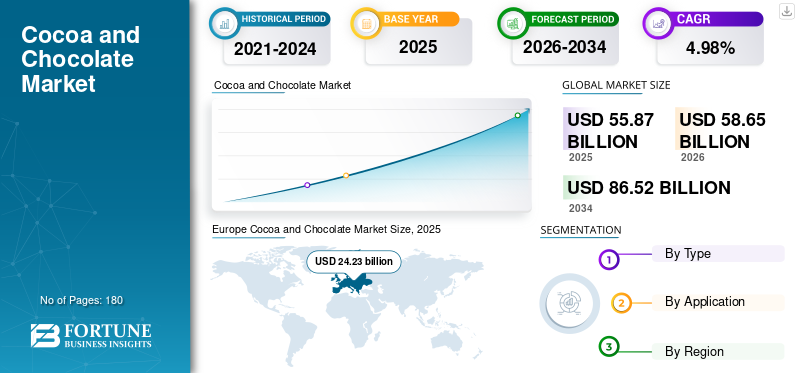
Download Free sample to learn more about this report.
COCOA AND CHOCOLATE MARKET TRENDS
Sustainability Raw Material Procurement Requirement is an Emerging Market Trend
Sustainable sourcing is currently seen as a necessary part of operations, instead of a way to boost brand. Manufacturers are improving direct sourcing, training for farmers, agroforestry projects, support for productivity, child labor monitoring, and checks for deforestation risks. This shift is speeding up due to new regulations, retailer demands, and investor’s expectation. The EU Deforestation Regulation has a huge impact since it enables market to careful inspection and track products including cocoa. Thus, suppliers are focusing more on collecting data from farms, keeping supply chains separate, and maintaining clear records of product movement.
MARKET DYNAMICS
Market Drivers
Download Free sample to learn more about this report.
Expanding Bakery, Confectionery, Dairy, and Beverage Manufacturing Drives Market Growth
As processed-food manufacturing grows, more businesses are using cocoa powder, cocoa liquor, cocoa butter, industrial chocolate, compound coatings, fillings, chips, and inclusions. Bakeries use cocoa and chocolate in cakes, biscuits, pastries, cookies, and fillings. Dairy and frozen-dessert companies add these ingredients to flavored milk, yogurt, ice cream, and desserts. Café chains, beverage companies, snack makers, and nutritional-product producers are also finding new ways to use cocoa beyond traditional sweets. By diversifying, companies rely less on chocolate bars and give cocoa suppliers access to more high-volume food categories.
Market Drivers - Impact & CAGR Contribution (2026–2034)
| Rank | Market Drivers | Overall Impact Rank | CAGR Contribution (2026-2034) | Impact: 2026-2028 | Impact: 2029-2031 | Impact: 2032-2034 |
|---|---|---|---|---|---|---|
| 1 | Premiumization and Persistent Demand for Indulgent Chocolate Products | High | 2.00% | High | High | High |
| 2 | Expanding Use of Cocoa and Chocolate across Food Manufacturing and Foodservice | High | 1.65% | High | High | High |
| 3 | Innovation in Healthier, Plant-Based, Functional and Traceable Chocolate Products | Medium-High | 1.40% | Medium | High | High |
| 4 | Urbanization and Organized Retail Expansion in Emerging Markets | Medium | 1.15% | Medium | High | High |
| 5 | Expansion of E-commerce and Omnichannel Distribution | Medium-Low | 0.85% | Medium | Medium | Medium |
| 6 | Others | Low | 0.50% | Low | Low | Low |
| Total Positive Growth Contribution | 7.55% | |||||
Source: Fortune Business Insights
Market Restraints
Extreme Cocoa-Price Volatility Increases Manufacturing Costs and Suppresses Volume Demand
Cocoa-price volatility is a significant restraint affecting market growth. Production shortfalls, weather disturbances, tight inventories, ageing trees, crop disease, and limited farm productivity have created substantial instability in the cocoa supply chain. For instance, the International Cocoa Organization called the 2024/25 cocoa year a time of historic volatility, with limited production, shrinking stocks, and ongoing weather problems. With increasing cocoa bean prices, cost of manufacturing cocoa liquor, butter, powder, and industrial chocolate rises. To cope with this instability, manufacturers might raise prices, make products smaller, offer fewer promotions, change cocoa usage, or utilize more substitutes and alternative fats. These steps can help protect profits, but they might slow down sales growth, especially in markets where customers are sensitive to price changes.
Realizing the strong demand for certified cocoa ingredients substitutes due to increasing price of cocoa ingredients, major market players such as are also offering a wide range of cocoa butter equivalent blends to meet the market requirements, which is restricting cocoa and chocolate market growth.
Market Restraints - Impact & Negative CAGR Contribution (2026–2034)
| Rank | Market Restraints | Overall Impact Rank | Negative CAGR Contribution (2026-2034) | Impact: 2026-2028 | Impact: 2029-2031 | Impact: 2032-2034 |
|---|---|---|---|---|---|---|
| 1 | Cocoa Supply Concentration, Climate and Disease Risks, and Price Volatility | High | -1.05% | High | High | Medium |
| 2 | Health Concerns and Pressure to Reduce Sugar and Calorie Intake | High | -0.65% | Medium | Medium | High |
| 3 | Rising Sustainability, Traceability and Regulatory Compliance Costs | Medium | -0.38% | High | Medium | Medium |
| 4 | Others | Low | -0.20% | Low | Low | Low |
| Total Negative Growth Impact | -2.28% | |||||
Source: Fortune Business Insights
MARKET OPPORTUNITIES
Expansion of Local Cocoa Processing in Producing Countries Creates Value-Addition Opportunities
Cocoa-producing countries have an opportunity to increase export earnings by processing beans into cocoa liquor, butter, cake, and powder rather than exporting only raw beans. Local grinding can create industrial employment, strengthen technical capabilities, improve foreign-exchange realization, and reduce exposure to lower-value commodity exports. Countries such as Côte d’Ivoire, Ghana, Indonesia, Ecuador, and Brazil are in a good position to attract more investment in cocoa processing, as long as they have strong energy, transport, and financial infrastructure. Additionally, global companies can benefit from working with local processors. These partnerships can make it easier to trace cocoa, shorten some supply chains, and offer access to unique cocoa varieties.
Segmentation Analysis
By Product Type
Broad Industrial Applications and High-Volume Ingredient Consumption Augment Cocoa-Based Compounds and Preparations Segment Dominance
The market is segmented, by product type, into cocoa ingredients, industrial chocolate, and cocoa-based compounds and preparations.
Cocoa-based compounds and preparations segment held the largest cocoa and chocolate market share in 2025. They serve as essential intermediate ingredients across a wide range of food, beverage, bakery, confectionery, dairy, and nutraceutical applications. This segment includes cocoa liquor (mass), cocoa butter, cocoa powder, cocoa nibs, cocoa cake, cocoa coatings, compound coatings, chocolate fillings, cocoa inclusions, and other semi-finished cocoa ingredients supplied primarily to food manufacturers. Their extensive use as functional ingredients rather than finished consumer products results in significantly higher product demand, particularly within the B2B segment.
Industrial chocolate holds the second-largest market share, and is expected to grow at a CAGR of 5.19% during the forecast period. It serves as the primary chocolate input for confectionery manufacturers, bakery processors, ice cream producers, dairy companies, and foodservice operators. Demand for this product continues to increase with the expansion of premium chocolates, artisanal bakery, gourmet desserts, premium beverages, and seasonal chocolate products.
By Nature
Cost Efficiency and Large-Scale Cocoa Procurement Leads to Conventional Products Segment Dominance
Based on nature, the market is segmented into conventional and organic.
Conventional segment accounted for the largest market share in 2025 as they are widely available, have strong global supply chains, and cost less to produce. Most of the world’s cocoa comes from conventional beans, which helps manufacturers get a steady supply of raw materials for making chocolate and cocoa ingredients on a large scale. Most large food manufacturers choose conventional cocoa ingredients as they are easier to source, economical and offer steady availability. Conventional cocoa products are widely used in sweets, baked goods, drinks, dairy items, breakfast cereals, frozen desserts, and foodservice.
Organic segment captures second-largest share of the market and is expected to grow at a CAGR of 5.82% during the forecast period as consumers increasingly seek sustainably produced clean label products with certified organic ingredients and greater supply-chain transparency. Food manufacturers are responding by expanding organic chocolate bars, cocoa powders, baking ingredients, and premium confectionery portfolios to meet demand from health-conscious consumers.
By Form
Efficient Transportation and Industrial Processing Drive Solid Bulk Segment Leadership
The market is segmented, by form, into liquid and semi-liquid, solid bulk, small solid pieces, decorative and inclusion formats, and dry powder.
Solid bulk segment led the global market in 2025. Solid bulk products dominate the market as they represent the preferred commercial format for industrial handling, storage, and transportation across the cocoa value chain. Cocoa liquor blocks, cocoa butter blocks, industrial chocolate blocks, compound coatings, chips, chunks, drops, and couverture products are widely traded in solid bulk form before processing by food manufacturers. Bulk solid formats provide longer shelf life, easier inventory management, reduced transportation costs, and compatibility with automated manufacturing systems.
Dry powder segment is another major segment expected to grow with a CAGR of 5.16% during the forecast period. Dry powder is the second most common form, due to its wide use in drinks, baked goods, dairy products, nutrition items, dessert mixes, and foodservice recipes. Cocoa powder mixes well, can be stored easily, is flexible for different recipes, and can be added to both dry and liquid foods. Manufacturers are using more natural and alkalized cocoa powders in protein drinks, hot chocolate mixes, breakfast cereals, functional foods, baked goods, and desserts. Even though dry powder is used in many industries, its total sales are still lower than those of solid bulk cocoa, which is used more widely in large-scale chocolate production.
To know how our report can help streamline your business, Speak to Analyst
By End Use
Industrial Food Manufacturing and Ingredient Procurement Drive B2B Segment Leadership
The market is segmented, by end use, into B2B and B2C.
B2B segment accounted for the largest market share in 2025 as majority of cocoa ingredients are supplied as industrial raw materials rather than finished consumer products. Chocolate makers, bakeries, dairy processors, beverage and ice cream producers, snack makers, nutraceutical firms, and foodservice operators buy cocoa ingredients in large amounts to use in their products.
B2C segment captured second largest share in the market in 2025 and is expected to register a CAGR of 5.83% during the forecast period as more consumers buy finished cocoa and chocolate products in supermarkets, specialty shops, convenience stores, online, and directly from brands. As consumers look for plant-based ingredient which are premium, single-origin, reduced-sugar, organic, and sustainably sourced chocolate, manufacturers are launching new and unique products to meet these demands.
Cocoa and Chocolate Market Regional Outlook
By geography, the market is categorized into Europe, North America, Asia Pacific, South America, and Middle East & Africa.
Asia Pacific
Europe Cocoa and Chocolate Market Size, 2025 (USD Billion)
To get more information on the regional analysis of this market, Download Free sample
The Asia Pacific market was valued at USD 16.40 billion in 2025. Asia Pacific has a long-term growth prospect due to its fast-growing economies, urbanization, growing middle class population, modern retail, and more investment in bakery, dairy, snack, beverage, and foodservice manufacturing. China, India, Japan, Indonesia, Malaysia, South Korea, and Australia are key markets in the region, each with its own stage of development. Industrial growth in the food sector is making the region’s B2B market even stronger.
India Cocoa and Chocolate Market
The India market in 2025 was valued around USD 2.07 billion, accounting for roughly 2.53% of global market revenues. Personalized nutrition is expected to support market growth by increasing demand for sugar-reduction solutions tailored to different health issues.
China Cocoa and Chocolate Market
China’s market in 2025 was valued around USD 3.97 billion, representing roughly 12.30% of global market share. China is one of the leading producer and has fast-growing consumer base for cocoa and chocolate. China’s low manufacturing costs, strong fermentation capacity, large food-processing industry, and access to natural sweeteners such as stevia and monk fruit help it supply steviol glycosides, monk fruit extracts, erythritol, xylitol, and other sweeteners globally.
Japan Cocoa and Chocolate Market
The Japan market in 2025 reached a valuation of around USD 2.65 billion, accounting for roughly 4.39% of global market revenues.
North America
The market in North America reached a valuation of USD 17.89 billion in 2025. North America is a valuable market, due to rising disposable incomes, a big packaged-food industry, active foodservice, and strong demand for seasonal treats. The U.S. contributes to most of the regional value, while Canada and Mexico strengthen cross-border manufacturing and trade integration. B2B demand is closely tied to the output of confectionery, bakery, dairy, frozen-dessert, cereal, snack, beverage, and nutritional-product manufacturers. The region has a large food-processing industry, where cocoa powder, industrial chocolate, coatings, inclusions, and fillings are used in many products and not in just traditional chocolate treats.
U.S. Cocoa and Chocolate Market
In 2025, the U.S. market reached USD 14.74 billion. The U.S. market is leading in North America region due to its strong economy, high household consumption, and large food manufacturing industry. The U.S. market still relies on imported cocoa beans and cocoa products.
Europe
The European market reached a valuation of USD 27.36 billion in 2025 and is the leading region globally. Europe holds a leading share of the market as it combines high per-capita purchasing power with an extensive cocoa-processing, industrial chocolate, bakery, dairy, and confectionery manufacturing base. Germany, the Netherlands, Belgium, France, Italy, Switzerland, and the U.K. collectively generate substantial B2B demand for cocoa liquor, cocoa butter, cocoa powder, couverture, compound coatings, fillings, and customized chocolate types.
Germany Cocoa and Chocolate Market
The market in Germany, in 2025, reached around USD 5.35 billion, representing roughly 5.46% of global market revenues. Germany is one of Europe’s largest cocoa and chocolate manufacturing centers. Its extensive confectionery, bakery, dairy, and private-label industries generate substantial demand for cocoa liquor, butter, powder, fillings, natural cocoa powder, and industrial chocolate. The country’s mature economy and high household income support premium and seasonal chocolate consumption. Germany’s export-oriented clean-label ingredients manufacturing sector helps offset weakness in domestic demand. The market is therefore influenced by industrial production, energy costs, wage pressures, and demand from neighboring European economies.
U.K. Cocoa and Chocolate Market
The U.K. market reached approximately USD 3.48 billion in 2025, equivalent to around 3.33% of global market sales.
South America and Middle East & Africa
The South America market in 2025 recorded USD 8.03 billion revenue. The market in South America is influenced by uneven economic growth, high inflation in some countries, changing exchange rates, and varying household purchasing power. Brazil leads regional consumption as it has a large population, a strong food-processing industry, and its own cocoa production. Argentina, Colombia, Chile, Peru, and Ecuador also offer more opportunities for both demand and supply. Some of the key cocoa growing countries include Brazil, Ecuador, Peru, and Colombia.
Middle East & Africa region reached a valuation of USD 8.47 billion in 2025. Côte d’Ivoire, Ghana, Nigeria, and Cameroon are economically important to the global B2B market as cocoa exports generate foreign-exchange earnings and support rural employment. Governments are encouraging more domestic grinding to capture a larger share of the value chain through cocoa liquor, butter, cake, and powder production. However, processing investment is affected by energy costs, financing conditions, infrastructure quality, and access to working capital.
UAE Cocoa and Chocolate Market
UAE market is set to grow at a CAGR of 4.23% during the forecast period. The United Arab Emirates leads the Gulf region due to its high per-capita income, modern retail infrastructure, significant food and beverage imports, nutraceutical industry growth and a large hospitality sector.
COMPETITIVE LANDSCAPE
KEY INDUSTRY PLAYERS
Increasing Focus on Base Expansion and Development of Premium Products to Fuel Market Competition
The key cocoa and chocolate market players are actively pondering upon new product launches and base expansion. These manufacturers are extensively working toward expanding their outreach to the consumers as a strategy to strengthen their market presence. Barry Callebaut AG, a leading player, is focused on investing in expanding its product portfolio by introducing new cocoa and chocolate products that appeal to the modern consumer demand.
LIST OF COCOA AND CHOCOLATE COMPANIES PROFILED
- Barry Callebaut, AG (Switzerland)
- Cargill, Inc. (U.S.)
- Olam Group Limited (Singapore)
- Fuji Oil Company Ltd. (Japan)
- ECOM Agroindustrial Corporation Ltd. (Switzerland)
- Cocoa Processing Co. PLC. (Ghana)
- Touton S.A. (France)
- Niche Cocoa Industry Ltd. (Ghana)
- BD Associates Ghana Ltd. (Ghana)
- PLOT Enterprise Ghana Limited (Ghana)
KEY INDUSTRY DEVELOPMENTS
- February 2026: Barry Callebaut introduced its first AI based chocolate development center in Singapore. This facility is aimed to help the company in new product development.
- November 2024: Swiss Chocolate company Lindt announced its plans to boost its presence in the China market.
- March 2024: Cargill India, a subsidiary of Cargill Inc., expanded its product portfolio by unveiling block chocolates, chocolate chips, and cocoa powder products under its NatureFresh Professional brand. The company developed these products for manufacturers from the food & bakery industry across India.
- August 2023: Belgian chocolate brand BENOIT NIHANT expanded its presence in Japan by launching its first flagship store in the country.
- November 2022: Barry Callebaut, a global leader in chocolate and confectionery ingredients manufacturing, invested nearly USD 52.36 million to build a new production facility in India at Neemrana, Delhi. Its new facility will cover about 20,000 sq. meter area, which includes state-of-the-art assembly lines for producing chocolate & compounds and an R&D laboratory.
- January 2022: Blommer Chocolate Company, a subsidiary of Fuji Oil Co., Ltd., announced the opening of an R&D applications lab in downtown Chicago. The new space represents an expansion of R&D capabilities, with new and improved ways to support the business.
REPORT COVERAGE
The cocoa and chocolate market report provides an in-depth study of market size & forecast by all the market segments included in the report. The market analysis includes details on the market dynamics and market trends expected to drive the market during the forecast period. It offers information on the technological advancements, supply chain, new product launches, key industry developments, and details on partnerships, mergers & acquisitions. The market forecast also encompasses detailed competitive landscape with information on the market segmentation, market share and market research of profiles of key operating players.
Request for Customization to gain extensive market insights.
Report Scope and Segmentation
| ATTRIBUTE | DETAILS |
| Study Period | 2021-2034 |
| Base Year | 2025 |
| Estimated Year | 2026 |
| Forecast Period | 2026-2034 |
| Historical Period | 2021-2024 |
| Growth Rate | CAGR of 5.27% from 2026-2034 |
| Unit | Value (USD Billion) |
| Segmentation | By Product Type, By Nature , By Form, By End Use, and Region |
| By Product Type |
|
| By Nature |
|
| By Form |
|
| By End Use |
|
| By Region |
|
Frequently Asked Questions
Fortune Business Insights says that the global market value stood at USD 77.79 billion in 2025 and is projected to reach USD 122.88 billion by 2034.
In 2025, the Europe’s market value stood at USD 27.36 billion.
The market is expected to grow at a CAGR of 5.27% during the forecast period.
By form, solid bulk support segment led the global market in 2025.
Expanding bakery, confectionery, dairy, and beverage manufacturing increases market growth.
Barry Callebaut, AG, Cargill, Inc., Olam Group Limited, and Fuji Oil Company Ltd. are the top players in the market.
Europe held the largest market share in 2025.
Sustainability raw material procurement requirement is one of the major market trend.



- 2021-2034
- 2025
- 2021-2024
- 220
-
(Offer valid till 30th Sep 2026)
Get 30-60 hrs Free Customization
Expand Regional and Country Coverage, Segments Analysis, Company Profiles, Competitive Benchmarking, and End-user Insights.




















Related Reports
-
US +1 833 909 2966 ( Toll Free )
-
Get In Touch With Us