Assembly Automation Market Size, Share & Industry Analysis, By Type (Robotic Assembly Cells, Fixed Automated Assembly Machines, Rotary Indexing Assembly Systems, Linear Transfer Assembly Systems), By Automation Type (Fixed, Programmable, Flexible), By Application (Component Assembly, Fastening & Screwdriving, Welding & Joining, Dispensing & Sealing, Testing & Inspection, Packaging), By End-Use (Automotive, Consumer Electronics & 3C, Medical Devices, Aerospace & Defense, Industrial Machinery, Metal & Fabrication, Consumer Goods, Pharmaceuticals), and Regional Forecast, 2026 – 2034
 Download Free Sample
Assembly Automation Market Size and Future Outlook
 Listen to Audio Version
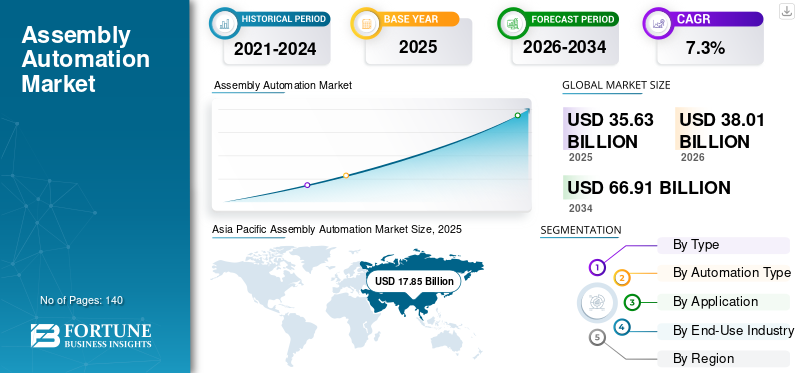
The global assembly automation market size was valued at USD 35.63 billion in 2025. The market is projected to grow from USD 38.01 billion in 2026 to USD 66.91 billion by 2034, exhibiting a CAGR of 7.3% during the forecast period. Asia Pacific dominated the assembly automation market with a market share of 50.09% in 2025.
Assembly automation comprises robotic assembly cells, fixed automated assembly machines, rotary indexing systems, linear transfer systems, feeding and part handling systems, assembly inspection and vision systems, control platforms, sensors, actuators, controllers, end effectors, conveyors, software, and robot automation equipment used to automate product assembly operations across manufacturing environments. These systems support component assembly, fastening and screwdriving, welding and joining, dispensing and sealing, testing and quality inspection, packaging and labeling, material handling, and part feeding across automotive, consumer electronics, medical devices, aerospace and defense, industrial machinery, metal fabrication, consumer goods, pharmaceuticals, semiconductors, telecommunications, and renewable energy applications.
The growing use of robotic assembly cells, machine vision inspection, programmable automation, flexible assembly lines, and AI-enabled production monitoring is helping manufacturers gain a competitive edge, improve throughput, reduce manual errors, optimize labor utilization by supporting human operators, and strengthen product consistency. Increasing adoption of automation technologies, Industry 4.0 practices, real-time monitoring, predictive maintenance, and connected assembly systems is further improving production visibility, reducing downtime, and enhancing supply chain responsiveness across high-volume and high-mix manufacturing operations.
- For instance, in May 2026, FANUC America introduced its Cobot and Go rapid-deployment automation solutions at Automate 2026, showcasing ready-to-deploy collaborative robotic systems designed to improve flexibility, scalability, and faster automation adoption across manufacturing operations.
ABB Ltd., FANUC Corporation, KUKA AG, Yaskawa Electric Corporation, and Mitsubishi Electric Corporation are among the major companies operating in the market.
Download Free sample to learn more about this report.
Assembly Automation Market Key Takeaways
 Global Market Size & Forecast
- 2025 Market Size: USD 35.63 Billion
- 2026 Market Size: USD 38.01 Billion
- 2034 Forecast Market Size: USD 66.91 Billion
- CAGR: 7.3% from 2026–2034
 Market Share
- Asia Pacific dominated the assembly automation market with a 50.09% share in 2025.
- Robotic assembly cells held the largest market share by type in 2025.
- Fixed automation accounted for the largest market share by automation type in 2025.
 Key Regional Highlights
Asia Pacific
Asia Pacific led the market with USD 17.85 billion in 2025, supported by strong electronics, EV, and smart manufacturing investments.
North America led the global market with a 49.53% share in 2025.
North America reached USD 7.08 billion in 2025, driven by advanced manufacturing and high automation adoption.
Europe
Europe is projected to witness steady growth, supported by manufacturing modernization and increasing adoption of flexible automation.
U.S.
The market is estimated at USD 5.48 billion in 2026, driven by advanced manufacturing, EV production, and robotics adoption.
Japan
The market is estimated at USD 2.72 billion in 2026, accounting for approximately 7.2% of global sales.
Read More

ASSEMBLY AUTOMATION MARKET TRENDS
Growing Shift Toward Modular and Reconfigurable Assembly Lines is a Key Market Trend
The market is witnessing a strong shift from rigid, single-product assembly lines toward modular and reconfigurable automation systems that can support frequent product changes, shorter production cycles, and high-mix manufacturing. Manufacturers are increasingly adopting modular assembly workstations, collaborative robot cells, flexible feeding systems, vision-guided inspection units, and plug-and-play control platforms to reduce downtime during product changeovers. This trend is particularly visible across automotive electronics, EV components, medical devices, consumer electronics, and precision industrial products, where product designs change rapidly and production volumes vary by model.
Instead of investing only in dedicated fixed lines, manufacturers are prioritizing scalable automation technologies that allow faster line balancing, easier equipment redeployment, and real-time process adjustments. The growing use of digital twins, simulation tools, and connected controllers is further enabling manufacturers to test assembly layouts virtually before physical deployment. This shift is helping companies improve asset utilization, reduce engineering lead time, and build a stronger competitive edge in fast-changing manufacturing environments.
- For instance, in June 2025, Siemens announced new AI and robotics capabilities for automated production, showcasing how artificial intelligence and robotics are transforming industrial automation and supporting more autonomous manufacturing operations.
MARKET DYNAMICS
MARKET DRIVERS
Download Free sample to learn more about this report.
Rising Adoption of Smart Manufacturing and AI-Enabled Assembly Lines is Driving Market Growth
The assembly automation market growth is increasingly being driven by rising smart manufacturing adoption, growing demand for precision assembly, and increasing integration of AI-enabled robotics across automotive, electronics, medical devices, aerospace, industrial machinery, and consumer goods manufacturing. Manufacturers are investing in robotic assembly cells, fixed automated assembly machines, rotary indexing systems, linear transfer systems, feeding systems, machine vision platforms, and control software to improve throughput, reduce manual errors, and ensure consistent product quality.
Assembly automation solutions play a critical role in supporting fastening, screwdriving, welding, joining, dispensing, sealing, testing, quality inspection, packaging, labeling, and material handling operations. The growing adoption of sensors, controllers, actuators, collaborative robots, AI-based vision inspection, digital twins, and real-time production monitoring is improving line flexibility and enabling high-mix manufacturing.
- For instance, in June 2025, ABB Robotics expanded its large robot portfolio with the launch of IRB 6730S, IRB 6750S, and IRB 6760, powered by OmniCore controllers, to support higher performance, flexibility, and energy efficiency in industrial manufacturing applications.
MARKET RESTRAINTS
High Initial Investment and Integration Complexity Limit Market Expansion
The growth of the market is constrained by high upfront investment, complex system integration, and limited technical readiness among small and mid-sized manufacturers. Assembly automation systems require robotic cells, fixed automation equipment, sensors, controllers, actuators, end effectors, conveyors, machine vision cameras, safety systems, software platforms, installation, programming, commissioning, and maintenance support, which increases total ownership cost compared with manual or semi-automated assembly lines. Many manufacturers also face challenges in integrating automated assembly equipment with legacy machines, existing production layouts, ERP/MES platforms, and quality control systems. In addition, skilled labor shortages in robot programming, vision calibration, PLC configuration, and preventive maintenance can slow deployment.
MARKET OPPORTUNITIES
Expansion of Flexible Assembly Cells and AI-Enabled Robotics is Creating Significant Market Opportunities
A major opportunity emerging within the market is the rapid expansion of flexible assembly cells, AI-enabled robotics, machine vision systems, autonomous material flow, and modular automation platforms across global manufacturing industries. These solutions are enabling automotive, electronics, medical device, aerospace, industrial machinery, and consumer goods manufacturers to automate complex assembly tasks while supporting high-mix, low-volume production requirements. Growing adoption of collaborative robots, robotic assembly cells, digital twins, intelligent controllers, feeding systems, vision-guided inspection, and real-time production monitoring is creating strong opportunities for manufacturers to expand scalable automation portfolios. The opportunity is particularly strong in EV components, electronics miniaturization, battery packs, medical devices, precision machinery, and customized industrial products where quality consistency, faster changeovers, traceability, and labor optimization remain critical priorities.
- For instance, in June 2025, KUKA highlighted artificial intelligence, autonomous mobile robots, and its largest robot ever at automatica 2025, demonstrating “making automation easier” for complex automation industry challenges.
MARKET CHALLENGES
High Integration Complexity, Skilled Labor Shortage, and ROI Uncertainty Hinder Market Growth
One of the major challenges affecting the market is the complexity of integrating assembly automation systems into existing manufacturing environments. Many manufacturers face high upfront costs, limited in-house automation expertise, legacy equipment compatibility issues, and difficulty justifying return on investment for high-mix or low-volume production lines. Assembly automation systems require robotic cells, fixed automation equipment, sensors, controllers, actuators, end effectors, machine vision cameras, safety systems, conveyors, software platforms, programming, commissioning, and maintenance support, which increases total ownership cost. At the same time, manufacturers may struggle with robot programming, PLC integration, vision calibration, product changeovers, operator training, and preventive maintenance. In developing markets, limited technical support, fragmented supplier networks, and budget constraints further slow adoption. These factors create ongoing challenges for assembly automation providers and end users seeking scalable, flexible, and cost-effective automation deployment.
Segmentation Analysis
By Type
Robotic Assembly Cells Segment Led Market Owing to Their Wider Adoption in High-Precision Manufacturing Lines
By type, the market is segmented into robotic assembly cells, fixed automated assembly machines, rotary indexing assembly systems, linear transfer assembly systems, feeding & part handling systems, assembly inspection & vision systems, control & monitoring systems, and others.
Robotic assembly cells held the largest market share in 2025. The segment growth is driven by the rapid adoption of articulated robots, SCARA robots, collaborative robots, end effectors, sensors, controllers, and integrated assembly workstations across automotive, electronics, medical devices, aerospace, industrial machinery, and consumer goods manufacturing. Compared with fixed automated assembly machines, robotic assembly cells offer higher flexibility, faster redeployment, and better suitability for high-mix production, making them preferred for fastening, component assembly, dispensing, joining, testing, packaging, and material handling operations. Their ability to improve throughput, reduce manual dependency, enhance repeatability, and support precision assembly continues to strengthen adoption across discrete manufacturing industries.
- For instance, in May 2025, DENSO Robotics announced that it would showcase its high-performance robots at Automate 2025, including live demonstrations of its precision 4-axis, 6-axis, and collaborative models for advanced robotic automation applications.
Assembly inspection & vision systems are expected to witness the highest growth rate, with a CAGR of 8.1% in the coming years. The segment growth is driven by rising demand for AI-based defect detection, automated quality inspection, traceability, dimensional verification, and real-time process monitoring. Growing adoption of machine vision cameras, smart sensors, deep learning inspection software, and vision-guided robotics is accelerating their use across electronics, medical devices, automotive components, battery packs, and precision assembly lines.
To know how our report can help streamline your business, Speak to Analyst
By Automation Type
Fixed Automation Segment Led Market as It Delivers Higher Throughput and Stable Process Control
By automation type, the market is segmented into fixed automation, programmable automation, and flexible automation.
Fixed automation held the largest assembly automation market share in 2025. The segment growth is attributed to the higher deployment of dedicated assembly machines, rotary indexing systems, linear transfer lines, fastening stations, dispensing units, feeding systems, and automated inspection stations across high-volume manufacturing environments. Fixed automation is widely used in automotive components, consumer electronics, appliances, medical devices, packaging-linked assembly, and industrial machinery production where repeatability, speed, cycle-time reduction, and consistent output quality are critical. Compared with programmable and flexible automation, fixed automation remains preferred for standardized products and large-batch production as it delivers higher throughput, lower per-unit assembly cost, and stable process control.
Flexible automation is expected to witness the highest growth rate, with a CAGR of 8.4% in the coming years. The segment growth is driven by increasing demand for high-mix production, faster product changeovers, collaborative robots, vision-guided assembly, modular workstations, and AI-enabled line optimization.
By Application
Rising Need for Quick Cycle Times and Consistent Product Quality Boosted Component Assembly Segment Growth
By application, the market is segmented into component assembly, fastening & screwdriving, welding & joining, dispensing & sealing, testing & quality inspection, packaging & labeling, material handling & feeding, and others.
Component assembly held the largest market share in 2025, driven by its extensive use across automotive, electronics, medical devices, aerospace, industrial machinery, consumer goods, and electrical equipment manufacturing. Assembly automation systems are widely deployed for placing, aligning, inserting, joining, handling, and validating components across high-volume and precision manufacturing lines. Compared with other applications, component assembly accounts for the largest share as it forms the core operation in most automated production environments and requires robotic cells, fixed assembly machines, feeding systems, transfer systems, sensors, controllers, and end effectors. Rising demand for faster cycle times, lower manual dependency, improved repeatability, and consistent product quality continues to strengthen adoption of automated component assembly solutions globally.
Testing & quality inspection is expected to witness the highest growth rate, with a CAGR of 8.6% in the coming years. The segment growth is driven by increasing demand for AI-based defect detection, vision-guided inspection, traceability, dimensional verification, torque validation, leak testing, and real-time quality monitoring.
By End-Use Industry
Automotive Segment Led the Market Owing to High Deployment of Automated Assembly Lines
By end-use industry, the market is segmented into automotive, consumer electronics & 3C, medical devices, aerospace & defense, industrial machinery, metal & fabrication, consumer goods, pharmaceuticals, and others.
The automotive segment held the largest market share in 2025. The segment growth is driven by the high deployment of robotic assembly cells, fixed automated assembly machines, rotary indexing systems, linear transfer systems, feeding systems, machine vision platforms, and control systems across vehicle, EV, battery, powertrain, electronics, and component assembly lines. Automotive manufacturers require assembly automation to improve cycle time, reduce labor dependency, maintain repeatability, enhance traceability, and ensure consistent quality across high-volume production environments.
Medical devices are expected to witness the highest growth rate, with a CAGR of 8.7% in the coming years. The segment growth is driven by rising demand for cleanroom-compatible assembly, micro-component handling, automated inspection, traceability, validation, and high-precision manufacturing.
Assembly Automation Market Regional Outlook
By geography, the market is categorized into Europe, North America, Asia Pacific, South America, and the Middle East & Africa.
Asia Pacific
Asia Pacific Assembly Automation Market Size, 2025 (USD Billion)
To get more information on the regional analysis of this market, Download Free sample
Asia Pacific led the market with USD 17.85 billion in 2025. Growth is supported by rising electronics production, EV battery manufacturing, automotive assembly, semiconductor investments, and smart factory adoption across China, India, Japan, South Korea, ASEAN, Oceania, and the rest of Asia Pacific. Demand for robotic assembly cells, fixed automated machines, feeding systems, machine vision, control platforms, and AI-enabled inspection software is increasing as manufacturers focus on higher throughput, reduced labor dependency, quality consistency, and precision assembly.
China Assembly Automation Market
China’s market is projected to remain the dominant one in the Asia Pacific region, with 2026 revenues estimated at around USD 8.20 billion, representing roughly 21.6% of global sales.
Japan Assembly Automation Market
The Japanese market in 2026 is estimated at around USD 2.72 billion, accounting for roughly 7.2% of global sales.
India Assembly Automation Market
The Indian market in 2026 is estimated at around USD 1.88 billion, accounting for roughly 4.9% of global sales.
North America
The market in North America accounted for USD 7.08 billion in 2025, supported by mature manufacturing infrastructure, strong adoption of robotic assembly cells, reshoring initiatives, and rising demand for flexible automation across the U.S., Canada, and Mexico. Labor shortages, high manufacturing wages, EV component production, medical device manufacturing, aerospace assembly, and growing investment in smart factories strongly influence regional demand. The region benefits from established automation integrators, strong industrial robotics adoption, advanced quality standards, and wider deployment of machine vision, control systems, collaborative robots, and AI-enabled production monitoring. Assembly automation adoption remains particularly strong across automotive, electronics, aerospace, medical devices, industrial machinery, and consumer goods manufacturing.
U.S. Assembly Automation Market
The U.S. is expected to dominate the market with an estimated revenue of about USD 5.48 billion in 2026, driven by its large advanced manufacturing base, strong aerospace and defense sector, expanding EV and battery production, and high adoption of robotic assembly systems. Demand for assembly automation remains particularly strong across automotive components, electronics, medical devices, industrial machinery, semiconductors, and precision manufacturing applications requiring robotic assembly cells, machine vision systems, automated testing, feeding systems, and control platforms. The country continues to witness investments from manufacturers, automation integrators, robotics providers, and industrial software companies seeking to improve productivity, reduce labor dependency, enhance traceability, and support high-mix production.
Europe
The European market is expected to witness steady growth during the forecast period. Market growth in the region is driven by advanced manufacturing modernization, rising adoption of flexible automation, increasing demand for machine vision inspection, and strong deployment of assembly automation across Germany, the U.K., France, Italy, Spain, BENELUX, Nordics, Russia, and the rest of Europe. Regional demand is closely associated with automotive manufacturing, industrial machinery, aerospace, medical devices, electronics, pharmaceuticals, and precision engineering. Europe remains one of the most important value-intensive markets as manufacturers increasingly prioritize energy-efficient production, quality consistency, worker safety, digital manufacturing, and automated quality validation. Germany, Italy, France, and the U.K. remain key contributors, while Central and Eastern Europe are gaining traction due to automotive components, electronics assembly, and nearshoring-led manufacturing expansion.
U.K. Assembly Automation Market
The U.K. market in 2026 is estimated at around USD 0.96 billion, representing roughly 2.5% of global sales.
Germany Assembly Automation Market
Germany’s market is projected to reach approximately USD 2.65 billion in 2026, equivalent to around 7.0% of global sales.
Middle East & Africa
The Middle East & Africa market is driven by rising industrial diversification, smart manufacturing investments, and growing demand for assembly automation across GCC countries, South Africa, North Africa, Israel, and other regional markets. Demand is closely linked to automotive components, electronics assembly, medical devices, packaging, metal fabrication, defense manufacturing, and industrial machinery production. GCC countries lead regional adoption due to stronger capital investment, manufacturing localization programs, and higher deployment of robotic assembly cells, fixed automated machines, feeding systems, machine vision platforms, and control systems. Israel shows strong growth in precision automation, driven by electronics, defense technology, and medical device manufacturing.
GCC Assembly Automation Market
The GCC market is projected to reach around USD 0.32 billion in 2026, representing roughly 0.8% of the global sales.
South America
The market in South America is driven by rising industrial modernization, automation upgrades, and demand for assembly automation across Brazil, Argentina, Chile, Colombia, Peru, and other regional economies. Demand is mainly linked to automotive components, consumer goods, appliances, packaging, metal fabrication, industrial machinery, and electrical equipment manufacturing. Brazil leads regional adoption due to its larger manufacturing base and stronger use of robotic assembly cells, fixed automated machines, feeding systems, and inspection solutions.
Brazil Assembly Automation Market
The Brazilian market is projected to reach around USD 0.70 billion in 2026, representing roughly 1.9% of the global sales.
COMPETITIVE LANDSCAPE
Key Industry Players
Competitive Advantage Driven by Robotics Integration, Machine Vision, and Flexible Assembly Capabilities
The assembly automation market is moderately fragmented, with competitive positioning shaped by robotic assembly cells, fixed automation systems, machine vision platforms, control software, feeding technologies, and system integration capabilities. Leading companies, including ABB Ltd., FANUC Corporation, KUKA AG, Yaskawa Electric Corporation, and Mitsubishi Electric Corporation, maintain strong positions through robotic cells, SCARA robots, collaborative robots, controllers, sensors, end effectors, transfer systems, and automated inspection solutions.
Competitive differentiation is increasingly influenced by the ability to provide flexible automation, AI-enabled vision inspection, modular assembly workstations, faster changeover systems, predictive monitoring, and end-to-end integration with MES, PLC, and production control platforms. Companies are investing in robotics, digital manufacturing, collaborative automation, and precision assembly technologies to improve throughput, traceability, quality consistency, and labor productivity across automotive, electronics, medical devices, aerospace, and industrial machinery applications.
- For instance, in March 2025, Mitsubishi Electric Automation launched RH-10CRH and RH-20CRH SCARA robots, designed for applications including assembly, coating, and precision conveyance, strengthening its robotic automation portfolio.
LIST OF KEY ASSEMBLY AUTOMATION COMPANIES PROFILED
- ABB Ltd. (Switzerland)
- FANUC Corporation (Japan)
- KUKA AG (Germany)
- Yaskawa Electric Corporation (Japan)
- Mitsubishi Electric Corporation (Japan)
- Siemens AG (Germany)
- Rockwell Automation, Inc. (U.S.)
- Bosch Rexroth AG (Germany)
- Omron Corporation (Japan)
- Denso Corporation (Japan)
KEY INDUSTRY DEVELOPMENTS
- May 2026: Comau and OMRON Robotics signed a strategic collaboration agreement to accelerate the adoption of advanced industrial automation solutions across light industry, electronics, semiconductors, and medical manufacturing.
- October 2025: Rockwell Automation announced that the first OTTO autonomous mobile robots rolled off the production line at its Milwaukee headquarters, strengthening its smart manufacturing and industrial automation capabilities.
- October 2025: Epson Robots showcased its high-performance SCARA, 6-Axis, and automation solutions at The ASSEMBLY Show 2025, supporting manufacturers facing labor shortages, reshoring, and demand for flexible production.
- July 2025: Yaskawa launched the MOTOMAN-GP10 robot with 10 kg payload capacity and 1,101 mm maximum reach, expanding its compact robot lineup for high-precision industrial automation applications.
- June 2025: Stäubli introduced Robotics Suite 2025 and showcased mobile robotics solutions, including cleanroom-compatible automation platforms, strengthening its digital and robotic automation portfolio.
REPORT COVERAGE
The global assembly automation market analysis includes a comprehensive study of the market size & forecast by all the market segments included in the report. It includes details on the market dynamics and market trends expected to drive the market over the forecast period. It provides information on key aspects, including an overview of technological advancements, the regulatory environment, and product launches. Additionally, it details partnerships, mergers & acquisitions, and key industry developments and prevalence by key regions. The global market research report also provides a depth competitive landscape with information on the market share and profiles of key operating players.
Request for Customization to gain extensive market insights.
Report Scope & Segmentation
| ATTRIBUTE | DETAILS |
| Study Period | 2021-2034 |
| Base Year | 2025 |
| Estimated Year | 2026 |
| Forecast Period | 2026-2034 |
| Historical Period | 2021-2024 |
| Growth Rate | CAGR of 7.3% from 2026 to 2034 |
| Unit | Value (USD Billion) |
| Segmentation | By Type, Automation Type, Application, End-Use Industry, and Region |
| By Type |
|
| By Automation Type |
|
| By Application |
|
| By End-Use Industry |
|
| By Region |
|
Frequently Asked Questions
According to Fortune Business Insights, the global market value stood at USD 38.01 billion in 2026 and is projected to reach USD 66.91 billion by 2034.
In 2025, North Americas market value stood at USD 7.08 billion.
The market is expected to exhibit a CAGR of 7.3% during the forecast period (2026-2034).
By end-use industry, the automotive segment led the market.
Rising adoption of smart manufacturing and AI-enabled assembly lines is driving market growth.
ABB Ltd., Yaskawa Electric Corporation, Mitsubishi Electric Corporation, Siemens AG, and Bosch Rexroth AG are the top players in the market.
Asia Pacific held the largest market share in 2025.


- 2021-2034
- 2025
- 2021-2024
- 140
Get 30-60 hrs Free Customization
Expand Regional and Country Coverage, Segments Analysis, Company Profiles, Competitive Benchmarking, and End-user Insights.















Related Reports
-
US +1 833 909 2966 ( Toll Free )
-
Get In Touch With Us