Automotive Curtain Airbags Market Size, Share & Industry Analysis, By Vehicle Type (Hatchbacks, Sedans, SUVs, Vans, Pickup Trucks, and HCVs), By Airbag Type (Rollover and Full-Length), By Material Type (Silicone-Coated Nylon, Neoprene-Coated Nylon, and Uncoated Woven Nylon), By Inflator Type (Pyrotechnic Inflators, Hybrid Gas Inflators, and Compressed Gas Inflators), By Component (Airbag Fabric Module, Inflator Module, Sensors, ECU, and Folding & Packaging Module), By Propulsion (ICE and Electric), and Regional Forecast, 2026-2034
 Download Free Sample
(Offer valid till 15th Oct 2026)

KEY MARKET INSIGHTS
 Listen to Audio Version
The global automotive curtain airbags market size was valued at USD 3.03 billion in 2025 and is projected to grow from USD 3.18 billion in 2026 to USD 5.29 billion by 2034, exhibiting a CAGR of 6.6% during the forecast period. Asia Pacific dominated the global automotive curtain airbags market with a market share of 57.43% in 2025.
Automotive curtain airbags are side-impact safety systems installed along a vehicle’s roofline that deploy downward such as a protective curtain. This is to ensure safety during collisions or rollovers, shielding occupants’ heads and upper bodies, reducing injury risk, and enhancing overall passenger protection across front and rear seating rows. The market is driven by rising safety regulations, increasing vehicle production, growing consumer demand for enhanced protection, higher adoption in mid-range cars, technological advancements, and greater focus on reducing side-impact and rollover fatalities.
Major players in the automotive curtain airbags market include Autoliv, ZF Friedrichshafen, Joyson Safety Systems, and Toyoda Gosei. These companies compete by advancing airbag deployment technology, enhancing sensor integration, improving lightweight materials, and expanding global manufacturing. Additionally, they collaborate with automakers to meet stringent safety regulations, reduce side-impact injuries, and support wider adoption across vehicle segments.
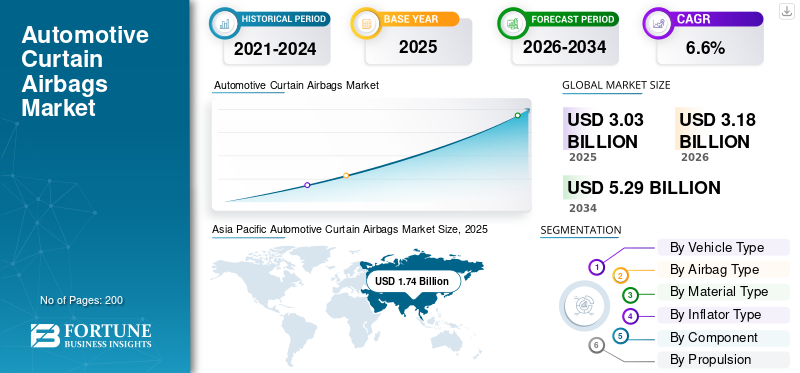
Download Free sample to learn more about this report.
Automotive Curtain Airbags Market Takeaways
 Market Size & Forecast
- 2025 Market Size: USD 3.03 Billion
- 2026 Market Size: USD 3.18 Billion
- 2034 Forecast Market Size: USD 5.29 Billion
- CAGR: 6.6% from 2026–2034
 Market Share
- Asia Pacific dominated the automotive curtain airbags market with a 57.43% share in 2025.
- The SUVs segment held the largest share by vehicle type in 2025.
- The full-length curtain airbags segment accounted for the largest share by airbag type in 2025.
 Key Regional Highlights
North America
North America held the second-largest market share due to stringent crash safety regulations.
Europe
Europe witnessed steady growth driven by rigorous safety standards and premium vehicle adoption.
Asia Pacific
Asia Pacific led the global market, supported by strong vehicle production and rising safety awareness.
U.S.
Strong demand for SUVs and strict safety regulations continue to support curtain airbag adoption.
Japan
Advanced automotive manufacturing and increasing focus on occupant safety drive market growth.
Read More

MARKET DYNAMICS
MARKET DRIVERS
Stringent Safety Regulations Significantly Accelerate Market Expansion
Growing global emphasis on occupant protection is driving strong demand for curtain airbags. Governments in North America, Europe, and Asia are continuously updating crash-test protocols and mandating enhanced side-impact performance. Automakers must integrate automotive curtain airbags to comply with these evolving regulations, strengthening adoption across mass-market and premium vehicles. As safety ratings influence purchasing decisions, manufacturers increasingly prioritize curtain airbag deployment to maintain competitiveness, elevate brand perception, and satisfy insurance-related safety technology requirements. In November 2025, the Indian government regulations proposed Bharat NCAP 2.0, expanding crash-tests to five types, adding pedestrian- and post-crash-safety assessments, and mandating features such as electronic stability control and curtain airbags, significantly raising vehicle safety-rating standards.
MARKET RESTRAINTS
High System and Integration Costs Restrain Wider Market Penetration
Despite rising adoption, advanced curtain airbag systems remain costly due to specialized inflators, sensors, and precision installation requirements. These expenses are particularly challenging for entry-level vehicle segments and automakers operating in price-sensitive markets. Higher engineering complexity, calibration needs, and compliance testing further increase development costs. As manufacturers balance affordability with safety, the financial burden associated with integrating reliable automotive curtain airbags limits adoption speed and restricts penetration in emerging economies where cost constraints dominate purchasing decisions.
MARKET OPPORTUNITIES
Lightweight Material Innovations Create Attractive Growth Opportunities
The shift toward sustainable, lightweight automotive design presents a substantial opportunity for curtain airbag suppliers. Innovations in high-strength fabrics, compact inflators, and weight-optimized mounting modules help automakers reduce vehicle mass to meet fuel-efficiency and emissions targets. Suppliers investing in recyclable textiles, advanced weaving techniques, and modular architectures can secure new partnerships. As global OEMs prioritize lighter yet high-performance safety systems, technological advancements in materials will unlock additional contracts, market differentiation, and revenue expansion. In June 2024, Autoliv introduced curtain-airbag cushions made from 100% recycled polyester, cutting greenhouse gas emissions by around 50% while maintaining safety performance, a major step toward sustainable automotive safety.
MARKET CHALLENGES
Ensuring Reliable Deployment across Diverse Real-World Scenarios Remains a Challenge
A critical challenge for manufacturers is achieving consistent, reliable curtain airbag deployment across varied crash conditions, temperatures, and vehicle configurations. Automotive curtain airbags must inflate correctly during side collisions, rollovers, or severe angles, without accidental deployment. Validating performance across global markets requires extensive testing, simulation, and compliance verification, increasing complexity. Differences in body platforms, occupant positions, and aftermarket modifications further complicate reliability engineering, making deployment accuracy a persistent technical obstacle for industry players.
AUTOMOTIVE CURTAIN AIRBAGS MARKET TRENDS
Integration of Smart Sensors and Advanced Electronics Emerges as a Key Trend
A key automotive curtain airbags market trend is the integration of curtain airbags with intelligent electronic systems, including side-impact sensors, rollover detection units, and predictive crash algorithms. These enhancements enable faster, more accurate deployment, improving occupant protection across diverse crash scenarios. Automakers increasingly adopt networked vehicle architectures, making sensor-airbag synchronization crucial. As digitalization accelerates, suppliers are focusing on diagnostic capabilities, software-driven performance tuning, and seamless electronic integration, reflecting the broader shift toward smarter and safer vehicle ecosystems.
Download Free sample to learn more about this report.
Segmentation Analysis
By Vehicle Type
Advanced Safety Prioritization Strengthens SUV Adoption of Curtain Airbags
Based on vehicle type, the market is segmented into hatchbacks, sedans, SUVs, vans, pickup trucks, and HCVs. SUVs dominate curtain airbag adoption due to their global popularity, larger cabin dimensions, and higher rollover propensity. Automakers increasingly prioritize advanced passive safety systems in SUVs to meet stringent regulations and achieve superior crash-test ratings. Consumers prefer SUVs for family use, further driving demand for robust head-protection solutions. Manufacturers integrate multi-row automotive curtain airbags to enhance occupant safety across all seating positions.
As SUV sales surge in North America, Europe, and Asia, their substantial production volumes reinforce their leading automotive curtain airbags market share. Rapid SUV sales growth, greater focus on family safety, and wider multi-row airbag integration make SUVs the fastest-expanding segment in the automotive curtain airbags market forecast period. In October 2025, Hyundai Motor Company unveiled its all-new electric SUV ELEXIO, featuring a nine-airbag system including extended side airbags as curtains to enhance passenger safety in electric-vehicle adoption.
By Airbag Type
Enhanced Multi-Row Occupant Protection Drives Full-Length Curtain Airbag Demand
By airbag type, the market is bifurcated into rollover and full-length. Full-length curtain airbags dominate the market due to their ability to protect all seating rows, offering comprehensive head coverage during side-impact collisions. Automakers increasingly install them across mass-market and premium models to meet evolving global safety standards and consumer expectations. Their broad deployment footprint, compatibility with diverse vehicle architectures, and proven effectiveness in improving crash-test ratings strengthen their leadership.
As SUVs, MPVs, and sedans emphasize multi-occupant safety, full-length curtain airbags maintain the highest adoption rate and largest market share. In July 2025, Ford Motor Company filed a patent for a full-width side curtain airbag concept, potentially expanding curtain-airbag coverage across future U.S. vehicles beyond conventional side-window protection. Growing demand for advanced rollover protection and heightened SUV adoption accelerate the rapid market expansion of rollover automotive curtain airbags.
By Material Type
High Durability and Heat Resistance Strengthen Silicone-Coated Nylon Airbag Dominance
Based on material type, the market is divided into silicone-coated nylon, neoprene-coated nylon, and uncoated woven nylon. Silicone-coated nylon dominates the curtain airbag material segment due to its superior heat resistance, controlled gas permeability, and excellent durability during rapid inflation. Automakers rely on this material to meet stringent global safety and performance standards, especially for full-length automotive curtain airbags requiring stable deployment across various crash scenarios.
Its consistent quality, compatibility with advanced inflators, and proven reliability in mass-production platforms ensure widespread adoption. As manufacturers prioritize long-term safety performance, silicone-coated nylon continues to lead material usage across vehicle categories. Lower material cost, reduced weight, and ongoing improvements in fabric strength make uncoated woven nylon the fastest-growing curtain airbag material.
By Component
Critical Structural Role and Broad Vehicle Integration Boost Airbag Fabric Module Demand
By component, the market is sub-segmented into airbag fabric module, inflator module, sensors, ECU, and folding & packaging module.
The airbag fabric module dominates the component segment because it forms the essential structure responsible for protecting occupants during deployment. Its high-volume requirement across all vehicle classes, combined with continuous advancements in weaving techniques and material strength, reinforces its leadership. Automakers prioritize robust, multi-row curtain airbag fabrics to meet stringent global crash standards and enhance side-impact performance.
As SUVs and family vehicles expand worldwide, demand for dependable, lightweight, and durable fabric modules remains significantly higher than other component categories. Increasing adoption of advanced crash detection, faster response algorithms, and electronic integration drives rapid growth in curtain airbag sensor demand.
To know how our report can help streamline your business, Speak to Analyst
By Propulsion
Large Vehicle Parc and Established Production Volumes Reinforce the ICE Segment
Based on propulsion, the market is categorized by ICE and electric. Internal combustion engine (ICE) vehicles dominate curtain airbag adoption due to their vast global fleet, extensive manufacturing base, and widespread availability across all price segments. Automakers equip ICE models with full-length and rollover curtain airbags to meet evolving safety regulations and maintain competitive crash ratings. Their high annual production volumes, strong presence in developing markets, and broader model diversity create consistently higher automotive curtain airbags market demand.
As ICE vehicles remain mainstream in many regions, they continue to hold the largest market share. In May 2025, Maruti Suzuki Arena announced that several of its popular models, including the WagonR, Alto K10, Celerio, and Eeco, would be equipped with six airbags as standard, including curtain airbags, elevating occupant protection even in budget-segment passenger cars and commercial vehicles. Rising EV sales, new platform designs, and heightened emphasis on integrated occupant protection make electric vehicles the fastest-growing curtain airbag segment.
By Inflator Type
Proven Reliability and Rapid Deployment Sustain Pyrotechnic Inflator Market Leadership
By inflator type, the market is categorized into pyrotechnic inflators, hybrid gas inflators, and compressed gas inflators. Pyrotechnic inflators dominate the curtain airbag market due to their long-established reliability, rapid deployment capability, and compatibility with a wide range of vehicle architectures. Automakers prefer these inflators for their proven performance in side-impact and rollover protection, cost-effectiveness, and simpler integration compared to advanced systems.
Their extensive use across mass-produced vehicles, coupled with consistent compliance with global safety regulations, reinforces their dominance. As demand for dependable and scalable airbag solutions remains strong, pyrotechnic inflators maintain the largest market share. Superior inflation control, reduced thermal stress, and rising adoption in premium safety architectures make hybrid gas inflators the fastest-growing category. In December 2024, ZF LIFETEC broke ground at its Xi’an facility to expand airbag-inflator production capacity and build a dedicated R&D center, supporting growing global demand and hybrid inflator innovation.
Automotive Curtain Airbags Market Regional Outlook
By geography, the market is categorized into Europe, North America, Asia Pacific, and the rest of the world.
Asia Pacific
Asia Pacific Automotive Curtain Airbags Market Size, 2025 (USD Billion) To get more information on the regional analysis of this market, Download Free sample
Asia Pacific dominates the automotive curtain airbag market due to massive vehicle production in China, India, Japan, and Southeast Asia. Rising adoption of SUVs, growing consumer focus on safety, and stricter regulatory frameworks accelerate the curtain airbag integration. Expanding middle-class purchasing power and rapid urbanization further boost demand. Strong OEM manufacturing bases, localization of airbag production, and wider deployment in mid-range models reinforce the region’s leadership, making it a central hub for global market expansion. The region also represents the fastest-growing market, driven by increasing safety awareness, accelerating EV adoption, and expanding premium vehicle sales across China and ASEAN nations. Government-led safety initiatives and crash-test program upgrades push automakers to integrate curtain airbags across more models. In September 2025, the Toyota Rumion MPV in India got six-airbag safety across all variants, including curtain shield airbags for better occupant protection in its seven-seater configuration.
North America
North America holds the second-largest share in the market of automotive curtain airbags due to stringent crash regulations, strong SUV and pickup demand, and high consumer preference for advanced safety features. U.S. NCAP updates and rollover-focused safety norms drive widespread curtain airbag adoption across vehicle segments. The region benefits from technologically advanced OEMs, a strong presence of leading airbag suppliers, and ongoing investments in smarter deployment systems. Continued demand for family vehicles and premium models ensures stable, long-term curtain airbag market expansion.
The U.S. is one of the most influential contributors to the North American automotive curtain airbags industry, driven by strict NHTSA safety standards, updated U.S. NCAP protocols, and heightened emphasis on rollover protection. The country’s strong consumer shift toward SUVs, crossovers, and pickup trucks significantly boosts demand for multi-row curtain airbags. Leading automakers focus heavily on advanced side-impact protection to maintain competitive safety ratings. Continued investment in smart sensors, electronic integration, and premium vehicle features further accelerates automotive curtain airbags market growth in the U.S.
Europe
Europe’s growth is supported by rigorous Euro NCAP requirements, high adoption of premium and luxury vehicles, and consumer demand for top-tier occupant protection. Automakers prioritize multi-row curtain airbags to maintain safety ratings amid tougher crash protocols. Germany, France, and the U.K. lead integration, while electrification and lightweighting trends boost innovation in airbag materials and inflators. Continued focus on advanced electronics, intelligent crash detection, and in-house OEM safety development drives consistent regional market progression. In September 2025, Firefly, a compact electric car by NIO, earned a 5-star rating from Euro NCAP, with standard ultra-long side curtain airbags among its comprehensive airbag suite, boosting occupant and side-impact safety.
Rest of the World
The rest of the world markets, including South America, the Middle East, and Africa, experience steady expansion as governments tighten safety norms and consumer awareness increases. Growing SUV sales, rising automotive imports, and gradual localization of component manufacturing support curtain airbag adoption. Although cost sensitivity remains a barrier, multinational OEMs are offering more vehicles equipped with advanced safety features. Infrastructure development, urban growth, and expanding middle-income populations contribute to long-term demand for improved occupant safety systems.
COMPETITIVE LANDSCAPE
Key Industry Players
Technological Innovation, Global Footprint, and OEM Collaboration Define Curtain Airbag Competitiveness
The automotive curtain airbags market competitive landscape is shaped by advanced material innovation, precision inflator technology, and strong partnerships with global automakers. Key players such as Autoliv, ZF, Joyson Safety Systems, and Toyoda Gosei compete through extensive manufacturing networks, rapid deployment reliability, and integration of smart sensors. Companies increasingly focus on lightweight fabrics, scalable architectures, and compliance with evolving safety standards. Continuous R&D investment, localized production, and expansion into emerging markets further intensify industry competitiveness.
LIST OF KEY AUTOMOTIVE CURTAIN AIRBAGS MARKET COMPANIES PROFILED
- Autoliv (Sweden)
- ZF Friedrichshafen (Germany)
- Joyson Safety Systems (U.S.)
- Toyoda Gosei (Japan)
- Hyundai Mobis (South Korea)
- Ashimori Industry (Japan)
- Yanfeng (China)
- Sumisho Airbag Systems (Japan)
- Kolon Industries (South Korea)
- Toray Industries (Japan)
- Toyobo (Japan)
- Milliken & Company (U.S.)
- Seiren Co., Ltd. (Japan)
- Zodiac Automotive (France)
- Indorama Ventures Mobility (Thailand)
- Continental AG (Germany)
KEY INDUSTRY DEVELOPMENTS
- July 2025: Toyota updated the Rumion MPV in India with six airbags, including full-length curtain airbags, standard across all variants. The upgrade enhances protection for all three seating rows, aligning with rising customer expectations and upcoming safety norms. Toyota’s move reflects a wider industry shift toward mass-market adoption of curtain-airbag systems.
- July 2024: Kia’s EV9 received global praise after launching with a comprehensive airbag suite that includes extended-coverage curtain airbags protecting all three rows. Media coverage highlighted the SUV’s robust side-impact performance and family-focused safety engineering. The EV9’s design demonstrates growing regional emphasis on multi-row curtain-airbag integration in premium electric SUVs.
- April 2024: Toyoda Gosei inaugurated its new airbag-manufacturing plant in Haryana, India, expanding output for curtain airbags, driver airbags, passenger airbags, and inflators. The facility strengthens supply for major automakers in India as demand surges for curtain-airbag integration driven by upcoming safety mandates and growing multi-airbag adoption.
- January 2025: Maruti Suzuki announced that all its passenger cars will offer six airbags, including side-curtain airbags, as standard by the end of 2025. This marks a major safety transformation for India’s largest automaker, accelerating nationwide adoption of curtain airbags in entry-level hatchbacks, compact sedans, and high-volume utility vehicles.
- April 2025: Toyota updated the Urban Cruiser Taisor lineup with standardized safety features, including six airbags, integrating curtain airbags on all variants. The upgrade enhances side-impact protection for occupants and aligns Toyota with India’s evolving crash-safety expectations, making curtain-airbag protection more widely accessible in compact SUV segments.
REPORT COVERAGE
Request for Customization to gain extensive market insights.
Report Scope & Segmentation
|
ATTRIBUTE |
DETAILS |
|
Study Period |
2021-2034 |
|
Base Year |
2025 |
|
Estimated Year |
2026 |
|
Forecast Period |
2026-2034 |
|
Historical Period |
2021-2024 |
|
Growth Rate |
CAGR of 6.6% from 2026-2034 |
|
Unit |
Value (USD Billion) |
|
Segmentation |
By Vehicle Type, Airbag Type, Material Type, Inflator Type, Component, Propulsion, and Region |
|
Vehicle Type |
· Hatchbacks · Sedans · SUVs · Vans · Pickup Trucks · HCVs |
|
Airbag Type |
· Rollover Curtain Airbags · Full-Length Curtain Airbags |
|
Material Type |
· Silicone-Coated Nylon · Neoprene-Coated Nylon · Uncoated Woven Nylon |
|
Inflator Type |
· Pyrotechnic Inflators · Hybrid Gas Inflators · Compressed Gas Inflators |
|
Component |
· Airbag Fabric Module · Inflator Module · Sensors · ECU · Folding & Packaging Module |
|
Propulsion |
· ICE · Electric |
|
By Geography |
· North America (By Vehicle Type, Airbag Type, Material Type, Inflator Type, Component, Propulsion, and Country) o U.S. o Canada o Mexico · Europe (By Vehicle Type, Airbag Type, Material Type, Inflator Type, Component, Propulsion, and Country) o Germany o U.K. o France o Rest of Europe · Asia Pacific (By Vehicle Type, Airbag Type, Material Type, Inflator Type, Component, Propulsion, and Country) o China o Japan o India o South Korea o Rest of Asia Pacific · Rest of the World (By Vehicle Type, Airbag Type, Material Type, Inflator Type, Component, and Propulsion) |
Frequently Asked Questions
Fortune Business Insights says that the global market in 2025 was at USD 3.03 billion and is projected to reach USD 5.29 billion by 2034.
In 2025, Asia Pacifics market value stood at USD 1.74 billion.
The market is expected to exhibit a CAGR of 6.6% during the forecast period.
The SUVs segment led the market in terms of vehicle type.
Stringent safety regulations significantly accelerate market expansion.
Major players in the market include Autoliv, ZF Friedrichshafen, Joyson Safety Systems, and Toyoda Gosei.
In 2025, Asia Pacific held the largest share of the market.



- 2021-2034
- 2025
- 2021-2024
- 200
-
(Offer valid till 15th Oct 2026)
Get 30-60 hrs Free Customization
Expand Regional and Country Coverage, Segments Analysis, Company Profiles, Competitive Benchmarking, and End-user Insights.




















Related Reports
-
US +1 833 909 2966 ( Toll Free )
-
Get In Touch With Us