Aviation Tooling Market Size, Share & Industry Analysis, By Tool Type (Hand Tools, Engine & APU Tooling, and Assembly Jigs & Fixtures), By Application (Aircraft Manufacturing & Assembly, Line Maintenance, and Engine & APU MRO), By Aircraft Type (Commercial Aircraft, Business Aviation Aircraft, and Military Aircraft), By Tooling Material (Metallic Tooling, Composite Tooling, and Polymer Tooling), By Technology (Conventional Tooling and Digitally Enabled Tooling), By End User (Aircraft OEMs, Airlines & Aircraft Operators, and Independent MRO Providers), and Regional Forecast, 2026-2034
 Download Free Sample
Aviation Tooling Market Size and Future Outlook
 Listen to Audio Version
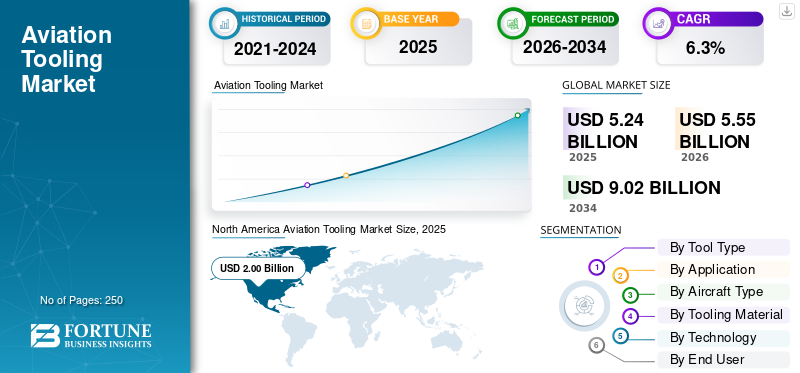
The global aviation tooling market size was valued at USD 5.24 billion in 2025. The market is projected to grow from USD 5.55 billion in 2026 to USD 9.02 billion by 2034, exhibiting a CAGR of 6.3% during the forecast period. North America dominated the aviation tooling market with a market share of 38.17% in 2025.
Aviation tooling comprises specialized aircraft maintenance, manufacturing, assembly, inspection, testing, calibration, and handling tools used to support safe, efficient, and compliant aircraft operations across commercial, business, general aviation, defense, helicopter, and unmanned aerial platforms. These tools enable aircraft OEMs, engine OEMs, airlines, MRO providers, defense aviation operators, and component manufacturers to perform critical tasks. Such tasks include aircraft assembly, line maintenance, base maintenance, engine and APU maintenance, structural repair, avionics testing, component overhaul, torque application, lifting, positioning, and tool-control management.
Industry players and specialized aviation tooling suppliers are developing integrated aerospace tooling solutions. These suppliers include aircraft tooling manufacturers, engine tooling providers, aerospace fixture suppliers, test equipment companies, calibration service providers, digital tool-control system developers, and MRO tooling equipment manufacturers. Their solutions include general and calibrated hand tools, aircraft-specific special tools, engine and APU tooling, airframe and structural tooling, assembly jigs and fixtures. They also provide test and measurement equipment, access and lifting tools, aircraft assembly tools, RFID/barcode-based tracking systems, and managed tooling services. Moreover, key players operating in the market include Dedienne Aerospace SAS, HYDRO Systems KG, Rhinestahl, and AGSE, LLC.
Download Free sample to learn more about this report.
AVIATION TOOLING MARKET KEY TAKEAWAYS
 Global Market Size & Forecast
- 2025 Market Size: USD 5.24 billion
- 2026 Market Size: USD 5.55 billion
- 2034 Forecast Market Size: USD 9.02 billion
- CAGR: 6.3% from 2026–2034
 Market Share
- North America dominated the market with a 38.17% share in 2025.
- The Commercial Aircraft segment held the largest market share in 2025.
- The Metallic Tooling segment held the largest market share in 2025.
 Key Regional Highlights
North America
North America: Reached USD 2.00 billion in 2025 and is projected to reach USD 2.10 billion in 2026, supported by a large aircraft production base, engine MRO activity, defense aviation programs, and mature airline maintenance networks.
Europe
Europe witnessed strong growth, driven by Airbus production, Safran and Rolls-Royce engine programs, defense aviation modernization, and a strong aerospace tooling supplier ecosystem.
Asia Pacific
Asia Pacific projected to record the fastest adoption growth, supported by fleet expansion, aircraft production localization, engine MRO investments, and rising aerospace manufacturing across China, India, Japan, South Korea, and Southeast Asia.
U.S.
The market was estimated at USD 1.74 billion in 2025, driven by Boeing's aircraft manufacturing base, major engine programs, defense aviation production, and extensive airline MRO operations.
Japan
The market was estimated at USD 0.21 billion in 2025, accounting for approximately 4.0% of global revenues.
Read More

AVIATION TOOLING MARKET TRENDS
Shift Toward Digital Tool Control, Connected Tracking, and FOD Risk Reduction is Emerging as a Defining Market Trend
The market is witnessing a clear shift from manual tool logs, paper-based tool crib records, and basic shadow boards toward digital tool control, automated asset tracking, connected torque tools, and software-enabled tool accountability. Airlines, MRO providers, defense aviation units, and aircraft OEMs are adopting systems that track tool issue/return history, calibration status, user accountability, tool location, and foreign object damage risk in real time. This trend is becoming more important as aircraft maintenance environments become more regulated, labor-constrained, and turnaround-time sensitive.
- In January 2025, Snap-on Industrial began the rollout of its digital tool-control solution for the Royal Navy Fleet Air Arm at 815 and 825 Naval Air Squadrons. Further, replacing paper-based tool-control processes and supporting permanent digital audit trails, tool traceability, and faster maintenance handovers.
This trend is expected to increase demand for digital tool-control systems, RFID/barcode-based tracking, connected torque tools, smart tool cabinets, automated tool cribs, calibration monitoring platforms, and managed tooling software. Over the forecast period, aviation tooling will become more closely linked with MRO digitalization, safety management systems, FOD prevention programs, and predictive maintenance workflows.
MARKET DYNAMICS
MARKET DRIVERS
Download Free sample to learn more about this report.
Rising Aircraft Production, Fleet Expansion, and MRO Workload is Propelling Market Growth
The aviation tooling market growth is being driven by increasing aircraft deliveries, rising fleet utilization, expanding airline networks, and growing maintenance workload across commercial, defense, helicopter, and business aviation platforms. Every aircraft delivery and every fleet expansion cycle creates demand for assembly jigs, production tooling, calibrated hand tools, engine tooling, access equipment, test equipment, and line/base aircraft maintenance tools. As aircraft OEMs expand production and airlines add capacity, tooling demand grows not only at the manufacturing level but also across MRO shops, airline maintenance bases, engine facilities, and component repair centers.
- In January 2026, Airbus reported 793 commercial aircraft deliveries in 2025, up 4% year-on-year, and a year-end record backlog of 8,754 aircraft, indicating sustained production and fleet-support demand across the aerospace supply chain.
This driver is expected to sustain demand from aircraft OEMs, engine OEMs, aerostructure suppliers, airlines, independent MRO providers, and defense aviation operators. The strongest tooling demand will remain linked to narrow-body aircraft, high-cycle engines, base maintenance checks, engine shop visits, structural repair programs, and final assembly line expansion.
MARKET RESTRAINTS
Strict Calibration, Certification, and Tool-Control Compliance to Limit Market Expansion
A key restraint for the market is the strict compliance burden attached to aviation maintenance tools, test equipment, and inspection systems. Tools used to make airworthiness decisions must be controlled, traceable, calibrated, and aligned with manufacturer-recommended or approved-equivalent tooling requirements. This increases procurement cost, documentation workload, inspection burden, and supplier qualification complexity. Smaller tooling suppliers face higher barriers as aviation customers require quality systems, calibration records, material traceability, OEM approval, technical documentation, and long-term service support.
This restraint is likely to slow adoption among smaller MRO providers and new market entrants, particularly for specialized aircraft tools, calibrated measurement equipment, engine tooling, and safety-critical test systems. The market will remain difficult for generic tool suppliers that cannot meet aerospace-grade documentation, traceability, and approved-equivalent tooling requirements.
MARKET OPPORTUNITIES
Expansion of Engine MRO, OEM-Licensed Tooling, and Managed Tooling Services Presents Growth Opportunities for the Market
A major opportunity in the market lies in the expansion of engine MRO capacity, OEM-licensed tooling programs, tool leasing, tool pooling, lifecycle tool management, and regional tooling support networks. New-generation engines such as CFM LEAP and Pratt & Whitney GTF require specialized tooling, certified handling equipment, inspection tools, and overhaul support packages. As engine shop visits rise and airlines seek faster turnaround, demand is increasing for tooling providers that can deliver approved tools, training, calibration, repair, recertification, and digital lifecycle management.
- In June 2025, RH Aero Systems executed a Phase 2 agreement with UAMCO at the Paris Air Show covering additional OEM-licensed overhaul tools for CFM LEAP engines, with delivery planned from the third quarter of 2025 onward.
This opportunity is expected to increase demand for engine and APU tooling, OEM-approved overhaul tools, tool calibration and certification services, regional tooling hubs, digital readiness platforms, and long-term tooling support contracts. Suppliers with OEM licenses, global service centers, quick-turn logistics, and tool lifecycle management capability will be better positioned to capture recurring aftermarket demand.
MARKET CHALLENGES
Tool Availability, Engine MRO Bottlenecks, and Supply Chain Complexity to Challenge Market
A major challenge for the market is ensuring timely availability of specialized tools across a fragmented global MRO network. Aircraft and engine tooling is often platform-specific, engine-specific, and task-specific, which makes demand difficult to balance across airlines, lessors, engine shops, military depots, and independent MRO providers. Delays in tool availability, calibration, recertification, or logistics can extend aircraft-on-ground time, slow shop visits, and reduce maintenance productivity. The issue becomes more serious for latest-generation engines and high-utilization narrow-body fleets, where shop-visit demand is rising faster than support capacity.
- In June 2026, IATA stated that engine MRO bottlenecks were disrupting airline operations and called for fair access to parts, repair information, and tools needed to develop additional MRO capacity, especially for latest-generation single-aisle engines.
This challenge is expected to remain important as aircraft fleets grow, engine technology becomes more complex, and maintenance demand rises. Tooling suppliers must balance OEM approval, availability, calibration compliance, local stocking, repair turnaround, and digital tracking while supporting airlines and MRO providers under tight operational timelines.
Segmentation Analysis
By Tool Type
Universal Maintenance Use and Calibration Compliance Requirements to Support General & Calibrated Hand Tools Segment Dominance
Based on tool type, the market is divided into general & calibrated hand tools, aircraft-specific special tools, engine & APU tooling, airframe, structural & composite tooling, assembly jigs & fixtures, test, measurement & calibration tooling, access, lifting & handling tooling, digital tool control & tracking systems, and others.
The general & calibrated hand tools segment held a leading aviation tooling market share in 2025 due to its universal usage across aircraft manufacturing, line maintenance, base maintenance, engine MRO, component repair, and inspection activities. These tools include torque wrenches, calibrated measuring tools, hand tools, tool kits, and inspection-support tools that are required in almost every aircraft maintenance and assembly workflow. Their dominance is supported by strict tool-control and calibration requirements, as aviation repair stations must ensure that test, inspection equipment, and tools used for airworthiness determinations are calibrated to acceptable standards.
The digital tool control & tracking systems segment is anticipated to rise with the fastest CAGR of 8.9% over the forecast period.
By Application
Aircraft Production Ramp-Up and High Tooling Intensity in Final Assembly to Support Aircraft Manufacturing & Assembly Segment Dominance
Based on application, the market is divided into aircraft manufacturing & assembly, line maintenance, base maintenance / heavy checks, engine & APU MRO, component MRO, structural repair & modification, avionics & electrical testing, and others.
The aircraft manufacturing & assembly segment held a leading share in the market in 2025 due to the high tooling intensity required during aircraft production, structural assembly, system installation, final assembly, inspection, and delivery preparation. Aircraft manufacturing requires assembly jigs, fixtures, drilling tools, torque tools, calibrated tools, airframe handling equipment, test equipment, and aircraft-specific special tools.
- In October 2024, Tata Advanced Systems and Airbus stated that the C295 final assembly line in Vadodara would integrate manufacturing of detail parts, related tooling, sub-assemblies, major component assemblies, tools, jigs, and testers.
The engine & APU MRO segment is anticipated to rise with the fastest CAGR of 8.1% over the forecast period.
By Aircraft Type
Large Fleet Base, High Aircraft Utilization, and Recurring MRO Demand to Support Commercial Aircraft Segment Dominance
Based on aircraft type, the market is divided into commercial aircraft, business & general aviation aircraft, military aircraft, helicopters, and unmanned aerial vehicles.
The commercial aircraft segment held a leading share in the market in 2025 due to the large global installed fleet, high production volume, heavy utilization, and recurring maintenance requirements of narrow-body and wide-body aircraft. Commercial aircraft require tooling across aircraft assembly, engine installation, line maintenance, base checks, structural repair, component MRO, avionics testing, and engine shop visits.
The unmanned aerial vehicles segment is anticipated to rise with the fastest CAGR of 9.0% over the forecast period.
To know how our report can help streamline your business, Speak to Analyst
By Tooling Material
Durability, Load-Bearing Strength, and Repeated Use in Aircraft Assembly and MRO to Support Metallic Tooling Segment Dominance
Based on tooling material, the market is divided into metallic tooling, composite tooling, polymer / resin-based tooling, additively manufactured tooling, and hybrid tooling.
The metallic tooling segment held a leading share in the market in 2025 due to its durability, load-bearing capability, dimensional stability, heat resistance, and suitability for repeated use in aircraft assembly and maintenance environments. Metallic tooling remains widely used for engine stands, jigs, fixtures, lifting tools, hoists, jack adapters, alignment tools, torque tooling, handling equipment, and inspection fixtures.
The additively manufactured tooling segment is anticipated to rise with the fastest growth rate of 9.3% over the forecast period.
By Technology
Broad Use in Aircraft Maintenance, Lifting, Positioning, and Installation Tasks to Support Conventional Mechanical Tooling Segment Dominance
Based on technology, the market is divided into conventional mechanical tooling, digitally enabled tooling, automated test equipment, connected torque & measurement tools, RFID / barcode-based tool tracking, and additive manufacturing-based tooling.
The conventional mechanical tooling segment held a leading market share in 2025. The dominance is due to the continued dependence of aircraft manufacturing and MRO operations on mechanical tools, engine stands, jacks, hoists, service carts, lifters, fixtures, and manually operated maintenance equipment. These tools remain essential as many aircraft maintenance tasks require direct mechanical access, lifting, positioning, fastening, removal, installation, and inspection support.
The digitally enabled tooling segment is anticipated to rise with the fastest growth rate of 9.3% over the forecast period.
By End User
High Production Tooling Demand and Aircraft Program-Level Tooling Investments to Support Aircraft OEMs Segment Dominance
Based on end user, the market is divided into aircraft OEMs, engine OEMs, airlines & aircraft operators, independent MRO providers, defense aviation operators, and aerostructure & component manufacturers.
The aircraft OEMs segment held a leading share in the market in 2025 due to the high volume of tooling required for aircraft production, final assembly, quality inspection, aircraft integration, testing, and delivery operations. OEMs require large-scale investments in assembly jigs, fixtures, special tools, calibrated tools, production tooling, structural tooling, system-installation tools, and digital tool-control systems.
The independent MRO providers segment is anticipated to rise with the fastest CAGR of 7.5% over the forecast period.
Aviation Tooling Market Regional Outlook
By region, the market is segmented into North America, Europe, Asia Pacific, Latin America, and the Middle East & Africa.
North America
North America Aviation Tooling Market Size, 2025 (USD Billion)
To get more information on the regional analysis of this market, Download Free sample
North America dominated the market in 2025 with a valuation of USD 2.00 billion, growing to USD 2.10 billion in 2026. The region’s dominance is supported by a large aircraft production base, high engine MRO activity, mature airline maintenance networks, defense aviation programs, and the presence of major aircraft, engine, and tooling suppliers. Tooling demand in the region is driven by aircraft final assembly, engine build-up, component repair, line maintenance, heavy checks, defense depot maintenance, and digital tool-control adoption. The region has strong demand for calibrated hand tools, aircraft-specific special tools, engine & APU tooling, assembly jigs & fixtures, inspection tools, torque tools, and digital tool tracking systems.
- In March 2025, GE Aerospace announced plans to invest nearly USD 1 billion in its U.S. factories and supply chain, including expansions, new inspection technology, and building upgrades across more than two dozen communities.
U.S. Aviation Tooling Market
Based on North America’s strong contribution and the U.S. dominance within the region, the U.S. market was approximated at around USD 1.74 billion in 2025. The dominance is due to Boeing’s commercial aircraft manufacturing base, GE Aerospace and Pratt & Whitney engine programs, and large defense aviation production. Other factors include extensive airline MRO operations and a dense supplier ecosystem for aerospace tools, fixtures, calibration systems, and engine support equipment. Demand is especially strong for engine tooling, airframe tooling, test and measurement tooling, digital tool-control systems, and OEM-approved special tools used across commercial aircraft, military aircraft, business jets, helicopters, and engine overhaul facilities.
- In December 2025, Boeing completed its acquisition of Spirit AeroSystems, bringing Boeing-related commercial and aftermarket operations in-house and strengthening commercial production, supply chain stability, and defense program continuity.
Europe
Europe is expected to witness strong growth in the market. It is supported by Airbus commercial aircraft production, Safran and Rolls-Royce engine programs, Dassault and Leonardo aircraft manufacturing, defense aviation modernization, and a strong ecosystem of specialized tooling suppliers. These suppliers include Dedienne Aerospace, HYDRO Systems, RH Aero Systems, and other aerospace tooling providers. Demand is being driven by A320 Family, A220, A350, business jet, helicopter, and military aircraft programs, along with rising adoption of digital tool-control systems across military and commercial MRO environments.
U.K. Aviation Tooling Market
The U.K. market size in 2025 was estimated at around USD 0.28 billion, representing roughly 5.3% of global revenues.
Germany Aviation Tooling Market
Germany market value reached approximately USD 0.32 billion in 2025, equivalent to around 6.2% of global sales.
Asia Pacific
Asia Pacific is projected to record the fastest adoption growth in the market. It is supported by fleet expansion, aircraft production localization, engine MRO investments, growing airline maintenance requirements, and defense aerospace manufacturing in China, India, Japan, South Korea, and Southeast Asia. Demand is rising for line maintenance tools, base maintenance tooling, engine overhaul tools, aircraft-specific special tools, assembly fixtures, calibration systems, and aircraft manufacturing equipment.
- In November 2025, Safran inaugurated its largest global MRO center for CFM International LEAP engines in Hyderabad, India, marking the first time a global engine OEM established an MRO operation in India.
Japan Aviation Tooling Market
The Japan market size in 2025 was estimated at around USD 0.21 billion, accounting for roughly 4.0% of global revenues.
China Aviation Tooling Market
China’s market is projected to be one of the largest worldwide, with 2025 revenues estimated at around USD 0.45 billion representing roughly 8.7% of global sales.
India Aviation Tooling Market
The Indian market size in 2025 was estimated at around USD 0.20 billion, accounting for roughly 3.7% of global revenues.
Latin America
Latin America’s market is led by Brazil, supported by Embraer’s commercial, executive, and defense aircraft manufacturing base, while Mexico contributes through aerospace manufacturing clusters, component supply, and MRO activity. Regional demand is supported by Embraer E-Jets, Praetor and Phenom business jets, C-390 defense aircraft, airline fleet renewal, executive jet operations, and maintenance of pressurization components across regional and business aviation fleets.
Brazil Aviation Tooling Market
Brazil market value in 2025 was estimated at around USD 0.11 billion, accounting for roughly 2.2% of global revenues.
Middle East & Africa
The Middle East & Africa region’s adoption in the market is supported by expanding airline fleets, long-haul aircraft operations, premium MRO hubs, defense aviation programs, business jet activity, and aerospace localization initiatives in the UAE, Saudi Arabia, Turkey, Israel, and South Africa. Demand is being driven by aircraft line maintenance, wide-body and narrow-body fleet support, engine MRO, component repair, defense depot maintenance, and tool-control requirements in high-utilization airline environments. The strongest demand areas include engine tooling, access and lifting tools, test and calibration equipment, digital tool tracking, and MRO shop tooling.
UAE Aviation Tooling Market
UAE market size in 2025 was estimated at around USD 0.14 billion, accounting for roughly 2.6% of global revenues.
COMPETITIVE LANDSCAPE
Key Industry Players
Specialized Aviation Tooling Portfolio, OEM Approval Strength, Digital Tool-Control Capability, and Aftermarket Support Drive Competitive Leadership
The global market is characterized by competition among specialized aircraft tooling manufacturers, engine tooling providers, aerospace fixture suppliers, test and calibration equipment companies, and access and lifting tool manufacturers. The market also includes digital tool-control system providers and MRO support equipment suppliers. Competitive leadership is increasingly shaped by companies such as Dedienne Aerospace SAS, HYDRO Systems KG, Rhinestahl, and AGSE, LLC. These companies deliver aircraft-specific special tools, engine & APU tooling, calibrated hand tools, airframe and structural tooling, and assembly jigs and fixtures. They also provide test and measurement systems, access and lifting equipment, and digital tool-tracking platforms. Their competitive strength is supported by strong OEM approvals, regulatory compliance, calibration traceability, and reliable performance across commercial aircraft, business aviation, military aircraft, helicopters, and unmanned aerial platforms.
LIST OF KEY AVIATION TOOLING COMPANIES PROFILED
- Dedienne Aerospace SAS (France)
- HYDRO Systems KG (Germany)
- Rhinestahl (U.S.)
- AGSE, LLC (U.S.)
- Didsbury Engineering Co. Ltd. (U.K.)
- Tronair, Inc. (U.S.)
- Semmco Limited (U.K.)
- TEST-FUCHS GmbH (Austria)
- Malabar International, LLC (U.S.)
- STANLEY Engineered Fastening / Stanley Black & Decker, Inc. (U.S.)
KEY INDUSTRY DEVELOPMENTS
The global market analysis provides an in-depth study of market size & forecast by all the market segmentation included in the report. It includes details on the market dynamics, and market trends, and regional analysis expected to drive the market in the forecast period. The market report includes porter’s five forces analysis which illustrates the potency of buyers suppliers in the market. The market forecast offers information on the technological advancements, new product launches, key trends, major aviation sector developments, and details on partnerships, mergers & acquisitions. The aviation tooling market analysis also encompasses detailed competitive landscape with information on the market share and profiles of key players.
Request for Customization to gain extensive market insights.
Report Scope & Segmentation
| ATTRIBUTE | DETAILS |
| Study Period | 2021-2034 |
| Base Year | 2025 |
| Estimated Year | 2026 |
| Forecast Period | 2026-2034 |
| Historical Period | 2021-2024 |
| Growth Rate | CAGR of 6.3% from 2026-2034 |
| Unit | Value (USD Billion) |
| Segmentation | By Tool Type, By Application, By Aircraft Type, By Tooling Material, By Technology, By End User, and Region |
| By Tool Type |
|
| By Application |
|
| By Aircraft Type |
|
| By Tooling Material |
|
| By Technology |
|
| By End User |
|
| By Region |
|
Frequently Asked Questions
According to Fortune Business Insights, the global market value stood at USD 5.24 billion in 2025 and is projected to reach USD 9.02 billion by 2034.
In 2025, the market value stood at USD 2.00 billion.
The market is expected to exhibit a CAGR of 6.3% during the forecast period.
By aircraft type, the commercial aircraft segment is expected to lead the market.
Rising aircraft production, fleet replacement, and defense aircraft demand is driving market expansion.
Dedienne Aerospace SAS, HYDRO Systems KG, Rhinestahl, and AGSE, LLC are some of the major players in the global market.
North America dominated the market in 2025.



- 2021-2034
- 2025
- 2021-2024
- 250
Get 30-60 hrs Free Customization
Expand Regional and Country Coverage, Segments Analysis, Company Profiles, Competitive Benchmarking, and End-user Insights.




















Related Reports
-
US +1 833 909 2966 ( Toll Free )
-
Get In Touch With Us