Baby Pacifier Market Size, Share & Industry Analysis, By Type (Single-Piece and Multi-Piece), By Material (Silicon, Natural Rubber/Latex, and Others), By Age Group (Infants and Toddlers), By Distribution Channel (Specialty Stores, Supermarkets & Hypermarkets, Online Stores, and Others), and Regional Forecast, 2026-2034
 Download Free Sample
(Offer valid till 15th Oct 2026)

KEY MARKET INSIGHTS
 Listen to Audio Version
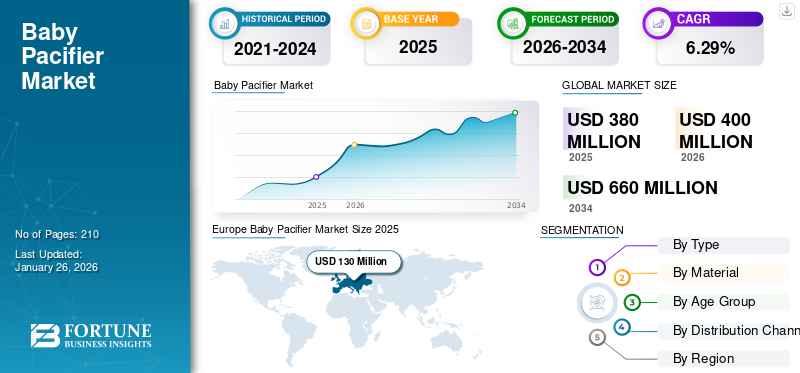
The global baby pacifier market size was valued at USD 380.00 million in 2025 and is projected to grow from USD 400.00 million in 2026 to USD 660.00 million by 2034, exhibiting a CAGR of 6.29% during the forecast period. Europe dominated the baby pacifier market with a market share of 33.44% in 2025.
Recently, key companies such as Philips Avent, MAM Baby, NUK have been investing in research and development to create innovative designs that address specific consumer needs, such as eco-friendly materials and orthodontic shapes. Besides, collaborations with healthcare professionals and parenting influencers help brands build credibility and reach a wider audience, fostering market share in the long run.
A pacifier is a soothing device designed for babies, typically made from rubber, silicone, or plastic. It serves to satisfy a baby's natural sucking reflex, providing comfort and helping to calm them when they are fussy or upset. Moreover, a global rise in birth rate contributes to higher demand for baby care products, including pacifiers, leading to increased the market growth.
Download Free sample to learn more about this report.
BABY PACIFIER MARKET KEY TAKEAWAYS
 Market Size & Forecast
- 2025 Market Size: USD 380.00 Million
- 2026 Market Size: USD 400.00 Million
- 2034 Forecast Market Size: USD 660.00 Million
- CAGR: 6.29% from 2026–2034
 Market Share
- Europe dominated the baby pacifier market with a 33.44% share in 2025.
- Single-piece baby pacifier segment held a 72.50% market share in 2026.
- Silicon segment accounted for a 65.00% market share in 2026.
 Key Regional Highlights
North America
North America recorded USD 100 million in 2025 with a 26.66% share and is expected to reach USD 110 million in 2026, driven by product innovation and growing awareness of infant health.
Europe
Europe generated USD 130 million in 2025 with a 33.44% share and is projected to reach USD 134 million in 2026, supported by strong demand for safe and premium infant products.
Asia Pacific
Asia Pacific reached USD 84 million in 2025 with a 21.90% share and is projected to grow to USD 88.7 million in 2026 due to rising disposable income and increasing adoption of premium baby products.
U.S.
The market is projected to reach USD 75.38 million in 2026, supported by widespread pacifier use and recommendations to reduce SIDS risk.
Japan
The market is projected to reach USD 16.71 million in 2026.
Read More

Baby Pacifier Market Trends
Growing Demand for Sustainable Baby Care Products to Fuel Market Expansion
The growing demand for sustainable baby care products and eco-friendly options is reshaping the baby pacifier market. Parents are increasingly seeking out environmentally friendly options that minimize harm to both their children and the planet. Therefore, pacifier manufacturers are responding to consumer demand by introducing pacifiers made from natural rubber, silicone, and other sustainable materials. These products attract eco-conscious consumers and also align with broader trends in sustainability across various baby care products.
Rising Demand for Innovative and Advanced Baby Products to Drive Market Growth
The integration of technology into baby products is reforming the market landscape of baby pacifiers. Innovations, such as smart pacifiers, that monitor a baby's health or provide soothing features are becoming more popular. These products attract tech-savvy parents who prioritize convenience and functionality in their baby care choices. Moreover, medical professionals often recommend specific types of pacifiers that promote oral health, further driving demand for innovative designs that prioritize safety and comfort.
- Europe witnessed baby pacifier market growth from USD 118.62 Million in 2023 to USD 123.21 Million in 2024.
Download Free sample to learn more about this report.
Market Dynamics
Market Drivers
Increasing Parental Awareness of Infant Well-being to Boost Market Growth
Nowadays, parents are increasingly concerned about the health implications of the products they use for their infants. This awareness encompasses various aspects, including oral health, comfort, and safety, which are crucial for the development of infants. As parents become more informed about the importance of these factors, they are more inclined to invest in high-quality pacifiers that align with their health-conscious parenting practices. Besides, pacifiers are known to soothe fussy babies, which can lead to a more relaxed feeding environment. When babies are calm, they may be more willing to feed effectively, leading to increased food intake during breastfeeding or bottle-feeding sessions. For instance, the World Health Organization (WHO) advises that infants should be introduced to complementary foods starting at 6 months of age. Initially, these foods should be provided 2 to 3 times a day for infants aged 6 to 8 months. As the infant grows, the frequency should increase to 3 to 4 times daily for those aged 9 to 11 months and from 12 to 24 months.
Rapid Urbanization and Changing Lifestyles to Augment Product Demand
Urbanization often correlates with higher disposable incomes, enabling parents to purchase premium baby care products, including pacifiers designed for safety and comfort durability. As more families move to urban areas, they often experience increased disposable incomes and a shift in lifestyle that demands convenience. Urban parents typically seek products that can help soothe their infants while fitting into their busy schedules. For instance, according to the World Bank, by 2030, it is anticipated that approximately one billion people will reside in urban areas of China, representing nearly 70% of the nation's total population.
Market Restraints
Negative Health Perceptions May Hamper Market Growth of Baby Pacifiers
Negative health perceptions regarding pacifiers significantly hamper the growth of the baby pacifier market. These perceptions occur from various concerns among parents and healthcare professionals, influencing the purchasing decisions of the consumers. Furthermore, there is a prevalent belief that prolonged pacifier use can lead to dental issues, such as misalignment of teeth and bite problems. Therefore, pediatricians often recommend limiting pacifier use to avoid these complications, which discourages parents from purchasing them, limiting baby pacifier market growth.
Market Opportunities
Expansion of E-commerce Platforms to Surge Market Development
E-commerce platforms enable manufacturers and retailers to reach a broader audience, including urban and rural consumers who may not have access to specialized baby product stores. Also, online stores operate 24/7, allowing parents to shop at their convenience, regardless of time constraints. This flexibility is particularly beneficial for working parents who may find it challenging to visit physical stores during regular hours, surging product demand. For instance, according to the India Brand Equity Foundation, India's e-commerce platforms have reached a remarkable achievement, recording a Gross Merchandise Value (GMV) of USD 60 billion in the fiscal year of 2023. This marks a 22% increase compared to the previous year.
Increasing Partnerships and Collaborations among Various Stakeholders to Boost Product Demand
Increasing collaborations between manufacturers and health organizations or technology firms leads to innovative product designs. Also, collaborations with popular children’s characters or brands allow manufacturers to create unique designs that resonate with both children and parents. For instance, partnerships like that of Dr. Brown’s Natural Flow LLC with Kinsa Health Group Inc. have resulted in pacifiers with integrated thermometers, enhancing child wellness monitoring. Such innovations attract health-conscious parents seeking multifunctional products, boosting baby pacifier market growth.
Market Challenges
Presence of Counterfeit Products to Hinder Market Development
Counterfeit pacifiers often do not meet safety standards, posing serious health risks to infants. These products may contain harmful materials or lack essential safety features, leading to potential choking hazards or exposure to toxic substances. Such risks can limit parents from purchasing pacifiers altogether, fearing for their child's safety and challenging the market growth of pacifiers.
Impact of COVID-19
The COVID-19 pandemic caused significant disruptions in global supply chains, affecting the production and distribution of baby pacifiers. Lockdowns and factory closures led to delays in sourcing raw materials, which increased production costs and caused shortages in the baby products market. Therefore, manufacturers had to adapt by diversifying their sourcing strategies and improving their logistics to ensure product availability during the impact of the pandemic.
Segmentation Analysis
By Type
Safety Features of Single-Piece Pacifier to Drive Segment Growth
Based on type, the market is divided into single-piece and multi-piece.
The single-piece baby pacifier segment is expected to lead the market during the forecast period. Single-piece designs are often perceived as safer since they eliminate the risk of choking hazards associated with multiple components. This simplicity attracts parents who prioritize safety in their purchasing decisions, boosting segment growth. The single-piece segment is projected to dominate the market with a share of 72.50% in 2026.
The multi-piece baby pacifier market is expected to acquire a significant share of the market during the upcoming years. These pacifiers allow for greater customization, enabling parents to mix and match components (nipple, shield, handle) according to personal preferences or aesthetic choices. This flexibility is attractive to parents looking for personalized products for their infants.
To know how our report can help streamline your business, Speak to Analyst
By Material
BPA-free Properties of Silicon to Enlarge Segment Growth for Silicon Material
On the basis of material, the market is segregated into silicon, natural rubber/latex, and others.
The silicon segment is expected to dominate the market share by 65.00% in 2026. Silicon pacifiers are typically free from bisphenol A (BPA) and other harmful chemicals, making them a safer choice for infants. Parents are increasingly aware of the health risks associated with certain plastics, driving demand for BPA-free alternatives such as piece of plastic silicone pacifier.
The natural rubber/latex segment is predicted to hold a CAGR of 5.54% during the coming years. Natural rubber, often referred to as latex, is gaining traction in the baby pacifier market due to its unique properties and growing consumer preferences for natural and eco-friendly products.
By Age Group
Pacifiers Help Infants to Adopt Flexible Feeding, which in turn Expands Segment Growth
Under the age group, the market is divided into infants and toddlers.
The infant segment is expected to hold 65.00% of the market share in 2026. Infants are born with a natural sucking reflex, which is crucial for feeding. This reflex begins developing even before birth and is essential for breastfeeding or bottle-feeding. Therefore, pacifiers provide a means for infants to engage in non-nutritive sucking, which helps satisfy this instinct and provides comfort between feedings.
The toddlers segment is also predicted to gain a strong CAGR of 4.91% during the forecast period. Pacifiers can help toddlers fall asleep more easily and stay asleep longer. The act of sucking can promote relaxation, making it a useful tool for bedtime routines and boosting segment growth.
By Distribution Channel
Availability of Wide Range of Products to Foster Segment Growth for Supermarkets & Hypermarkets
In terms of distribution channel, the market is subdivided into specialty stores, supermarkets & hypermarkets, online stores, and others.
The supermarkets & hypermarkets segment is projected to dominate the market with a share of 35.00% in 2026. They typically offer a broad range of baby pacifiers, including various brands, types, and materials, which are widely available at affordable prices. This extensive selection allows parents to compare different products easily and choose the suitable product according to their needs.
The online stores segment is forecasted to grasp a strong CAGR of 7.60% during the forecast period. Online platforms allow parents to shop from the comfort of their homes without the need to visit physical stores. This convenience is particularly appealing for busy parents who may have limited time to browse in-store.
Baby Pacifier Market Regional Outlook
Europe
Europe Baby Pacifier Market Size 2025 (USD Million)
To get more information on the regional analysis of this market, Download Free sample
The Europe market accounted for USD 130 million in 2025, representing 33.44% of the global industry, and is expected to reach USD 134 million in 2026. European consumers are increasingly aware of infant health and safety, leading to a preference for high-quality, safe products. This awareness drives demand for pacifiers made from non-toxic materials such as silicone and natural rubber, which are perceived as safer options compared to traditional plastic variants. European market is the largest region with the value USD 134 million in 2026, and USD 130 million in 2025. The U.K. market size in 2026 is estimated to be USD 35.95 million, whereas Germany’s market size is anticipated to hit USD 32.23 million and France’s market is likely to value at USD 16.70 million in 2025.
North America
In 2025, North America generated USD 100 million, contributing 26.66% to global market revenue, and is projected to grow to USD 110 million in 2026. In North America, manufacturers of baby products are at the forefront of product innovation, introducing features, such as orthodontic designs and smart pacifiers, that monitor temperature or other health metrics. The market includes a variety of pacifiers tailored to different needs, single-piece designs for safety and ease of cleaning, and multi-piece options that allow for customization and aesthetic attraction. North American market is expected to be the second-largest region with the value USD 110 million in 2026, along with exhibiting the second-fastes growing CAGR of 7.04% during the forecast period.
The U.S. market is projected to hit USD 75.38 million in 2026. In the U.S., pacifiers are widely recognized for their effectiveness in calming fussy babies. The act of sucking on a pacifier satisfies infants' innate non-nutritive suckling (NNS) reflex, which is crucial for their emotional regulation. This reflex helps lower heart rate and stress levels, making pacifiers a quick solution for soothing crying babies in the country. For instance, the American Academy of Pediatrics (AAP) recommends pacifier use during naps and bedtime to reduce the risk of Sudden Infant Death Syndrome (SIDS).
Asia Pacific
Asia Pacific recorded a market size of USD 84 million in 2025, capturing 21.90% of the global market share, and is projected to reach USD 88.7 million in 2026. In many Asia Pacific countries, the use of pacifiers is culturally ingrained. Some parents believe that pacifiers can help reduce the risk of Sudden Infant Death Syndrome (SIDS), which encourages their use during sleep times. Besides, as disposable income rises in Asia Pacific countries such as China, India, and Japan, parents are more willing to spend on premium baby products, including pacifiers. For instance, according to the Ministry of Statistics and Programme Implementation (MOSPI), disposable personal income in India rose to USD 3,556.78 billion in 2023, an increase from USD 3,303.45 billion in 2022. The market in India size in 2026 is estimated to be USD 23.43 million, whereas China’s market size is anticipated to hit USD 30.41 million and Japan’s market is likely to value at USD 16.71 million in 2026.
Rest of the World
The Middle East & Africa market generated USD 34.36 million in 2025, representing 8.95% of the global market landscape, and is expected to reach USD 34.93 million in 2026. E-commerce platforms in South America and Middle East & Africa enable manufacturers and retailers to reach a broader audience across diverse geographical regions, including remote areas where traditional retail may not be present. Also, digital marketing tools facilitate data-driven insights that help businesses understand consumer preferences and behaviors. By leveraging analytics, companies can create targeted advertising campaigns that resonate with specific demographics, enhancing engagement and conversion rates for pacifier products. As reported by the International Trade Administration (ITA), the e-commerce sector in UAE experienced a remarkable 53% surge in 2020, achieving sales of USD 3.9 billion, which represented 10% of the total retail sales in the region. The UAE market is experiencing a significant size of USD 4.45 million in 2025.
Competitive Landscape
Key Market Players
The competitive landscape of the global baby pacifier market provides valuable insights into various competitors. It includes detailed profiles of various companies operating in the market, highlighting their business models and strategic initiatives and examining the financial health of these companies, including revenue generation and overall financial performance. The report also details the investments made by companies in research and development, indicating their commitment to innovation, products, and improvement.
Philips Avent, MAM Baby, NUK, and Tommee Tippee are a few of the leading players in the market. The global market is extremely fragmented, with the top 5 players accounting for 5% of the market share.
List of Key Companies Profiled In The Report
- Philips Avent (Netherlands)
- MAM Baby (Austria)
- NUK (U.K.)
- Tommee Tippee (U.K.)
- Chicco (Italy)
- Brown's Medical (U.S.)
- Playtex (U.S.)
- Munchkin (U.S.)
- GumDrop (U.S.)
- Nuby (Belgium)
Key Industry Developments
- March 2024 – Philips Avent recently launched a new brand positioning in North America called Share the Care, aimed at encouraging families and communities to support mothers better. This initiative coincides with the Daylight Saving Time change, which serves as a poignant reminder of the need for collective support for new parents.
- February 2024 – WubbaNub, a company specializing in baby products, launched the Baby Bullseye range. This exclusive pacifier plush features Target's Bull Terrier mascot, combining a pacifier with a plush toy. It is made from 100% silicone and free of harmful chemicals such as BPA, PVC, and phthalates, which are also machine washable.
- September 2022 - Neste, Borealis, and MAM collaborated to launch a new pacifier called the MAM Original Pure, which is made from renewably sourced feedstock. This innovative product utilizes polypropylene (PP) derived from Borealis' Bornewables portfolio, which is manufactured using Neste RE, a renewable feedstock produced entirely from waste and residue materials.
- March 2022 – NUK launched its first sustainable baby care collection, NUK For Nature, aimed at meeting the growing demand for eco-friendly baby products. This collection includes a range of items such as orthodontic pacifiers, cups, plates, bowls, and utensils, all designed with sustainability in mind.
- September 2020 – The Moms Co, a mother and baby care brand based in India, successfully raised USD 8 million in Series B funding from both Indian and global venture capital firms. With this latest investment, the company aims to expand its reach to five million consumers and solidify its position as one of India's fastest-growing direct-to-consumer brands.
Investment Analysis and Opportunities
Increasing Investments of Companies toward Marketing & Promotional Campaigns to Offer Growth Opportunities
In recent times, companies have increasingly invested in leveraging digital marketing strategies, including social media and online ads, to reach specific demographics of parents. This targeted approach helps to raise awareness about their pacifier products, highlighting unique features and benefits that resonate with consumers. Additionally, engaging marketing campaigns that involve contests, giveaways, and interactive content fosters a stronger connection with potential customers, gaining market opportunities in the long run.
REPORT COVERAGE
Request for Customization to gain extensive market insights.
The baby pacifier market research report provides a comprehensive analysis, focusing on key elements such as major companies, regional and market segmentation, competitive dynamics, product categories, and distribution channels. Additionally, it offers insights into market trends and highlights significant developments within the industry. Beyond these aspects, it also examines various factors that have contributed to market growth in recent years.
Report Scope & Segmentation
|
ATTRIBUTE |
DETAILS |
|
Study Period |
2021-2034 |
|
Base Year |
2025 |
|
Estimated Year |
2026 |
|
Forecast Period |
2026-2034 |
|
Historical Period |
2021-2024 |
|
Growth Rate |
CAGR of 6.29% from 2026 to 2034 |
|
Unit |
Value (USD Million) |
|
Segmentation |
By Type
By Material
By Age Group
By Distribution Channel
By Region
|
Frequently Asked Questions
Fortune Business Insights says that the global market size stood at USD 400 million in 2026 and is anticipated to record a valuation of USD 660 million by 2034.
Fortune Business Insights says that the global market value stood at USD 380 million in 2025.
The global market will exhibit a CAGR of 6.29% during the forecast period.
By type, the single-piece segment is predicted to dominate the market during the forecast period.
The increasing parental awareness of infant well-being is a key factor driving the global market.
Philips Avent, MAM Baby, NUK, and Tommee Tippee are some of the leading players globally.



- 2021-2034
- 2025
- 2021-2024
- 210
-
(Offer valid till 15th Oct 2026)
Get 30-60 hrs Free Customization
Expand Regional and Country Coverage, Segments Analysis, Company Profiles, Competitive Benchmarking, and End-user Insights.


















Related Reports
-
US +1 833 909 2966 ( Toll Free )
-
Get In Touch With Us