Base Editing Market Size, Share & Industry Analysis, By Offering (Products {Base Editing Platforms, Reagents & Kits, and Others}, and Services {gRNA Design, Cell Line Engineering, and Others}), By Type (DNA Base Editing and RNA Base Editing), By Application (Drug Discovery & Development, Diagnostics & Screening, and Others), By End User (Pharmaceutical & Biotechnology Companies, CROs & CDMOs, Academic & Research Institutes, and Others), and Regional Forecast, 2026-2034
 Download Free Sample
Base Editing Market Size and Future Outlook
 Listen to Audio Version
The global base editing market size was valued at USD 323.7 million in 2025. The market is projected to grow from USD 362.9 million in 2026 to USD 956.1 million by 2034, exhibiting a CAGR of 12.87% during the forecast period. North America dominated the global base editing market with a market share of 43.34% in 2025.
Base editing is a highly precise and advanced genome-editing technology, which allows researchers to modify a single DNA base without cutting the DNA double strands. Base editors are being considered as advanced research tools for various therapeutic applications, especially for monogenic and rare diseases. This market is anticipated to witness notable growth over the forecast period. This is due to an increasing investment in cell and gene therapy research and a rising focus on precision medicine. In addition, various key players are focusing on partnerships to advance their market positions.
Furthermore, the market is dominated by several key players, with Thermo Fisher Scientific Inc., GenScript, and others occupying the dominating positions. Advanced technology integration and strengthening product offerings through collaborations further enhance the position of these companies in the global market.
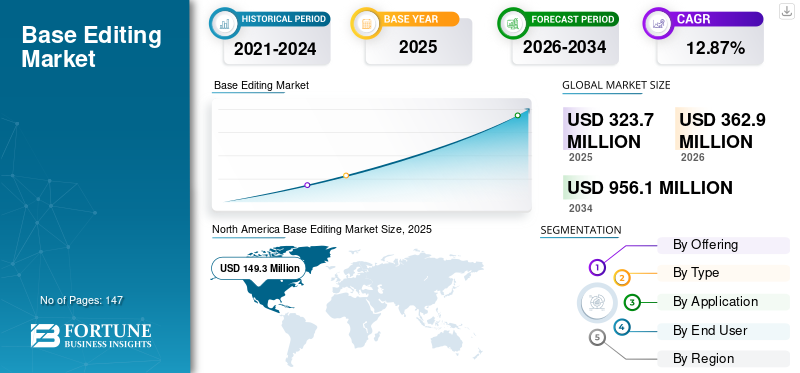
Download Free sample to learn more about this report.
Base Editing MARKET KEY TAKEAWAYS
 Market Size & Forecast
- 2025 Market Size: USD 323.7 Million
- 2026 Market Size: USD 362.9 Million
- 2034 Forecast Market Size: USD 956.1 Million
- CAGR: 12.87% from 2026–2034
 Market Share
- North America dominated the base editing market with a 43.34% share in 2025.
- The products segment held the largest market share in 2025 due to high-volume demand for reagents & kits.
- The DNA base editing segment accounted for the largest market share in 2025, driven by strong therapeutic pipeline adoption.
 Key Regional Highlights
North American
North America led the market with USD 140.3 Million in 2025 and is driven by strong R&D funding and advanced therapeutic research infrastructure.
Europe
Europe is projected to reach USD 94.1 Million in 2026, supported by growing precision medicine initiatives and increasing pharmaceutical R&D.
Asia Pacific
Asia Pacific is expected to reach USD 71.5 Million in 2026, driven by rising biotechnology investments and expanding genomic research activities.
U.S.
The market is projected to reach USD 149.8 Million in 2026, supported by strong gene-editing R&D funding and advanced biotechnology infrastructure.
Japan
Growth is driven by increasing adoption of genomic research technologies and expanding applications in biotechnology and healthcare innovation.
Read More

MARKET DYNAMICS
MARKET DRIVERS:
Rising Investment in Gene & Cell Therapy Pipelines to Boost the Market Growth
Growing investments in gene and cell therapy pipelines are accelerating the adoption of base editing technologies globally. As pharmaceutical and biotechnology companies expand their clinical development programs targeting monogenic diseases, there is an increasing demand for highly precise tools that are capable of correcting single-nucleotide mutations. This pushes organizations to shift from traditional CRISPR-Cas9 systems toward cytosine and adenine base editors, which offer safer and more accurate editing without double-strand breaks. Additionally, rising funding for such research enables companies to initiate new preclinical and IND-enabling studies, thereby increasing the demand for base-editing products and services. Moreover, strategic initiatives between technology developers and large pharmaceutical companies further support this adoption by integrating the technology into in vivo therapeutic programs.
- For instance, in June 2025, Eli Lilly and Company announced the acquisition of Verve Therapeutics for up to USD 1.3 billion, turning an existing collaboration into a full acquisition.
MARKET RESTRAINTS:
Safety and Off-Target Editing Concerns to Restrict Market Expansion
One of the most significant challenges restraining the global base editing market growth includes safety and off-target editing concerns. The risk of unintended base modification and uncertainty in outputs slows clinical adoption, as regulators require long-term toxicity data, extensive off-target mapping, and higher preclinical validation. Owing to this, operating players may hesitate to advance base-editing programs into clinical trials, extending development timelines and increasing costs.
- For instance, in October 2024, a study published in Nature Biotechnology reported unintended RNA off-target effects associated with certain adenine base editors, prompting several developers to re-evaluate editor designs and tighten safety screening pipelines.
MARKET OPPORTUNITIES:
Development of Next-Generation Editors to Offer Lucrative Growth Opportunities
The development of safer and more precise genome-editing tools is creating a major opportunity for next-generation base editor development in the market. As current CBEs and ABEs still carry risks of unintended edits, companies are investing in dual-function, high-fidelity, and RNA base editors to minimize off-target activity. This technological advancement addresses key regulatory and safety concerns, making next-generation editors more attractive for therapeutic development. The growing need for improved accuracy in single-nucleotide correction is prompting academia and biotech firms to adopt upgraded editor variants. As a result, the demand is rising for newly engineered deaminases, minimized editing windows, and editors with transient RNA-based activity. These innovations open commercial pathways for new reagent kits, service offerings, and clinical partnerships, expanding the market for tool providers and CROs.
- For instance, in January 2024, Beam Therapeutics announced upgraded “BEAM-102” high-fidelity base editors with reduced off-target activity for sickle cell and liver-targeted programs.
BASE EDITING MARKET TRENDS:
Growth of Precision Medicine & Need for Accurate Disease Models is a Prominent Market Trend
The market is witnessing a strong shift toward precision medicine. It is driving the need for highly accurate, mutation-specific disease models. As precision-medicine pipelines are rapidly growing, diagnostic developers and pharmaceutical companies are increasingly adopting base-edited cell lines and organoids to improve clinical relevance and regulatory confidence. This trend accelerates the demand for base-editing reagents, custom cell-line engineering services, and genome-editing CRO capabilities.
- For instance, Revvity (Horizon Discovery) offers custom-engineered SNV cell-line models using the technology for oncology diagnostic validation.
MARKET CHALLENGES:
Regulatory and Ethical Considerations Pose a Significant Challenge for Market Growth
One of the major challenges in the global market is the regulatory and ethical considerations. The technology alters the genome with permanent single-nucleotide changes. Thus, regulators require exhaustive evidence of safety, off-target minimization, and long-term biological impact before allowing clinical progression. This leads to prolonged preclinical testing, complex IND-enabling datasets, and frequent regulatory queries that extend development timelines. Additionally, ethical concerns, particularly around germline editing, and potential misuse, further slow down the adoption by prompting restrictive policy environments in many regions.
- For example, in January 2024, the U.S. FDA issued a draft guidance with a focus on gene-editing therapies, specifically highlighting additional requirements for base editor–related off-target, durability, and germline-transmission assessments.
Download Free sample to learn more about this report.
Segmentation Analysis
By Offering
Frequent Purchases of Products to Drive the Products Segmental Growth
Based on offering, the market is bifurcated into products and services. Products are further segmented into base editing platforms, reagents & kits, and others. In addition, services segment is classified into gRNA design, cell line engineering, and others.
To know how our report can help streamline your business, Speak to Analyst
The products segment held the largest global base editing market share in 2025. This can be attributed to frequent purchases of base editing products such as reagents & kits, along with large volumes of purchases by end users globally. This creates a high-volume, recurring-revenue generation that outpaces more project-based service income. In addition, as the adoption of this technology increases from early innovators to mainstream academic and biotechnology users, the demand for standardized kits and platforms is anticipated to grow continuously over the forecast period.
- For instance, in November 2025, Synthego announced a major expansion of its molecular reagent portfolio to supply high-performance reagents for research and clinical workflows.
On the other hand, the services segment is the fastest-growing segment expected to record a CAGR of 16.94% during the forecast period.
By Type
Increasing Usage of DNA Editing in Therapeutic Applications to Drive the DNA Base Editing Segmental Growth
In terms of type, the market is subdivided into DNA base editing and RNA base editing.
In 2025, the DNA base editing segment dominated the market with the largest share. The growth of this segment is driven by its increasing usage in innovative therapeutic development. Pharmaceutical and biotechnology companies are expanding their pipelines in sickle cell disease, liver disorders, and oncology. This increases the usage of DNA base editors for durable therapeutic effects, in turn driving the segment growth. In addition, strategic initiatives undertaken by the operating players further support the market growth.
- For instance, Beam Therapeutics, a biopharmaceutical company, is actively involved in DNA base-editing programs such as BEAM-101 for sickle cell disease and BEAM-302 for alpha-1 antitrypsin deficiency.
The RNA base editing segment is expected to grow at a CAGR of 20.55% over the forecast period.
By Application
Expanding Therapeutic Pipeline to Drive Growth of the Drug Discovery & Development Segment
In terms of application, the market is categorized into drug discovery & development, diagnostics & screening, and others.
The drug discovery & development segment captured the leading share of the market in 2025. The segment is anticipated to dominate with a 72.3% share in 2026. This dominance is primarily attributed to factors such as rising focus on precision medicine, expanding preclinical & clinical pipelines, and advantages of genome editing in drug development. As in vivo and ex vivo therapies move through the pipeline, discovery-stage and preclinical work remain the most intensive users of base-editing technologies, making this the dominant application segment.
- For instance, in 2024, Verve Therapeutics presented and advanced its in vivo base-editing program VERVE-102 for cardiovascular disease, using base editing to inactivate PCSK9 in patients.
The diagnostics & screening segment is expected to grow at a CAGR of 16.40% over the forecast period.
By End User
Pharmaceutical & Biotechnology Companies Segment to Grow with Increasing Emphasis on Innovative Therapeutic Development
In terms of end user, the market is categorized into pharmaceutical & biotechnology companies, CROs & CDMOs, academic & research institutes, and others.
The pharmaceutical & biotechnology companies segment accounted for the largest market share in 2025 and is expected to maintain its dominance in 2026 with an estimated 45.2% share. This leading position is primarily driven by the extensive use of the technology in research and therapeutic development. Additionally, pharmaceutical and biotech companies fund large-scale discovery programs, IND-enabling studies, and clinical translation, which demand high volumes of reagents and complex custom base-editing services, in turn driving the segment growth.
- For instance, in January 2022, Pfizer Inc. and Beam Therapeutics signed a collaboration agreement focused on in vivo base editing programs for rare diseases.
The CROs & CDMOs segment is expected to grow at a CAGR of 16.82% over the forecast period.
Base Editing Market Regional Outlook
By geography, the market is categorized into Europe, North America, Asia Pacific, Latin America, and the Middle East & Africa.
North America
North America Base Editing Market Size, 2025 (USD Million)
To get more information on the regional analysis of this market, Download Free sample
North America held the dominant market share in 2024, valued at USD 123.2 million, and also maintained the leading share in 2025, with USD 140.3 million. Key factors contributing to the regional dominance include a strong focus of pharmaceutical companies on advanced therapeutic research, an advanced research base, and increasing funding for innovative drug research in the region. North America is the fastest adopter of advanced technologies, in turn supporting the market growth.
The U.S. is leading the North American market, owing to factors such as strong R&D funding for base editing, increasing focus of operating players on gene-editing technologies, and availability of advanced infrastructure. Additionally, strategic initiatives undertaken by key operating players also support the market growth over the study period. In 2026, the U.S. market is estimated to reach USD 149.8 million.
Europe and Asia Pacific
Regions, such as Europe and the Asia Pacific, are expected to experience notable growth in the coming years. During the analysis period, the European region is projected to record a growth rate of 12.64%, which is the second highest among all regions, and reach a valuation of USD 94.1 million by 2026. This can be attributed to the increasing focus of pharmaceutical companies on precision medicine in the region, leading to growing demand for custom antibody services. Owing to these aspects, the U.K., Germany, and France are expected to record the valuation of USD 21.0 million, USD 19.3 million, and USD 15.1 million in 2026.
After Europe, the market growth in the Asia Pacific region is driven by prominent factors such as an increasing research investment, emerging biotechnology hubs in countries such as China, Japan, and South Korea, and growing adoption of this technology in agricultural biotech applications. Additionally, increasing involvement of the research community in genomic research also supported the regional market growth. The market in Asia Pacific is estimated to secure the position of the third-largest region with a value of USD 71.5 million in 2026. In the region, India and China are projected to reach USD 12.7 and USD 21.5 million, respectively, in 2026.
Latin America and the Middle East & Africa
Over the forecast period, the Latin America and the Middle East & Africa market would witness reasonable growth. The Latin America market, in 2026, is set to reach a valuation of USD 21.0 million. Increasing research and development activities in these regions are expected to further drive growth in these regions. Early-stage adoption of base editing technologies along with growing research collaborations in the Middle East & Africa region have supplemented the regional market growth. In this region, the GCC market held a valuation of USD 7.8 million in 2025.
COMPETITIVE LANDSCAPE
Key Industry Players:
Strategic Initiatives and Technology Advancements Strengthen the Leadership of Key Players
The market reflects a moderately consolidated structure, with a presence of well-established as well as emerging players in the market. Industry participants such as Thermo Fisher Scientific Inc., GenScript, Revvity, and Danaher are among the most prominent market players. These companies continue to strengthen their market position through advanced base-editing platforms, integrated workflows, and optimized delivery technologies. Additionally, new product launches by these players also supports their leading position.
- For instance, in September 2023, Revvity introduced Pin-point base editing platform reagents to expand access to next-generation technology.
Apart from this, other prominent players, Charles River Laboratories, Addgene, Takara Bio Inc., and others, are investing in offering advanced products and services to maintain their competitive edge in the market.
LIST OF KEY BASE EDITING COMPANIES PROFILED:
- Danaher (U.S.)
- Thermo Fisher Scientific Inc. (U.S.)
- GenScript (U.S.)
- Synthego (U.S.)
- Revvity (U.S.)
- Addgene (U.S.)
- Charles River Laboratories (U.S.)
- Takara Bio Inc. (Japan)
- Intellia Therapeutics, Inc. (U.S.)
- Creative Biogene (U.S.)
KEY INDUSTRY DEVELOPMENTS:
- October 2025: KACTUS and Base Therapeutics signed a strategic partnership with Synthego aimed at the distribution of the AccuBase cytosine base editor.
- September 2025: Revvity, Inc. and Profluent announced a strategic collaboration for the launch of AI-enhanced adenine deaminase pin-point base editing systems.
- July 2025: YolTech Therapeutics received China’s NMPA approval for its Base-Editing Therapy YOLT-101.
- May 2023: Novo Nordisk signed a research and development agreement with Life Edit Therapeutics for next-generation gene editing technologies.
REPORT COVERAGE
The market analysis provides a comprehensive study of market size and forecast for all the market segments included in the report. It includes details on the market dynamics and trends expected to drive the market during the forecast period. It also provides overviews of technological advancements, product development, key industry developments, mergers, and acquisitions, and strategic insights into market growth. The market forecast report also encompasses a detailed competitive landscape with information on market share and profiles of key operating players.
Request for Customization to gain extensive market insights.
Report Scope & Segmentation
| ATTRIBUTE | DETAILS |
| Study Period | 2021-2034 |
| Base Year | 2025 |
| Forecast Period | 2026-2034 |
| Historical Period | 2021-2024 |
| Growth Rate | CAGR of 12.87% from 2026-2034 |
| Unit | Value (USD Million) |
| Segmentation | By Offering, Type, Application, End User, and Region |
| By Offering |
|
| By Type |
|
| By Application |
|
| By End User |
|
| By Geography |
|
Frequently Asked Questions
Fortune Business Insights says that the global market value stood at USD 323.7 million in 2025 and is projected to reach USD 956.1 million by 2034.
In 2025, the market value stood at USD 140.3 million.
The market is expected to exhibit a CAGR of 12.87% during the forecast period of 2026-2034.
The DNA base editing segment led the market in terms of type in 2025.
Increasing investment in cell and gene therapy research and rising focus on precision medicine are the key factors driving the market.
Thermo Fisher Scientific Inc., Danaher, and GenScript are some of the prominent players in the market.
North America dominated the market in 2025 with the largest share.



- 2021-2034
- 2025
- 2021-2024
- 147
Get 30-60 hrs Free Customization
Expand Regional and Country Coverage, Segments Analysis, Company Profiles, Competitive Benchmarking, and End-user Insights.













.webp)






-
US +1 833 909 2966 ( Toll Free )
-
Get In Touch With Us