Bath & Body Soap Market Size, Share & Industry Analysis, By Form (Solid, Liquid, and Others), By Category (Organic and Conventional), By Application (Household and Commercial), By Distribution Channel (Hypermarkets/Supermarkets, Pharmacies, Online Channel, and Others), and Regional Forecast, 2026-2034
 Download Free Sample
(Offer valid till 31st Oct 2026)

KEY MARKET INSIGHTS
 Listen to Audio Version
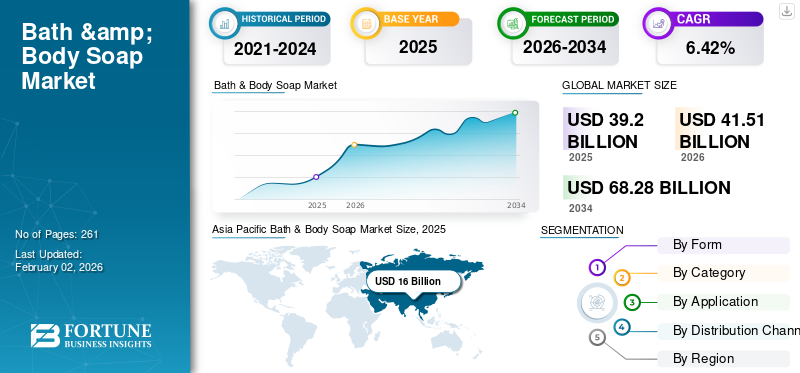
The global bath & body soap market size was valued at USD 39.20 billion in 2026. The market is projected to grow from USD 41.51 billion in 2026 to USD 68.28 billion by 2034, exhibiting a CAGR of 6.42% during the forecast period. Asia Pacific dominated the bath & body soap market with a market share of 40.15% in 2026.
Bath & body soaps are made of ingredients including glycerin, shea butter, and natural oils which aid in moisturizing the user’s skin. In addition, products with added botanical extracts reduces minor changes that causes skin irritation.
Manufacturers’ incorporation of skincare-benefiting ingredients, including herbs, exfoliating ingredients, soothing & calming ingredients, and others in the soap formulation, aids in skin health and favors the market growth. For instance, in September 2026, Kedila Hardik Herbals Institute received a central government grant on its patent on its unique kokareka herbal bath body soap which is available in the Indian market.
Leading players operating in the global market include The Procter & Gamble Company, The Colgate-Palmolive Company, Unilever Plc., Henkel AG & Co. KGaA, and Johnson & Johnson Services, Inc. These players are launching organic formulation-based products to build their product portfolio of personal care category. In May 2026, Dove, a Unilever Plc.-owned bath products brand, launched Dove Advanced Care Body Wash, engineered with new formulas and Dove’s DEFI technology for the users’ gentle, non-stripping cleansing experience.
Download Free sample to learn more about this report.
BATH & BODY SOAP MARKET KEY TAKEAWAYS
 Global Market Size & Forecast
- 2025 Market Size: USD 39.20 Billion
- 2026 Market Size: USD 41.51 Billion
- 2034 Forecast Market Size: USD 68.28 Billion
- CAGR: 6.42% from 2026–2034
 Market Share
- Asia Pacific dominated the bath & body soap market with a 40.15% share in 2025.
- The leading form segment accounted for the largest market share.
- The leading application segment held a dominant market share.
 Key Regional Highlights
Asia Pacific
Asia Pacific is the leading regional market, driven by rising demand for premium and organic bath & body soaps across China, Japan, and Southeast Asia.
Europe
Europe holds the second-largest market, supported by growing demand for natural personal care products and increasing soap imports.
North America
North America remains a significant market, driven by rising household spending on personal care products and expanding hospitality infrastructure.
U.S.
Growing consumer spending on premium bath & shower products and expanding hospitality facilities continue to support market growth.
Japan
Rising demand for premium and organic personal care products is expected to strengthen market growth.
Read More

MARKET DYNAMICS
MARKET DRIVERS
Increasing Demand for Premium Formulation-based Body Soaps Drives Market Growth
Increasing demand for premium formulation-based bath & body soaps and the growing number of customers investing in purchasing premium products for self-care drives the bath & body soap market growth. In addition, growing awareness about personal hygiene and consistent brands’ launches of social media promotional campaigns uplifts the product demand across many countries. In April 2026, The Colgate-Palmolive Company launched a first-ever mega campaign to feature its body wash product range in India.
MARKET RESTRAINTS
Occurrence of Skin Rashes Due to Chemical-based Bath Soaps to Restrain Market Growth
Increasing incidences of skin rashes and irritation due to concentrated chemical formulation-based soaps reduces the product demand among global consumers. In addition, consistent unorganized industry manufacturers’ provision of counterfeit products leads to skin health hazards thus restraining the market growth. Besides, fluctuating costs of raw materials used in producing body soaps challenges the key players in conducting production operations, negatively impacting market expansion.
MARKET OPPORTUNITIES
Increasing Demand for Natural Formulation-based Soaps to Create Growth Opportunities
Increasing demand for natural formulation-based body soaps and the growing number of manufacturers incorporating natural ingredients in the soap formulation, including shea butter, essential oils, avocado oil, and others, create newer market growth opportunities. In addition, the growing trend of sustainable shopping and consumer preference for clean formulation-based, ethically-produced products support the future development of the market.
BATH & BODY SOAP MARKET TRENDS
Rising Demand for Personalized Formulation-based Skincare Products to Favor Growth
Rising demand for soaps prepared with luxury ingredients, catering to personalized individual skincare needs, and an increasing number of upper-income groups of consumers preferring custom personal hygiene products favor the global market growth. In addition, growing awareness about personal hygiene & cleanliness majorly among men and consistent key players’ provision of body wash tailoring specific men's hygiene needs create newer growth avenues. Furthermore, increasing parental consumers’ accessibility to baby soaps addressing specific baby skincare needs, such as reducing skin rashes and improving skin hydration, accelerates product revenues globally.
Download Free sample to learn more about this report.
Segmentation Analysis
By Form
Higher Demand for Affordable Solid-form Bath Soaps Resulted in Dominance of Solid Segment
By form, the market is segmented into solid, liquid, and others.
The solid form segment dominates the market. This soap form is usually more affordable than liquid, spray, foam, and other options. High consumer demand for affordable personal care products increases the demand for solid soaps, contributing to the bath & body soap market share. In addition, the growing trend of buying bar soaps equipped with personalized formulations of scents and fragrances favors the solid segment’s growth.
The liquid segment is slated to grow at the fastest rate during the forecast period. Liquid body washes are more suitable for consumers with sensitive skin. During usage, the liquid soap creates a luxurious lather that moisturizes the users’ sensitive skin. The liquid segment growth is mainly driven by the increasing prevalence of consumers with sensitive skin preferring liquid body washes worldwide. Furthermore, increasing consumer demand for natural formulation-based liquid soaps containing vitamin E and other antioxidants favor segmental growth.
By Category
Rising Need for Cost-effective and Long Shelf Life in Products Fuels Demand for Conventional Soaps
By category, the market is bifurcated into organic and conventional.
The conventional segment exhibited a major market share due to the cost-effectiveness and longer shelf life compared to its counterpart. In addition, a growing number of manufacturers producing conventional bar soaps with added nourishing ingredients, including coconut oil or shea butter, supports the segmental growth.
The rising number of consumers opting for natural formulation-based personal hygiene goods is expected to propel organic segmental growth at the fastest rate during the forecast period of 2026-2034. In addition, consistent Food & Drugs Administration (FDA) and many other governmental organizations’ regulations toward the usage of materials in soap formulation enabled market players to develop products made of sustainable ingredients.
By Application
Increasing Demand for Premium and Herbal Soaps to Accelerate Product Sales within Household Segment
Based on application, the market is bifurcated into household and commercial.
Significant household consumers’ demand for premium, herbal, and dermatologically-tested soaps to address specific skincare needs resulted in the household segment exhibiting a major market share in 2026. In addition, growing household consumers’ necessities of using products of diverse form formats and the increasing number of single & dual-person households supports the product demand across many countries.
The growing infrastructural facilities related to hotel accommodation settings, hospitals, and other public facilities preferring premium-based personal hygiene products is mainly expected to drive commercial segmental growth at the fastest rate during the forecast period of 2026-2034. Furthermore, increasing number of hospitality settings, preferring anti-bacterial property-based body wash items to maintain a sanitized environment in the bathroom spaces drives commercial segmental revenue growth.
By Distribution Channel
Wide Availability of Affordable Products to Trigger Product Sales across Hypermarkets/Supermarkets
Based on the distribution channel, the global market is divided into hypermarkets/supermarkets, pharmacies, online channels, and others.
The wide availability of affordable, branded personal hygiene products at supermarkets and the growing trend of bulk purchasing accelerates revenue generation across hypermarkets/supermarkets globally. The hypermarkets/supermarkets segment is forecast to dominate the global market throughout the forecast period, given the shops’ provision of bath and shower products at discounted prices.
The rising adoption of online shopping for personal care goods is expected to drive the segment’s growth at the fastest rate during the forecast period. Furthermore, the emergence of global drop-hipping businesses and increasing consumers’ usage of shopping coupons favor product purchase through online channels.
Bath & Body Soap Market Regional Outlook
The market is categorized by geography into North America, Europe, Asia Pacific, South America, and the Middle East & Africa.
Asia Pacific
Asia Pacific Bath & Body Soap Market Size, 2025 (USD Billion)
To get more information on the regional analysis of this market, Download Free sample
Asia Pacific dominates the global market share. The regional market is predicted to grow at the fastest rate during the forecast period. The high number of middle-income households preferring luxury bath soaps and shower gels triggers the product demand across China, Japan, and Southeast Asia. In addition, the rising number of nuclear families and their preference for organic formulation-based products support the regional market growth.
Europe
Europe accounts for the second-leading market share. Significant imports of soap & other personal hygiene products and the growing trend of gift-giving personal care goods among households drive the product revenues across the Western European region. In addition, shifting consumers’ preference toward natural formulation-based bath & body soaps and shower gels to avoid skin irritation issues due to chemical-based products creates new market growth opportunities in Europe.
North America
North America accounted for the third-leading global market share in 2026. It is projected to grow at the fifth-fastest rate during the forecast period of 2026-2034. The increasing number of single-person groups of households and their considerable spending on daily essential goods, including bath & shower products, drives the product sales across the U.S. and Canada. In addition, growing hospitality infrastructural facilities preferring luxury bathroom products to enhance their customers’ hotel accommodation experience supporting the future development of the market in Canada and Mexico. In May 2026, Germain Hotels secured a USD 160 million equity investment from Caisse de dépôt et placement du Québec, a pension fund company, to execute its plan of opening Alt location hotel at Ottawa airport and Germain hotel at Casino de Montréal.
South America
South American accounted a fourth-leading global market share in 2026. It is slated to grow at the second fastest rate during the forecast period of 2026-2034. Significant imports of soap bars and liquid soaps in Argentina, Chile, and Peru and an increasing number of youngsters preferring scented bath & body soaps accelerate product revenues across the region. According to the Brazilian Cosmetic, Toiletries, and Perfumery Industry Association (ABIHPEC), in 2022, soap imports in Argentina, Chile, Peru, Colombia, Paraguay, Venezuela, Mexico, and Uruguay reached
USD 14.8 million, 19% of the total cosmetic, toiletry, and perfumery products (USD 122.5 million). During the year, most of the soap imports are soap bars (67%).
Furthermore, consistent manufacturers' introduction of innovative products encourages consumers to purchase newer bath products, driving the South American market growth. For instance, in April 2024, Dana Cosmetics, a Brazilian personal care manufacturer, established a collaboration agreement with Mentos, a mint brand of Perfetti Van Melle, to launch a collection of liquid soap, Herbissimo Mentos bar soap, liquid talcum, shampoo, and a matching conditioner.
Middle East & Africa
Middle East & Africa is forecast to grow at a significant rate in the coming years. It is predicted to grow at the third fastest rate during the forecast period of 2026-2034. The growing awareness about the availability of plant and fruit formulation-based bath soaps and increasing demand for luxury home goods among households accelerate product revenues across UAE and Saudi Arabia. In addition, a rising number of cosmetic stores and pharmacy shops offering natural formulation-based products drive product demand in the African region.
COMPETITIVE LANDSCAPE
Key Industry Players
Key Players' Implementation of Agile Businesses Approaches to Enable Players to Build Product Sales
The global market is concentrated with companies such as The Procter & Gamble Company, The Colgate-Palmolive Company, Unilever Plc., Henkel AG & Co. KGaA, and Johnson & Johnson Services, Inc. These key players focus on building their production capacity and product supply rate to strengthen their market position.
- For instance, Unilever, Plc. has implemented lean and agile SEM approaches, including the utilization of Digital twin technology for optimized operations and real-time data sharing.
LIST OF KEY BATH & BODY SOAP COMPANIES PROFILED
- The Procter & Gamble Company (U.S.)
- Unilever Plc (U.K.)
- Natura & Co. (Brazil)
- Kao Corporation (Japan)
- Johnson & Johnson Services, Inc. (U.S.)
- Reckitt Benckiser Group Plc. (U.K.)
- Ecolab Inc. (U.S.)
- Beiersdorf AG (Germany)
- Henkel AG & Co. KGaA (Germany)
- ITC Limited (India)
- The Colgate-Palmolive Company (U.S.)
KEY INDUSTRY DEVELOPMENTS
- July 2026: Rocky Mountain Soap, a Canadian natural skincare company, launched RM Soap Market, a new brand with craftsmanship body wash products made of natural formulas.
- July 2026: Cinthol launched a lime-contained foam body wash, enabling users to wash off the body in less time.
- December 2024: Bath & Body Works, Inc., a specialty retailer company, established a partnership with Shoppers Stop, a departmental store chain, to expand its American-based fragrance brand business presence in the Indian market. Through such a partnership, the retailer is able to expand its bath soap product reach in India.
- July 2024: Fiama, an ITC-owned personal hygiene products brand, launched a Rashmika Mandanna ambassador-inspired gel bar made of patchouli and sandalwood oil.
- October 2022: mCaffeine, an Indian skincare brand, launched a line of body wash products, including Assorted Coffee Bathing Soaps, bath bombs, and seven other products.
REPORT COVERAGE
Request for Customization to gain extensive market insights.
Report Scope & Segmentation
|
ATTRIBUTE |
DETAILS |
|
Study Period |
2021-2034 |
|
Base Year |
2026 |
|
Estimated Year |
2026 |
|
Forecast Period |
2026-2034 |
|
Historical Period |
2021-2026 |
|
Growth Rate |
CAGR of 6.42% from 2026-2034 |
|
Unit |
Value (USD Billion) |
|
Segmentation |
By Form
|
|
By Category
|
|
|
By Application
|
|
|
By Distribution Channel
|
|
|
By Geography
|
Frequently Asked Questions
The global bath & body soap market size is projected to grow from $41.51 billion in 2026 to $68.28 billion by 2034, a CAGR of 6.42% during the forecast period
In 2025, the market value stood at USD 39.20 billion.
At a CAGR of 6.42%, the global market forecasted to grow from 2026-2034.
By form, the solid segment leads the global market.
The increasing demand for premium formulation-based body soaps is driving the worldwide market growth.
The Procter & Gamble Company, The Colgate-Palmolive Company, Unilever Plc., Henkel AG & Co. KGaA, and Johnson & Johnson Services, Inc. are the key companies operating in the market.
Globally, Asia Pacific region dominates the market.
The increasing demand for natural formulation-based soaps is set to create newer market growth opportunities.



- 2021-2034
- 2025
- 2021-2024
- 261
-
(Offer valid till 31st Oct 2026)
Get 30-60 hrs Free Customization
Expand Regional and Country Coverage, Segments Analysis, Company Profiles, Competitive Benchmarking, and End-user Insights.







Related Reports
-
US +1 833 909 2966 ( Toll Free )
-
Get In Touch With Us