Biogas Purification Systems Market Size, Share & Industry Analysis, By Feedstock (Agricultural Waste, Municipal Solid Waste (MSW), Wastewater Treatment Plants, Landfill Gas, and Others), By Technology (Membrane Separation, Water Scrubbing, Pressure Swing Adsorption (PSA), Chemical Scrubbing, Cryogenic Separation, and Others), By End User (Utilities & Gas Grid Operators, Transportation Sector, Industrial Sector, Municipal Authorities, and Others), and Regional Forecast, 2026-2034
 Download Free Sample
Biogas Purification Systems Market Size and Future Outlook
 Listen to Audio Version
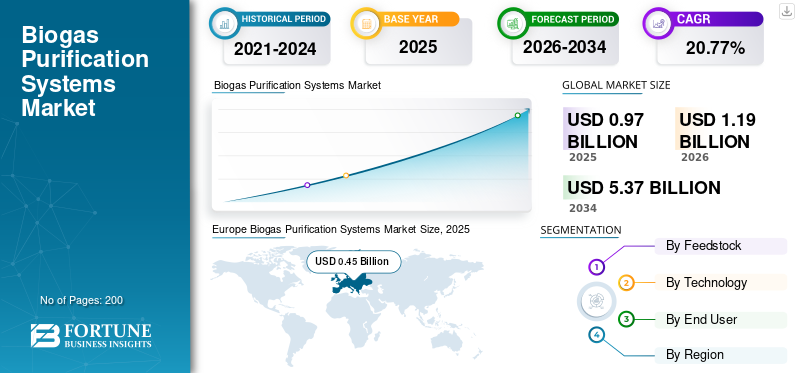
The global biogas purification systems market size was valued at USD 0.97 billion in 2025. The market is projected to grow from USD 1.19 billion in 2026 to USD 5.37 billion by 2034, exhibiting a CAGR of 20.77% during the forecast period. Europe dominated the global market with a market share of 46.39% in 2025.
Biogas purification systems are advanced gas upgrading technologies used to convert raw biogas generated from agricultural waste, municipal solid waste, landfill gas, wastewater sludge, and industrial organic residues into high-purity biomethane or Renewable Natural Gas (RNG). These systems remove impurities such as carbon dioxide, hydrogen sulfide, moisture, siloxanes, and trace contaminants through technologies including membrane separation, pressure swing adsorption (PSA), water scrubbing, chemical scrubbing, and cryogenic upgrading. The purified gas is then utilized for natural gas grid injection, Bio-CNG and Bio-LNG production, industrial fuel replacement, and low-carbon transportation applications. In addition, the Combined Heat and Power (CHP) systems in biogas purification applications enable simultaneous generation of electricity and thermal energy from upgraded biogas, improving energy efficiency and waste-to-energy utilization.
The market share is being driven by increasing global focus on methane emission reduction, expansion of biomethane infrastructure, and rising investments in waste-to-energy projects. Government programs such as Europe’s REPowerEU biomethane targets and India’s Sustainable Alternative Toward Affordable Transportation (SATAT) initiative are accelerating the deployment of upgrading facilities. In addition, growing demand for renewable transportation fuels and industrial decarbonization is significantly increasing the adoption of high-efficiency biogas purification technologies and clean energy worldwide.
- For instance, in February 2024, Air Liquide announced the expansion of its biomethane production and renewable natural gas infrastructure activities in Europe through investments in advanced membrane-based biogas production systems. The initiative focused on supporting agricultural and municipal waste-to-energy projects aimed at increasing biomethane injection into regional gas grids. The company emphasized high methane recovery efficiency and reduced carbon emissions through upgraded purification technologies.
Some of the leading companies operating in the global industry include Air Liquide, Wärtsilä, and Xebec Adsorption Inc., among others. Wärtsilä is a Finland-based energy and marine technology company actively involved in the biogas purification systems market through biomethane upgrading and waste-to-energy solutions. The company provides biogas processing, gas conditioning, and upgrading technologies for converting organic waste into RNG and Bio-LNG. Wärtsilä supports utilities, industrial facilities, and transportation sectors with integrated renewable gas and decarbonization solutions. Biogas purification systems provide a cost-effective alternative to fossil fuels by converting organic waste into high-purity renewable natural gas for industrial, utility, and transportation applications.
Download Free sample to learn more about this report.
Biogas Purification Systems Market KEY TAKEAWAYS
 Global Market Size & Forecast
- 2025 Market Size: USD 0.97 Billion
- 2026 Market Size: USD 1.19 Billion
- 2034 Forecast Market Size: USD 5.37 Billion
- CAGR: 20.77% from 2026–2034
 Market Share
- Europe dominated the market with a 46.39% share in 2025.
- Agricultural waste was the leading feedstock segment, accounting for 37.15% market share in 2025.
- Membrane separation led the technology segment with a 34.42% share in 2025.
 Key Regional Highlights
Asia Pacific
Asia Pacific reached USD 0.19 billion in 2025, driven by Bio-CNG and waste-to-energy projects.
North America
North America reached USD 0.26 billion in 2025, supported by RNG projects and favorable policies.
Europe
Europe reached USD 0.45 billion in 2025, led by biomethane expansion and REPowerEU targets.
U.S.
U.S. reached USD 0.23 billion in 2025, driven by renewable natural gas and biomethane projects.
Japan
Japan growth is supported by expanding waste-to-energy and biogas upgrading technologies.
Read More

BIOGAS PURIFICATION SYSTEMS MARKET TRENDS
Increasing Biomethane Grid Injection and Bio-CNG Adoption is the Key Market Trend
The biogas industry that deals with purification systems is witnessing strong adoption due to the rapid expansion of biomethane grid injection and Bio-CNG infrastructure across Europe, North America, and Asia Pacific. Utilities and gas network operators are increasingly upgrading raw biogas into pipeline-quality biomethane to reduce dependence on fossil natural gas and to support the global shift toward increasing demand for renewable energy sources with transition targets.
In Europe, renewable gas integration programs and biomethane blending mandates are accelerating the deployment of membrane separation and PSA upgrading systems for agricultural and municipal waste projects. Simultaneously, transportation sectors are driving demand for Bio-CNG and Bio-LNG as low-carbon alternatives for heavy-duty vehicles, buses, and fleet operations. In addition, industries are adopting renewable natural gas for decarbonization of thermal operations and process heating applications, increasing investments in high-efficiency gas upgrading technologies with improved methane recovery and lower operational energy consumption.
MARKET DYNAMICS
MARKET DRIVERS
Download Free sample to learn more about this report.
Expansion of Agricultural Waste-to-Biomethane Infrastructure is Driving Market Growth
The growing development of agricultural waste-to-biomethane infrastructure is becoming a major driver for the market. Large volumes of livestock manure, crop residue, sugarcane waste, and food processing by-products are increasingly being utilized for anaerobic digestion and renewable gas production instead of open disposal or landfill dumping. This shift is driving the installation of advanced purification technologies capable of producing high-purity biomethane for industrial fuel, transportation, and grid injection applications.
European countries are expanding farm-based biomethane clusters integrated with local gas distribution networks, while Brazil and India are accelerating projects utilizing agricultural residue and cattle waste for Bio-CNG production. In addition, food and beverage industries are investing in on-site biogas upgrading systems to convert organic waste into usable renewable fuel for captive operations. These factors are anticipated to drive the biogas purification systems market growth during the forecast period.
MARKET RESTRAINTS
High Operational Complexity and Gas Quality Variability to Hamper Market Demand
The market faces challenges due to operational complexity associated with fluctuating raw biogas composition and inconsistent feedstock quality. Biogas generated from agricultural waste, landfill gas, municipal solid waste, and wastewater sludge contains varying concentrations of carbon dioxide, hydrogen sulfide, moisture, ammonia, and siloxanes, requiring customized upgrading configurations and continuous process optimization. Variations in methane concentration and contaminant levels can reduce purification efficiency, increase membrane fouling, raise chemical consumption, and accelerate equipment corrosion, resulting in higher operational and maintenance costs. These operational limitations can delay project scalability, increase lifecycle costs, and reduce profitability for biomethane producers, especially in emerging markets with limited technical infrastructure and financing support.
MARKET OPPORTUNITIES
Rising Development of Bio-LNG for Heavy Transport to Create New Revenue Opportunities
The increasing development of Bio-LNG infrastructure for heavy-duty transportation and marine applications is creating significant growth opportunities for the biogas projects. Logistics operators, shipping companies, and industrial transport fleets are actively seeking low-carbon fuel alternatives to comply with emission reduction regulations and decarbonization targets. This is driving investments in advanced biogas upgrading and liquefaction facilities capable of producing high-purity biomethane suitable for liquefied renewable fuel applications. Countries across Europe and North America are expanding Bio-LNG corridors and fueling infrastructure for long-haul trucks and commercial transport networks, increasing demand for cryogenic upgrading and high-efficiency purification technologies.
MARKET CHALLENGES
Limited Renewable Gas Infrastructure and Grid Connectivity Impose Market Challenges
The market faces significant challenges due to limited renewable gas infrastructure and inadequate biomethane grid connectivity in several developing and emerging economies. Many regions lack dedicated pipeline networks, gas injection facilities, standardized biomethane quality regulations, and storage infrastructure required for large-scale commercialization of upgraded biogas. As a result, several biogas producers remain dependent on localized consumption models, restricting scalability and long-term project economics. Remote agricultural and rural biogas projects often face difficulties connecting purification facilities to natural gas distribution systems due to high pipeline extension costs and limited utility integration support.
Segmentation Analysis
By Feedstock
Agricultural Waste Segment Dominated Due to Abundant Feedstock Availability Across Agricultural Regions
Based on the segmentation of feedstock, the market is classified into agricultural waste, Municipal Solid Waste (MSW), wastewater treatment plants, landfill gas, and others.
In 2025, agricultural waste dominated the market share, accounting for 37.15% of biogas purification systems market share. The segment offers continuous availability of livestock manure, crop residues, sugarcane waste, and agro-industrial by-products suitable for large-scale anaerobic digestion. Countries with strong agricultural economies, such as Germany, India, Brazil, and the U.S., are increasingly utilizing farm waste for biomethane and Bio-CNG production. Agricultural feedstocks also provide a stable, long-term raw material supply compared to seasonal municipal waste streams.
The wastewater treatment plants segment is expected to grow at a CAGR of 21.43% over the forecast period.
To know how our report can help streamline your business, Speak to Analyst
By Technology
Membrane Separation Segment Dominated as it Offers High Efficiency with Modular Scalability
Based on the segmentation of technology, the market is classified into membrane separation, water scrubbing, Pressure Swing Adsorption (PSA), chemical scrubbing, cryogenic separation, and others.
In 2025, the membrane separation segment dominated the global market, accounting for 34.42% share. This growth is majorly attributed to high methane recovery efficiency, compact system design, and lower operational complexity compared to conventional upgrading technologies. The technology enables continuous separation of carbon dioxide and impurities without requiring large chemical consumption or extensive water usage. Membrane systems are increasingly preferred for decentralized agricultural and municipal biomethane projects due to their modular scalability and easier integration into containerized upgrading plants.
The cryogenic separation segment is expected to grow at the highest CAGR of 25.33% over the forecast period.
By End User
Utilities & Gas Grid Operators Segment Led with Extensive Biomethane Grid Integration Projects
On the basis of the segmentation of the end user, the market is classified into utilities & gas grid operators, transportation sector, industrial sector, municipal authorities, and others.
In 2025, the utilities & gas grid operators segment dominated the global market, accounting for 35.14% share. Energy utilities are deploying advanced upgrading systems to convert raw biogas into pipeline-quality renewable natural gas compatible with existing distribution infrastructure. European gas operators are particularly expanding grid-connected biomethane facilities to support decarbonization and energy diversification targets.
The transportation sector is expected to grow at a CAGR of 22.88% over the forecast period.
Biogas Purification Systems Market Regional Outlook
By region, the market is categorized into North America, Europe, Asia Pacific, Latin America, and the Middle East & Africa.
Europe
Europe Biogas Purification Systems Market Size, 2025 (USD Billion)
To get more information on the regional analysis of this market, Download Free sample
Europe's market accounted for a dominant market share and is projected to record a growth rate of 21.11% in the coming years, and further reached a valuation of USD 0.45 billion in 2025. In Europe, countries such as Germany, France, Denmark, and Italy are expanding agricultural and municipal waste-based biomethane projects to meet REPowerEU renewable gas targets. The region is witnessing strong adoption of membrane separation and water scrubbing technologies for decentralized farm-scale upgrading facilities.
Germany Biogas Purification Systems Market
The Germany market in 2025 was estimated at around USD 0.12 billion in 2025 and is further estimated to be around USD 0.14 billion in 2026, representing roughly 12.20% of the global revenues. Germany remains a leading market for biogas purification systems due to its extensive agricultural biogas infrastructure and strong biomethane grid injection network. The country is increasingly upgrading existing biogas plants with advanced membrane and PSA systems to improve methane recovery and support renewable gas integration.
North America
The North America market in 2025 was valued at USD 0.26 billion, and also expected to take a significant share in 2026 with USD 0.32 billion.
North America is witnessing strong growth in the market due to the rapid expansion of RNG projects across landfill gas, dairy waste, and wastewater treatment facilities. The U.S. is increasingly deploying membrane separation and PSA upgrading systems to support pipeline-grade biomethane production under Renewable Fuel Standard (RFS) and Low Carbon Fuel Standard (LCFS) programs. Canada is also expanding agricultural biomethane and utility-led gas injection projects, particularly in British Columbia and Quebec.
U.S. Biogas Purification Systems Market
Based on North America’s strong contribution and the U.S. dominance within the region, the U.S. market was analytically approximated at around USD 0.23 billion in 2025, accounting for roughly 23.35% of the global market size.
Asia Pacific
Asia Pacific was estimated to account for a significant market share and reached USD 0.19 billion in 2025. In the region, India and China both reached USD 0.053 billion and 0.062 USD billion, respectively, in 2025.
Asia Pacific is emerging as a high-growth market for biogas purification systems due to increasing investments in compressed biogas and waste-to-energy infrastructure across China and India. Government initiatives promoting agricultural residue utilization, municipal waste processing, and Bio-CNG production are accelerating the deployment of modular membrane and PSA upgrading technologies throughout the region.
India Biogas Purification Systems Market
The Indian market accounted for roughly 5.49% of global revenues. India’s market is expanding with increasing deployment of biogas upgrading facilities integrated with sugar mills, distilleries, and food processing industries for captive renewable fuel generation. State-level policies supporting organic waste management and rising adoption of LNG alternatives for commercial transport fleets are further accelerating investments in high-purity biomethane and Bio-LNG production infrastructure.
China Biogas Purification Systems Market
China’s market represents roughly 6.38% of the global market.
Australia Biogas Purification Systems Market
The Australia market in 2025 was estimated at around USD 0.01 billion, accounting for roughly 1.27% of global revenues.
Latin America
Latin America is expected to witness moderate growth in this market space in the long term. The market reached a valuation of USD 0.04 billion in 2025.
Latin America is witnessing increasing adoption of biogas purification systems through livestock waste and sugarcane residue-based biomethane projects, particularly in Brazil, where renewable gas is gaining traction for industrial fuel substitution and heavy transportation applications.
Brazil Biogas Purification Systems Market
Brazil's market value reached at around USD 0.02 billion in 2025, representing roughly 1.94% of the market.
Middle East & Africa
The Middle East & Africa region is expected to witness significant growth in this market space during the forecast period. The market reached a valuation of USD 0.03 billion in 2025.
The region’s market is gradually expanding through municipal waste-to-energy projects and landfill gas utilization initiatives, particularly across GCC countries and South Africa. Increasing focus on circular economy strategies, wastewater treatment modernization, and diversion of organic waste from landfills is supporting the adoption of biomethane upgrading and gas purification technologies in the region.
GCC Biogas Purification Systems Market
The GCC market was valued at around USD 0.02 billion in 2025, representing roughly 1.52% of the global market.
COMPETITIVE LANDSCAPE
Key Industry Players
Leading Companies are Actively Expanding Market Share Through Collaborations, Business Expansion, and Technological Innovation
The global biogas purification systems market exhibits a consolidated market landscape, with major participants including Air Liquide, Wärtsilä, and Xebec Adsorption Inc., among others. Market participants are implementing focused growth initiatives aimed at enhancing their product portfolio, advancing technical expertise, increasing manufacturing capabilities, and broadening their operational footprint.
- In October 2023, Wärtsilä strengthened its renewable gas portfolio through biomethane upgrading and Bio-LNG infrastructure projects targeting waste-to-energy and transportation fuel The company supplied integrated biogas processing and purification systems designed for converting organic waste into high-purity renewable gas.
Moreover, notable players operating in the global market include Pentair plc, Bright Renewables, and DMT Environmental Technology. These organizations are anticipated to emphasize new product launches and strategic collaborations in order to strengthen their global market share throughout the forecast period.
LIST OF KEY BIOGAS PURIFICATION SYSTEMS COMPANIES PROFILED
- Air Liquide (France)
- Wärtsilä (Finland)
- Xebec Adsorption Inc. (Canada)
- Greenlane Renewables Inc. (Canada)
- Pentair plc (U.K.)
- Bright Renewables (Netherlands)
- DMT Environmental Technology (Netherlands)
- Evonik Industries AG (Germany)
- Carbotech Gas Systems GmbH (Germany)
- Malmberg Group (Sweden)
KEY INDUSTRY DEVELOPMENTS
- June 2024: Greenlane Renewables secured contracts for multiple biomethane upgrading facilities utilizing membrane separation technology across Europe and North America. The projects involved upgrading biogas generated from agricultural waste and wastewater treatment operations into renewable natural gas for grid injection and vehicle fuel applications.
- May 2024: Malmberg Group commissioned a biomethane upgrading facility for a municipal wastewater treatment project in Scandinavia using advanced water scrubbing purification technology. The system upgraded sewage-based biogas into renewable natural gas suitable for transportation fuel and utility applications. Malmberg emphasized efficient contaminant removal and stable methane purity for long-term plant operations.
- April 2024: Bright Renewables commissioned a biomethane upgrading plant utilizing membrane purification technology for an agricultural waste-based renewable gas project in the Netherlands. The facility was designed to convert manure and organic residues into high-purity biomethane suitable for gas grid injection. The company focused on compact and modular upgrading systems for decentralized farm-scale operations.
- February 2024: Evonik Industries expanded production capabilities for its SEPURAN membrane technology used in biogas purification and biomethane upgrading applications. The company targeted the growing demand for membrane separation systems in Europe and the Asia Pacific, particularly for agricultural and wastewater-based renewable gas projects. Evonik’s membranes were designed to improve methane purity and reduce energy requirements in upgrading operations.
- November 2023: Carbotech Gas Systems delivered biogas upgrading solutions based on pressure swing adsorption technology for biomethane production facilities in Germany and neighboring European markets. The systems enabled efficient separation of carbon dioxide and impurities from raw biogas for gas grid injection and Bio-CNG applications.
REPORT COVERAGE
The global biogas purification systems market analysis provides an in-depth study of the market size & forecast by all the market segments included in the report. It includes details on the market dynamics and the market trends expected to drive the market in the forecast period. It offers information on the technological advancements, new product launches, key industry developments, and details on partnerships, mergers & acquisitions. The market research report also encompasses a detailed competitive landscape with information on the market share and profiles of key operating players.
Request for Customization to gain extensive market insights.
Report Scope & Segmentation
| ATTRIBUTE | DETAILS |
| Study Period | 2021-2034 |
| Base Year | 2025 |
| Estimated Year | 2026 |
| Forecast Period | 2026-2034 |
| Historical Period | 2021-2024 |
| Growth Rate | CAGR of 20.77% from 2026 to 2034 |
| Unit | Value (USD Billion) |
| Segmentation | By Feedstock, Technology, End User, and Region |
| By Feedstock |
|
| By Technology |
|
| By End User |
|
| By Region |
|
Frequently Asked Questions
Fortune Business Insights says that the global market value stood at USD 0.97 billion in 2025 and is projected to reach USD 5.37 billion by 2034.
In 2025, the market value stood at USD 0.45 billion.
The market is expected to exhibit a CAGR of 20.77% during the forecast period.
The agricultural waste segment led the market by feedstock.
Increasing biomethane grid injection projects, renewable fuel demand, and agricultural waste-to-energy investments are the key factors driving the market.
Air Liquide, Wärtsilä, and Xebec Adsorption Inc. are some of the prominent players in the market.
Europe dominated the market in 2025.
Expansion of Bio-CNG and Bio-LNG infrastructure, stricter methane emission regulations, and growing renewable natural gas integration into utility grids are the major factors expected to favor adoption.



- 2021-2034
- 2025
- 2021-2024
- 200
Get 30-60 hrs Free Customization
Expand Regional and Country Coverage, Segments Analysis, Company Profiles, Competitive Benchmarking, and End-user Insights.



















Related Reports
-
US +1 833 909 2966 ( Toll Free )
-
Get In Touch With Us