Brick Liquid Cartons Market Size, Share & Industry Analysis, By Material (Paper, Plastic, and Aluminum), By Opening Type (Straw Hole, Clip, Twist, and Cut), By End-use Industry (Food & Beverages, Personal Care & Cosmetics, Pharmaceuticals, and Others), and Regional Forecast, 2026-2034
 Download Free Sample
(Offer valid till 30th Sep 2026)

Brick Liquid Cartons Market Size and Industry Overview
 Listen to Audio Version
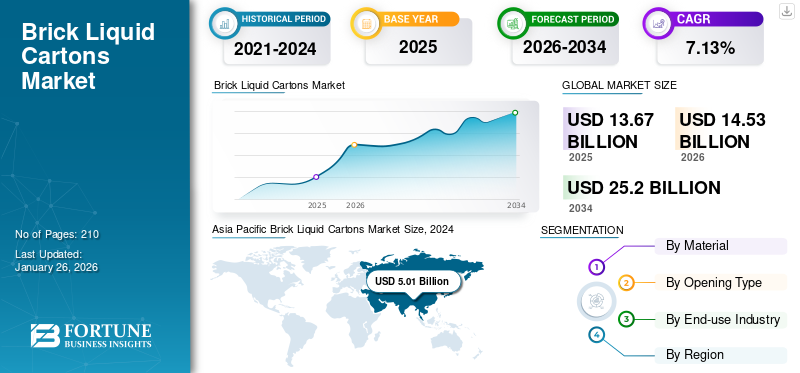
The global brick liquid cartons market size was valued at USD 13.67 billion in 2025 and is projected to grow from USD 14.53 billion in 2026 to USD 25.20 billion by 2034, exhibiting a CAGR of 7.13% during the forecast period. Asia Pacific dominated the brick liquid cartons market with a market share of 38.87% in 2024.
A brick liquid carton is a rectangular container, often flat on top, utilized for packaging liquids such as milk, juice, and beverages. These cartons are crafted for optimal stacking and storage and are generally composed of multiple layers of materials, including paperboard, plastic, and occasionally aluminum, for added barrier protection. The demand for packaged liquid products is propelled by the rapid urbanization in developing nations, contributing to market growth. Furthermore, increasing consumer spending and higher disposable incomes are driving the expansion of the global liquid packaging cartons sector.
- The International Dairy Federation states that the dairy industry is crucial for feeding the global population, generating 881 million tons of milk in 2019, which continues to grow annually. Over 80% of people globally, around 6 billion individuals, frequently consume liquid milk or various dairy items.
Axalta Coating and Akzo Nobel N.V. are the leading manufacturers, accounting for the largest global market share.
Download Free sample to learn more about this report.
Brick Liquid Cartons Market Key Takeaways
 Global Market Size & Forecast
- 2025 Market Size: USD 13.67 billion
- 2026 Market Size: USD 14.53 billion
- 2034 Forecast Market Size: USD 25.20 billion
- CAGR: 7.13% from 2026-2034
 Market Share
- Asia Pacific dominated the brick liquid cartons market with a 38.87% share in 2024.
- The paper segment accounted for the largest market share in 2025.
- The twist segment accounted for the largest market share in 2025.
 Key Regional Highlights
Asia Pacific
Asia Pacific dominated the global brick liquid cartons market, driven by strong demand for packaged beverages.
North America
North America remained the second-largest regional market, supported by increasing consumption of liquid food packaging.
Europe
Europe held a significant share of the global market due to rising demand for sustainable carton packaging.
U.S.
The country is a significant market for brick liquid cartons, supported by strong demand for packaged dairy and beverages.
Japan
Rising consumption of packaged and ready-to-drink beverages is driving demand for brick liquid cartons.
Read More

MARKET DYNAMICS
MARKET DRIVERS
Augmenting Demand from E-commerce & Beverages Sector Drives Market Growth
The beverage industry is growing rapidly across the globe. Several millennials' rising consumption of beverage products contributes to the demand for brick cartons. The industry is experiencing a shift toward environmentally friendly packaging as governments across the globe are implementing stricter regulations on plastic packaging. Growth in the plant-based and dairy beverage segments, including milk, juices, and soft drinks, continues to drive the demand for brick cartons. Furthermore, in the e-commerce industry, protecting packaged goods from tampering or damage is essential, which increases the need for reusable packaging materials.
- According to the data provided by the Union of EU Soft Drinks Associations (UNESDA), there are chances of France becoming a potential market for soft drinks. The data shows France consumed 3958 million liters of soft drinks in 2021.
MARKET RESTRAINTS
Volatility in Raw Material Prices & Changing Consumer Preferences Hamper Market Expansion
Despite favorable market conditions, several constraints hinder growth. The upfront investment required for producing brick liquid cartons can exceed that of conventional packaging materials, potentially discouraging smaller enterprises from entering the market. Additionally, fluctuations in raw material prices can affect profit margins, as evidenced by the increasing costs of paperboard and coatings in production. While consumers are increasingly looking for ready-to-eat products, packaging manufacturers are confronted with the difficulty of maintaining perishable goods such as dairy and juices for extended periods, which is stifling market expansion.
MARKET OPPORTUNITIES
Rising Demand for Sustainable Packaging & Smart Cartons will Offer Potential Growth Opportunities
The global market for brick liquid cartons is witnessing a robust expansion, fueled by a growing need for packaged liquid goods and a heightened interest in sustainable packaging alternatives. Both consumers and regulators are focusing more on eco-friendly packaging solutions, which is increasing the demand for brick liquid cartons constructed from renewable resources such as paperboard with thin coatings of plastic and aluminum. Advancements in smart carton technology, featuring innovations such as freshness indicators and RFID tags, are attracting consumers and propelling further significant growth in the market.
BRICK LIQUID CARTONS MARKET TRENDS
Utilization of Plant-based Materials & Anti-counterfeiting Technologies Booms as a Market Trend
Brick packaging cartons increasingly incorporate plant-based materials, primarily paperboard and polymers derived from renewable sources like wood and sugarcane, to enhance sustainability. This shift is driven by consumer demand for eco-friendly packaging and a desire to reduce reliance on fossil fuels. Plant-based packaging, often called bioplastics, is projected to experience a twofold increase in market value within the next ten years. This eco-friendly substitute for conventional plastics aligns with long-term environmental objectives and attracts environmentally aware consumers by minimizing waste and decreasing dependence on fossil fuels. Features that prevent counterfeiting—such as seals that indicate tampering, digital verification tools, and systems for tracking and tracing—are becoming crucial for safeguarding brand integrity and ensuring consumer safety. Henceforth, the rising utilization of plant-based materials & anti-counterfeiting technologies booms as a market trend.
Download Free sample to learn more about this report.
Segmentation Analysis
By Material
Rising Awareness About Ecological Effects Boosted Paper Segment Expansion
Based on material, the market is divided into paper, plastic, and aluminum.
The paper segment accounted for the largest share of the market in 2025. Paper decreases dependence on alternative packaging materials, offering environmentally friendly traits. This material is a more sustainable option for packaging various liquids and drinks. The increasing consciousness about the ecological effects is driving growth in this segment.
Plastic material is the second dominating material segment. Utilizing plastic in brick packages presents numerous advantages. It creates a lighter, more robust, and possibly more cost-effective packaging option than conventional materials such as cardboard or wood. Additionally, plastic effectively safeguards against moisture and damage, guaranteeing that the bricks reach their destination in excellent shape.
By Opening Type
Twist Segment Dominated as It Ensures Freshness and Convenience for Consumers
Based on opening type, the market is divided into straw hole, clip, twist, and cut.
The twist segment accounted for the largest market share in 2025. Twist openings on brick cartons are screw-cap designs that facilitate easy access, sealing, and resealing of the carton. This kind of opening is especially beneficial for liquid food packaging, as it helps ensure freshness and convenience for consumers. Twist openings also aid in preserving product freshness and reducing spoilage by limiting exposure to air, thus boosting the brick liquid cartons market growth.
Straw hole opening type is the second dominating segment in the brick liquid carton market. These openings are designed for direct drinking with a straw, making them suitable for various beverages such as juices and milk. They offer a convenient and easy way to consume the contents of the carton.
By End-use Industry
Increased Emphasis on Protection Against External Contaminants Fueled Food and Beverages Segment Expansion
Based on the end-use industry, the market is segmented into food & beverages, personal care & cosmetics, pharmaceuticals, and others.
Food and beverages dominated the market in 2025. The increasing use of this packaging in developing countries is driving segment growth. The affordability of brick carton packaging is encouraging manufacturers to choose solutions that lower their overall production costs. Brick cartons provide a high level of protection against external contaminants such as moisture, heat, light, and pressure, thus gaining traction in the beverages sector.
On the other hand, the pharmaceuticals segment is expected to witness steady growth in the forecast period. Brick cartons provide a high level of protection against external contaminants such as moisture, heat, light, and pressure.
Brick Liquid Cartons Market Regional Outlook
By geography, the market is categorized into Asia Pacific, North America, Europe, and Rest of the World.
Asia Pacific
Asia Pacific Brick Liquid Cartons Market Size, 2024 (USD Billion)
To get more information on the regional analysis of this market, Download Free sample
The Asia Pacific region dominates the global brick liquid cartons market share. The liquid packaging cartons in this region are preferred for products such as milk and juices. These cartons help in the longer shelf life of products and preserve their freshness. The increasing need for environmentally friendly packaging has led to advancements, including producing cartons from recyclable and biodegradable materials. With a rising inclination toward packaged and ready-to-drink beverages in Japan, India, and other developing economies, the growth of this segment underscores a wider trend toward convenient and portable packaging options. Furthermore, paper and cardboard production have been rapidly growing in the region.
- According to the National Bureau of Statistics of China, the output of processed paper and cardboard is steadily rising in the nation. The output of processed paper and cardboard increased from 11.3 million metric tons in August 2020 to 11.48 million metric tons in August 2021.
North America
North America is the second-largest market. In North America, the U.S. stands out as a significant market for gable top containers. This is due to the increasing demand for flexible packaging options among consumers in the nation. The market is expected to gain from the growing trend of takeout meals and the need for suitable beverage packaging. The swift growth of the food and beverage sector, the rise in fast-moving consumer goods (FMCG), and advancements in packaging technology are the key factors driving market growth.
- For instance, the International Organization of Vine and Wine (OIV) states that the U.S. holds the title of the largest wine market in the world. In 2023, wine consumption saw a drop of 3.0%, totaling 33.3 million hectoliters. Likewise, Canada experienced a decrease in consumption by 5.6%, amounting to 4.8 million hectoliters, which is the first instance since 2016 that total consumption has fallen below 5 million hectoliters.
Europe
Europe has a significant market for brick liquid cartons. The market in the region is expected to thrive, driven by an increasing demand for dairy products and beverages. Government initiatives aimed at encouraging sustainable packaging options are facilitating market growth. Shifts in consumer habits, a significant demand for PET containers, and heightened concerns about product quality are likely to enhance the demand for brick liquid cartons.
Rest of the World
The market in the rest of the world is expected to witness considerable growth in the near future. The dairy and health drink sectors utilize brick cartons to enhance the shelf life of their products. Consumers appreciate their convenience for on-the-go use, which is expected to increase the demand for brick liquid cartons further.
COMPETITIVE LANDSCAPE
Key Industry Players
Continuous Development and Introduction of New Products by Key Companies Resulted in Their Dominating Positions in the Market
The global brick liquid cartons market is concentrated with companies such as Tetra Pak International S.A., Shanghai Skylong Aseptic Package Material Co., Ltd., International Paper, Nippon Paper Industries Co., Ltd., Elopak AS, and Reynolds Group Holdings, accounting for a significant market share.
Tetra Pak is a global leader in solutions for food processing and packaging, committed to ensuring that food is safe and accessible to every individual. Its dedication stems from the conviction that everyone deserves access to safe and nutritious food. The company accomplishes this through cutting-edge processing and packaging technologies, which help maintain food quality and prolong shelf life.
International S.A. is a worldwide leader in eco-friendly packaging solutions, offering an extensive variety of products made from renewable fiber-based resources. The main office is located in Memphis, Tennessee, with its Europe, Middle East, and Africa headquarters based in London. The primary focus of the company involves manufacturing containerboard, corrugated packaging, and cellulose fibers that are utilized in diverse applications such as diapers, tissue, and personal care items.
Additionally, SIG and Pactiv Evergreen are among the other prominent players in the market. Focus on significant investments in the research & development of innovative products has supported the companies’ share in the market.
- In April 2025, SIG collaborated with Plastic Bank, Carta Misr, and TileGreen to create Egypt's first comprehensive recycling system for used aseptic beverage cartons. This initiative aims to transform the Egyptian recycling landscape and convert waste into valuable materials. Carta Misr, a regional paper mill, extracts paper fibers from the aluminum and polymer components of the cartons to produce high-quality recycled paper products. In addition, TileGreen, an Egyptian startup, transforms the PolyAl mixture into sturdy interlock bricks.
LIST OF KEY BRICK LIQUID CARTON COMPANIES PROFILED
- Tetra Pak International S.A. (Switzerland)
- Shanghai Skylong Aseptic Package Material Co., Ltd. (China)
- International Paper (U.S.)
- Nippon Paper Industries Co., Ltd. (Japan)
- Elopak AS (Norway)
- Reynolds Group Holdings (New Zealand)
- Sealed Air (U.S.)
- Saxon Packaging Limited (U.K.)
- Mondi (U.K.)
- SIG (Switzerland)
- Nampak (South Africa)
- Refresco (Netherlands)
- Greatview Aseptic Packaging (China)
- Adam Pack (Greece)
- Pactiv Evergreen (U.S.)
KEY INDUSTRY DEVELOPMENTS
- April 2024: Nampak Liquid Cartons, in collaboration with Woodlands Dairy, introduced a tethered cap carton in South Africa. This innovation was designed to address the reduction of plastic waste, and the new design aims to keep the cap attached to the carton during its recycling process after consumer use.
- November 2023: Ariake launched its first premium liquid broths in SIG carton packs. Ariake, a top company in Japan specializing in livestock-based natural seasonings and operating across two continents, is the first in Belgium to employ aseptic package filling of food products in SIG carton packs. Ariake plans to expand its broth selection with a new assortment of high-quality liquid broths packaged in SIG Slimline carton packs.
- August 2022: Delamere Dairy reintroduced its primary fresh goat's milk range in a novel SIG Combidome packaging design. The specialty milk producer from Cheshire stated that this format – a fairly recent idea for U.K. shops – merges the convenience and ease of pouring found in bottles alongside the eco-friendly benefits of the Brick cartons that were used before.
- January 2022: SIG introduced Signature Evo, the first-ever full-barrier packaging material for aseptic carton packs that are free of aluminum. This new offering expands SIG's range of lower-carbon aluminum-free packaging materials, which were previously available for plain white milk, to include oxygen-sensitive products such as fruit juices, nectars, flavored milk, and plant-based beverages.
- October 2020: Ovostar Union, a prominent Ukrainian manufacturer of chicken eggs and egg-based products, introduced an innovative solution to the national market: liquid egg products packaged in Pure-Pak gable-top cartons. Before this launch, OVOSTAR offered liquid egg products in plastic containers for both the food service and retail sectors, including liquid egg white, liquid whole egg, and scrambled eggs, all of which are pasteurized.
REPORT COVERAGE
Request for Customization to gain extensive market insights.
Report Scope & Segmentation
|
ATTRIBUTE |
DETAILS |
|
Study Period |
2021-2034 |
|
Base Year |
2025 |
|
Estimated Year |
2026 |
|
Forecast Period |
2026-2034 |
|
Historical Period |
2021-2024 |
|
Growth Rate |
CAGR of 7.13% from 2026-2034 |
|
Unit |
Value (USD Billion) |
|
Segmentation |
By Material
|
|
By Opening Type
|
|
|
By End-use Industry
|
|
|
By Region
|
Frequently Asked Questions
Fortune Business Insights says that the global market value stood at USD 14.53 billion in 2026 and is projected to reach USD 25.20 billion by 2034.
In 2024, the market value stood at USD 5.01 billion.
The market is expected to grow at a CAGR of 7.13% during the forecast period.
The food and beverages segment led the market by end-use industry.
The key factor driving the market is the augmenting demand from the e-commerce & beverages sector.
Tetra Pak International S.A., Shanghai Skylong Aseptic Package Material Co., Ltd., International Paper, Nippon Paper Industries Co., Ltd., Elopak AS, and Reynolds Group Holdings are the top players in the market.
Asia Pacific dominated the market in 2024.
Increased demand from the beverage industry is one of the factors that is expected to favor product adoption.


- 2021-2034
- 2025
- 2021-2024
- 210
-
(Offer valid till 30th Sep 2026)
Get 30-60 hrs Free Customization
Expand Regional and Country Coverage, Segments Analysis, Company Profiles, Competitive Benchmarking, and End-user Insights.





Related Reports
-
US +1 833 909 2966 ( Toll Free )
-
Get In Touch With Us