Burn Care Market Size, Share & Industry Analysis, By Product Type (Advanced Dressings, Traditional Dressings, Biologics & Skin Substitutes, Topical Burn Care Products, and Others), By Burn Depth (Partial-thickness Burns, Full-thickness Burns, and Others), By Burn Cause (Thermal Burns, Chemical Burns, Electrical Burns, and Others), By End-user (Hospitals & Burn Centers, Homecare Settings, and Others), and Regional Forecast, 2026-2034
 Download Free Sample
 Burn Care Market Size and Future Outlook
 Listen to Audio Version
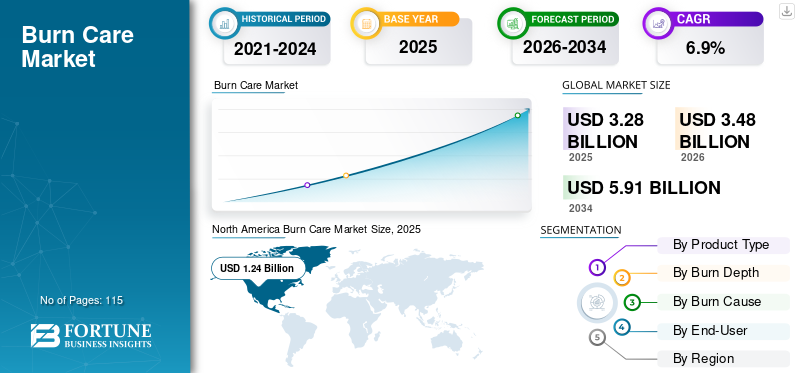
The global burn care market size was valued at USD 3.28 billion in 2025. The market is projected to grow from USD 3.48 billion in 2026 to USD 5.91 billion by 2034, exhibiting a CAGR of 6.9% during the forecast period. North America dominated the burn care market with a market share of 37.80% in 2025.
Burn care includes the treatment and management of skin injuries caused by heat, chemicals, electricity, or radiation. It also covers products such as dressings, ointments, skin substitutes, and supportive care used in hospitals, burn centers, and clinics. The market growth is attributed to rising prevalence of burn injuries, launch of advanced burn care devices, and growing emphasis on preventive care. Moreover, healthcare providers are also focusing more on faster healing, infection control, and reducing long hospital stays. This has increased the use of advanced dressings and modern wound care solutions. Companies are also introducing improved products that help manage pain and healing more effectively.
- For instance, in March 2026, FibroBiologics, Inc. announced launch of its new burn treatment. The new product is incorporating Firbroblast Spheriod technology.
Furthermore, many key industry players, such as Smith+Nephew, Mölnlycke Health Care, Convatec Group, Integra LifeSciences, and Vericel Corporation are operating in the market. Such players are focusing on developing various innovative technologies to offer better products with improved efficiency.
Download Free sample to learn more about this report.
Burn Care Market Key Takeaways
 Market Size & Forecast
- 2025 Market Size: USD 3.28 billion
- 2026 Market Size: USD 3.48 billion
- 2034 Forecast Market Size: USD 5.91 billion
- CAGR: 6.9% from 2026–2034
 Market Share
- North America dominated the burn care market with a 37.80% share in 2025.
- The Advanced Dressings segment accounted for the largest market share in 2025.
- The Hospitals & Burn Centers segment is projected to hold a 68.4% share in 2026.
 Key Regional Highlights
North America
North America held 37.80% share in 2025, valued at USD 1.24 billion.
Asia Pacific
Asia Pacific market projected to reach USD 0.93 billion by 2026.
Europe
Europe market projected to reach USD 1.04 billion by 2026.
U.S.
Market projected to reach USD 1.20 billion by 2026.
Japan
Market projected to reach USD 0.16 billion by 2026.
Read More

BURN CARE MARKET TRENDS
Rising Adoption of Bioactive and Antimicrobial Wound Dressings is One of the Important Trends Observed in the Market
The market is witnessing a substantial shift toward bioactive and antimicrobial wound dressings that go beyond passive wound coverage to actively support the healing process. Healthcare providers are increasingly preferring dressings that incorporate antimicrobial agents such as ionic silver, honey, Polyhexamethylene Biguanide (PHMB), and iodine, which are effective in reducing wound bioburden and preventing infection in burn wounds. Moreover, the growing clinical evidence supporting the use of dressings with growth factor delivery, collagen scaffolds, and biocompatible polymers is further accelerating adoption across burn centers and wound care clinics. In addition, companies are focusing on developing dressings with features such as reduced adherence, extended wear time, and enhanced exudate management, which are improving both patient comfort and clinical outcomes.
MARKET DYNAMICS
MARKET DRIVERS
Download Free sample to learn more about this report.
Rising Global Incidence of Burn Injuries to Accelerate Market Growth
A major driver of this market is the increasing global incidence of burn injuries resulting from domestic accidents, industrial workplace hazards, road traffic accidents, and conflict-related trauma. Burn injuries represent one of the most prevalent and resource-intensive categories of traumatic injury globally, generating sustained and large-scale demand for wound care products, surgical interventions, and rehabilitation support. In addition, as urbanization and industrialization continue to expand in emerging economies, occupational burn injuries in manufacturing, chemical processing, and construction sectors are contributing to growing patient volumes in burn centers and emergency departments. This rising incidence of burn injuries is directly driving the need for a broad range of burn care products across the acute, sub-acute, and rehabilitation phases of treatment.
MARKET RESTRAINTS
High Cost of Advanced Burn Care Products to Deter Market Growth
High cost of advanced burn-care products is one of the prominent factors deterring the global market growth. Advanced dressings incorporating antimicrobial agents, biologics, skin substitutes, and bioengineered tissue products carry significantly higher price points compared to conventional gauze and bandage-based wound care solutions. Further, smaller hospitals, wound care clinics, and healthcare facilities in low- and middle-income countries may find it difficult to consistently procure and utilize premium burn care products due to budget constraints and limited reimbursement frameworks. In addition to product acquisition costs, the overall economic burden of burn treatment, which includes prolonged hospitalization, multiple surgical procedures, and long-term rehabilitation, further limits the ability of healthcare systems to allocate resources toward advanced wound care technologies.
MARKET OPPORTUNITIES
Increasing Development of Skin Substitutes and Bioengineered Tissue Products to Offer Lucrative Market Growth Opportunities
Increasing emphasis on the development and adoption of skin substitutes and bioengineered tissue products is estimated to offer lucrative opportunities for burn care market growth. The growing clinical recognition that conventional autografting techniques are associated with donor site morbidity, limited availability of donor skin in large surface area burns, and prolonged healing timelines is creating strong demand for effective biological and synthetic alternatives. Moreover, bioengineered skin substitutes, acellular dermal matrices, and cell-based therapies are demonstrating promising clinical outcomes in the management of deep partial-thickness and full-thickness burns, and their expanding clinical adoption is opening significant revenue opportunities for market participants.
MARKET CHALLENGES
Risk of Wound Infection and Antimicrobial Resistance to Pose as a Critical Challenge to Market Growth
The risk of wound infection and the growing challenge of Antimicrobial Resistance (AMR) in burn wounds is posing a critical challenge to the global market. Burn wounds are inherently susceptible to colonization by pathogenic microorganisms due to the loss of the skin's natural barrier function, and the prolonged open wound environment associated with severe burns creates significant infection risk. The increasing prevalence of Multidrug-Resistant Organisms (MDROs) such as Methicillin-Resistant Staphylococcus Aureus (MRSA), Pseudomonas aeruginosa, and Acinetobacter baumannii in burn center environments is complicating wound management and limiting the effectiveness of conventional antimicrobial dressing strategies. As burn care facilities manage increasingly complex infection profiles, maintaining the clinical efficacy of antimicrobial wound care products and developing new approaches to biofilm disruption and resistance management is becoming an important and growing challenge for both manufacturers and clinicians.
Segmentation Analysis
By Product Type
Superior Wound Management Capabilities of Advanced Dressings to Drive Segment Growth
Based on the product type, the market is divided into advanced dressings, traditional dressings, biologics & skin substitutes, topical burn care products, and others.
The advanced dressings segment held substantial market share in 2025. The segment growth is attributed to the superior wound management properties of advanced dressings, including their ability to maintain a moist wound environment, reduce infection risk, and promote faster tissue regeneration. In addition, the growing preference of clinicians for dressings that minimize the frequency of dressing changes, reduce patient pain during removal, and support better cosmetic outcomes is also expected to augment segment growth during the forecast period.
- For instance, in February 2025, Convatec Group announced the launch of its next-generation AQUACEL Ag+ burn dressing with enhanced ionic silver technology, aimed at improving antimicrobial performance and reducing biofilm formation in partial and full-thickness burn wounds.
The biologics & skin substitutes segment is anticipated to rise with a CAGR of 7.5% over the forecast period.
To know how our report can help streamline your business, Speak to Analyst
By Burn Depth
High Prevalence and Clinical Management Complexity of Partial-Thickness Burns to Boost Segment Growth
Based on burn depth, the market is segmented into partial-thickness burns, full-thickness burns, and others.
In 2025, the partial-thickness burns segment dominated the global market. The segment growth is attributed to its representation of the most commonly occurring burn category encountered in clinical practice, encompassing both superficial partial-thickness and deep partial-thickness wounds that require active wound care management. These burns affect the epidermis and varying depths of the dermis, necessitating the use of specialized wound dressings, antimicrobial agents, and in deeper cases, skin grafting procedures.
The full-thickness burns segment is anticipated to rise with a CAGR of 7.1% over the forecast period.
By Burn Cause
Widespread Incidence of Heat and Flame-Related Injuries to Accelerate Thermal Burns Segment Growth
Based on burn cause, the market is segmented into thermal burns, chemical burns, electrical burns, and others.
In 2025, the thermal burns segment dominated the global market. The segment leads as heat and flame-related injuries represent the most prevalent cause of burn wounds globally, accounting for the majority of burn center admissions across all age groups. Thermal burns, which result from contact with flames, scalding liquids, hot surfaces, and steam, span a broad severity spectrum ranging from minor superficial injuries to life-threatening full-thickness wounds requiring surgical intervention and prolonged hospitalization. The high incidence of domestic accidents, industrial workplace injuries, and cooking-related scalds is generating consistent and large-scale demand for burn care products in both developed and emerging markets.
The electrical burns segment is anticipated to rise with a CAGR of 7.7% over the forecast period.
By End-User
Availability of Superior Infrastructure in Hospitals & ASCs to Boost Segment Growth
Based on end-user, the market is segmented into hospitals & burn centers, homecare settings, and others.
In 2025, the hospitals & burn centers segment held the highest burn care market share. The growth is due to the reason that they serve as the primary treatment facilities for moderate to severe burn injuries. Further, offering comprehensive multidisciplinary care that encompasses emergency management, surgical intervention, wound care, infection control, and long-term rehabilitation. Dedicated burn centers are equipped with specialized infrastructure including negative pressure wound therapy systems, sterile dressing rooms, skin grafting suites, and intensive care units, all of which drive substantial and sustained demand for advanced care products. Furthermore, the segment is set to hold 68.4% share in 2026.
In addition, the homecare settings segment is projected to grow at a CAGR of 7.1% during the forecast period.
Burn Care Market Regional Outlook
By region, the market is categorized into Europe, North America, Asia Pacific, Latin America, and the Middle East & Africa.
North America
North America Burn Care Market Size, 2025 (USD Billion)
To get more information on the regional analysis of this market, Download Free sample
North America held the dominant share in 2024, valuing at USD 1.17 billion, and also maintained the leading share in 2025, with USD 1.24 billion. The market in North America is expected to increase due to higher patient volume, and technological advancements in burn-care.
U.S. Burn Care Market
Based on North America’s strong contribution and the U.S. dominance within the region, the U.S. market can be analytically approximated at around USD 1.20 billion in 2026, accounting for roughly 34.6% of global sales.
Europe
Europe is projected to record a growth rate of 6.3% in the coming years, and reach a valuation of USD 1.04 billion by 2026. The region is estimated to witness considerable market growth due to increasing awareness of advanced products, strong government initiatives for healthcare improvement, and a developed market for specialized treatment of both acute and chronic burns.
U.K. Burn Care Market
The U.K. market size in 2026 is estimated at around USD 0.17 billion, representing roughly 4.9% of global revenues.
Germany Burn Care Market
Germany’s market is projected to reach approximately USD 0.23 billion in 2026, equivalent to around 6.7% of global sales.
Asia Pacific
Asia Pacific is estimated to reach USD 0.93 billion in 2026 and secure the position of the third-largest region in the market. Asia Pacific is projected to witness the fastest growth owing to the large burn patient population, rising healthcare expenditure, and improving access to advanced wound care products. Countries such as China and India experience a high incidence of thermal and household burns, creating substantial demand for burn treatment consumables.
Japan Burn Care Market
The Japan market in 2026 is estimated at around USD 0.16 billion, accounting for roughly 4.6% of global revenues.
China Burn Care Market
China’s market size is projected to be one of the largest worldwide, with 2026 revenues estimated at around USD 0.31 billion, representing roughly 8.8% of global sales.
India Burn Care Market
The India market size in 2026 is estimated at around USD 0.21 billion, accounting for roughly 5.9% of global revenues.
Latin America and Middle East & Africa
Latin America and the Middle East & Africa regions are expected to witness moderate growth in this market space during the forecast period. The Latin America market is set to reach a valuation of USD 0.15 billion in 2026. In the Middle East & Africa, the GCC is set to reach a value of USD 0.03 billion in 2026. The Latin American market is expanding due to improving healthcare infrastructure, rising access to hospital-based wound care, and increasing awareness regarding advanced burn treatment products. Brazil and Mexico account for a significant share of the regional market due to their relatively larger healthcare systems and increasing procurement of advanced dressings and topical antimicrobial products. The Middle East & Africa market is witnessing growth due to the relatively high incidence of burn injuries, particularly household and occupational burns, combined with improving healthcare access in several countries. GCC countries are experiencing increased adoption of advanced burn-care products due to higher healthcare spending and modernization of hospital infrastructure.
South Africa Burn Care Market
The South Africa market is projected to reach around USD 0.01 billion in 2026, representing roughly 0.31% of global revenues.
COMPETITIVE LANDSCAPE
Key Industry Players
Growing Number of Collaborations and Strong Emphasis on New Product Launches by Key Players to Boost Market Competition
The global burn care market holds a semi-consolidated market structure, constituting prominent players such as Smith+Nephew, Mölnlycke Health Care, Convatec Group, Integra LifeSciences, and Vericel Corporation. The significant global market share of these companies is due to numerous strategic activities, including distribution collaborations and new product launches.
- For instance, in May 2024, Molnlycke Health Care AB announced a new partnership with Phoenix Society for Burn Survivors, a US-based patient advocacy organization serving burn survivors globally since 1977.
Other notable players in the global market are AVITA Medical, PolyNovo Limited, Coloplast/Kerecis, B. Braun Melsungen AG, and Paul Hartmann AG. These companies are expected to prioritize collaborations to increase their global market share during the forecast period.
LIST OF KEY BURN CARE COMPANIES PROFILED
- Smith+Nephew (U.K.)
- Mölnlycke Health Care (Sweden)
- Convatec Group (U.K.)
- Integra LifeSciences (U.S.)
- Vericel Corporation (U.S.)
- AVITA Medical (U.S.)
- PolyNovo Limited (Australia)
- Coloplast / Kerecis (Denmark)
- Braun Melsungen AG (Germany)
- Paul Hartmann AG (Germany)
KEY INDUSTRY DEVELOPMENTS
- March 2026: Sonoma Pharmaceuticals, Inc. received FDA approvals for its advanced HOCl-based burn relief hydrogel in the U.S.
- September 2025: Molnlycke Health Care AB announced the groundbreaking of a major USD 135 million expansion of its wound care manufacturing facility in Brunswick, Maine, U.S. The expansion is expected to be completed by early 2027.
- July 2024: Molnlycke Health Care AB and MediWound Ltd. announced an agreement to strengthen their strategic partnership, with Molnlycke making a new investment in MediWound, a global leader in next-generation enzymatic therapeutics for non-surgical wound debridement.
- March 2024: Integra LifeSciences Holdings Corporation announced the commercial launch of MicroMatrix Flex in the U.S., a dual-syringe wound management system enabling precise delivery of MicroMatrix paste to hard-to-reach wound spaces.
- March 2023: ConvaTec Group Plc received clearance from the U.S. Food and Drug Administration (FDA) for its InnovaBurn placental extracellular matrix medical device.
REPORT COVERAGE
The global burn care market analysis includes a comprehensive study of the market size & forecast by all the market segments included in the report. It includes details on the market dynamics and market trends expected to drive the market over the forecast period. It provides information on key aspects, including an overview of technological advancements, the regulatory environment, and product launches. Additionally, it details partnerships, mergers & acquisitions, as well as key industry developments and investments by key regions. The global market research report also provides a depth competitive landscape with information on the market share and profiles of key operating players.
Request for Customization to gain extensive market insights.
Report Scope & Segmentation
| ATTRIBUTE | DETAILS |
| Study Period | 2021-2034 |
| Base Year | 2025 |
| Estimated Year | 2026 |
| Forecast Period | 2026-2034 |
| Historical Period | 2021-2024 |
| Growth Rate | CAGR of 6.9% from 2026-2034 |
| Unit | Value (USD Billion) |
| Segmentation | By Product Type, Burn Depth, Burn Cause, End-User, and Region |
| By Product Type |
|
| By Burn Depth |
|
| By Burn Cause |
|
| By End-User |
|
| By Region |
|
Frequently Asked Questions
According to Fortune Business Insights, the global market value stood at USD 3.28 billion in 2025 and is projected to reach USD 5.91 billion by 2034.
In 2025, the market value stood at USD 1.24 billion.
The market is expected to exhibit a CAGR of 6.9% during the forecast period.
By product type, the advanced dressing segment is expected to lead the market.
The rising prevalence of burn injuries and launch of new products are driving the market expansion.
Smith+Nephew, Mölnlycke Health Care, Convatec Group, Integra LifeSciences, and Vericel Corporation are the major players in the global market.
North America dominated the market in 2025.



- 2021-2034
- 2025
- 2021-2024
- 115
Get 30-60 hrs Free Customization
Expand Regional and Country Coverage, Segments Analysis, Company Profiles, Competitive Benchmarking, and End-user Insights.













.webp)






Related Reports
-
US +1 833 909 2966 ( Toll Free )
-
Get In Touch With Us