Canned Mackerel Market Size, Share & Industry Analysis, By Preserving Agent (Sauce, Oil, and Others), By Distribution Channel (HoReCa and Retail {Supermarkets/Hypermarkets, Convenience Stores, Specialty Stores, and Online Retail}), and Regional Forecast, 2026-2034
 Download Free Sample
(Offer valid till 31st Oct 2026)

Canned Mackerel Market Size and Industry Overview
 Listen to Audio Version
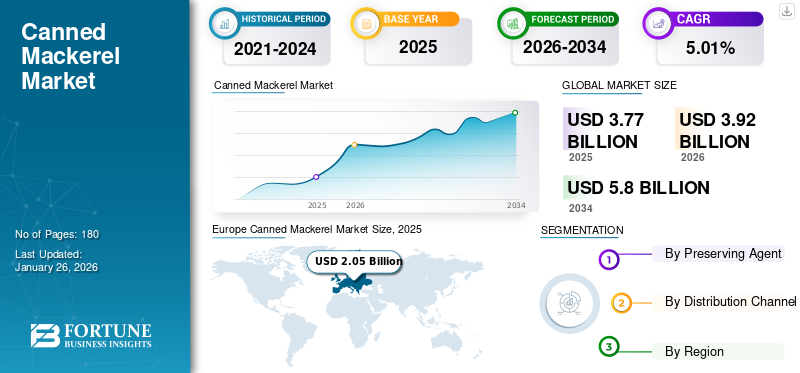
The global canned mackerel market size was valued at USD 3.77 billion in 2025 and is projected to grow from USD 3.92 billion in 2026 to USD 5.80 billion by 2034, exhibiting a CAGR of 5.01% during the forecast period. Europe dominated the canned mackerel market with a market share of 11.05% in 2025.
A few of the key players in the canned mackerel industry include Thai Union Group PCL, Maruha Nichiro Corporation, and FCF Co., Ltd., among others.
Canned mackerel is a fatty fish that has been processed, hermetically sealed, and later sterilized via heat treatment. Particularly, canned seafood production is concentrated in Spain, and mackerel is a famous choice. Compared to other canned fish, mackerel has a milder flavor and is more sustainable. Moreover, it has a high-fat content, which contributes to its richness. With respect to convenience, it is recognized as a readily available, cost-effective, and convenient food source, specifically for individuals who may not have access to frozen/fresh seafood. A few of the well-known examples include canned mackerel in tomato sauce, olive oil, and brine, among others.
The rising product variants and innovative flavors, and increasing demand for easy-to-cook/eat products are the pivotal factors supporting the market’s growth.
Download Free sample to learn more about this report.
Canned Mackerel Market Key Takeaways
 Global Market Size & Forecast
- 2025 Market Size: USD 3.77 billion
- 2026 Market Size: USD 3.92 billion
- 2034 Forecast Market Size: USD 5.80 billion
- CAGR: 5.01% from 2026–2034
 Market Share
- Europe dominated the canned mackerel market with an 11.05% share in 2025.
- The sauce segment accounted for the largest market share in 2025.
- The retail segment held the dominant market share in 2025.
 Key Regional Highlights
Europe
Europe contributed 11.05% of the global market in 2025, valued at USD 2.05 billion, and is projected to reach USD 2.13 billion in 2026.
North America
North America generated USD 0.66 billion in 2025 and is expected to reach USD 0.69 billion in 2026.
Asia Pacific
Asia Pacific accounted for USD 0.60 billion in 2025 and is projected to reach USD 0.63 billion in 2026.
U.S.
U.S. The U.S. remains a key contributor to North America's canned mackerel market growth, supported by increasing demand for convenient seafood products.
Japan
Japan Japan continues to be a significant market in Asia Pacific, driven by strong seafood consumption and sustained demand for canned fish products.
Read More

Canned Mackerel Market Trends
Celebrity Endorsements of Canned Products is the Current Market Trend
Celebrity endorsements play a remarkable role in canned seafood marketing by leveraging their popularity, boosting product visibility, and enhancing consumer trust. In today's digital world, most individuals are attracted to products publicized by their famous celebrities. In order to enhance their product sales, the manufacturers operating in the canned food industry are gravitating toward celebrity collaboration that can help strengthen the sales of finished items.
Download Free sample to learn more about this report.
MARKET DYNAMICS
Market Drivers
Growing Demand for Quick Meal Options Bolsters Market Momentum
The surging demand for grab-and-go product options is a substantial factor driving the market's potential. In today's busy schedule, most consumers are seeking food edibles that have extended shelf life and require minimal preparation. As a result, this ongoing trend aligns well with canned mackerel products. Moreover, similar to other canned products, this item is also economical, thus making it a pocket-friendly choice. Additionally, this canned fish is easy to transport and store and can be easily consumed while traveling. Along with convenience, this tinned mackerel provides various necessary omega-3 fatty acids, minerals, and vitamins. Thus, such advantages of ready to eat food products stimulate the industry's growth.
Market Restraints
Heavy Metal Contamination and Mislabeling Pose Health Risks to Consumers
One of the foremost difficulties faced by consumers is the heavy metal contamination in canned mackerel products. Canned seafood, including mackerel, can be contaminated with heavy metals due to the presence of metals (zinc, lead) in packaging materials or in the food item itself. As a result, such factors hamper the product's availability. Moreover, microplastic contamination, originating from the environment or the canning procedure, can contribute to the poor quality of canned seafood.
Another hurdle in the global marketplace is the increasing incidence of mislabeling. Generic labels on canned seafood packs, such as mackerel, can result in misinterpretation of species, further affecting consumers' awareness. Thus, all these factors hinder the global canned mackerel market share.
Market Opportunities
Technological Advancements in Production of Tinned Mackerel Create Growth Opportunities
Technological advancements in the manufacturing of canned fish, especially mackerel, provide numerous growth opportunities for the market. In order to achieve high quality of the finished product, global canned fish producers should utilize technologies such as Pulsed Electric Fields (PEF) and High-Pressure Processing (HPP). Both these technologies help in retaining the lifespan of canned items by inactivating enzymes/disrupting cell membranes. Moreover, the emergence of machine learning algorithms aids in assessing the quality of canned fish as well as in identifying defects without opening the cans. As a result, the use of advanced technologies builds possibilities for the canned mackerel market growth.
SEGMENTATION ANALYSIS
By Preserving Agent
Sauce is the Leading Preserving Agent Due to Its Several Advantages
On the basis of preserving agent, the market is divided into sauce, oil, and others.
Amongst all, the sauce sector dominated the market and held a considerable share. Mackerel in sauces such as tomato sauce, chili sauce, and mustard sauce has gained high traction in the market, especially due to its improved flavor profile. Such a type of product can be consumed raw or can be easily incorporated into pizza, pasta, and salads. As a result, such availability of mackerel in numerous sauces appeals to a broad consumer base, thus making it a versatile option.
The oil sector is anticipated to be the fastest-growing segment throughout the forecast period. Mackerel can be preserved in numerous types of oil, such as sunflower oil and olive oil, and is favored for its health advantages, thus appealing to gourmet food enthusiasts.
By Distribution Channel
Retail Sector Dominated Owing to High Household Consumption
Depending on the distribution channel, the market is segmented into HoReCa and retail.
Out of both, the retail sector led the market and held the major share in 2025. The increasing home-cooking trend and vast availability of economical canned seafood are pivotal components responsible for boosting the segment's growth. Moreover, the wide local/international brand variety of tinned mackerel, improved customer service, and promotional offers further stimulate the growth.
HoReCa is ranked second in the market and is projected to soar at a higher pace in the upcoming years. The increasing usage of canned seafood in preparing cuisines and its cost-effectiveness is expected to propel its acceptability rate.
Canned Mackerel Market Regional Outlook
On the basis of region, the market is segmented into North America, Europe, Asia Pacific, South America, and the Middle East & Africa.
Europe
Europe Canned Mackerel Market Size, 2025 (USD Billion)
To get more information on the regional analysis of this market, Download Free sample
Europe led the global marketplace and generated the highest share with 11.05% in 2026. Europe contributed 11.05% to the global market in 2025, with a valuation of USD 2.05 billion, and is projected to reach USD 2.13 billion in 2026. In this region, the market for canned fish is huge and rapidly growing, driven by a combination of factors such as demand for shelf-stable products and rising convenience. Along with robust production, the European countries also rely on imports of canned seafood to fulfill the domestic demand. As a result, such dependency bolsters the intake of such products. Moreover, the vast availability of tinned mackerel in numerous forms, such as brine-cured options and steaks, has captivated consumers' attention.
North America
The North America market generated USD 0.66 billion in 2025, representing 13.89% of the global market landscape, and is expected to reach USD 0.69 billion in 2026. Compared to other forms, the canned form of seafood is consumed in a substantial amount, owing to the rising use of packaged mackerel in numerous cuisines and the surging number of canned seafood producers. Apart from this, the high trading activities with prominent nations also encourage the consumption rate.
Out of all the North American countries, the U.S. is the leading country and holds the maximum share of the market. Factors such as increasing sustainable production of seafood-based products and rising innovation aid in fueling the country's momentum.
Asia Pacific
Asia Pacific accounted for USD 0.6 billion in 2025, representing 11.72% of the global market share, and is projected to reach USD 0.63 billion in 2026. The growing adoption of ready-to-consume meals and the increasing working women population are the major factors promoting the region's potential. In today's time, the majority of consumers are becoming aware of the role of convenience foods as well as their health benefits. Particularly, tinned mackerel is known to provide strong levels of omega-3 fatty acids, which can strengthen brain and heart health. As a result, the prominent players in the region are working toward building an advanced portfolio of mackerel, which can escalate their profit generation.
Amongst all Asian countries, Japan is recognized as the biggest consumer of canned mackerel, mainly because of the inclination toward animal-based protein and price competitiveness.
South America
South America is at its nascent stage and is anticipated to grow at a high pace in the future. The improved awareness of canned seafood and growing private label players propel the market's growth.
Middle East & Africa
In 2025, Middle East & Africa held 13.79% of the global market, reaching a valuation of USD 0.21 billion, and is projected to grow to USD 0.22 billion in 2026. Similarly, South America and the Middle East & Africa are also at their developing stage and are anticipated to maintain the same pace in the forecast period. The augmented product innovation with respect to canned seafood and rising disposable income bolsters the region's potential.
Latin America
Latin America contributed approximately USD 0.25 billion to the global market in 2025, accounting for 13.53% share, and is expected to reach USD 0.26 billion in 2026.
COMPETITIVE LANDSCAPE
Key Industry Players
Major Players are Concentrating on New Product Offerings to Facilitate Brand's Awareness
The major players in the global industry include Thai Union Group PCL, Maruha Nichiro Corporation, Bolton Group S.r.l., and others. All the companies are highly focused on expanding their product range by launching innovative canned mackerel for consumers. Moreover, the demand for sustainably certified products further assists in driving the industry's growth.
List of Key Canned Mackerel Companies Profiled
- Thai Union Group PCL (Thailand)
- Maruha Nichiro Corporation (Japan)
- Bolton Group S.r.l. (Italy)
- Kumpulan Fima Berhad (Malaysia)
- Marushin Canneries Malaysia Sdn Bhd (Malaysia)
- Tropical Food Manufacturing (Ningbo) Co., Ltd. (China)
- Diavena (Bulgaria)
- Xiamen Amoytop Import & Export Co., LTD. (China)
- FCF Co., Ltd. (U.S.)
- Seahath (India)
KEY INDUSTRY DEVELOPMENTS
- April 2025: King Oscar, a canned seafood producer and a brand of Thailand-based firm, Thai Union Group PCL, introduced a new flavor of their bestselling product, canned wild-caught mackerel – Sweet Thai Chilli Sauce. This item can be purchased through online means such as Amazon and Walmart, nationwide.
- December 2024: Simak, a state-backed enterprise owned by Fisheries Development Oman, a subsidiary of Oman Investment Authority, a capital market firm, released their line of canned tuna and mackerel across the Oman market.
- April 2024: Pumpui, a Thai brand, announced the launch of their healthy canned fried mackerel in chilli sauce, which particularly targets health-centric consumers. This offering comprises less than 29% sodium and 36% less sugar compared to the conventional recipe.
- September 2022: Ocean Brands, a Canadian seafood company, unveiled the range of canned fish across the U.S. market. The products in the line include Wild Mackerel fillets in korma curry, Mediterranean-style wild brisling sardines, and others.
- January 2019: Japanese Consumers Cooperative Union (JCCU), a national federation of consumers' cooperatives, revealed two MSC-certified canned items, such as CO-OP North Atlantic Mackerel Fillet Boiled in Water and CO-OP North Atlantic Mackerel Fillet Marinated in Oil. Both products can be either eaten raw or utilized as an ingredient.
REPORT COVERAGE
The global canned mackerel market report includes quantitative and qualitative insights into the market. It also offers a detailed market analysis of the market sizing and growth rate for all possible market segments. Key insights presented in the report include an overview of related markets, a competitive landscape, recent industry developments such as mergers & acquisitions, the regulatory environment in critical countries, and current market trends.
Request for Customization to gain extensive market insights.
Report Scope & Segmentation
|
ATTRIBUTE |
DETAILS |
|
Study Period |
2021-2034 |
|
Base Year |
2025 |
|
Estimated Year |
2026 |
|
Forecast Period |
2026-2034 |
|
Historical Period |
2021-2024 |
|
Unit |
Value (USD Billion) |
|
Growth Rate |
CAGR of 5.01% from 2026 to 2034 |
|
Segmentation |
By Preserving Agent
|
|
By Distribution Channel
|
|
|
By Geography
|
Frequently Asked Questions
Fortune Business Insights says that the global market size was valued at USD 3.77 billion in 2025.
The market is expected to grow at a CAGR of 5.01% during the forecast period of 2026-2034.
By distribution channel, the retail segment led the market.
Growing demand for quick meal options bolsters the market momentum.
Thai Union Group PCL, Maruha Nichiro Corporation, and FCF Co., Ltd. are a few of the major players in the market.
Europe held the highest share of the market.
Technological advancements in the production of tinned mackerel is a key opportunity for market growth.



- 2021-2034
- 2025
- 2021-2024
- 180
-
(Offer valid till 31st Oct 2026)
Get 30-60 hrs Free Customization
Expand Regional and Country Coverage, Segments Analysis, Company Profiles, Competitive Benchmarking, and End-user Insights.




















Related Reports
-
US +1 833 909 2966 ( Toll Free )
-
Get In Touch With Us