Canthaxanthin Market Size, Share & Industry Analysis, By Source (Natural and Synthetic), By Form (Liquid, Powder, and Beadlet), By Application (Food & Beverages, Dietary Supplements, Personal Care & Cosmetics, Animal Feed, and Pharmaceuticals), and Regional Forecast, 2026-2034
 Download Free Sample
(Offer valid till 30th Sep 2026)

KEY MARKET INSIGHTS
 Listen to Audio Version
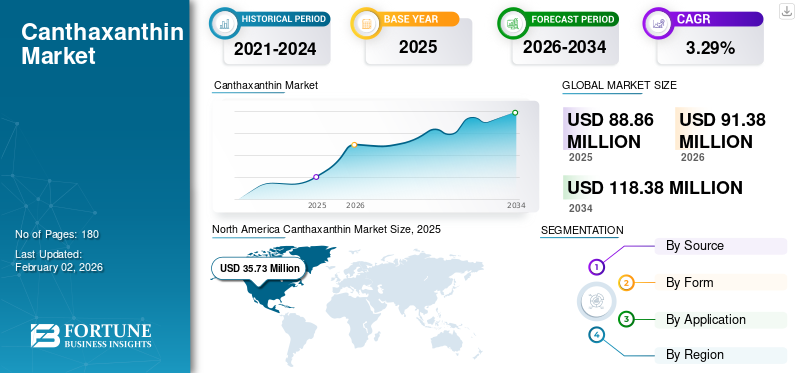
The global canthaxanthin market size was valued at USD 88.86 million in 2025 and is projected to grow from USD 91.38 million in 2026 to USD 118.38 million by 2034, exhibiting a CAGR of 3.29% during the forecast period. North America dominated the canthaxanthin market with a market share of 8.33% in 2025.
Canthaxanthin is a red keto-carotenoid, naturally found in algae, fungi, and bacteria. This carotenoid belongs to a broader class of phytochemicals known as terpenoids and was first isolated from mushrooms. This component is also produced synthetically and can be used as a feed additive and food colorant. Moreover, this ingredient is recognized for its anti-inflammatory and antioxidant properties, leading to its use in the pharmaceutical and cosmetics sectors. Some popular natural extraction sources include egg yolks, crustaceans, and poultry, and are gaining utmost traction for natural extraction as an efficient and sustainable option. Regionally, Europe and North America have emerged as the leading consumers of carotenoids. The expanding application of carotenoid pigment in dietary supplements and the popularity of natural ingredients propel the growth of the global market.
A few industry players in the market include DSM-Firmenich, Merck Group, Novepha Company, and others.
Download Free sample to learn more about this report.
Canthaxanthin Market Key Takeaways
 Global Market Size & Forecast
- 2025 Market Size: USD 88.86 million
- 2026 Market Size: USD 91.38 million
- 2034 Forecast Market Size: USD 118.38 million
- CAGR: 3.29% from 2026–2034
 Market Share
- North America dominated the market with an 8.33% share in 2025.
- Synthetic canthaxanthin dominated the market due to its cost-effectiveness.
- Powder led the form segment due to easy storage and transportation.
 Key Regional Highlights
North America
North America reached USD 35.73 million in 2025, representing an 8.33% market share.
Europe
Europe reached USD 31.51 million in 2025, capturing a 4.47% market share.
Asia Pacific
Asia Pacific reached USD 16.46 million in 2025, accounting for a 4.36% market share.
U.S.
The U.S. leads North America, supported by pharmaceutical and functional food demand.
Japan
Japan is supported by growing carotenoid use in cosmetics and aquaculture.
Read More

MARKET DYNAMICS
Market Drivers
Growing Cosmetics Industry Strengthens Market Growth
The flourishing personal care & cosmetics sector is a main driver of canthaxanthin usage. This ingredient is popularly used as a tanning agent that easily deposits in the skin, producing a browning effect. This ingredient adds color to makeup items such as lipsticks, blush, and eyeshadows, creating vibrant shades. Moreover, it is considered safe for use in cosmetic formulations, improving the user's skin tone. Additionally, it is used in a few skin pigmentation items, particularly for treating skin conditions. As a result, cosmetic companies are encouraged to develop ingredient-enriched personal care products to capitalize on growing consumer interest that can bolster the market's potential.
Market Restraints
Fluctuating Raw Ingredient Costs and Tough Competition to Inhibit Market Growth
Fluctuating raw material prices are a key hurdle in the global canthaxanthin industry. Particularly, the cost of extracting and cultivating carotenoids from plants, microalgae, and fungi can be highly expensive. This extraction requires particular environmental conditions, such as controlled temperature and light, and advanced production facilities, contributing to elevated operational costs. This cost burden acts as a barrier to the broader adoption of the product, impeding the global canthaxanthin market growth.
Another obstacle experienced by carotenoid producers is stiff competition from other substitutes. Canthaxanthin faces strong competition from various carotenoids such as lutein, astaxanthin, and others, which can have different functional properties and, in some cases, are more readily available.
Market Opportunities
Growing Usage of Technology in Carotenoid Production Builds Growth Opportunities
The high adoption of technology in the carotenoid industry creates numerous growth opportunities. In today's landscape, producers are turning to advanced technologies to enhance stability and production efficiency. For instance, ultrasonication can minimize the particle size of canthaxanthin-loaded nanocarriers, strengthening their dispersibility and stability. Moreover, manufacturers are exploring genetic modification of regulatory genes to boost carotenoid productivity and yield. Additionally, the firms are concentrating on sequential extraction with methanol, an effective method for extracting carotenoids from microalgae. Enzyme-assisted extraction is also gaining traction as it helps break cell walls, releasing carotenoids and other compounds, mostly with improved yields.
Canthaxanthin Market Trends
Extensive Use of Carotenoids in Pharmaceuticals Sector is a Current Industry Trend
Canthaxanthin, a natural pigment, plays a substantial role in the expanding pharmaceuticals sector. This carotenoid is utilized in certain formulations aimed at treating skin pigmentation. Moreover, it's utilized in curing photosensitivity disorders (erythropoietic protoporphyria), a sensitivity to sunlight observed by consumers. Additionally, it exhibits anti-inflammatory properties, which further support its usage in medicinal purposes. Moreover, its antioxidant properties are proven beneficial for treating numerous diseases. Recognizing these advantages, the pharmaceutical enterprises are concentrating on introducing high-quality carotenoid-rich medicines for consumers.
Download Free sample to learn more about this report.
SEGMENTATION ANALYSIS
By Source
Synthetic Segment Dominated Market Due to Its Cost-Effectiveness
Based on the source, the market is segmented into natural and synthetic.
The synthetic segment dominated the market in 2024 as it can be economically produced and is suitable for large-scale production, and offers strong control over concentration and purity. Moreover, it is not subject to geographical and seasonal limitations, making it an all-time available option. Thus, such advantages propel the segment's growth.
The natural segment emerged as the fastest-growing segment. Natural carotenoids are increasingly considered safer and sustainable than synthetic canthaxanthin. Moreover, they offer numerous advantages to consumers, owing to their antioxidant and disease prevention properties.
By Form
Powder Led Market Owing to Ease of Storage
On the basis of form, the market is fragmented into liquid, powder, and beadlet.
The powder segment led the global market in 2024, driven by the ease of storage and transportation, and has enhanced chemical and physical stability. Moreover, powder components have a prolonged shelf life and assist in accurate dosing, driving the segment's growth.
The liquid segment is expected to register the highest CAGR during the forecast period. Liquid formulations are known for their faster absorption rate and are more flexible compared to powder forms.
By Application
Food & Beverages Segment Led Market Due to Its Strong Consumption
Depending on the application, the market is segmented into food & beverages, dietary supplements, personal care & cosmetics, animal feed, and pharmaceuticals.
The food & beverages segment led the market. Likewise, other carotenoids, canthaxanthin, are mainly used as a natural colorant in the food & beverage sector. In the food industry, it is used for improving the color of numerous cuisines/dishes. Along with this, it is utilized to attain a desired color in fruit juices and iced teas.
Animal feed emerged as the fastest-growing segment. This ingredient is primarily used as a feed additive to intensify the color of animal-based products.
Global Canthaxanthin Market Regional Outlook
Based on region, the market is segmented into North America, Europe, Asia Pacific, South America, and the Middle East & Africa.
North America
North America Canthaxanthin Market Size, 2025 (USD Million)
To get more information on the regional analysis of this market, Download Free sample
The North America market accounted for USD 35.73 million in 2025, representing 8.33% of the global industry, and is expected to reach USD 36.67 million in 2026. North America captured the key canthaxanthin market share in 2024 due to the increasing awareness of the health benefits of carotenoids and their rising usage in the animal feed sector. Predominantly, this ingredient is widely used in the food & beverage sector to improve the visual appeal of products and contribute to their nutritional value. Moreover, the expanding nutraceutical sector fuels the usage of such carotenoids in the region.
Among all the countries, the U.S. is the leading nation in the regional market. The surging utilization of carotenoids in the pharmaceutical industry and increasing inclination toward functional foods drive the market's momentum.
Europe
Europe recorded a market size of USD 31.51 million in 2025, capturing 4.47% of the global market share, and is projected to reach USD 32.4 million in 2026. Europe is emerging as a prominent region in the global market, observing a strong growth trajectory. The growing veganism trend and increasing chronic health ailments are pivotal factors facilitating the market growth. European consumers actively seek naturally extracted components that provide numerous health advantages. To fulfil consumer preferences, food producers are responding by launching new carotenoid-enriched products. Moreover, the rising use of dietary supplements for health and wellness is further driving canthaxanthin intake. Additionally, the increasing demand for animal-based protein augments the carotenoid usage in feed.
Asia Pacific
In 2025, Asia Pacific represented USD 16.46 million, accounting for 4.36% of the worldwide market, and is projected to grow to USD 17.01 million in 2026. Likewise, other regions, Asia Pacific, is experiencing a shift toward natural ingredients due to the rising health consciousness and the clean-label trend. Moreover, the region is known as a substantial player in the aquaculture industry, where carotenoids are widely utilized as feed additives. Along with this, the expanding cosmetics industry in Asian countries such as China and Japan further bolsters the use of such carotenoids. It is increasingly incorporated in personal care sector players, including tanning pills, owing to its skin-enhancing properties.
South America
South America is at its nascent stage and is predicted to grow rapidly in the upcoming years. Growth is being driven by the increasing demand for cosmetics and personal care products and the growing presence of established regional players.
Middle East & Africa
Middle East & Africa contributed 3.34% to the global market in 2025, with a valuation of USD 2.29 million, and is projected to reach USD 2.36 million in 2026. The Middle East & Africa region is in its developing stage and is projected to expand rapidly in the near term. The surging emphasis on health & wellness and rising use of cost-effective synthetic carotenoids are boosting the regional market growth.
Latin America
The Latin America market was valued at USD 2.87 million in 2025, capturing 2.04% of global revenue, and is estimated to reach USD 2.95 million in 2026.
COMPETITIVE LANDSCAPE
Key Industry Players
Major Players Focus on New Launches to Boost Their Revenue
Key players in the global industry include DSM-Firmenich, Merck Group, and Divi's Nutraceuticals. The firms operating in the industry are focusing on launching new products to boost their revenue. Moreover, companies in the global market should aim at expanding their production as the majority of consumers are seeking natural ingredients-enriched food products, which can improve their health.
List of Key Canthaxanthin Companies Profiled
- Divi's Nutraceuticals (U.S.)
- ZMC (China)
- Guangzhou Wisdom Bio-Technology Co., Ltd (China)
- Merck Group (Germany)
- National Analytical Corporation (India)
- DSM-Firmenich (Switzerland)
- Fenchem (China)
- SimSon Pharma Limited (India)
- Xi'an Healthful Biotechnology Co., Ltd (China)
- BASF SE (Germany)
KEY INDUSTRY DEVELOPMENTS
- June 2024: Researchers based at ENEA Trisaia Research Center, Italy, developed a technology to derive carotenoids for nutraceutical and pharmaceutical applications.
- March 2023: NovoNutrients, a California-based biotechnology firm, launched new carotenoid SCP’s which are the first addition to their latest line of feed additives. For production, it utilized innovative technology for the production of superior-quality carotenoids.
REPORT COVERAGE
The market research report includes quantitative and qualitative insights into the market. It also offers a detailed market analysis of the market sizing and growth rate for all possible market segments. Key insights in the global canthaxanthin market report include an overview of related markets, a competitive landscape, recent industry developments such as mergers & acquisitions, the regulatory environment in critical countries, and current global market trends.
Request for Customization to gain extensive market insights.
Report Scope & Segmentation
|
ATTRIBUTE |
DETAILS |
|
Study Period |
2021-2034 |
|
Base Year |
2025 |
|
Estimated Year |
2026 |
|
Forecast Period |
2026-2034 |
|
Historical Period |
2021-2024 |
|
Unit |
Value (USD Million) |
|
Growth Rate |
CAGR of 3.29% from 2026 to 2034 |
|
Segmentation |
By Source
|
|
By Form
|
|
|
By Application
|
|
|
By Region
|
Frequently Asked Questions
Fortune Business Insights says that the global market size was valued at USD 88.86 million in 2025.
The market is expected to grow at a CAGR of 3.29% during the forecast period (2026-2034).
By source, the synthetic segment led the market.
The growing cosmetics industry is a key factor driving the market’s growth.
DSM-Firmenich, Merck Group, and Divi's Nutraceuticals are a few of the top players in the market.
North America held the highest share of the market.
Growing usage of technology in carotenoid production builds new growth opportunities.



- 2021-2034
- 2025
- 2021-2024
- 180
-
(Offer valid till 30th Sep 2026)
Get 30-60 hrs Free Customization
Expand Regional and Country Coverage, Segments Analysis, Company Profiles, Competitive Benchmarking, and End-user Insights.




















Related Reports
-
US +1 833 909 2966 ( Toll Free )
-
Get In Touch With Us