 Download Free Sample



Get a Quote
Receive a tailored pricing based on your needs.
- Choose license type
- Multiple user options
- Custom scope & coverage
- Fast turnaround
"Designing Growth Strategies is in our DNA"
 Listen to Audio Version
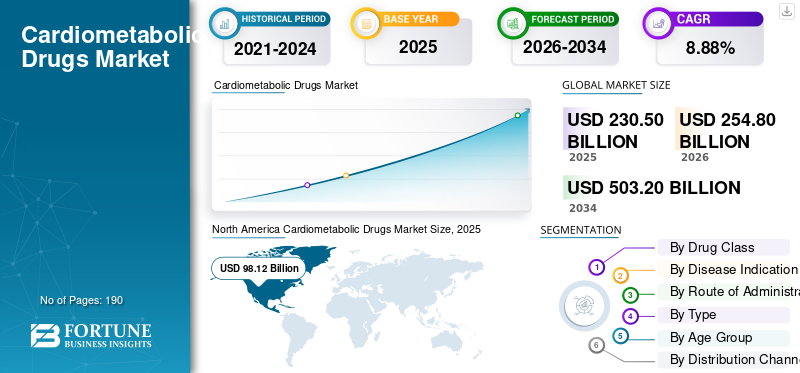
The global cardiometabolic drugs market size was valued at USD 230.50 billion in 2025. The market is projected to grow from USD 254.80 billion in 2026 to USD 503.20 billion by 2034, exhibiting a CAGR of 8.88% during the forecast period. North America dominated the cardiometabolic drugs market with a market share of 42.56% in 2025.
The global cardiometabolic drugs market is growing as the prevalence of obesity, diabetes, and cardiovascular complications continues to rise globally. As these complications are closely linked, patients often require long-term treatment. The market is also witnessing a shift from simple disease control toward therapies that provide broader benefits, such as weight reduction, blood glucose control, cardiovascular risk reduction, and renal protection. These factors are encouraging leading pharmaceutical companies to invest in advanced cardiometabolic therapies and next-generation lipid-lowering cardiovascular drugs, strengthening the market growth.
Furthermore, key players such as Novo Nordisk A/S, Lilly USA, LLC, AstraZeneca., and Boehringer Ingelheim International GmbH., are actively participating in new product launches, strategic collaborations, and acquisitions, as well as investment initiatives to expand their market presence.
Download Free sample to learn more about this report.
 Global Market Size & Forecast
 Market Share
 Key Regional Highlights
North America
Dominated the market with USD 98.12 billion in 2025, supported by the high burden of obesity, diabetes.
Europe
The market is projected to reach USD 61.05 billion in 2026.
Asia Pacific
The market is estimated to reach USD 63.32 billion in 2026.
U.S.
The market is estimated to reach approximately USD 95.88 billion in 2026.
Japan
The market is estimated to reach approximately USD 12.20 billion in 2026.
Read More

Increasing Focus on Weight Management is a Prominent Trend Observed
The global market is witnessing the strong shift toward weight management. Type 2 diabetes, hypertension, dyslipidemia, sleep apnea, and other cardiovascular diseases are closely linked with obesity. Earlier, weight reduction was mainly managed through lifestyle changes, but launch of advanced incretin-based therapies has made pharmacological weight management a major treatment approach. This trend is expected to increase the adoption of anti-obesity drugs and expand the revenue opportunity for companies operating in diabetes, obesity, and cardiovascular therapeutics.
Rising Prevalence of Type 2 Diabetes and Obesity to Expand the Treatment Patient Base
The global cardiometabolic drugs market growth is propelling as type 2 diabetes and obesity are increasing across both developed and emerging countries. The increased patient pool is driving the demand, expanding the number of patients requiring long-term cardiometabolic treatment. These factors are pushing the demand for GLP-1 mono-agonists, dual incretin therapies, SGLT2 inhibitors, insulin, lipid-lowering drugs, and antihypertensive drugs, thereby supporting overall market growth.
|
Rank |
Market Driver |
Overall Impact Rank |
CAGR Contribution (2026-2034) |
Impact: 2026-2028 |
Impact: 2029-2031 |
Impact: 2032-2034 |
|
1 |
Rising Prevalence Of Type 2 Diabetes And treatment Intensification Expands The Treated Patient Base |
High |
3.20% |
High |
High |
High |
|
2 |
Obesity pharmacotherapy expansion is changing the value mix |
High |
2.60% |
Medium |
High |
High |
|
3 |
Broader SGLT2 use across diabetes, CKD, and heart failure |
High |
2.10% |
High |
High |
Medium |
|
4 |
High-volume hypertension and dyslipidemia treatment base |
Medium-High |
1.65% |
Medium |
High |
High |
|
5 |
Cardiovascular and renal outcomes are expanding treatment eligibility |
Medium |
1.23% |
Medium |
Medium |
High |
|
6 |
Others |
Low |
0.90% |
Low |
Low |
Low |
|
Total Gross Growth Contribution |
11.68% |
High Therapy Cost and Limited Reimbursement to Restrict Adoption of Premium Cardiometabolic Drugs
The global market growth may be restrained by the high cost of premium therapies and limited reimbursement coverage, especially for advanced GLP-1 mono-agonists, and other branded therapies. Majority of these drugs are intended for long-term use, which increases the overall treatment cost for patients, employers, insurers, and public payers. As a result, payers are applying strict prior authorization rules, limiting coverage to selective indications, or excluding certain weight-loss uses from reimbursement. This can reduce treatment access, increase patient out-of-pocket burden, and slow adoption in cost-sensitive markets despite strong clinical demand.
|
Rank |
Market Restraint |
Expected Impact on Market Growth |
Negative CAGR Contribution (2026-2034) |
Impact: 2026-2028 |
Impact: 2029-2031 |
Impact: 2032-2034 |
|
1 |
Reimbursement and prior authorization restrictions |
High |
1.35% |
High |
High |
Medium |
|
2 |
Supply constraints in high-demand injectable therapies |
Medium-High |
0.75% |
High |
Medium |
Medium |
|
3 |
Generic erosion in mature drug classes can limit high-growth injectables |
Medium |
0.45% |
Medium |
Medium |
Low |
|
4 |
Others |
Low |
0.25% |
Low |
Low |
Low |
|
Total Market Reduction |
2.80% |
Expanding Oral Incretin and Next-Generation Obesity Drugs to Create New Revenue Potential
The development of oral incretin and next-generation obesity drugs is expected to create a strong growth opportunity for the market. Current GLP-1 and incretin-based therapies have already shown strong adoption for diabetes and obesity. Still, the majority of leading products are injectable, which can limit acceptance among patients who prefer convenient oral treatment. Oral incretin drugs can reduce the treatment barrier, support wider prescribing in primary care, and improve long-term patient adherence. Additionally, next-generation obesity drugs, including multi-target incretin, amylin, and combination therapies, are being developed to deliver better weight loss, improved tolerability, fewer injections, and broader cardiometabolic benefits. This is expected to bring revenue growth opportunities.
Long-Term Cost Burden of Premium Therapies to Create Accessibility Challenges in Cardiometabolic Care
The global market is facing a major challenge due to long-term cost burden of premium therapies. High treatment cost is pushing for stricter coverage rules, prior authorization requirements, and benefit exclusions for selected high-cost therapies. As a result, even though clinical demand for advanced cardiometabolic drugs is increasing, limited reimbursement and affordability concerns may restrict patient access and slow wider market adoption.
Insulin & Analogs Led The Market Owing To Their Role As Core Treatment Option For Type 1 Diabetes
Based on the drug class, the market is categorized into GLP-1 mono-agonists, dual GIP/GLP-1 agonists, SGLT2 inhibitors, insulin & analogs, statins, angiotensin receptor-neprilysin inhibitors, PCSK9 inhibitors, and others.
Insulin & analogs segment dominated the market as insulin remains a core treatment option for patients with type 1 diabetes and for many patients with advanced or uncontrolled type 2 diabetes. Since diabetes is a chronic disease that often requires lifelong therapy, regular use of basal, rapid-acting, premixed, and long-acting insulin analogs creates high treatment volume across hospitals, retail pharmacies, and long-term outpatient care. The segment also benefits from broad physician familiarity, established reimbursement in many countries, and growing availability of biosimilar insulin products, which helps improve access while keeping insulin use central in cardiometabolic disease management.
The dual GIP/GLP-1 agonists segment is expected to grow at a CAGR of 21.47% over the forecast period.
To know how our report can help streamline your business, Speak to Analyst
Large Diagnosed Patient Pool and Chronic Therapy for Type 2 Diabetes to Drive Segment Leadership
Based on disease indication, the market is segmented into Type 2 diabetes, obesity, hypertension, dyslipidemia, ASCVD / MACE Risk, heart failure, chronic kidney disease, and others.
In 2025, Type 2 diabetes captured largest share in disease indication segment. It represents one of the largest and most treatment-intensive cardiometabolic conditions globally, driving the demand for diabetes medications. The segment also benefits from frequent condition overlap with obesity, hypertension, lipid disorders, kidney disease, and cardiovascular risk, which increases the need for long-term drug use. As a result, the large diagnosed aging population, continuous treatment cycle, and increasing use of premium therapies have supported the dominance of type 2 diabetes in the market.
The obesity segment is projected to grow at a 18.83% CAGR during the forecast period.
Higher Disease Burden and Long-Term Treatment Demand to Propel Adult Segment’s Dominance
Based on the age group, the market is segmented into pediatric and adult.
Based on age group, adults dominated the market as cardiovascular diseases have become more common in working-age and older populations. They also have a higher likelihood of multiple overlapping conditions such as type 2 diabetes, hypertension, dyslipidemia, heart failure, chronic kidney disease, and MASH. This increases the need for chronic drug treatment and combination therapy especially for cardiovascular disease prevention, leading to higher prescription volume and revenue contribution from the adult population.
The pediatric segment is projected to grow at a CAGR of 12.92% during the forecast period.
Innovations and Premium Pricing Propel the Leading Share of Branded Therapies
Based on the type, the market is segmented into branded and generic.
Based on the type, branded drugs dominated the market by value as several high-growth cardiometabolic therapies remain patent-protected and command premium pricing. This includes GLP-1 mono-agonists, dual incretin therapies, SGLT2 inhibitors, PCSK9 inhibitors, siRNA-based lipid-lowering drugs, and newer therapies for obesity, heart diseases, and MASH. Branded products generate higher revenue due to stronger clinical differentiation, broader label expansion, and specialist-driven adoption. Therefore, innovation-led branded products continue to hold a leading position in overall market value.
The generic segment is projected to grow at a CAGR of 2.70% during the forecast period.
Easy Refill, Lower Administration Burden, and High Prescription Volume of Oral Drugs to Support Its Dominance
Based on the route of administration, the market is segmented into oral, subcutaneous, intravenous, and others.
Based on route of administration, the oral route of administration accounted for the majority share. Oral drugs are easier to prescribe, refill, and administer compared to injectable therapies. Large-volume drug classes such as antihypertensives, statins, SGLT2 inhibitors, DPP-4 inhibitors, anticoagulants, and several MASH therapies are primarily available as oral medicines. This improves patient convenience, reduces dependency on healthcare professionals, and supports better use across primary care and retail pharmacy settings.
The subcutaneous segment is projected to grow at a CAGR of 12.87% during the forecast period.
Frequent Refills and Easy Access Offered by Drug Stores & Retail Pharmacies Boosted Their Dominance
Based on the distribution channel, the market is segmented into hospital pharmacies, retail pharmacies, specialty pharmacies, online pharmacies, and others.
In 2025, drug stores and retail pharmacies dominated the distribution channel segment. Patients with cardiometabolic conditions usually continue therapy for long periods, making local pharmacies a significant access point for prescription fulfillment, counseling, insurance processing, and adherence support. For instance, in 2026, CVS Pharmacy announced expanded GLP-1 support to lower costs, improve access, and help patients stay on therapy. The CVS Pharmacy is a retail pharmacy partnered with NovoCare and supported patients through pharmacist-led care, showing the growing role of retail pharmacies in cardiometabolic drug access.
The specialty pharmacies segment is projected to grow at a CAGR of 13.62% over the forecast period.
By geography, the market is categorized into Europe, North America, Asia Pacific, Latin America, and the Middle East & Africa.
North America Cardiometabolic Drugs Market Size, 2025 (USD Billion)
To get more information on the regional analysis of this market, Download Free sample
North America held the dominant cardiometabolic drugs market share in 2024 at USD 84.81 billion and maintained its leading position in 2025 at USD 98.12 billion. The market is growing due to the high burden of obesity, diabetes, cardiovascular disease, and heart failure. Strong adoption of GLP-1s, SGLT2 inhibitors, PCSK9 therapies, and branded obesity drugs is increasing market value. Favorable diagnosis rates, specialist access, and premium drug uptake are furthering supporting the regional market growth.
Given North America's substantial contribution and the U.S. dominance in the region, the U.S. market is estimated at around USD 95.88 billion in 2026, accounting for roughly 37.63% of the global market.
Europe is projected to grow at a rate of 7.46% over the coming years, taking the position of third-highest among all regions, and reach a valuation of USD 61.05 billion by 2026. Growth is supported by rising cardiometabolic disease prevalence and a strong public healthcare focus on chronic disease management. Wider use of diabetes, lipid-lowering, heart failure, and obesity therapies is increasing treatment volume. However, pricing controls keep growth steady.
The U.K. market is estimated at USD 10.39 billion in 2026, accounting for roughly 4.08% of the global market.
Germany's market is projected to reach approximately USD 13.61 billion in 2026, equivalent to around 5.34% of the global market.
Asia Pacific is estimated to reach USD 63.32 billion in 2026 and secure second place in the market. The region is growing rapidly due to a large diabetic, obese, and hypertensive population base. Improving diagnosis, expanding healthcare access, and rising affordability are increasing drug adoption. Launches of branded therapies and strong generic penetration are both supporting market expansion.
The Japanese market in 2026 is estimated at around USD 12.20 billion, accounting for approximately 4.79% of the global market.
China's market is projected to be among the largest globally, with 2026 revenues estimated at around USD 20.70 billion, accounting for approximately 8.12% of global sales.
The Indian market is estimated at around USD 10.12 billion in 2026, accounting for roughly 3.97% of global revenue.
The Latin America region is expected to witness growth in this market during the forecast period and are estimated to reach a valuation of USD 12.87 billion in 2026. Market growth is driven by increasing diabetes, obesity, and cardiovascular risk factors across major countries. Expanding access to chronic disease medicines through retail pharmacies and public programs is improving treatment rates. Growing use of newer diabetes and obesity drugs is also supporting value growth. In the Middle East & Africa, the GCC is set to reach USD 4.07 billion in 2026.
The South African market is projected to reach approximately USD 1.67 billion by 2026, accounting for roughly 0.65% of global revenue.
Product Launches and Strategic Collaborations among Key Companies are Defining the Market Competition
Strong presence of large pharmaceutical companies, specialty metabolic drug developers, and generic manufacturers is defining the global cardiometabolic drugs market. Companies are focusing on strengthening their product portfolios through new product launches, label expansions, clinical pipeline development, and strategic collaborations to monetize growth potential.
Major players such as Novo Nordisk, Eli Lilly and Company, AstraZeneca, Boehringer Ingelheim, Merck & Co., are actively competing through product innovation, portfolio expansion, partnerships, and geographic launches. Companies with strong branded portfolios, advanced clinical pipelines, broad distribution networks, and established physician access are expected to maintain a leading position in the market.
The cardiometabolic drugs market report provides a detailed assessment of all market segments, highlighting key drivers, trends, opportunities, restraints, and challenges shaping industry growth. It also covers technological advancements, major industry developments, market share analysis, and comprehensive profiles of leading companies. The report also evaluates drug class trends, route of administration, branded and generic adoption, age group dynamics, and distribution channel performance across key regions. It includes global market analysis including pipeline developments, regulatory approvals, product launches, pricing and reimbursement trends, and competitive strategies adopted by leading pharmaceutical companies. The study also highlights regional growth patterns across North America, Europe, Asia Pacific, Latin America, and the Middle East & Africa, along with key factors supporting adoption in each region.
Request for Customization to gain extensive market insights.
| ATTRIBUTE | DETAILS |
| Study Period | 2021-2034 |
| Base Year | 2025 |
| Estimated Year | 2026 |
| Forecast Period | 2026-2034 |
| Historical Period | 2021-2024 |
| Growth Rate | CAGR of 8.88% from 2026 to 2034 |
| Unit | Value (USD Billion) |
| Segmentation | By Drug Class, Disease Indication, Route of Administration, Type, Age Group, Distribution Channel, and Region |
| By Drug Class |
|
| By Disease Indication |
|
| By Age Group |
|
| By Type |
|
| By Route of Administration |
|
| By Distribution Channel |
|
| By Region |
|
Approach 1: Revenues and Market Share of Major Cardiometabolic Drug Players
According to Fortune Business Insights, the global market value stood at USD 230.50 billion in 2025 and is projected to reach USD 503.20 billion by 2034.
In 2025, the market value stood at USD 98.12 billion.
The market is expected to grow at a CAGR of 8.88% over the forecast period of 2026-2034.
The GLP-1 mono-agonists segment is expected to lead the market.
Rising prevalence of type 2 diabetes and treatment intensification expands the treated patient base and drives market growth
Novo Nordisk A/S, Lilly USA, LLC, AstraZeneca., and Boehringer Ingelheim International GmbH. are among the major players in the global market.
North America dominated the market in 2025.

Get 30-60 hrs Free Customization
Expand Regional and Country Coverage, Segments Analysis, Company Profiles, Competitive Benchmarking, and End-user Insights.













.webp)






Related Reports
Get In Touch With Us
US +1 833 909 2966 ( Toll Free )
Receive a tailored pricing based on your needs.
Discuss your questions with our industry experts.
Have questions? Get quick answers before you purchase.

