Cell Therapy Technologies Market Size, Share & Industry Analysis, By Offering (Instruments & Automation Technologies, Single-use Assemblies, Media & Reagents, QC & Analytics Technologies, Software), By Workflow (Cell Collection, Cell Isolation & Selection, Cell Activation & Engineering), By Cell Type (CAR-T Cell, TCR-T Cell, TIL, NK Cell, Stem Cell, IPSC-derived Cell), By Scale of Operation (Research & Discovery, Process Development, Clinical Manufacturing), By End User (Pharmaceutical & Biotechnology Companies, CROs & CDMOs, Academic & Research Institutes), and Regional Forecast, 2026-2034
 Download Free Sample
Cell Therapy Technologies Market Size and Future Outlook
 Listen to Audio Version
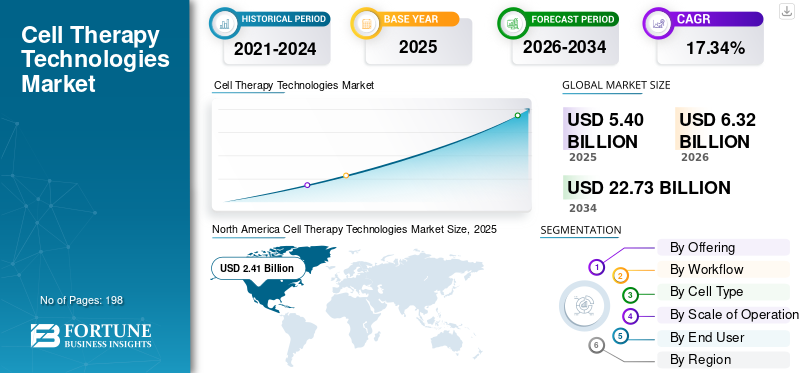
The global cell therapy technologies market size was valued at USD 5.40 billion in 2025. The market is projected to grow from USD 6.32 billion in 2026 to USD 22.73 billion by 2034, exhibiting a CAGR of 17.34% during the forecast period. North America dominated the cell therapy technologies market with a market share of 44.62% in 2025.
The global market includes products and services used to support cell therapy development and manufacturing. The market is growing due to rising cell therapy clinical trials, increasing commercial CAR-T adoption, expanding CDMO capacity, and higher demand for closed, automated, and traceable manufacturing systems. The market covers key workflows such as cell collection, isolation & selection, activation & engineering, expansion & culture, harvest & fill-finish, and analytical testing & quality control.
Key players operating in the global market include Thermo Fisher Scientific Inc., Danaher Corporation (Cytiva), Sartorius AG, and Lonza. These firms are focusing on offering advanced products and expanding service capacities to maintain their market positions.
Download Free sample to learn more about this report.
Cell Therapy Technologies Market Key Takeways
 Global Market Size & Forecast
- 2025 Market Size: USD 5.40 billion
- 2026 Market Size: USD 6.32 billion
- 2034 Forecast Market Size: USD 22.73 billion
- CAGR: 17.34% from 2026–2034
 Market Share
- North America dominated the cell therapy technologies market with a 44.62% share in 2025.
- The clinical manufacturing segment is projected to hold a 26.6% share in 2026.
- The pharmaceutical & biotechnology companies segment is projected to account for a 45.8% share in 2026.
 Key Regional Highlights
North America
North America maintained its leading position in 2025, with the market valued at USD 2.41 billion.
Europe
Europe is expected to witness steady expansion, registering a 14.64% CAGR during the forecast period.
Asia Pacific
Asia Pacific is projected to reach a market valuation of USD 1.41 billion by 2026.
U.S.
U.S. The market is projected to reach approximately USD 2.54 billion by 2026, leading the North American region.
Japan
Japan The market is estimated to reach around USD 0.31 billion by 2026, accounting for roughly 4.8% of global revenue.
Read More

CELL THERAPY TECHNOLOGIES MARKET TRENDS
Growing Demand for Personalized Healthcare Solutions is a Prominent Trend Observed in Global Market
The rising need for personalized healthcare solutions is a significant trend in the global market, as numerous advanced therapies are customized to the patient's individual cells, disease characteristics, and treatment journey. This is particularly evident in autologous CAR-T and TIL treatments, in which cells are gathered from a specific patient, altered or increased in number, evaluated, and subsequently reintroduced to the same patient. With the transition of more oncology and rare-disease therapies to personalized or patient-specific approaches, there is a growing need for automated closed manufacturing systems, disposable assemblies, media and reagents, quality control testing, cryopreservation, and chain-of-identity software. The trend is also encouraging businesses to shorten production schedules, minimize variability, and enhance patient access. Consequently, technology suppliers are concentrating on automation, distributed manufacturing, and digital traceability to enhance the scalability and commercial feasibility of personalized cell therapies. These factors are supporting the overall global cell therapy technologies market growth.
- For instance, in October 2025, Avantor and BlueWhale Bio announced a strategic partnership to accelerate CAR-T manufacturing using BlueWhale Bio’s cell activation and expansion technology. The partnership aims to streamline CAR-T production, reduce variability, and shorten time-to-patient, directly supporting the growing demand for personalized cell therapy solutions.
MARKET DYNAMICS
MARKET DRIVERS
Download Free sample to learn more about this report.
Rising Adoption of Regenerative Medicine is Propelling Market Growth
The rising utilization of regenerative medicine is a major market driver, as regenerative treatments rely on sophisticated cell processing, cultivation, expansion, quality control testing, and GMP manufacturing infrastructure. With the increasing number of companies and research institutions creating stem cell, iPSC-derived, immune-cell, and tissue-repair treatments, there is a growing need for instruments, single-use assemblies, media, reagents, analytics systems, cryopreservation solutions, and CDMO services. Regenerative medicine necessitates rigorous process management since living cells must maintain their viability, identity, potency, and safety during production. This is encouraging developers to focus on closed systems, scalable production, and specialized testing abilities. Consequently, broader implementation of regenerative medicine directly boosts the need for cell therapy technologies in research, clinical, and commercial processes. All these factors cumulatively drive the overall market growth.
- For instance, in August 2025, Sumitomo Pharma announced completion of its CRAFT regenerative medicine and cell therapy manufacturing facility in Osaka, Japan. The facility was built to strengthen CDMO manufacturing capacity for regenerative medicine and cell therapy products.
MARKET RESTRAINTS
High Manufacturing and Therapy Costs to Limit Wider Adoption of Cell Therapy Technologies
High manufacturing and therapy costs are a key restraint for the global market as cell therapy production requires specialized facilities, skilled labor, GMP-grade reagents, single-use consumables, viral/non-viral engineering tools, QC testing, cold-chain logistics, and strict batch release controls. Autologous therapies are especially costly as each patient often requires an individualized manufacturing run, making scale-up more difficult than conventional biologics. These high costs can limit treatment-center adoption, payer reimbursement, and commercial rollout, which in turn slows the pace at which developers invest in new instruments, automation systems, software, and outsourced manufacturing services. The restraint is also visible in pipeline decisions, as companies may reduce or restructure cell therapy programs when operating costs become too high. Therefore, unless automation and scalable manufacturing reduce cost of goods, wider adoption of cell therapy technologies may remain limited.
- For instance, in August 2025, Galapagos announced its intention to wind down its cell therapy business as part of a strategic transformation. The company stated that, if the wind-down proceeded, it expected USD 112.9 -141.1 million in cell therapy operating costs from Q4 2025 through 2026 and USD 169.3 - 225.7 million in one-time restructuring costs in 2026, highlighting the heavy cost burden associated with maintaining cell therapy operations.
MARKET OPPORTUNITIES
Rising Investments in Cell-Based Therapies to Offer Market Growth Opportunities
Increasing investments in cell-based therapies offer a significant market opportunity for the global market, as funding directly backs new clinical programs, manufacturing capabilities, automation platforms, QC systems, and large-scale infrastructure. With ongoing support for CAR-T, TCR-T, TIL, NK-cell, stem cell, and iPSC-derived therapy developers, there is a growing need for cell processing systems, single-use assemblies, media and reagents, analytical testing tools, software platforms, and CDMO services. This generates prospects not just for therapy creators but also for tech providers that facilitate scalable, closed, and standardized manufacturing. Increased investment is assisting the sector in overcoming major obstacles such as expensive production costs, restricted capacity, and prolonged turnaround times. Consequently, increasing capital inflow is anticipated to broaden the available market for cell therapy technology suppliers throughout research, clinical, and commercial manufacturing processes. All these factors would drive the market growth in the coming years.
- For instance, in September 2025, Cellares announced that it raised USD 257 million in Series D financing led by BlackRock and Eclipse to industrialize global cell therapy manufacturing.
MARKET CHALLENGES
Stringent Regulatory Requirements to Pose a Prominent Challenge to Market Growth
Strict regulatory demands pose a significant challenge to the global market for cell therapy technologies, as cell-based products are living entities that are complex and highly susceptible to variations in processes. Developers need to demonstrate product identity, purity, potency, sterility, safety, chain-of-identity, and manufacturing consistency prior to regulatory approval or clinical utilization. This boosts the need for QC tools, validated procedures, documentation systems, and GMP-compliant facilities, yet it also elevates development expenses and may postpone commercialization. The challenge is greater for autologous and engineered therapies since each batch may contain patient-specific materials, unique reagents, genetic alterations, and testing for release. Consequently, even potential cell therapy initiatives may experience setbacks if authorities find deficiencies in CMC, production controls, or facility adherence.
- For instance, in January 2025, Atara Biotherapeutics received an U.S. FDA Complete Response Letter for EBVALLO, and the company stated that the CRL was related to observations from a pre-license inspection of a third-party manufacturing facility. Later, Atara noted that the FDA clinical hold was directly linked to GMP compliance issues identified during that inspection, showing how regulatory and manufacturing compliance requirements can delay cell therapy programs.
Segmentation Analysis
By Offering
Media & Reagents Segment Dominated Market Due to Recurring Use Across Cell Therapy Manufacturing Workflows
In terms of offering, the market is divided into instruments & automation technologies, single-use assemblies, media & reagents, QC & analytics technologies, software & digital platforms, and services.
The media & reagents segment led the global cell therapy technologies market share in 2025. As these products are required repeatedly across almost every stage of cell therapy development and manufacturing. The segment’s dominance is also supported by rising CAR-T, TCR-T, NK-cell, stem cell, and iPSC-derived therapy development, where maintaining cell viability, potency, and consistency depends heavily on high-quality GMP-grade inputs. As cell therapy programs move from research to clinical and commercial manufacturing, demand for scalable, standardized, and regulatory-ready media and reagent solutions continues to increase. Also, new product launches by key players further support the segment growth.
- For instance, October 2025, Lonza launched TheraPEAK AmpliCell Cytokines and TheraPEAK 293-GT Medium to expand its GMP solutions for cell and gene therapy.
The software & digital platforms segment is anticipated to rise with a CAGR of 26.71% over the forecast period.
To know how our report can help streamline your business, Speak to Analyst
By Workflow
Mandatory Release Testing and Product Safety Requirements Supported Dominance of Analytical Testing & Quality Control Segment
Based on workflow, the market is segmented into cell collection, cell isolation & selection, cell activation & engineering, cell expansion & culture, harvest & fill-finish, analytical testing & quality control, and others.
The analytical testing & quality control segment captured the leading position in the global market in 2025. As every cell therapy batch requires strict testing before it can be released for clinical or commercial use. The segment’s dominance is further supported by increasing late-stage clinical trials and commercial manufacturing, where regulatory expectations for validated assays, batch documentation, contamination testing, and release criteria are higher. Furthermore, the segment is set to hold 21.9% share in 2026.
- For instance, in August 2024, Eurofins BioPharma Product Testing Italy and Cellply announced a strategic partnership to support cell and gene therapy development through single-cell characterization. The partnership enables cellular therapy developers to access Cellply’s platform for comprehensive characterization of cells and cell function at single-cell resolution, supporting stronger analytical testing, product characterization, and QC decision-making.
The cell activation & engineering segment is anticipated to rise with a CAGR of 17.01% over the forecast period.
By Cell Type
CAR-T Cell Therapy Segment Dominated Due to Strong Commercial Adoption and Mature Manufacturing Ecosystem
In terms of cell type, the market is segmented into CAR-T cell therapy, TCR-T cell therapy, TIL therapy, NK cell therapy, stem cell therapy, iPSC-derived cell therapy, and others.
The CAR-T cell therapy segment dominated the market share in 2025. The dominance is supported by being the most commercially mature and widely adopted advanced cell therapy platform. The segment’s dominance is supported by multiple approved CAR-T products, growing treatment-center networks, and expanding use in hematological malignancies such as lymphoma, leukemia, and multiple myeloma. Moreover, continued label expansions and commercial uptake further increase the need for scalable, automated, and GMP-compliant cell therapy technologies. Furthermore, the segment is set to hold 51.1% share in 2026.
- For instance, in December 2025, Bristol Myers Squibb announced that the U.S. FDA approved Breyanzi as the first and only CAR-T cell therapy for adults with relapsed or refractory marginal zone lymphoma.
The stem cell therapy segment is anticipated to rise with a CAGR of 16.21% over the forecast period.
By Scale of Operation
Clinical Manufacturing Segment Dominated Market Due to High Demand for GMP-compliant Trial Production
On the basis of scale of operation, the market is segmented into research & discovery, process development, clinical manufacturing, and commercial manufacturing.
In 2025, the clinical manufacturing segment led the market share. The growth is driven by large share of cell therapy programs that are currently in clinical development and require GMP-compliant production before commercialization. The segment’s dominance is supported by the growing number of CAR-T, TCR-T, TIL, NK-cell, stem cell, and iPSC-derived therapies entering early- and late-stage trials. As trial pipelines expand globally, developers continue to invest in scalable and compliant manufacturing technologies to support patient dosing, regulatory filings, and future commercial readiness. Furthermore, the segment is set to hold 26.6% share in 2026.
- For instance, in July 2025, Cellipont Bioservices and CellVax Therapeutics expanded their partnership to advance cGMP manufacturing of FK-GI101, an autologous cell-based immunotherapy for gastric, pancreatic, and colon cancers. The collaboration includes cGMP manufacturing, drug substance and drug product technology transfer, and GMP facility preparation, highlighting the strong demand for clinical-stage cell therapy manufacturing infrastructure.
The commercial manufacturing segment is anticipated to rise with a CAGR of 21.47% over the forecast period.
By End User
Pharmaceutical & Biotechnology Companies Led Demand Due to Strong In-house Cell Therapy Development and Manufacturing Investments
Based on end user, the market is segmented into pharmaceutical & biotechnology companies, CROs & CDMOs, academic & research institutes, and others.
The pharmaceutical & biotechnology companies segment accounted for the dominant market share in 2025 as these companies are the primary developers and commercial owners of various cell therapy programs. Their dominance is also supported by the need to control product quality, protect proprietary manufacturing know-how, and scale production for approved or late-stage therapies. As more cell therapy assets move toward commercialization, pharma, and biotech companies are expanding in-house infrastructure while also partnering with technology suppliers and CDMOs. This keeps them the largest buyer group for cell therapy technologies across both clinical and commercial workflows. Furthermore, the segment is set to hold 45.8% share in 2026.
- For instance, in February 2026, Johnson & Johnson announced more than USD 1 billion investment in a next-generation cell therapy manufacturing facility in Pennsylvania, U.S.
In addition, CROs & CDMOs are projected to witness 19.33% growth rate during the forecast period.
Cell Therapy Technologies Market Regional Outlook
By geography, the market is divided into, Europe, North America, Latin America, Asia Pacific, and the Middle East & Africa.
North America
North America Cell Therapy Technologies Market Size, 2025 (USD Billion)
To get more information on the regional analysis of this market, Download Free sample
The North America accounted for the largest share of the global market size and was valued at USD 2.07 billion in 2024. In 2025, the region maintained its dominance, with USD 2.41 billion. North America is driven by the strong commercial base for CAR-T and other advanced cell therapies, a large number of the U.S. FDA-approved cellular and gene therapy products, high clinical trial activity, and the presence of major technology suppliers and CDMOs.
U.S. Cell Therapy Technologies Market
The U.S. market led the North American region and is projected to be approximately USD 2.54 billion in 2026, representing about 40.1% of the global market.
Europe
Europe cell therapy technologies market size is growing at a CAGR of 14.64% during the forecast period. Europe’s growth is supported by a mature ATMP regulatory framework, strong academic and translational research centers, and established bioprocessing and CDMO infrastructure in countries in Europe.
U.K. Cell Therapy Technologies Market
The U.K. market is estimated at around USD 0.34 billion in 2026, representing roughly 5.4% of global revenues.
Germany Cell Therapy Technologies Market
Germany’s market size is projected to reach approximately USD 0.39 billion in 2026, equivalent to around 6.1% of global sales.
Asia Pacific
The Asia Pacific market size is expected to reach a valuation of USD 1.41 billion by 2026. Asia Pacific is expected to be the fastest-growing region due to rapid expansion of cell therapy clinical development, domestic manufacturing investments, and rising government and investor support in Asian countries.
Japan Cell Therapy Technologies Market
The Japanese market is estimated at around USD 0.31 billion in 2026, accounting for roughly 4.8% of global revenues.
China Cell Therapy Technologies Market
China’s market is projected to reach revenues of around USD 0.56 billion in 2026, representing roughly 8.8% of global sales.
India Cell Therapy Technologies Market
The Indian market is estimated at around USD 0.14 billion in 2026, accounting for roughly 2.2% of global revenues.
Latin America and Middle East & Africa
The growth in the Latin America and Middle East & Africa regions is anticipated to be slower over the forecast period. The Latin America market is estimated at around USD 0.21 billion in 2026. Latin America’s growth is mainly led by Brazil and Mexico, where advanced therapy adoption is gradually increasing through oncology centers, academic hospitals, clinical research collaborations, and selective manufacturing partnerships.
On the other hand, in the Middle East & Africa the regional growth is supported by a smaller base, supported by advanced healthcare investments in GCC countries, Israel, and South Africa, along with rising interest in regenerative medicine, oncology care, and specialty treatment centers.
GCC Cell Therapy Technologies Market
The GCC market is projected to reach approximately USD 0.07 billion by 2026, representing about 1.1% of global revenues.
COMPETITIVE LANDSCAPE
Key Industry Players
Strong Focus on Product Innovation and Strategic Collaborations by Key Players to Strengthen Market Share
The global cell therapy technologies market is moderately consolidated, with companies such as Thermo Fisher Scientific Inc., Danaher Corporation (Cytiva), Sartorius AG, and Lonza holding notable positions. Strategic collaborations, product launches, manufacturing capacity expansion, and automation-focused partnerships are helping companies strengthen their market presence.
- For instance, in January 2025, Cytiva and Cellular Origins announced a collaboration to integrate Cytiva’s automated Sefia platform with Cellular Origins’ robotic Constellation platform to enable scalable and cost-effective automated robotic manufacturing of cell and gene therapies.
Other notable players in the market include Miltenyi Biotec, STEMCELL Technologies, Terumo Corporation, and Catalent, Inc . These firms are anticipated to concentrate on closed-system automation, GMP-compliant reagents, advanced analytics, digital traceability, and scalable manufacturing platforms to enhance competitiveness throughout the forecast period.
LIST OF KEY CELL THERAPY TECHNOLOGIES COMPANIES PROFILED IN REPORT
- Thermo Fisher Scientific Inc. (U.S.)
- Danaher Corporation (Cytiva) (U.S.)
- Sartorius AG (Germany)
- Lonza (Switzerland)
- Miltenyi Biotec (Germany)
- STEMCELL Technologies (U.S.)
- Terumo Corporation (U.S.)
- Catalent, Inc (U.S.)
- TrakCel (U.S.)
- Fresenius Kabi AG (Germany)
KEY INDUSTRY DEVELOPMENTS
- June 2026: CCRM and its CDMO subsidiary OmniaBio partnered with Avectas to evaluate Avectas’ automated, integrated, and scalable cell therapy manufacturing platform.
- March 2026: Sartorius launched the Eveo Cell Therapy Platform, a next-generation platform designed to improve cell therapy production efficiency by integrating automation, quality control, and GMP materials.
- November 2025: The University of Chicago School of Medicine achieved first-ever automated 3-in-1 TCR-T manufacturing using Terumo BCT’s Quantum Flex Bioreactor, integrating activation, transduction, and expansion on a single closed, GMP-compliant platform.
- September 2025: PromoCell entered the GMP field with Custom GMP Cell Culture Media Services for cell-based therapy and regenerative medicine, supporting customers from discovery to preclinical, clinical, and commercial manufacturing.
- August 2025: Sartorius Stedim Biotech partnered with Nanotein Technologies for exclusive global distribution of NanoSpark immune-cell activation products and joint development of new cell and gene therapy manufacturing solutions.
REPORT COVERAGE
The global cell therapy technologies market analysis encompasses a comprehensive assessment of the market size and projections for each segment featured in the report. It provides an analysis of the market dynamics and trends anticipated to influence the market during the forecast period. It offers insight into key elements such as technological advancements, product developments, the regulatory landscape, pipeline evaluation, and the introduction of new offerings. The global market report also outlines collaborations, mergers & acquisitions, along with significant advancements in the industry within the market. The global report further offers a comprehensive competitive overview, featuring details on market share and profiles of major active participants.
Request for Customization to gain extensive market insights.
Report Scope & Segmentation
| ATTRIBUTE | DETAILS |
| Study Period | 2021-2034 |
| Base Year | 2025 |
| Estimated Year | 2026 |
| Forecast Period | 2026-2034 |
| Historical Period | 2021-2024 |
| Growth Rate | CAGR of 17.34% from 2026-2034 |
| Unit | Value (USD Billion) |
| Segmentation | By Offering, Workflow, Cell Type, Scale of Operation, End User, and Region |
| By Offering |
|
| By Workflow |
|
| By Cell Type |
|
| By Scale of Operation |
|
| By End User |
|
| By Region |
|
Frequently Asked Questions
According to Fortune Business Insights, the global market value stood at USD 5.40 billion in 2025 and is projected to reach USD 22.73 billion by 2034.
In 2025, the North America’s market value stood at USD 2.41 billion.
The market is expected to exhibit a CAGR of 17.34% during the forecast period.
By offering, the media & reagents segment led the market.
Rising cell therapy clinical trials, increasing commercial CAR-T adoption, and expanding CDMO capacity is primarily driving market expansion.
Thermo Fisher Scientific Inc., Danaher Corporation (Cytiva), Sartorius AG, and Lonza are the top players in the market.
North America held the largest market share in 2025.



- 2021-2034
- 2025
- 2021-2024
- 198
Get 30-60 hrs Free Customization
Expand Regional and Country Coverage, Segments Analysis, Company Profiles, Competitive Benchmarking, and End-user Insights.













.webp)






-
US +1 833 909 2966 ( Toll Free )
-
Get In Touch With Us